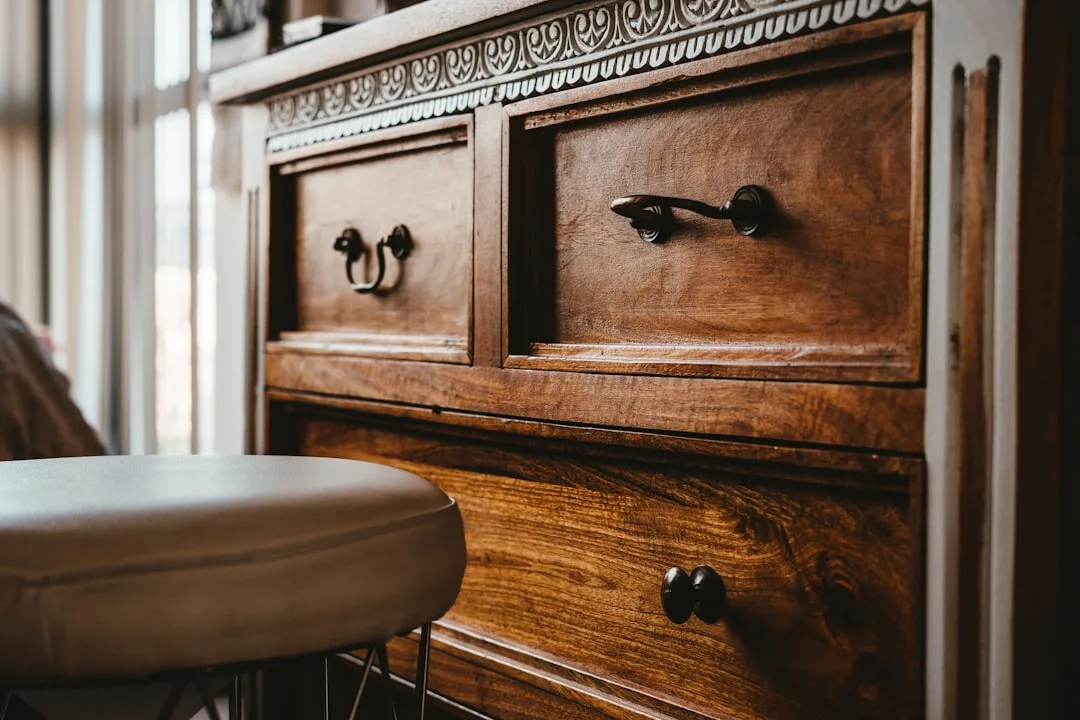
Most rooms that feel visually off are not suffering from a color problem — they are suffering from an undertone problem, and the two are almost never the same thing. You can have two pieces of furniture that are identical in darkness, pulled from the same “medium brown” category on a showroom floor, and still have them fight each other the moment you get them home. I watched this happen in a 900-square-foot Lincoln Park apartment years ago — my client had spent months sourcing pieces she loved individually, and every single one was a disaster together. Understanding why that happens is the entire point of this article.
Quick Answer
Most rooms that feel visually off are not suffering from a color problem — they are suffering from an undertone problem, and the two are almost never the same thing.
Learning how to mix wood tones furniture correctly is not about memorizing rules. It is about training yourself to see what’s actually happening on the surface of a wood piece before you commit to it — and understanding the psychological and visual mechanics that determine whether your room feels designed or just collected.
The Real Reason Mixed Wood Furniture Looks Clashing (It’s Not the Color)
In This Article
- The Real Reason Mixed Wood Furniture Looks Clashing (It’s Not the Color)
- How to Read a Wood’s Undertone Before You Buy (Without a Design Degree)
- The Contrast Ladder: A Framework for Deciding How Different Your Woods Should Be
- Pairing Wood With Your Floor Without Matching It (The Most Common Mistake in Every Room)
- Room-by-Room Wood Tone Logic: What Works in a Bedroom vs. a Kitchen vs. a Living Room
- The Unifying Element Rule: What Ties Mismatched Woods Together When Nothing Else Will
- How Lighting Changes Every Wood Pairing You Think You’ve Nailed
- Specific Wood Pairings That Work (And Three That Almost Never Do)
- When to Stop Adding Wood and Let One Tone Lead
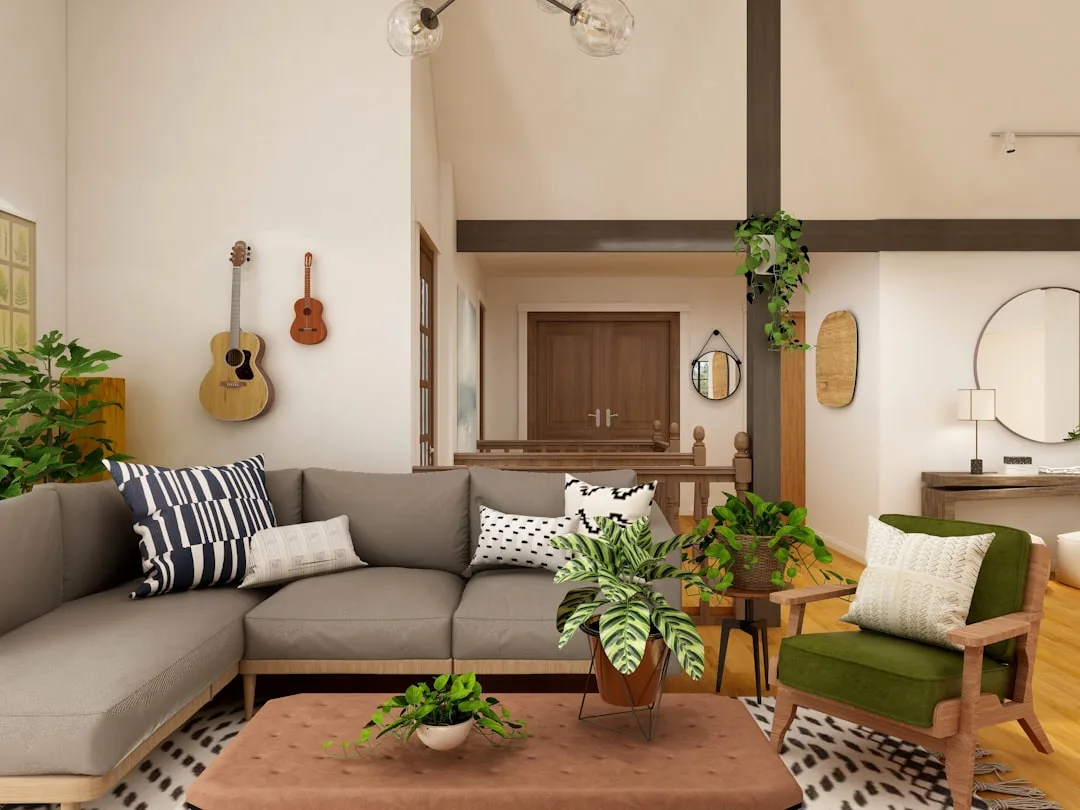
Here is the thing nobody in a furniture showroom will tell you: darkness and undertone are completely independent qualities, and most people only think about one of them. A medium walnut and a medium cherry can sit side by side at identical lightness levels and still produce the visual equivalent of fingernails on a chalkboard, because one pulls toward cool purple-brown and the other pulls toward warm red-orange. That tension has nothing to do with how light or dark either piece is. Nothing at all.
Undertone is the hidden variable that determines whether two woods read as complementary or combative. The major undertone families in common furniture woods break down roughly like this:
- Red/orange undertones: Cherry, mahogany, certain stained maples
- Yellow/warm undertones: Pine, teak, honey oak, most golden-era “colonial” finishes
- Cool gray-gold undertones: White oak, ash, limed or whitewashed species
- Cool purple-brown undertones: Walnut, wenge, some ebonized finishes
- Green-gray undertones: Reclaimed barnwood, some weathered teak, driftwood finishes
Two pieces from opposite ends of that list — say, a pine coffee table and a walnut media console — are not just different colors. They are pulling in genuinely opposing chromatic directions, and your eye knows it even if your brain hasn’t caught up yet.
Grain pattern adds another layer of complexity that I almost never see addressed in the usual “how to mix wood tones” content. Open-grained woods like oak and ash have a pronounced texture that reads visually busy from a distance. Tight-grained woods like maple and cherry read smooth and quiet. Pairing an aggressively grained piece with a very tight-grained piece in a similar tone creates a different kind of friction — not a color clash, but a texture contrast that registers as dissonance. Same family, wrong texture combination. I learned this the expensive way when I put a quarter-sawn white oak dining table next to tight maple chairs and couldn’t figure out why the pairing felt wrong for three weeks.
Surface finish amplifies all of this. A high-gloss lacquer bounces light back at you and makes undertones scream — warm woods look almost orange under incandescent light with a high-gloss finish. A matte or natural oil finish absorbs light and softens undertones, making even problematic pairings feel more cohesive. This is why the same walnut slab can look like two different woods depending on how it’s finished.
Research in environmental psychology supports something most designers know instinctively: humans are wired to detect pattern inconsistency at a level below conscious thought. Kaplan and Kaplan’s Attention Restoration Theory describes how environments that require constant low-level cognitive processing — spaces that are “off” without explanation — drain mental energy without the occupant understanding why. A single mismatched wood piece can do exactly this. It doesn’t ruin the room dramatically. It just makes the room exhausting to be in, and nobody can explain it.
Takeaway: Before you evaluate any two wood pieces together, identify each one’s undertone family independently — not its color, not its darkness, its undertone. That single step eliminates most mixing failures before they happen.
How to Read a Wood’s Undertone Before You Buy (Without a Design Degree)

Most people assess furniture wood the same way they assess paint colors — by looking at it directly under whatever light happens to be in the room. This is exactly backwards. Store lighting is almost universally warm, running between 2700K and 3000K on the color temperature scale. That warm light flatters warm-toned woods and flattens cool-toned ones, which means you are never seeing the full picture in the showroom. You are seeing the store’s best possible version of that piece. Then you get it home under your particular combination of north-facing daylight and 4000K kitchen pendants, and suddenly that “rich honey oak” cabinet looks muddy and strange next to everything else you own.
Here is a repeatable process that works whether you’re standing in a store or evaluating product photos from your couch.
The gray card test is the most reliable diagnostic I know for identifying undertone without a trained eye. Hold a neutral mid-gray card — a piece of medium gray cardstock works fine — directly next to the wood surface. The gray card gives your eye a true neutral reference point, and any remaining perceived color shift you see in the wood is the undertone revealing itself. The wood will look warm, or cool, or subtly red, or slightly green against that gray. Trust what you see. Don’t rationalize it.
Checking the end grain is something almost no buyer ever thinks to do in a furniture store, but it is enormously useful where accessible. End grain shows the true color of the wood before any stain or finish alteration. Face grain, which is the surface you normally see, is often dramatically altered by finishing products. When you can access end grain — on the underside of a tabletop, inside a drawer box, anywhere — you’re seeing the rawest version of the wood’s natural undertone.
Photograph it under two light sources. This sounds like extra work, but it takes about four minutes and has saved me from more bad decisions than I can count. Photograph the piece under the store’s artificial light, then take it outside or hold a sample near a window in natural daylight. The undertone shift between those two images tells you exactly how much that wood’s character will change when your room’s lighting changes throughout the day.
Common species and their dominant undertones, for quick reference:
- White oak: Cool gray-gold — the most reliably neutral of the common furniture woods
- Walnut: Cool purple-brown — darkens with age but stays cool
- Cherry: Warm red-orange — lightens and deepens dramatically over time; the hardest species to predict long-term
- Pine: Warm yellow — aggressive warmth that only increases with age
- Teak: Warm honey-gold with a slightly green cast when freshly cut
- Mahogany: Deep warm red — varies significantly by origin and cut
The color temperature point matters practically: retail lighting at 2700K–3000K makes warm woods look richer and makes cool woods appear more neutral than they actually are. A white oak piece that looks like a beautiful cool neutral in the showroom may read as distinctly cooler and grayer the moment you bring it into your home’s north-facing bedroom. Always bring a sample home, or at minimum, photograph it next to a window.
Takeaway: Use the gray card test plus a two-light-source photograph before committing to any furniture purchase — undertones that are invisible in one light are obvious in another.
The Contrast Ladder: A Framework for Deciding How Different Your Woods Should Be
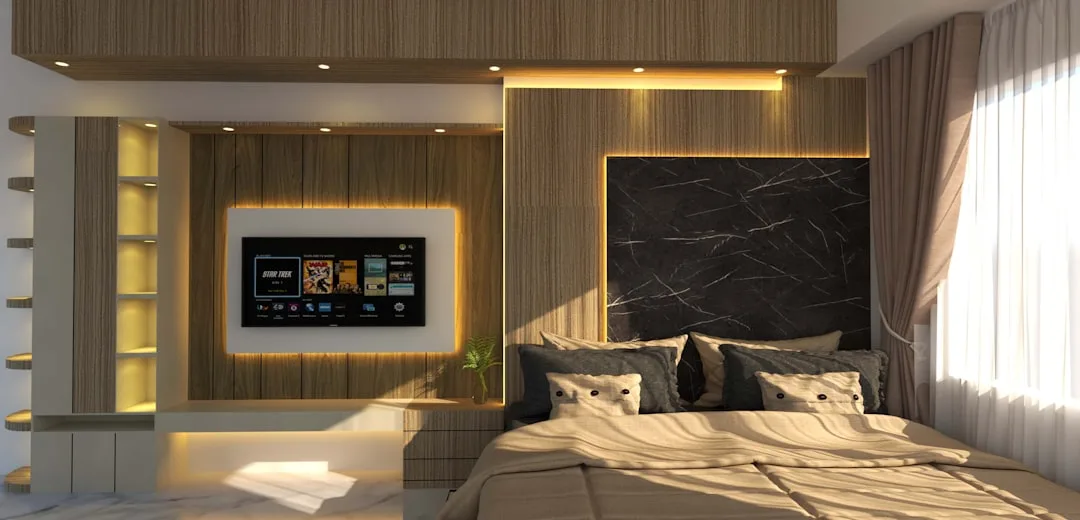
Not all mixing is equal. The distance between two wood tones — in undertone family, in darkness value, in grain complexity — determines how much work the rest of the room has to do to make the pairing cohere. I think about this in terms of a contrast ladder: the higher up you go in contrast between woods, the more deliberate everything else in the room has to be.
Low contrast pairing means woods that share the same undertone family and sit within one to two value steps of each other — a light ash next to a medium ash, or a medium walnut console against a slightly lighter walnut frame. This approach is forgiving and works particularly well in small rooms or rooms that already have a lot of competing visual elements: patterned tile, a bold rug, layered textiles. The woods recede, and the other elements lead.
Medium contrast pairing is the most widely applicable and the most forgiving combination for rooms of any size. Same undertone family, clearly different in value. Light ash with medium-dark walnut is the textbook example — both have cool undertones, but they’re different enough in darkness that the eye reads the contrast as intentional rather than accidental. This is the combination I would recommend to almost anyone who asks me where to start.
High contrast pairing — different undertone families, or extreme value jumps like bleached pine against ebonized oak — requires anchoring through a third unifying material. Stone, a dominant metal finish, or a large textile that contains colors present in both woods. Without that anchor, high contrast wood pairings read as disorder rather than intention. In rooms under 200 square feet, high contrast wood pairings are genuinely risky. The room cannot absorb the visual energy.
Fixed architectural wood changes everything. Your floors, built-in shelving, exposed beams — these elements are non-negotiable anchors at the base of the contrast ladder. You are not choosing where they fall; you are choosing everything else in relation to them. Most people treat floors as background and then wonder why their furniture choices feel chaotic.
Interior designers often apply the 60-30-10 proportion rule to material distribution, and the same logic applies to wood tones: the dominant material — floors plus the largest furniture pieces — should account for roughly 60% of visible wood surface area. The secondary tone takes about 30%. An accent or contrast tone gets the remaining 10%. When those proportions invert or equalize, the room loses hierarchy and starts to feel busy.
Takeaway: Identify where your planned pairing falls on the contrast ladder before purchasing — then ask whether your room has the size, light, and unifying elements to support that level of contrast.
Pairing Wood With Your Floor Without Matching It (The Most Common Mistake in Every Room)
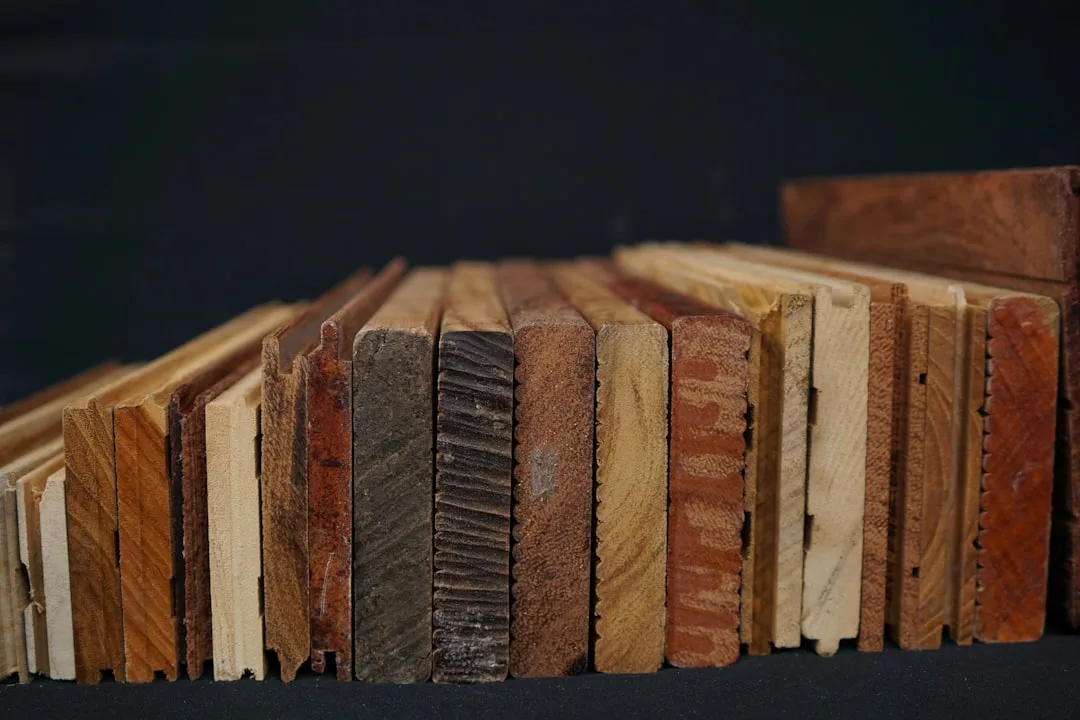
The question I got more than any other in eleven years of client work: “Does my furniture have to match my floors?” The short answer is no. The longer answer is that the way most people try to avoid matching — by choosing a floor and a furniture piece that are simply close but not identical — is actually the worst possible approach. Near-matches read as mistakes. Clear contrast reads as decisions.
Matchy-matchy flooring and furniture collapses a room visually. The eye needs tonal variation to travel around a space and perceive depth. When your coffee table, your media console, and your hardwood floor are all variations of the same honey oak, the lower half of your room becomes one undifferentiated brown mass, and the space looks smaller and less considered than it actually is. I made this exact mistake with a client’s living room on North Clark Street, and I still think about it.
The most reliable pairing logic, by floor type:
- Warm-toned floors (honey oak, red cherry, golden pine): introduce at least one furniture piece that is significantly darker or carries a cooler undertone — walnut and gray-washed oak both work well here. The contrast gives the eye a destination.
- Gray or whitewashed floors: the most forgiving anchor you can have. These suppress undertone conflict and pair with almost any furniture wood because they carry so little inherent color. Work with them freely.
- Dark floors (espresso, ebonized finishes): the most constrained situation. Furniture should generally run lighter to prevent the room from feeling heavy, but a single very dark accent piece — a walnut console, a dark credenza — can read as intentional rather than accidental if it’s placed with intention.
- Mixed-species or patterned floors: treat the floor’s dominant undertone as the anchor and the secondary tone as already-occupied contrast. You generally cannot add a third furniture undertone without chaos.
The baseboard factor is something almost nobody talks about, and it matters enormously. White trim acts as a visual separator between floor and furniture, creating a perceptual break that allows them to coexist without needing to relate. This is one practical reason white trim became a near-universal default in interior design — it’s not just fashion, it’s a functional buffer that gives designers more freedom with wood mixing.
Hardwood floors appear in the majority of living room renovation projects, which makes floor-to-furniture compatibility the most frequently encountered mixing challenge homeowners face. Yet most of the advice available is “don’t match exactly,” which is almost useless without the contrast logic behind it.
Takeaway: Choose furniture that contrasts clearly with your floor tone — not slightly differently, but clearly differently — and use white trim as a visual separator when the gap between floor and furniture undertone is wide.
Room-by-Room Wood Tone Logic: What Works in a Bedroom vs. a Kitchen vs. a Living Room

Every room has a different wood density — the total number of wood surfaces competing for visual attention — and that density changes which mixing rules apply. A kitchen has almost nothing in common, mixing-strategy-wise, with a home office. Treating them the same way is where most room-by-room advice falls apart.
Living rooms carry the highest wood density of any room in most homes. Floor, coffee table, media console, shelving, the legs of upholstered furniture, accent chairs — wood is everywhere, and every piece is visible from the primary sightline simultaneously. This is where the contrast ladder framework matters most. You want one dominant tone (usually the floor and the largest furniture piece), one contrast tone (a secondary piece that’s clearly different), and at most one wild-card accent. Three distinct tones from the same sightline is the practical ceiling for most living rooms. Four is almost always too many.
Bedrooms have a clear hierarchy that simplifies everything: the bed frame is the anchor wood. Full stop. Everything else — nightstands, dresser, bench — should either match the bed frame’s undertone closely or be clearly distinct enough to read as intentional contrast. The problem I see most often in bedrooms is a mid-range mismatched nightstand that is close to the bed frame but not the same. Close-but-not-matching reads as an error. Clearly different reads as a choice. Avoid introducing a third wood tone in any bedroom under 250 square feet — the room simply cannot absorb it.
Kitchens work differently because the cabinetry is fixed and dominant, and the countertop material acts as a bridge between cabinet wood and flooring. If you’re introducing a butcher block countertop, you are adding a third wood tone into a space that may already have two. That butcher block needs to share an undertone family with either the cabinets or the floor — not both, but at least one. Floating between them with no undertone relationship to either creates the visual equivalent of a dropped stitch.
Dining rooms are where intentional mismatch has become most socially acceptable and, honestly, most interesting. Mismatched dining chairs work when they share the same silhouette language — when the chair forms are related, finish differences read as collected rather than accidental. This is real, this is current, and it works — when the chairs share a visual grammar beyond just finish.
Home offices are often the most compromised room in the house, because functional furniture comes in limited finish options and most people buy pieces from different sources over time. The saving grace here: matching finish sheen level. A desk and shelving unit in different wood tones feel far more cohesive when both carry the same matte or satin finish than when one is high-gloss and the other is oiled. Sheen consistency is the home office’s substitute for undertone alignment.
Takeaway: Identify the dominant fixed wood element in each room before buying anything else — cabinetry in kitchens, bed frame in bedrooms, floor in living rooms — and build contrast logic from that anchor outward.
The Unifying Element Rule: What Ties Mismatched Woods Together When Nothing Else Will
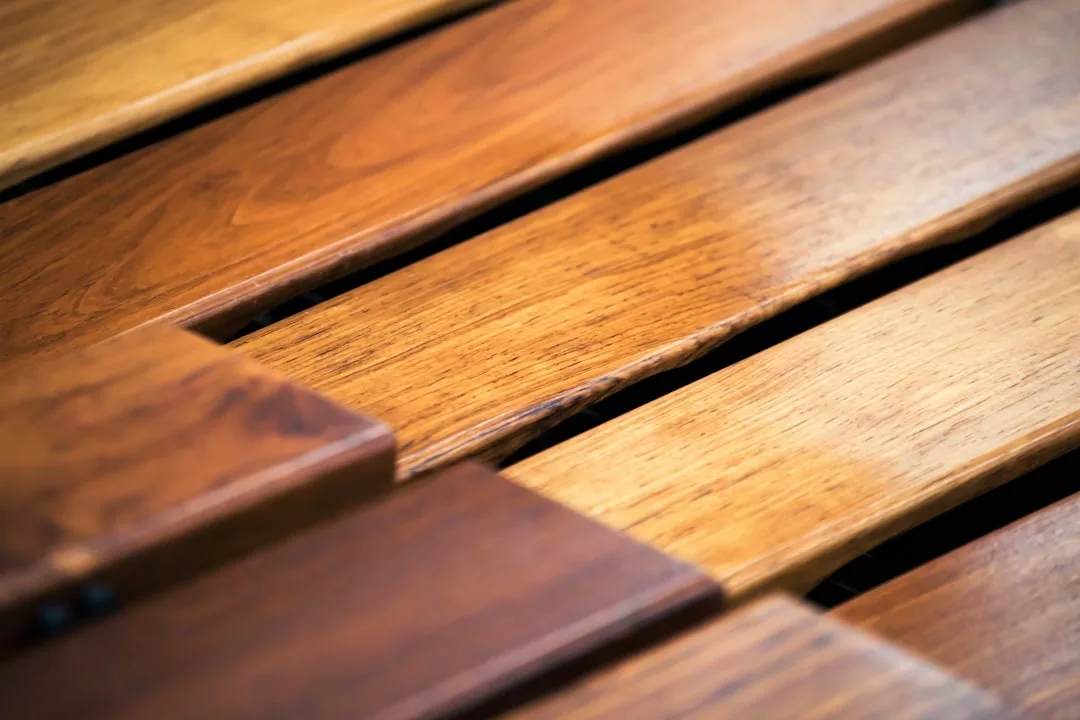
Some rooms are already assembled. The floor is what it is, the furniture came with the house, the built-ins were there when you moved in — and the combination doesn’t work. This is where a different category of thinking becomes necessary, because you’re not solving a purchasing problem anymore. You’re solving a visual chemistry problem, and the solution almost never involves more wood.
The most powerful tool for rescuing a mismatched wood combination is a consistent third material running through the room. Not another wood. Something else entirely — metal, stone, textile, paint. A unifying non-wood element creates what Gestalt psychology calls a “common region”: when disparate objects share a visual environment defined by a consistent third element, the brain groups them as belonging together regardless of their individual differences. This is why it works, and it works reliably.
Metal finishes are the most efficient unifier I’ve used in practice. When the same metal tone — brass, matte black, brushed nickel — appears in the light fixture, the furniture hardware, the curtain rod, and the chair legs, it creates a visual throughline that makes wood variety feel curated rather than chaotic. I’ve used this to rescue rooms where a client had three genuinely incompatible wood tones, and it worked every single time. The metal doesn’t erase the wood conflicts. It gives the eye something else to follow, and that’s enough.
Textile anchoring is slower to perceive but equally powerful. A rug that contains colors present in both conflicting wood tones creates a bridge between them — this is exactly why a rust-toned rug can make warm pine and cool walnut coexist in the same room. The rug is not matching either piece. It’s containing both. There’s a significant difference.
Stone and concrete function as visual resets. A marble-topped coffee table or a concrete planter placed between two competing wood pieces acts as a pause — a tonally neutral interruption that prevents the eye from having to make the leap directly from one conflicting wood to another. This is subtle but measurable.
Paint color can be deployed as a mediator more deliberately than most people realize. Wall color that picks up the undertone of the less dominant wood elevates it visually and creates parity between the two wood tones. Warm white walls — walls with yellow or cream undertones rather than blue-gray ones — flatter both warm and neutral wood tones simultaneously. This is why warm whites have dominated interior paint recommendations for the past decade. They’re not just fashionable. They are genuinely forgiving.
Takeaway: If your existing wood combination isn’t working, introduce a single consistent non-wood material — a metal finish, a unifying rug, a stone surface — before replacing any furniture. It is faster, cheaper, and often more effective.
How Lighting Changes Every Wood Pairing You Think You’ve Nailed
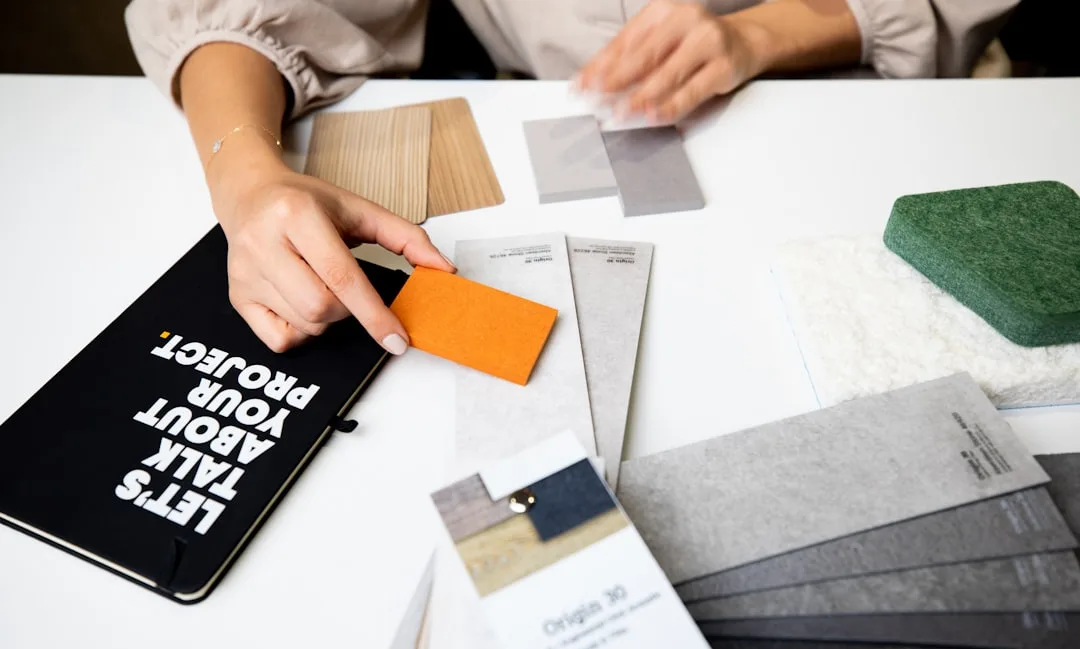
I have seen a furniture pairing that looked perfect in daylight turn into a visual disaster the moment the overhead lights came on at 6 p.m. This is not an edge case. This is what happens when you assess a wood combination under one light source and live under three different ones. Most rooms have ambient overhead light, task light near seating, and natural light from windows — and all three render wood undertones differently.
Warm bulbs at 2700K amplify warm undertones. Red and orange woods become richer and more saturated. Gray-toned woods appear warmer and more neutral than they actually are, which can create a false sense of compatibility under incandescent light that disappears entirely in daylight. If your room runs warm LED or incandescent bulbs, you are systematically underestimating the cool undertone in any gray or white oak piece you’re considering.
Daylight-spectrum bulbs at 5000K–6500K are the most diagnostic light source for assessing any wood sample. They reveal the truest undertone. If you have the option to evaluate a sample under daylight-spectrum light before purchasing, do it — you will sometimes be genuinely surprised by what the wood actually is.
Room orientation interacts with all of this in ways that take most people off guard. North-facing rooms receive cool, indirect light all day — warm woods read more muted and less vibrant, making warm-to-warm pairings feel safe but potentially flat and dull. South-facing rooms receive intense warm afternoon light, which means even cool-toned gray oak will be flooded with warmth for part of the day. I had a client with south-facing windows who thought her whitewashed oak floors were warm — they weren’t, they were just in an afternoon sunbath every day until 4 p.m.
The Color Rendering Index of your bulbs matters more than most homeowners realize. Lighting designers recommend a CRI above 90 for spaces where material color accuracy matters — meaning spaces where you want to see what you actually bought. Bulbs with CRI below 80 actively distort wood undertone perception. They can make a well-planned pairing look wrong, or make a problematic pairing look fine until you experience the room in daylight. Most standard contractor-grade bulbs run CRI around 80, and many budget LED options run lower than that.
Shadows also affect perceived wood value. High ceilings and deep window reveals create dramatic shadow patterns that make the same wood surface appear significantly darker in some zones than others — which can visually separate two pieces that would look well-matched in even light. Always assess a room at multiple times of day. Morning, midday, and artificial-light evening are the three tests that matter.
Takeaway: Before finalizing any large wood purchase, bring a physical sample into your room and observe it under every light condition you actually live in — morning daylight, afternoon direct sun if applicable, and your evening artificial light. One light source is not enough.
Specific Wood Pairings That Work (And Three That Almost Never Do)
Enough framework. Here is what I actually recommend and what I actually avoid — based on experience, not hedging.
White oak + walnut is the most reliable pairing in contemporary residential design. White oak’s cool gray-gold undertone contrasts cleanly against walnut’s cool purple-brown, and because both woods share the same undertone temperature (cool), they don’t fight — they just occupy different value registers. It works in small rooms, large rooms, living rooms, bedrooms, kitchens. White oak has been the most specified domestic hardwood in residential interiors for multiple consecutive years, and white oak plus walnut has become the de facto standard pairing in contemporary American interiors as a result. There’s a reason for that. It’s a genuinely excellent combination.
Ash + teak works because both are open-grained woods, and the grain similarity creates visual cohesion even though their tones are genuinely different — ash is pale and cool, teak reads warm honey. Shared texture, different temperature. This is a more adventurous pairing than white oak and walnut, but it has a quality of relaxed contrast that feels right in casual spaces.
Cherry + maple requires careful handling. Both are tight-grained and warm, which should make them natural partners. But cherry pulls red and maple pulls yellow-cream, and that undertone gap creates low-grade friction that’s hard to resolve. The combination works only when the cherry pieces have aged and deepened significantly — new cherry next to maple is genuinely difficult. I don’t recommend this pairing for new purchases.
Now. The three that almost never work:
Pine + walnut is the most common problematic pairing I encounter, probably because both are extremely popular and people assume popularity means compatibility. Pine’s aggressive yellow-warm undertone is the direct chromatic opposite of walnut’s cool sophistication. They fight. Loudly. If you already own both, a strong unifying textile in a color that bridges warm yellow and cool brown — rust, terra cotta, warm olive — can mediate the conflict, but it requires commitment.
Two very dark pieces in a small room is not a species pairing problem but a value problem. Ebonized or very dark stained pieces function as near-neutrals in larger spaces and can anchor almost any combination. But two dark anchors in a room under 250 square feet collapse visual depth entirely. The room starts to feel like it’s closing in.
Reclaimed wood as part of a system is something I’ve had to talk clients out of more than once. Reclaimed pieces have unpredictable undertones that shift across the surface — they age inconsistently, they often carry multiple finish layers, and they can look completely different under different light conditions. Treat a reclaimed piece as a standalone statement and let everything else respond to it. Don’t try to build a multi-wood system with it as one component of many.
Takeaway: Start with white oak and walnut if you’re uncertain — it’s genuinely reliable and forgiving across almost every room context.
When to Stop Adding Wood and Let One Tone Lead
There is a point past which adding another wood accent, another “collected” piece, another natural material becomes actively destructive to a room’s coherence. Most interiors content will not tell you this directly. More layering is presented as more sophisticated. Often it is not.
Count the visible wood tones from the room’s primary sightline. Stand in the doorway or the position where you most naturally see the room. Count every distinct wood tone you can identify without moving. If the count hits four or more, the room is almost certainly over-mixed. Not always — an extremely large room with very deliberate contrast logic can handle four — but almost always.
The squint test is the fastest diagnostic I know. Squint until the room blurs. If all the wood areas merge into one coherent mid-tone mass, the mixing is working — your eye is finding the average and resting there. If distinct warm and cool zones are fighting each other even through the blur, simplification is the answer. Not decoration. Subtraction.
Strategic subtraction is underutilized in every conversation about home design. Which single piece, if removed or replaced, reduces visual noise most efficiently? In my experience, it’s almost always the mid-range medium-brown piece — the one that’s close to but not the same as the dominant tone. Not dark enough to anchor, not light enough to contrast, not different enough to read as intentional. That piece is almost always the problem.
Painted furniture is an underrated reset. Converting one wood piece to a painted finish removes it from the wood-tone conversation entirely. It reduces a three-tone conflict to a two-tone one, and it often resolves the room immediately. I’ve done this with dressers, console tables, bookcases. Paint is not giving up. It is editing.
When the floor itself is the problem — which it sometimes is, particularly with older homes that have very red or very orange hardwood — area rugs are one of the most practical tools available. A large rug that covers a significant portion of the floor reduces its visual dominance and creates more freedom in furniture tone selection. You’re not hiding the floor, exactly. You’re reassigning its role from “dominant anchor” to “supporting element.”
Cognitive load research in environmental psychology supports what most people feel but struggle to articulate: visually complex spaces with high material variety measurably increase subjective feelings of disorder. Elsbach and Pratt’s 2007 research on workplace environments showed this clearly — and the principle transfers directly to residential spaces. Visual consistency and material calm are not the same as minimal or spare. You can have a rich, layered room that feels calm because the woods are working together. But when they’re not working together, the brain keeps trying to resolve the inconsistency, and the room becomes tiring to inhabit without the occupant knowing why.
Takeaway: If your room feels visually unsettled and you can’t explain it, stand at the door, count wood tones, then squint. The answer will usually show itself.
Frequently Asked Questions
Can you mix warm and cool wood tones in the same room?
Yes — but it requires a unifying element that bridges the temperature difference. The most reliable approach is a textile (a rug or large upholstered piece) that contains colors present in both woods, which gives the eye a visual reason to accept them as part of the same composition. Metal finishes running consistently through the space also create enough visual cohesion to let warm and cool woods coexist. What doesn’t work is placing warm and cool wood pieces in direct proximity with nothing between them — the contrast becomes jarring rather than dynamic. Keep the warm-toned pieces in one zone and the cool-toned pieces in another, connected by a bridge material.
How do you know if two wood finishes will clash before buying?
The gray card test is your best tool: hold a mid-gray card next to each wood sample and note the perceived undertone shift. If one pulls warm and one pulls cool against the same gray reference, they have opposing undertones and will require a unifying element to coexist. Beyond that, photograph both samples under two different light sources — warm artificial light and natural daylight — and assess whether the undertone difference expands or contracts. If they look increasingly different as you change the light, they are high-risk together. If the difference stays stable or narrows, the pairing is more manageable. Bringing a physical sample of one piece into the space where the other already lives is always more reliable than any in-store assessment.
Does wood furniture have to match the hardwood floor?
No, and attempting to match them closely usually produces a worse result than choosing clear contrast. Near-matches read as mistakes; clear contrast reads as intention. The most practical approach is to treat your floor as the dominant anchor — roughly 60% of the visible wood in a room — and choose furniture that is either clearly darker, clearly lighter, or clearly different in undertone. If your floor is a warm honey oak, walnut furniture provides excellent contrast. If your floor is dark espresso, lighter furniture in ash or white oak keeps the room from feeling heavy. The one situation where matching is genuinely acceptable is when white trim separates floor and furniture visually — the trim acts as a perceptual break that makes the similarity feel deliberate rather than lazy.
What is the easiest wood pairing for beginners to get right?
White oak and walnut. Both have cool undertones — white oak runs cool gray-gold and walnut runs cool purple-brown — so they share undertone temperature while offering clean contrast in value. There is no warm-versus-cool conflict to manage. The grain structures are different (white oak is more open-grained and textured; walnut is tighter and smoother), which adds visual interest without creating friction. This combination works in living rooms, bedrooms, and dining rooms, scales from minimal to layered styles, and requires the least intervention from unifying elements because the woods are already doing the relational work on their own. If you are starting a room from scratch and don’t know where to begin, start here.
Take one room in your home today — just one — and stand in the doorway and count the visible wood tones. Don’t assess whether you like them yet. Just count. Then look at the dominant tone and ask whether the other pieces in the room are clearly contrasting with it or just vaguely near it. That distinction — clear contrast versus vague approximation — is the single most useful lens for understanding why a space feels designed or feels accidental. Everything else builds from there.