The same brass figurine trophy sitting in a thrift store bin for $4 is being sourced by prop stylists for $60 a day on editorial shoots — the only difference is knowing what to look for and where to put it.
That gap between overlooked and intentional isn’t about irony, nostalgia, or a decorating theme built around athletic achievement. It’s about recognizing that a well-made mid-century trophy is, at its core, a sculptural object with real material weight, considered proportions, and the kind of accumulated surface character that you simply can’t manufacture new. Once you see it that way, the thrift store math becomes almost embarrassing.
—
Why Vintage Trophies Work as Serious Home Decor Objects

The case for vintage trophies as legitimate decor doesn’t start at the thrift store — it starts in the foundry.
Trophies produced between the 1940s and 1970s were made in the same industrial facilities casting architectural hardware: door handles, lamp bases, decorative brackets. The brass figurines — a bowler mid-release, an eagle with spread wings, a golfer at the top of a backswing — came out of the same lost-wax and sand-casting processes used for objects that now sell in antique shops for hundreds of dollars. The material quality is identical; only the context changed.
Look at a 1950s bowling trophy next to a small Art Deco bronze and the visual relationship is immediate. Both have figurative forms rising from a weighted base. Both use oxidized metal to suggest age and craft. Both sit in roughly the same scale range. The difference is that one carries a cultural association with rec-league sports and the other carries a price tag. Interior designers who source seriously have understood this for years — the mainstream just caught up.
The r/malelivingspace community on Reddit, with over 1.4 million members, has made this visible at scale. Posts featuring thrift-sourced objects styled with genuine design intention — vintage trophies among them — regularly climb to the top of the feed. That’s not a niche trend. That’s a broad cultural shift toward curated secondhand styling, and it’s pulled objects like vintage trophies out of the novelty bin and into real interior conversations.
The figurative forms also share visual DNA with modernist objets d’art that appear in serious collections. Eagles, athletes, and globes were recurring motifs in Art Deco and early Modernist decorative arts for a reason: they carry visual energy and directionality that abstract forms don’t. A trophy with an outstretched eagle on top creates movement on a shelf. That’s not an accident — it’s why prop stylists keep reaching for them.
Actionable takeaway: Next time you’re in a thrift store, stop looking at trophies as sports memorabilia and start looking at them as unsigned sculptural objects. The frame shift changes everything about what you’ll pick up.
—
How to Identify Vintage Trophies Worth Repurposing for Home Decor

Most trophies at thrift stores aren’t worth buying. Knowing which ones are is where you pull ahead of the spray-paint crowd.
Material is your first and most reliable filter. Pick it up before you decide anything else. A trophy worth repurposing has weight — the kind that comes from a solid marble or onyx base, a brass or pot-metal figurine with visible casting seams along the sides, and a column made from genuine resin, bakelite, or stacked marble rather than hollow plastic. Pre-1980 production almost always means denser, heavier materials. Post-1985 production usually means hollow aluminum cups and lightweight injection-molded figurines that photograph flat and read as clutter in a room rather than objects.
Here’s what to look for specifically:
- Bases: Solid marble or onyx, usually black, green, or dark brown — should feel cold and dense. Tap it. Marble rings; hollow plastic thuds.
- Figurines: Cast brass or pot-metal with visible seam lines and hand-finished details. Real casting has slight imperfections. Plastic figurines have crisp, uniform edges and feel light.
- Columns: Turned resin in amber or black, stacked marble discs, or fluted brass columns — all good. Single-piece injection-molded plastic shafts — skip it.
- Cups: Heavy spun brass or silver-plated metal with rolled edges. Thin aluminum with crimped seams is post-1985 production.
Patina is an asset, not a problem. Verdigris — that blue-green oxidation on brass — signals genuine age and adds surface complexity that new objects simply don’t have. Oxidation rings on marble bases, worn gold leaf on column edges, small dents in metal cups: all of these read as authenticity in a room. They’re the reason prop stylists reach for unmodified originals.
Brass figurine trophies produced between 1945 and 1975 are the most sought-after category among prop stylists and set decorators, consistently appearing in vintage prop house sourcing guides as preferred objects for editorial and commercial work.
For sourcing, the best search terms on eBay and Etsy are specific: try ‘vintage bowling trophy brass marble base’, ‘mid century athletic award onyx’, or ‘1960s figural trophy pot metal’. Estate sales — particularly in the Midwest, where bowling leagues and civic organizations were most active — are the richest in-person sources. Expect to pay $4–$20 at thrift stores and estate sales, and $15–$45 on eBay for the most photogenic pieces.
Actionable takeaway: Before buying any trophy, pick it up with both hands. If it doesn’t feel heavy for its size, put it back.
—
The Design Principles Behind Styling Trophies as Decor

Trophies don’t style themselves differently than any other sculptural object. The same principles that govern how a ceramicist arranges pottery on a gallery shelf apply directly here — which is useful, because those principles are well-established and not complicated.
Vary heights by at least one-third between pieces. If your tallest trophy is 12 inches, the next piece in the grouping should be no taller than 8 inches. This creates the visual step that allows the eye to move through an arrangement rather than registering it as a uniform block. The exact ratio matters less than the commitment to genuine variation.
Interior designers refer to triadic grouping — arranging objects in threes with varied heights — as one of the most reliable shelf-styling formulas in practice. It works for trophies exactly as it works for vases, books, or framed objects. A set of three: one tall, one medium, one low. Odd numbers create visual tension; even numbers create visual symmetry. Symmetry reads as formal. Tension reads as collected.
Material contrast is what separates a trophy vignette that stops the eye from one that disappears into the background. Brass and gold-toned metal need something visually different to push against:
- Pair brass against: Raw linen, matte white or terracotta ceramics, weathered or rough-sawn wood, unglazed stone
- Avoid pairing brass with: Chrome, polished silver, other metallic surfaces — metal on metal flattens everything out
- For silver or chrome cups: These read cooler and suit spaces with grey limestone, white oak, and natural linen — environments where the cooler tone harmonizes rather than fights
Color temperature is worth thinking through deliberately. Warm-toned brass and gold trophies anchor naturally in spaces built around warm whites (Benjamin Moore White Dove, Farrow & Ball Pointing), terracotta accents, and walnut or oak furniture. Drop a warm brass trophy into a cool-toned, all-white room and it will look like it arrived from a different design universe.
Never align all bases on the same plane. Flat arrangements — every object sitting directly on a shelf surface at the same level — register as background rather than focal points. Design research on visual attention confirms that the human eye actively seeks height variation and depth contrast when scanning a shelf. A stack of two or three books, a wooden block, or a flat stone slab as an impromptu riser immediately solves this.
Actionable takeaway: Before placing a single trophy, establish your three heights. Find two objects already in the space — a stack of books, a small ceramic — and use them to build the vertical structure before the trophy even enters the arrangement.
—
Where to Place Repurposed Vintage Trophies in Your Home

Placement determines whether a trophy reads as a collected object or a thrift store castoff left somewhere by accident. The room matters, but the specific surface and its relationship to everything else on it matters more.
Living Room Bookshelves
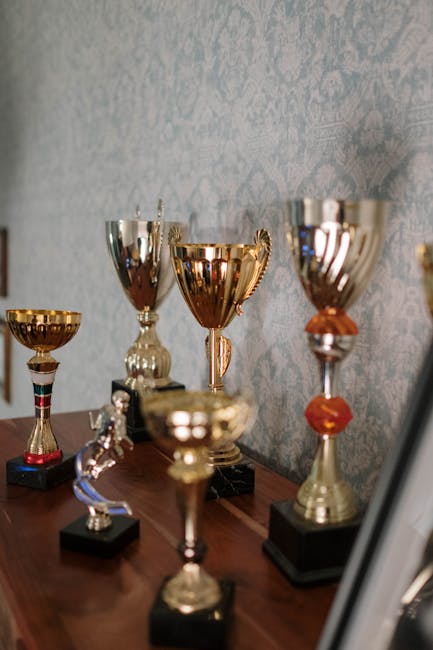
This is the highest-visibility placement and the most forgiving context. A bookshelf already contains multiple object types — books, frames, plants — which means a trophy integrates rather than dominates. Use one or two trophies as sculptural anchors within a larger vignette. A 14-inch brass bowling trophy anchoring one end of a shelf, paired with a stack of art books and a small trailing plant, reads as intentional curation. Dedicating an entire shelf to trophies alone reads as a collection display, which is a different thing entirely.
Entryway Console
Interior design surveys consistently identify the entryway and living room bookshelf as the two spaces homeowners most want to feel intentional and curated — and for good reason: they’re the first and most frequently seen surfaces in a home. A single tall trophy with a marble or onyx base functions as a focal object on a console table, especially alongside a tray, a candle, and a single stem of greenery. The combination of the trophy’s vertical height, the tray’s horizontal grounding, and the organic greenery hits all three material and form contrasts without effort.
Home Office or Study
Trophies carry genuine thematic resonance in a workspace — achievement, craft, history. A small group of two or three on a desk-adjacent shelf adds personality without competing with the work surface itself. Keep them off the actual desk unless you’re using a cup-style trophy as a pen holder, which is functional and visually appropriate simultaneously.
Bedroom Nightstand or Dresser
Scale down here. A small brass trophy — 6 to 8 inches — used as a ring dish or small object holder on a nightstand is genuinely useful and decorative without requiring a full styling concept around it. The nightstand isn’t a gallery surface; one well-chosen object does more than three competing ones.
Specific placement recommendations by room:
- Living room: 1–2 trophies within a larger vignette, bookshelf or console
- Entryway: 1 tall trophy as focal point, console table
- Home office: 2–3 small trophies grouped on a dedicated shelf, not the desk
- Bedroom: 1 small trophy as functional object, nightstand or dresser top
Actionable takeaway: Identify the one surface in your home where you most want visual impact. Start there with a single trophy before adding anything else — restraint is more effective than volume.
—
Functional Ways to Repurpose Vintage Trophies Without Destroying Them

Here’s the thing about the spray-paint approach that dominates every competing article on this topic: it destroys the exact qualities that make vintage trophies worth using in the first place. Uniform metallic paint erases layered patina, removes material variation, and turns a nuanced object into a craft-store prop. You end up with something that looks less interesting than what you started with.
The better approach is functional repurposing that requires zero modification to the trophy itself.
Cup-style trophies are immediately ready to use as:
- Pen and pencil holders (the proportions are nearly perfect)
- Catch-all vessels on an entryway console or dresser
- Small plant holders for succulents — add a small plastic liner insert to protect the metal from moisture, no drilling or alteration required
Tall trophy columns with flat bases function as sculptural risers. Set a pillar candle, a small ceramic bowl, or a framed 4×4 photograph on top and you’ve added a vertical level to your surface arrangement without buying a purpose-made riser.
Bowling trophies with large figural toppers often have hollow columns internally. A short string of battery-operated LED lights threaded into the base creates ambient light with zero alteration to the exterior — and the glow through the column seams reads as intentional rather than accidental.
Prop stylists working on editorial shoots regularly use unmodified vintage trophies as-found, citing their existing patina and proportions as already camera-ready without intervention. That’s not a coincidence — it’s the point. The manufacturing and aging process did the work. Your job is placement and context, not transformation.
The only genuine modification worth considering is removing an adhesive nameplate if it carries information that makes the object read as personal memorabilia rather than a sculptural form. A small amount of Goo Gone on a cotton swab removes most adhesive residue without damaging the base material underneath. That’s the full extent of recommended alteration.
Actionable takeaway: Before reaching for spray paint or a drill, spend five minutes finding a functional use for the trophy as-is. The answer is almost always already there.
—
How to Clean and Preserve Vintage Trophies for Home Decor Use

Cleaning a vintage trophy incorrectly takes seconds and causes damage that’s either permanent or requires professional restoration. This is the part of the process that most articles skip entirely — and it’s the part most likely to go wrong.
For brass figurines and cups:
Use a soft lint-free cloth with a small amount of mineral oil — the kind sold for cutting boards and wood care. Work it into the surface in small circular motions and buff off the excess. This removes surface grime and dust without stripping the oxidation layer that gives aged brass its warm, dimensional quality. Mineral oil also leaves a light protective film that slows further oxidation.
Do not use commercial brass polish — products like Brasso or Wright’s Copper Cream are designed to strip oxidation and restore a bright factory finish. On architectural salvage and antique brass, this is considered irreversible damage. Antique dealers and metal conservators advise against polishing any brass with genuine patina for exactly this reason: that characteristic surface depth takes decades of natural oxidation to develop and cannot be replicated once removed.
For marble or onyx bases:
Wipe with a damp cloth and a single drop of pH-neutral dish soap — plain Dawn works fine. Dry immediately and thoroughly with a separate cloth. Marble is porous and will absorb moisture, which causes staining and, over time, structural damage. Never use vinegar, lemon juice, or any acidic cleaner on marble; the acid etches the surface and leaves permanent dull patches.
For painted or resin column elements:
Dry dusting only, using a soft brush or microfiber cloth. Solvents — including most household cleaners, rubbing alcohol, and acetone — will lift paint from resin surfaces and cloud the resin itself. If there’s stuck-on grime in relief details, a barely damp cotton swab used carefully is the limit of safe cleaning.
To intentionally deepen brass patina:
A light application of liver of sulfur solution — available from jewelry supply retailers like Rio Grande for around $10 — darkens brass oxidation in a controlled, even way. Jewelers and metalworkers use it routinely to age new metal. Apply with a cotton ball, let it develop for 30 to 60 seconds, then wipe back with a dry cloth to the depth you want. It works on both solid brass and brass-plated surfaces.
Actionable takeaway: Clean your trophies with mineral oil and a soft cloth before placing them — it takes three minutes and immediately improves the surface depth. Then leave the patina alone.
—
Common Mistakes When Using Vintage Trophies as Home Decor

The most common errors with vintage trophies aren’t about craft — they’re about design judgment. Here’s where most people go wrong.
Overcrowding
Displaying every trophy you own together reads as storage, not styling. This is the hardest mistake to avoid because the instinct, once you start collecting, is to show everything. Edit ruthlessly. Three trophies styled well will always outperform twelve trophies grouped by proximity. Rotate pieces seasonally — the ones not currently on display aren’t wasted, they’re resting.
Ignoring scale
A 4-inch plastic trophy on a large console table disappears. It doesn’t read as minimalist restraint; it reads as a forgotten object. Match your trophy selection to the scale of the surface and the room it occupies. A dining room sideboard that’s 60 inches wide needs objects with presence — a 16-inch trophy with a substantial marble base, or a grouped arrangement that collectively fills the visual field.
Treating trophies as a theme
A room decorated around trophies as a concept tips immediately into novelty territory. Trophies should function as objects within a larger, considered interior — not as the entire concept. If someone walks into your living room and thinks “trophy room,” the edit has gone wrong. If they think “interesting shelf,” you’ve got it right.
Uniform base height
Placing all trophies on the same level surface without riser variation creates a flat, unresolved arrangement. Design research on visual attention confirms that the human eye seeks contrast and height variation when scanning a shelf — flat, uniform groupings register as background rather than focal points. Use books, wooden blocks, or flat stone slabs to introduce a second and third level into any arrangement.
Buying the wrong pieces
Hollow plastic trophies from post-1985 production have no visual mass in a room. They look like what they are: promotional items made from the cheapest available materials. The $4 investment is only worth making on a piece with real weight, real material, and real patina. Walk past everything else.
Actionable takeaway: Look at your current arrangement and ask one question: if you removed the trophies, would the rest of the vignette still work? If yes, you’ve integrated them correctly. If the whole thing collapses, the trophies are doing structural work they shouldn’t have to do.
—
Frequently Asked Questions
Where is the best place to find vintage trophies for home decor?
Estate sales are the single best source — particularly in the Midwest and Mid-Atlantic regions, where bowling leagues, civic organizations, and athletic clubs were most active from the 1940s through the 1970s. You’ll find the heaviest concentration of brass figurine trophies with marble bases at these sales, often priced between $2 and $15. Thrift stores like Goodwill and Salvation Army are reliable for volume but require more editing — expect to sort through a lot of hollow plastic before finding solid brass. On eBay, search specifically for ‘vintage bowling trophy brass marble’ or ‘mid century figural trophy onyx base’ and filter by sold listings to understand what’s actually worth paying for versus what’s optimistically priced. Etsy tends to run higher on price but sellers have often already done the quality editing for you. Google the estate sale companies active in your area and sign up for their mailing lists — first-day access to estate sales is where the best pieces go.
Do vintage trophies need to be modified before using them as decor?
Almost never. The most design-credible approach is using trophies as-found, with the only intervention being a light cleaning with mineral oil for brass components. Cup-style trophies work immediately as pen holders or catch-all vessels. Tall trophies work as sculptural anchors or risers. The patina, proportions, and material variation that make vintage trophies visually interesting are exactly what spray paint and other modifications erase. The one exception: removing an adhesive nameplate if it makes the object read as personal memorabilia rather than a sculptural form. A small amount of Goo Gone on a cotton swab handles most adhesive residue cleanly. Beyond that, modification is subtraction, not improvement.
How do you clean old brass trophies without damaging the patina?
Use a soft lint-free cloth with a small amount of mineral oil — the same product sold for conditioning cutting boards. Work it into the brass surface with small circular motions and buff the excess off with a clean section of cloth. This removes grime and dust while leaving the natural oxidation layer intact and adding a light protective film. Never use commercial brass polish: products like Brasso are formulated to strip oxidation and restore a bright factory finish, which is permanently destructive to antique brass patina that took decades to develop. For marble or onyx bases, use a barely damp cloth with a single drop of pH-neutral dish soap, then dry immediately and thoroughly — marble is porous and stains easily. If you want to deepen the existing patina on brass intentionally, liver of sulfur solution from a jewelry supply retailer gives you controlled, even darkening that you can stop at any depth you want.
How many vintage trophies should you display together without it looking cluttered?
The honest answer is fewer than you think. One well-chosen, well-scaled trophy used as a standalone sculptural anchor makes a stronger statement than five competing for attention. If you’re grouping, the triadic principle — three pieces with meaningfully varied heights — is the most reliable formula, and it applies to trophies as directly as it applies to any other shelf objects. The critical variable is whether the trophies are integrated into a larger vignette that includes different object types (books, ceramics, plants) or displayed in isolation. In isolation, three is already pushing the edge. Within a larger arrangement of six to eight total objects, two or three trophies can anchor without dominating. What makes groupings read as cluttered is uniformity of height and the absence of negative space — leave room between objects, vary the levels, and edit anything that doesn’t contribute something visually distinct.
—
Start Here: One Action You Can Take Today

Go to your nearest Goodwill or Salvation Army and spend twenty minutes in the trophy bin — not to buy everything, but to practice the filter. Pick up every trophy you consider. Feel the weight. Look at the base material. Run your thumb along the figurine seam lines. You’re training your eye to distinguish a 1962 solid-brass bowling figurine on an onyx base from a 1993 hollow aluminum cup on a plastic column.
If you find one piece that passes — heavy base, cast metal figurine, visible patina — buy it for the $4 asking price. Take it home and set it on the shelf or console where you most want visual impact. Don’t add anything else yet. Live with it for a week and notice what it does to the surface around it, how it reads from across the room, whether it earns its place.
That’s the whole method. Not a theme, not a collection, not a project. One good object in the right place.