The most common MCM wall art mistake has nothing to do with which print you pick — it’s hanging a piece that’s three sizes too small on a wall that demands to be owned. You’ve probably done it. Most people have. You found something with the right colors, the right vibe, and you hung it. Then it just sat there, floating timidly above the sofa like it was apologizing for taking up space.
Scale is one part of the problem. But the full picture involves three variables that almost no decorating guide discusses together: scale, framing, and negative space. Get all three right, and a single $80 print can anchor an entire room. Get one wrong, and a $400 framed piece looks like it wandered in from a different apartment.
This is the guide that treats MCM wall art as a structural design decision — because in a minimalist apartment, that’s exactly what it is.
Why Most MCM Wall Art Advice Fails Minimalist Apartments
Search for MCM wall art advice and you’ll find the same recycled list: bold colors, organic shapes, avoid clutter. That advice isn’t wrong. It’s just incomplete in a way that becomes genuinely costly when you’re working with a 650-square-foot apartment and bare white walls.
Minimalist apartments amplify every mistake. In a maximalist room, a poorly scaled piece disappears into visual noise. In a minimalist space, there’s nowhere to hide. Every hung piece is isolated, examined, and judged by the wall around it. This is why the same print that looks fine in a mood board photo looks wrong in your actual apartment — the supporting context that forgave its flaws in the photo doesn’t exist in your spare, edited space.
Generic MCM listicles treat wall art as decoration. In minimalist apartments, it functions closer to architecture. The piece you hang above your sofa isn’t accessorizing the room — it’s completing it. That’s a fundamentally different job description.
The three variables that determine success — scale, framing, and negative space — are almost never discussed together because most content treats them as separate topics. Scale goes in a “decorating tips” post. Framing goes in a “how to frame art” tutorial. Negative space, if it gets mentioned at all, ends up in a vague note about not overcrowding walls. None of that helps you make a single, unified decision about what to hang and how.
MCM-related searches on Pinterest have grown over 40% year-over-year as of 2024. Yet the top results on Google still recycle the same “balance bold colors with neutral furniture” advice from 2018 — content written before the surge of people specifically trying to adapt MCM to small-footprint, minimalist apartment living. The context has changed. The advice hasn’t kept up.
The actionable takeaway: Before you shop for any piece, identify the specific wall it will live on, measure it, and commit to treating scale, framing, and negative space as a single integrated decision — not three separate afterthoughts.
Understanding MCM Minimalism Before You Hang Anything

MCM minimalism isn’t emptiness. That’s a confusion worth clearing up before anything else. Scandinavian minimalism chases restraint as the end goal — the fewer objects, the better. MCM minimalism is different. It’s intentional reduction in service of clarity, where every object earns its place not by being absent but by being exactly right. A room can have a sofa, a credenza, a floor lamp, and one piece of wall art, and if those four things are chosen and placed correctly, the room is full. Full of the right things.
The style’s core tension is what makes it visually exciting: organic shapes and bold graphic forms set against restrained, uncluttered backdrops. An Eames lounge chair against a bare white wall isn’t minimalism in spite of the chair — it’s minimalism because of how the chair and the wall are in conversation. Wall art works the same way. A strong atomic-age print on a clean wall creates tension and resolution simultaneously. That’s the effect you’re after.
Here’s where apartments change everything. Original MCM interiors — the ones by George Nelson, Eero Saarinen, Alexander Girard — were built around ceiling heights of 9 to 12 feet. The average U.S. apartment ceiling sits at 8 feet, sometimes lower in older buildings. That 1-to-4-foot difference isn’t trivial. It changes the proportion of every wall, which changes how large a piece of art needs to be to hold visual authority, which changes what “correctly scaled” actually means in your space.
A print that reads as perfectly proportioned in a 10-foot-ceiling room will look timid on an 8-foot wall. The compressed vertical space means less visual breathing room above and below the art, which in turn means the art itself has to carry more weight with less support. Most people compensate by hanging the piece higher — which creates a different problem, as we’ll get to.
Understanding this compression is the functional foundation for every rule that follows. You’re not decorating a 1958 Eichler house. You’re working within apartment constraints, and MCM principles need to be recalibrated accordingly.
- 9–12 feet: Original MCM ceiling height — art proportions derived from this context
- 8 feet: Average U.S. apartment ceiling — requires upward adjustment in art size
- 7.5 feet or lower: Older urban apartments — demands the largest, most confident single pieces
The actionable takeaway: Measure your ceiling height before anything else. If you’re at 8 feet or below, plan to go larger than your instinct suggests — the compression of the space demands it.
The Scale Rule: Why One Large Piece Almost Always Wins

In a minimalist apartment, a single oversized piece reads as confident; multiple small pieces read as clutter trying to look intentional. This is the scale rule in one sentence. Everything else is detail.
The detail matters, though. Interior designers consistently recommend that the primary art piece above a sofa span 75 to 80 percent of the sofa’s width. A standard 84-inch sofa calls for art roughly 63 to 67 inches wide. Most apartment decorators hang pieces that cover only 40 to 50 percent of the sofa’s width — creating what designers call the “postage stamp” effect, where the art looks like it belongs on a different, smaller piece of furniture. You’ve seen this effect. It reads as tentative. It makes even good art look like a mistake.
The two-thirds rule is slightly different and applies to the full wall width rather than the furniture below. Art should occupy no more than two-thirds of the wall’s width — but in minimalist apartments, you want to be close to that ceiling, not hovering timidly at 30 or 40 percent. Aim for 55 to 65 percent of wall width as your target zone for primary anchor pieces.
Common scale mistakes in minimalist MCM apartments:
- Gallery walls that fragment the eye: In a spare room, a collection of small frames draws attention to each individual piece rather than creating a unified focal point. The eye can’t settle.
- Small art floating on large walls: A 16×20 inch print on a 10-foot-wide wall doesn’t just look small — it makes the wall look unfurnished.
- Matching art size to furniture proportions instead of wall proportions: The art is on the wall. It should be scaled to the wall first, furniture second.
- Oversized art on narrow walls: A wall under 4 feet wide can’t accommodate the scale rules above — here, a single vertically-oriented piece becomes the right move.
The single-piece strategy also aligns perfectly with MCM’s compositional logic. The style never celebrated accumulation. It celebrated the right object in the right place. One large, strong print above a credenza communicates exactly that — you chose this, you committed to it, and the wall supports it.
The actionable takeaway: Measure your sofa width and multiply by 0.75. That number is your minimum art width for the primary living room piece. If it feels uncomfortably large when you look it up, you’re probably right where you need to be.
Framing as a Design Decision, Not an Afterthought

Most people choose the art, then figure out the frame. In MCM minimalist apartments, that sequence is backwards. The frame is part of the composition — it bridges the art and the wall, and in a spare room where every element is visible, a wrong frame undermines a right piece of art with remarkable efficiency.
Authentic MCM framing is narrow, warm, and material-honest. Natural walnut, teak, and thin black metal are the three correct choices. Walnut specifically aligns with MCM’s core material palette in a way that’s not arbitrary — the style’s most iconic furniture, from the Eames lounge chair to George Nakashima’s dining tables to Hans Wegner’s CH24 Wishbone Chair, relied heavily on walnut as a warm-toned contrast to clean wall surfaces. A walnut frame doesn’t just look right in an MCM room; it’s part of the same material language that the furniture already speaks.
Wide ornate frames are categorically wrong here. So are silver metal frames, which read as contemporary or transitional. So are thick white or off-white frames, which carry a gallery formality that works against MCM’s lived-in confidence.
Two underused framing options that most guides skip entirely:
- Float mounting: The print is suspended slightly away from the backing, with a visible gap between the image and the frame. It’s clean, modern, and distinctly MCM-compatible — particularly for graphic prints and lithographs.
- Frameless canvas prints: For large-scale abstract work, a gallery-wrapped canvas with no frame at all can be the right answer. The wrapped edge becomes part of the composition, and the absence of a frame keeps the wall surface continuous and clean.
Frame-to-art ratio is a real consideration. In a minimalist space, a frame that’s too thick — anything over 1.5 inches wide for most apartment-scale pieces — starts to compete with the image. A frame under 0.75 inches can make smaller pieces look unfinished against a white wall, especially if there’s no mat. For most MCM minimalist applications, a frame between 0.75 and 1.25 inches wide in walnut or thin black metal hits the right balance.
Avoid over-matting. Thick white mats are a museum and gallery convention that reads as formal and traditional — the opposite of MCM’s casual, functional elegance. Slim mats of 1 to 1.5 inches are fine for smaller prints. For large-scale pieces, no mat at all is frequently the better call.
The actionable takeaway: Before ordering a frame, hold a physical swatch of walnut veneer against your existing furniture. If the warm wood tone already lives in your space — even in a chair leg or a side table — walnut framing will integrate rather than intrude.
Negative Space: The Part of Your Wall Art You Never Buy

Here’s something most wall art guides completely ignore: the most important part of your MCM wall art display isn’t what you hang. It’s what you don’t hang around it.
In MCM minimalist design, the wall around the art is as compositionally active as the art itself. The empty space isn’t dead space waiting to be filled — it’s doing work. It gives the hung piece room to breathe, creates visual tension, and signals that the person who decorated this room made deliberate choices rather than filling space because space made them anxious. Crowding art signals design insecurity. Restraint signals confidence.
Japanese design philosophy introduced the concept of Ma — meaningful negative space, the idea that emptiness itself has character and purpose. This philosophy directly influenced mid-century American designers including Charles and Ray Eames, making negative space not merely an aesthetic preference in MCM interiors but an ideological inheritance. When you leave wall space empty around a strong print, you’re not failing to finish the room. You’re doing exactly what the style asks.
Practical negative space guidelines for apartment walls:
- Leave at least 6 to 8 inches between the edge of any framed piece and adjacent furniture, shelving, or architectural features
- Resist the urge to fill vertical space above a strong anchor piece — the ceiling above an 8-foot wall is not an invitation to add a second piece
- Treat a long, empty wall as one composition rather than multiple zones to fill separately
- Avoid flanking a centerpiece with smaller pieces on either side — in minimalist apartments, this reads as decoration anxiety, not balance
One of the most effective MCM-aligned moves in an apartment is hanging a single piece slightly off-center on a long wall to create dynamic asymmetry. Centered placement is stable, even slightly formal. Off-center placement creates movement — it implies the object was placed there for compositional reasons, not just to split the difference. MCM interiors leaned heavily into this asymmetric balance, and it translates directly to apartment-scale walls.
The hardest part of using negative space intentionally is resisting the pressure — from instinct, from well-meaning friends, from social media — to fill empty wall space. A bare wall in an MCM minimalist apartment isn’t unfinished. It’s part of the design.
The actionable takeaway: After hanging a piece, step back and consciously look at the empty space around it. If your instinct is to add something, wait two weeks. That instinct usually passes, and what looked unfinished often reveals itself as exactly right.
What MCM Wall Art Actually Looks Like: Subject Matter and Color That Works
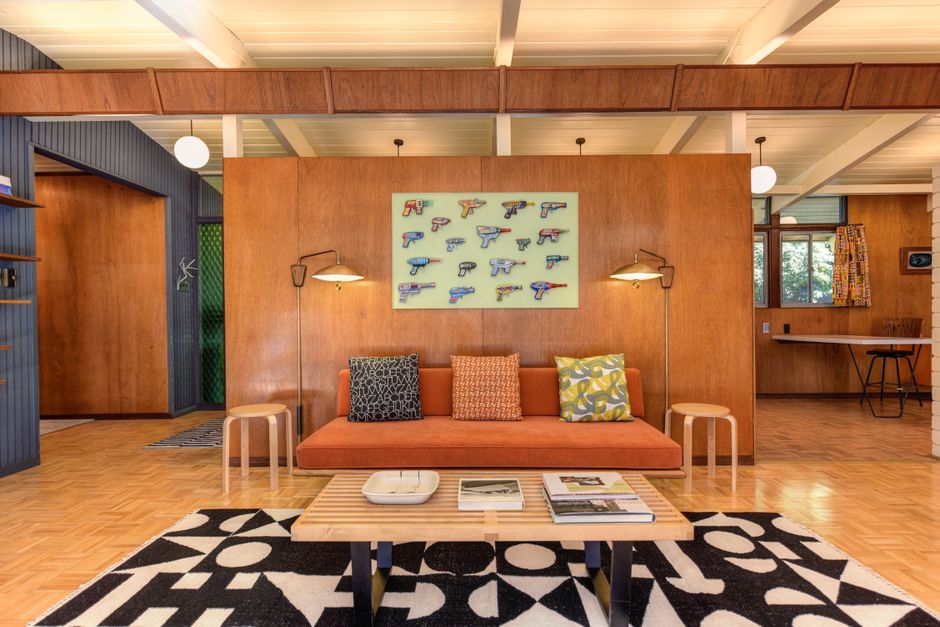
Knowing the rules around scale, framing, and negative space gets you halfway there. The other half is knowing what you’re actually hanging. MCM wall art has a specific visual vocabulary, and drifting from it — even slightly — pulls the whole room out of register.
Authentic MCM subject matter includes:
- Abstract geometric forms — hard-edged shapes, intersecting planes, Bauhaus-influenced compositions
- Atomic-age motifs — starburst patterns, molecular forms, boomerang shapes from the optimistic early space age
- Botanical line drawings — particularly mid-century graphic interpretations of tropical plants, not the current watercolor botanicals trending in farmhouse design
- Graphic landscape abstractions — horizon lines, stylized terrain, the kind of landscape that reads as both representation and pure form
What doesn’t work: farmhouse quote prints, gallery-wall photo collages, macramé-adjacent fiber art, abstract expressionism (too painterly for the graphic MCM sensibility), and anything that would look at home in a Scandinavian hygge-styled bedroom.
The MCM minimalist color palette for wall art is specific. Ochre, burnt orange, teal, olive, and charcoal on cream or off-white grounds are the authentic choices. Avoid the all-black-and-white route for a primary piece — it reads as contemporary or industrial, not MCM. The warm mid-tones are what distinguish the style from generic modernism.
On sourcing: Original vintage prints — lithographs, travel posters, exhibition art from the 1950s and 60s — are widely available and carry an authenticity that reproductions genuinely struggle to replicate. The ink aging, the slight texture of original printing, the actual period typography all contribute to a presence that a digitally reproduced print on modern paper doesn’t quite achieve. Searches for “atomic age art print” and “mid century abstract print” on Etsy have each surpassed 50,000 monthly searches as of 2024, reflecting enormous demand but also a saturated market where quality varies dramatically. For vintage originals, established sources include eBay’s vintage print category, Ruby Lane, and specialist dealers like International Poster Gallery. Condition matters — a torn or heavily faded original is often less satisfying than a high-quality reproduction.
When evaluating reproductions, look for:
- Archival inks on heavyweight cotton-rag paper — not standard photo paper
- Accurate color reproduction — many cheap prints shift the warm MCM tones toward digital-cool
- Original aspect ratios — cropped or re-proportioned prints lose the compositional integrity of the source work
The actionable takeaway: Narrow your search to two or three subject categories before you browse — abstract geometric, atomic motif, or graphic botanical — and filter by the warm MCM palette. This eliminates 90% of the noise in any marketplace search.
Room-by-Room Application: MCM Wall Art in Small Apartment Spaces

Principles need addresses. Here’s how the rules above apply specifically to the rooms you’re actually working with.
Living Room
The living room is where the anchor-piece strategy is most important and most impactful. The average U.S. apartment living room runs approximately 250 to 300 square feet — at that scale, the visual weight of wall art represents a disproportionately large share of the room’s total design impact compared to furniture or textiles. One large abstract or graphic print above the sofa, scaled to 75 to 80 percent of the sofa’s width, is the right call. Nothing competing on adjacent walls. A single secondary element — a small ceramic wall piece, a wall-mounted plant — can coexist if it’s on a completely different wall and well separated. Two statements on the same wall fight each other.
Bedroom
MCM minimalism in the bedroom favors serene subject matter. Botanical line drawings, low-contrast abstract work, and soft landscape abstractions are appropriate here. High-energy geometric pieces — the kind of bold atomic-age starburst that works brilliantly in a living room — introduce visual stimulation that competes with rest. The bedroom wall art doesn’t need to be less interesting. It needs to be calmer in its energy. A diptych (two related pieces hung with a precise gap between them) can work in a bedroom above a low platform bed, particularly if both pieces share a horizontal orientation that echoes the bed’s geometry.
Entryway and Narrow Hallways
This is an underutilized opportunity. A single vertically-oriented MCM print on a bare entry wall is a high-impact, low-cost move that sets the entire apartment’s aesthetic tone before a guest has walked three feet inside. In narrow hallways, vertical format counteracts the corridor effect by drawing the eye upward. One tall print — a 24×36 or 18×48 if the wall accommodates it — in a simple walnut or black metal frame is consistently more effective than a small horizontal piece centered at eye level.
The actionable takeaway: Treat each room’s wall art decision independently. The living room print you love may be exactly wrong for the bedroom. Start with the living room anchor piece, get it right, and let the other rooms follow from that established tone.
Common MCM Wall Art Mistakes in Minimalist Apartments (And How to Fix Them)
If your art is already up and something feels off, here’s a diagnostic rundown of the most common problems — and how to correct them without starting from scratch.
Hanging art too high. The industry standard centers art at 57 to 60 inches from the floor — which places the visual center of the piece at average eye level. In apartments with 8-foot ceilings, going slightly lower — 55 to 57 inches to center — keeps the art connected to the furniture plane rather than floating in the upper half of the wall. The fix is simple and free: rehang it lower.
Mixing MCM with incompatible styles. Bohemian macramé, Scandi hygge prints, and industrial metal art each carry their own design logic — none of it compatible with MCM minimalism. The result isn’t eclectic; it’s aesthetic static. In a minimalist room with limited objects, one style-conflicting piece pulls the entire room into confusion. The fix is removal, not addition.
Over-matting. Thick white mats are formal and traditional. In an MCM minimalist apartment, they introduce a museum register that belongs somewhere else. If you have existing pieces with 3 or 4-inch white mats, consider reframing with a slim 1-inch mat or no mat at all. This often transforms a piece that reads as stiff into something that feels right.
The postage stamp problem. If your art looks small on its wall, the answer is almost never to add more art around it. The answer is to replace it with a larger piece, or to remove it entirely and let the wall be empty until you find the right scale. Adding companion pieces to compensate for an undersized anchor piece rarely improves the situation.
Wrong framing for the aesthetic. Silver metal, chunky black, ornate gold — all common and all wrong for MCM minimalism. If the art is right and the frame is wrong, reframing is worth the cost. A $40 walnut frame from Frame It Easy or Framebridge can transform how a print reads in a space.
The actionable takeaway: Pick the single mistake from this list that resonates most with your current setup and fix only that. One focused correction almost always does more than a full room overhaul.
Frequently Asked Questions

What size wall art is best for a small MCM minimalist apartment?
Counterintuitively, larger. In a small apartment — say, under 700 square feet — a single large piece of art (typically 24×36 inches minimum for walls above a sofa, and ideally 30×40 or larger) creates a strong focal point that makes the space feel designed rather than cramped. Small pieces on small walls make everything look smaller. The 75 to 80 percent of sofa width rule is your most reliable guide for the living room. For a standard 84-inch sofa, that means art between 63 and 67 inches wide, which might mean a horizontal print, a canvas, or two closely related pieces treated as a unit.
Can you do a gallery wall in a mid-century modern minimalist apartment?
Technically yes, but you’ll need strict limits to keep it from undermining the minimalist aesthetic. A true gallery wall — 8 to 12 frames in varying sizes — is almost always wrong here. What can work is a tightly curated “micro-gallery” of two or three closely related pieces, hung with precise and deliberate spacing (at least 3 to 4 inches between frames), treated as a single unified composition rather than a collection. All pieces should share framing style, color palette, and subject matter. The moment the grouping starts to look assembled over time rather than planned as a unit, it reads as clutter in a minimalist space.
What frame style is most authentic for MCM wall art?
Narrow natural walnut frames are the most period-authentic choice, directly mirroring the material palette of MCM furniture. Thin black metal frames — particularly the floating/gallery style — are a close second and work especially well with graphic prints and abstract geometric work. Teak frames carry the same warm-wood logic as walnut and are historically appropriate. The critical specifications: frame width between 0.75 and 1.25 inches, no ornate detailing, no distressing, no wide profile. If you can find vintage solid walnut frames at an estate sale or thrift store, they’re often far better quality than contemporary equivalents at twice the price.
How do I find original vintage MCM prints without spending a fortune?
Start with estate sales — both physical and online through EstateSales.net and Everything But The House (EBTH). Original 1950s and 60s lithographs, travel posters, and exhibition prints appear regularly and often sell for $20 to $150 unframed, well below what galleries charge for the same material. eBay’s vintage print category is large and searchable by decade and subject matter — filter for “original” rather than “reproduction” and look for sellers with detailed condition photos. Ruby Lane and Chairish carry higher-end vintage prints with more curation. For free access to period-authentic MCM imagery that can be professionally printed at high quality, the Library of Congress digital archive and the Smithsonian’s open-access collection both contain extraordinary mid-century graphic design and illustration work that’s in the public domain.
Here’s what you can do right now, today: measure the wall above your sofa (or your primary empty wall if you don’t have a sofa yet), calculate 75 percent of that width, and search for a single horizontal abstract or geometric print in that size range. Filter for ochre, teal, or burnt orange on a light ground. Rule out anything that would need a thick mat or an ornate frame. You don’t need to buy today — but knowing the exact dimensions you’re looking for transforms browsing from vague searching into a specific mission. That specificity is where good MCM minimalist apartments actually get made.