The average man moves into his first apartment, pushes the sofa against the wall, mounts the TV too high, and then spends two years wondering why the room never feels quite right — and the fix costs less than a night out.
This isn’t about turning your living room into a showroom or hiring someone to make it look like you care. It’s about understanding a handful of specific, correctable mistakes that almost everyone makes — and knowing exactly what to do instead.
Why Most First Apartment Living Rooms for Men Feel Off (And How to Fix It)

There are three ways a first apartment living room goes wrong. The first is too sparse — a sofa, a TV, and a whole lot of bare wall and floor. The second is too random — furniture from five different eras, a floor lamp that belongs in a dentist’s office, and a rug that’s either missing or the wrong size. The third is the try-hard trap — everything matches too perfectly, usually in a dark, aggressive palette that screams “I found a Pinterest board called Modern Man Cave.”
All three fail for the same reason: there’s no intentional anchor. A well-designed room has one dominant piece that everything else orbits — usually a sofa or a rug — and every other decision flows outward from there. Without that anchor, your eye doesn’t know where to land, and the room feels restless even when it’s clean.
The “bachelor pad” aesthetic is worth calling out specifically because it’s genuinely dated. Dark leather sectionals, exposed brick wallpaper, Edison bulb strings, whiskey barrel coffee tables — this look peaked around 2014 and now reads as effort in the wrong direction. It signals that you shopped a template rather than made choices.
r/malelivingspace averages 400+ new posts per week during the June–August moving season, with “where do I start” being the most upvoted comment category. That’s not a coincidence — it reflects genuine confusion about sequence and priorities, not lack of taste.
The good news: most of the problems are structural, not aesthetic. You don’t need better taste. You need a better framework.
Actionable takeaway: Before buying a single thing, identify your anchor piece — almost always the sofa — and make every other decision relative to it.
The TV-Sofa Problem Every Man in a First Apartment Gets Wrong

Walk into most first apartments and you’ll see the same layout: sofa flat against the far wall, TV mounted high on the opposite wall, and a vast expanse of floor between them that nobody knows what to do with. It looks like a waiting room at a minor league stadium. The furniture is present. The room is not.
The fix is the floating sofa rule. Pulling your sofa 18–24 inches away from the wall immediately signals that someone made a decision. It creates a defined zone rather than a perimeter. It makes the room look designed rather than defaulted. This works in rooms as small as 12×14 feet — in fact, it works better in small rooms because it creates breathing room around the furniture rather than compressing it against the walls.
The TV height problem is almost universal. Interior designers recommend the center of your TV screen sit at seated eye level — roughly 42–48 inches from the floor. Most men mount theirs at 60 inches or higher, which strains your neck during a two-hour movie and looks like a sports bar, not a home. The rule is simple: sit on your sofa, have someone hold the TV where you’re looking naturally, and mark that height. That’s where it goes.
Cord management is a design move, not a chore. Two options by budget:
- Under $30: Cable raceways (D-Line is a solid brand) — flat plastic channels that run along the baseboard or wall and paint over cleanly
- $60–$150: In-wall recessed cable management kits like the Wiremold CMK series — requires cutting two small holes but the result is completely invisible
Both look dramatically better than a cable dangling down a white wall.
Actionable takeaway: Pull your sofa off the wall by 18 inches today — just try it — and lower your TV mount to 42–48 inches center height. These two changes cost nothing and visually redesign the room.
Choosing an Anchor Sofa That Won’t Look Cheap in 18 Months

Your sofa is the single most important furniture purchase in your living room, and it’s where most of the budget mistakes happen — either spending too little and replacing it in a year, or spending on the wrong thing.
Neutral always wins over statement. A charcoal, slate, or warm greige sofa works with everything and won’t box you in when your taste shifts or you move to a different apartment with different light. A dark brown leather Chesterfield looks cool in photos and becomes a liability in a 500-square-foot room with two small windows. It absorbs light, dominates the space, and fights with everything you try to add.
Honest fabric trade-offs for a guy who might move again in two years:
- Standard fabric (linen blends, polyester): Looks good, not very forgiving. Stains show and cleaning is inconsistent.
- Performance fabric (Crypton, Sunbrella-grade): Worth the extra cost. Resistant to stains, moisture, and wear. Looks like regular upholstery but cleans with a damp cloth. West Elm and Article both offer this at mid-tier prices.
- Leather: Ages well if it’s genuine leather, badly if it’s bonded or PU leather. Bonded leather peels within 18–24 months of regular use. Check the label carefully.
Budget tiers with specific guidance:
- Under $600: IKEA’s Kivik 3-seat (around $549) and Article’s Sven Birch are honest options. Look for tight construction, no wobble in the legs, and foam density above 1.8 lbs/cubic foot. Avoid anything with tufting at this price — the buttons usually fail.
- $600–$1,200: This is where Article, Joybird, and Benchmade Modern live. You’re getting better foam, real performance fabrics, and frame construction that lasts a move or two.
- $1,200+: Crate & Barrel’s Lounge II, the Interior Define Jagger, or a used Herman Miller or Room & Board piece from Facebook Marketplace. At this tier you’re buying longevity.
The average first apartment in the US is 500–700 square feet. A standard 3-seat sofa runs 84–96 inches wide — measure your wall clearance with 18 inches of float before ordering anything. Sectionals in under 350 square feet almost always overwhelm the space and make circulation feel like an obstacle course.
Actionable takeaway: Measure your living room wall before shopping. Write down your clearance on your phone and don’t look at sofas that don’t fit it — no exceptions.
A Color Palette That Feels Masculine Without Being a Cave

The design internet will tell you masculine rooms need charcoal walls, black accents, and dramatic contrast. That’s half right and also the reason so many first apartments feel like a moody hotel room rather than a place someone actually lives.
The smarter move is a warm neutral base. Warm whites (Benjamin Moore Chantilly Lace OC-17, Sherwin-Williams Alabaster SW 7008), taupes, and warm grays read as clean and intentional. They make rooms feel larger and calmer. They work as a background for literally any accent color or furniture you add. Cold grays — anything with a blue undertone — are less forgiving and tend to look stark without high-end finishing.
The accent strategy that actually works: pick one mid-tone anchor color and use it in two or three places. Forest green, slate blue, and terracotta are all working well right now and don’t feel trendy or dated. That color appears in a throw pillow, maybe a small plant pot, maybe a lamp shade. That’s it. You don’t need five “masculine” dark shades competing for attention — that’s how you get a room that looks busy and unresolved.
Going all-dark in a small apartment with low ceilings creates what environmental psychologists call a compression effect — the room literally reads as smaller and lower than it is, and occupants report higher stress levels in those spaces. Studies in environmental psychology show rooms with higher light reflectance values (LRV above 55) are consistently rated as more calm and spacious by occupants. That’s relevant information when your living room has one north-facing window and a ceiling at 8 feet.
If you rent and want to paint, it’s often negotiable. Many landlords will allow it if you agree to repaint before move-out. Ask. The worst answer is no. If painting isn’t an option, removable wallpaper has genuinely improved — Tempaper and Chasing Paper make products that peel cleanly without damaging surfaces and run about $10–$15 per square foot.
Actionable takeaway: Pull the LRV value of any paint color you’re considering — it’s on the Benjamin Moore or Sherwin-Williams website. Stay above 55 for primary walls in small apartments.
Affordable Anchor Furniture Beyond the Sofa: What to Buy First, Second, and Last

Most men furnish in the wrong order. They buy the TV stand, a floor lamp, a few prints, and then realize they have no budget left for a rug or a real coffee table. The room looks assembled in the wrong sequence because it was.
The acquisition order that works:
- Sofa — the anchor, takes the most floor space and dictates scale
- Rug — grounds the seating zone and makes the sofa look intentional
- Lighting — transforms how the whole room reads, dramatically underbudgeted
- Coffee table or ottoman — functional center of the seating zone
- Storage — a media console, a bookshelf, something that hides functional clutter
- Accent pieces — plants, art, throw pillows, candles
A 2023 survey by Apartment List found that 67% of first-time renters wished they’d spent more on a rug and less on decorative accessories in their first year. That’s one of the most consistent pieces of regret in new-renter data, and it’s entirely preventable.
The rug sizing mistake is near-universal: the rug is almost always too small. The front legs of all seating pieces should sit on the rug. In a standard living room, that means at least an 8×10 rug, and often a 9×12. A 5×7 rug floating in the middle of the seating area looks like a bathmat.
Coffee table alternatives that actually work better in small spaces:
- Upholstered ottoman (the Pottery Barn Bliss Ottoman or similar) — serves as extra seating, softer aesthetic
- Solid wood nesting tables — can be separated for parties, don’t dominate visually
- A low wooden crate or storage ottoman — adds hidden storage without bulk
On shelving: IKEA’s Lack floating shelves are fine. What kills them is placement. A symmetrical grid of three identical shelves at the same height looks like a storage solution, not a design decision. Instead, try an asymmetric arrangement — one long shelf, one shorter shelf at a different height — and style them with a mix of books, one small plant, and one object. Odd numbers. Varied heights.
Actionable takeaway: Before buying any accent pieces, get the sofa and rug sorted. A sofa and a correctly sized rug in an otherwise empty room already looks like a room.
Lighting Is the Cheat Code That Makes Every First Apartment Look Better

Here’s what overhead lighting does: it illuminates everything equally, creates flat shadows, and makes your living room feel exactly like the breakroom at an office. The ceiling fixture that came with your apartment was designed for function, not ambiance. Turn it off.
Layered lighting — three points at different heights — changes a room entirely. The approach:
- A floor lamp in a corner (not behind the sofa, angled into the room)
- A table lamp on a side table or credenza
- Either an LED strip behind your TV or a small shelf light that washes a wall
That’s it. Three light sources, none of them the ceiling. The room immediately reads as intentional, warm, and designed.
Bulb temperature is the detail most people miss. The difference between 2700K (warm white, close to candlelight) and 4000K (cool white, close to office fluorescent) is the difference between a living room and a hardware store. Every bulb in your living room should be 2700K–3000K. Switching all your bulbs to warm white costs under $20 and is the single fastest room upgrade available.
Lighting accounts for roughly 10% of the average home decorating budget but has a disproportionate impact on perceived room quality. That ratio is worth leaning into.
Affordable floor lamp picks worth considering:
- Under $80: The Brightech Sparq LED Floor Lamp — clean, minimal, warm-toned
- $80–$150: The Nathan James Theo Arc Floor Lamp — arched design, works over a sofa without a side table
- Under $100, design-forward: Any simple tripod floor lamp in matte black or warm brass — even mass-market versions look intentional in the right context
What to look for in any fixture: a shade that diffuses light rather than a bare bulb, a stable base, and a switch on the cord rather than the base (convenience matters).
Actionable takeaway: Replace every bulb in your living room with 2700K warm white tonight. Fifteen minutes and under $20. The difference is immediate.
The Art and Wall Problem: How to Hang Things So It Doesn’t Look Like a College Dorm

Most men make one of two wall mistakes: they leave everything bare — walls completely empty for months after moving in — or they hang too many small things at random heights with no relationship to each other. Both read as unfinished.
One large piece beats a grid of small frames every time in a first apartment. A single 24×30 or 30×40 print creates a focal point and reads as deliberate. A grid of six 8×10 prints, especially if they’re random subjects with mismatched frames, reads as filler.
If you want a gallery wall, here’s how to not make it look like a dorm:
- Odd number of pieces — three or five, not four or six
- Consistent frame finish (all black, all natural wood, all white) even if the art varies
- Consistent mat color — all white or all off-white matting creates cohesion
- Hang center at 57–60 inches from the floor — this is the museum standard, aligned with average human eye level. Most people hang art 6–12 inches too high, which creates a disconnected relationship between the art and the furniture below it.
Alternatives to framed art that read as genuinely considered:
- A single large textile or tapestry — adds texture and warmth, especially in a room with hard floors
- A wall-mounted shelf at 57 inches with three objects: a plant, a book, a small object
- A large mirror — amplifies light in a dark room, makes small spaces read larger, and looks expensive at almost any price point
For affordable art that doesn’t look like it came from a hotel lobby: Society6 and Etsy both have original and semi-original work at poster prices. The move that works at any budget: a $15 digital print downloaded from Etsy, printed at a local print shop at 18×24, framed in a simple $40 IKEA Ribba frame. Total cost: under $60. Looks like it cost five times that.
Actionable takeaway: Find one piece of art — one — that you’d actually choose for yourself. Frame it properly and hang it at 57–60 inches center height. Done.
The Small Details That Signal a Room Was Designed, Not Just Assembled

There’s a specific quality that makes a room feel lived-in versus just furnished. It’s not expensive. It’s the accumulation of small, considered decisions that r/malelivingspace commenters consistently flag when they say a room “works.”
Throw pillows and blankets: Two throw pillows is enough. Three is fine. One is too few, five is a showroom. A single folded throw blanket draped over one arm of the sofa adds texture and visual warmth. Odd numbers work better than even because they’re less symmetrical, less formal. Stick to your accent color or a neutral — no logos, no loud patterns unless you’re very confident.
Plants as a design element: two or three low-maintenance plants genuinely change the quality of a room. A pothos in a hanging planter or trailing over a shelf. A snake plant in a corner. A ZZ plant on a side table. All three are nearly unkillable, thrive in low light, and add the one thing no furniture provides: something living. Snake plants and pothos are both listed in NASA’s clean air study as among the most effective air-filtering houseplants — so there’s a functional argument on top of the aesthetic one.
Functional clutter is the thing that undoes an otherwise decent room. A tray on the coffee table to corral remotes, keys, and whatever else accumulates. A media console with a door or drawer so the router and game console don’t sit exposed. Cable management handled, not ignored.
Scent is the detail most visitors notice without knowing why they noticed it. A single candle on the coffee table — not a shelf full of candles, just one — or a reed diffuser in a corner registers subconsciously. Brands like Boy Smells and P.F. Candle Co. make things that smell like a real place rather than a department store.
Actionable takeaway: Add one plant, one tray for the coffee table, and replace the bare bulb in your floor lamp with a 2700K equivalent. That’s three changes that take under an hour and cost under $50 combined.
Room Layout Templates for the Three Most Common First Apartment Living Room Shapes
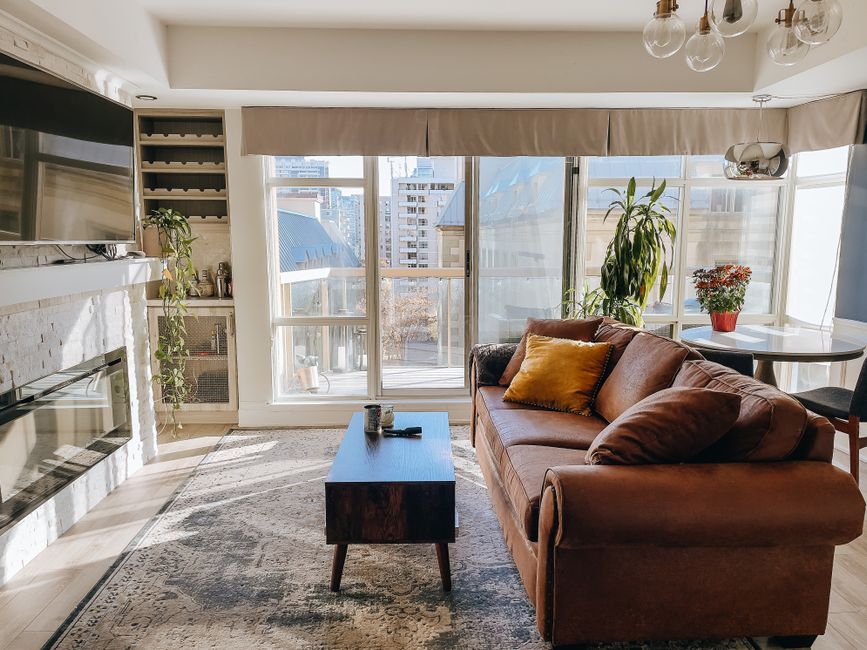
The National Multifamily Housing Council reports that over 70% of new apartment units built in the US since 2015 feature open-plan living layouts. That means zone definition isn’t optional — it’s one of the core skills for first-time renters.
Long rectangle (the most common):
The mistake is placing the sofa parallel to the long wall, which turns the room into a hallway. Instead, orient the sofa perpendicular to the long wall — pushed slightly into the room, facing across the shorter dimension. This creates a defined seating zone with clear circulation on both sides. The rug defines where the living area ends. The rest of the room becomes a distinct zone rather than wasted corridor space.
Square room:
Here, the floating furniture island works best. Place your sofa facing the TV wall with the coffee table centered in front of it. Keep clear circulation paths on all four sides — roughly 30–36 inches of walking clearance minimum. Avoid pushing anything against the walls. The room will feel larger and more purposeful with furniture floating in the center than with everything hugging the perimeter.
L-shaped or open-plan layout:
The rug does the heavy lifting here. A rug defines a room within a room — place it to anchor the seating zone, and the living area becomes distinct from the dining area or kitchen without any walls required. The sofa can function as a room divider if placed with its back to the kitchen, facing the TV. This is one of the most effective layout moves in open-plan spaces and costs nothing beyond the rug you’d buy anyway.
Before buying anything for a specific layout, use Roomstyler (free, browser-based) or IKEA’s free room planner. Both let you input exact room dimensions and drag furniture to scale. Fifteen minutes with these tools prevents the most expensive mistakes.
Actionable takeaway: Sketch your room dimensions on paper or enter them into Roomstyler before buying your next piece of furniture. Test the layout first.
Budget Breakdown: What a Solid First Apartment Living Room Actually Costs
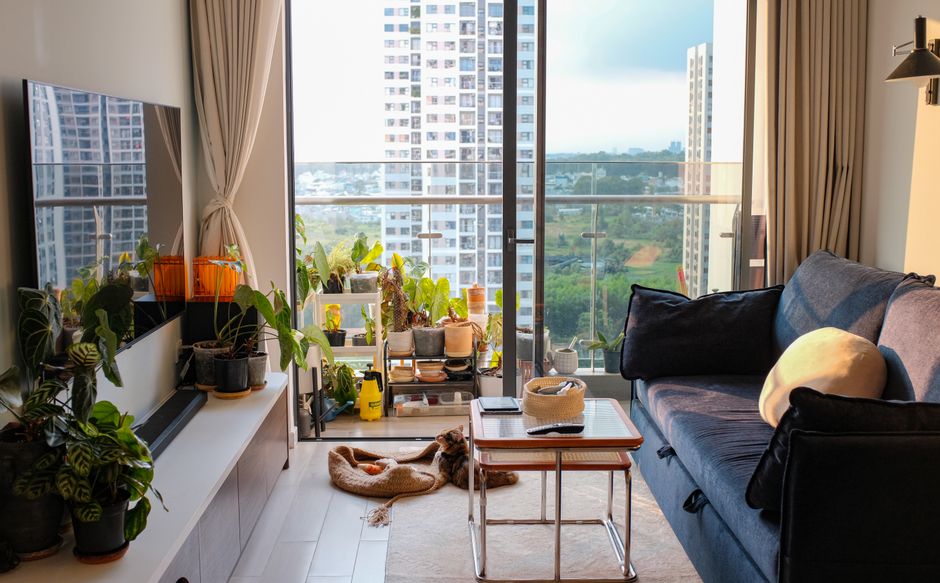
The average American spends $1,600–$2,200 furnishing their first apartment living room. Most men underestimate this figure by about 40% when budgeting — they plan for $800 and end up frustrated when they can’t get what they need.
Here’s how to think across three realistic tiers:
Tier 1: Under $1,000
This is achievable but requires ruthless prioritization. Sixty percent of your budget goes to the sofa — around $550–$600. The remaining $400 covers a used or sale-priced rug ($80–$120 at IKEA or Ruggable), two lamps ($80 total), and a secondhand coffee table from Facebook Marketplace ($50–$100). Art and accent pieces wait. A room with a good sofa, a right-sized rug, and warm lighting looks finished even when it isn’t fully furnished.
Tier 2: $1,000–$2,500
This is the sweet spot for most young professionals. Allocate roughly:
- Sofa: $800–$1,000 (Article, Joybird, or similar)
- Rug: $150–$300 (Ruggable, Loloi, or similar)
- Lighting (floor + table lamp): $150–$250
- Coffee table: $100–$200
- Art + accents: $100–$200
At this range you’re getting quality that survives a move, not quality that just survived the unboxing.
Tier 3: $2,500+
Spend more on the sofa and rug — these have the highest cost-per-use and age the most visibly. A $1,500 Crate & Barrel sofa bought once beats a $600 sofa bought twice. At this tier, the coffee table can be solid wood rather than veneer, and you can afford one or two pieces of actual original art rather than prints.
Buy-once-cry-once items: sofa, rug, and any hardwood furniture. These are worth spending on.
Places to buy cheap without regret: throw pillows, candles, plant pots, art prints, side tables, lamps (the fixture, not the bulb).
Actionable takeaway: Write down your total budget, allocate 40–50% to the sofa before you look at anything else, and treat that as a fixed number.
Frequently Asked Questions

What furniture should a man buy first for a new apartment living room?
The sofa, without hesitation. It determines the scale of everything else — the rug size, the coffee table height, the lighting placement, the amount of clearance you need for circulation. Buy the sofa first, measure the space it occupies, then add a rug that extends 12–18 inches beyond it on each side. Everything else is secondary. Men who buy a TV stand or accent chairs first often end up with a sofa that doesn’t fit or looks wrong relative to what’s already there.
How do I make my first apartment living room look less empty without spending a lot?
Lighting and a rug will do more than any amount of decorative accessories. A floor lamp in the corner turned on at evening creates warmth and depth that makes an empty room feel inhabited. A properly sized rug — 8×10 minimum in most living rooms — grounds the space and makes the sofa look placed rather than parked. After those two: one plant, one piece of art hung at the right height, and a throw blanket on the sofa arm. That’s a complete-looking room for under $300 if you shop carefully.
What is the best sofa color for a first apartment that will stay versatile?
Warm charcoal is the single most versatile option — it reads as masculine without being aggressive, works with warm wood tones and cooler metal accents equally well, and doesn’t show wear the way lighter colors do. Warm greige (a gray-beige blend) is the second best choice and photographs well, which matters if you’re ever listing the apartment. Avoid true black (absorbs light, shows dust and pet hair dramatically) and navy (looks great in photos, fights with most wood tones in practice). Whatever color you choose, make sure it’s in a performance fabric if there’s any chance of regular use.
How should I arrange my living room if the TV wall and the main wall are opposite each other in a narrow room?
Don’t place the sofa flat against the far wall facing the TV — this is the waiting room configuration and it makes the room feel like a corridor. Instead, pull the sofa 18–24 inches away from the wall and angle it slightly if the room is very narrow. If the room is under 10 feet wide, consider placing the sofa along one of the long side walls — perpendicular to the TV — and angling it toward the screen. This configuration creates a more intimate seating zone and breaks the narrow-hallway feeling. A rug that extends under both the sofa and any accent chairs helps define the zone and visually widths the space.
Here’s your move for today: measure your living room — write down the length, width, and the width of your main wall — and put those numbers in your phone. Then look at your sofa placement. If it’s flat against the wall, pull it out 18 inches. If your TV is mounted above 50 inches, think about lowering it. Those two changes, today, cost nothing and will make the room feel different by tonight.
The rest follows from there.