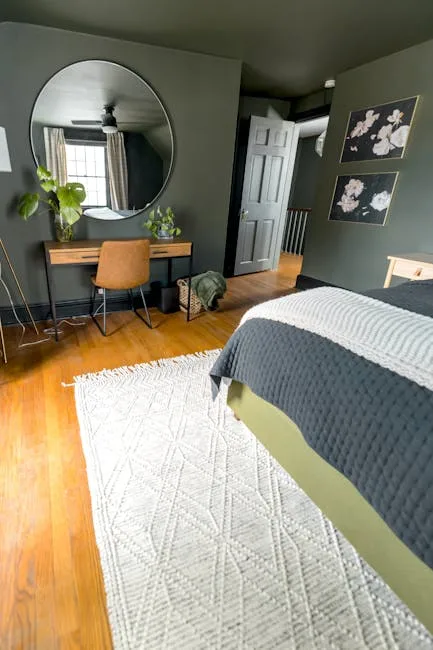
A built-in desk in a small bedroom reclaims between 12 and 20 square feet of dead corners, unused wall stretches, and the gap behind the door — enough space, in almost every case, to fit a fully functional workspace without sacrificing a single inch of sleeping room. Most people never see it. They assume a desk requires a dedicated room, or at minimum a large bedroom, and they keep working from the bed or the kitchen table until their back gives out and their productivity craters. What they’re missing isn’t square footage — it’s a different way of reading the room they already have.
Quick Answer
The average small bedroom loses between 12 and 20 square feet to dead corners, unused wall stretches, and the gap behind the door — enough space, in almost every case, to fit a fully functional built-in desk without sacrificing a single inch of sleeping room.
This isn’t about cramming a desk in. It’s about building something that belongs there.
1. Is a Desk in a Small Bedroom Even Worth It?
In This Article
- 1. Is a Desk in a Small Bedroom Even Worth It?
- 2. Why Built-In Desks Outperform Freestanding Options in Tight Rooms
- 3. How to Find and Use Dead Space in Your Bedroom for a Built-In Desk
- 4. Built-In Desk Configurations That Actually Work in Small Bedrooms
- 5. Materials, Finishes, and the Details That Make a Built-In Look Intentional
- 6. Renter-Friendly Approaches to a Built-In Desk in a Small Bedroom
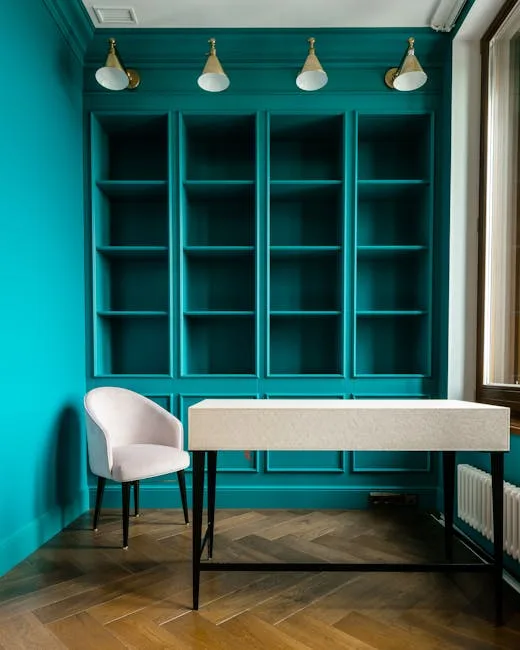
Before spending a dollar on lumber or IKEA flat packs, this question deserves a real answer — not the reflexive “yes, you can make anything work!” that populates most decor content.
The honest answer is: it depends entirely on how you do it. A freestanding desk dragged into a corner and buried under charging cables is a genuinely bad idea in a small bedroom. It competes with every other piece of furniture, it makes the room feel chaotic, and it keeps your brain in work mode at 11pm when you’re trying to sleep. I watched this happen to a client in a 280-square-foot studio apartment in Wicker Park — she was convinced she needed a bigger place. She didn’t. She needed the desk to stop dominating the room visually.
A purpose-built integrated workspace is a completely different object. It reads as architecture. It doesn’t float in the middle of the floor or stick out from a wall at an odd angle. It occupies the room the same way a window does — as a feature, not an intrusion.
The psychological concern is real, though, and worth addressing directly. Sleep researchers have documented that proximity to work materials can affect sleep onset, particularly for people who struggle to mentally disconnect after work hours. But the variables that actually drive that effect are visual exposure to the workspace while lying in bed, and ambient light from screens. Both are solvable with design: orient the desk to face away from the bed, put the task lighting on a separate switch, and use a surface or curtain that can signal “closed” when the workday ends. Zoning matters more than square footage.
A 2021 study from the Sleep Foundation found that 60% of remote workers reported working from their bedroom at least occasionally — which means bedroom workspace design isn’t a niche problem anymore. It’s a mainstream one that most bedroom furniture is completely unprepared for.
When it genuinely doesn’t make sense:
- Rooms under 100 square feet with no dead walls
- Shared bedrooms where one occupant works different hours
- Rental situations where the landlord prohibits wall mounting
- Rooms with non-standard layouts where every wall is interrupted by a door, window, or radiator
Renters still have options — more on that later — but a full built-in requires at least a basic level of wall commitment.
Takeaway: The problem isn’t the desk. It’s the type of desk and the placement. A built-in, properly zoned, sidesteps almost every legitimate objection to bedroom workspaces.
2. Why Built-In Desks Outperform Freestanding Options in Tight Rooms
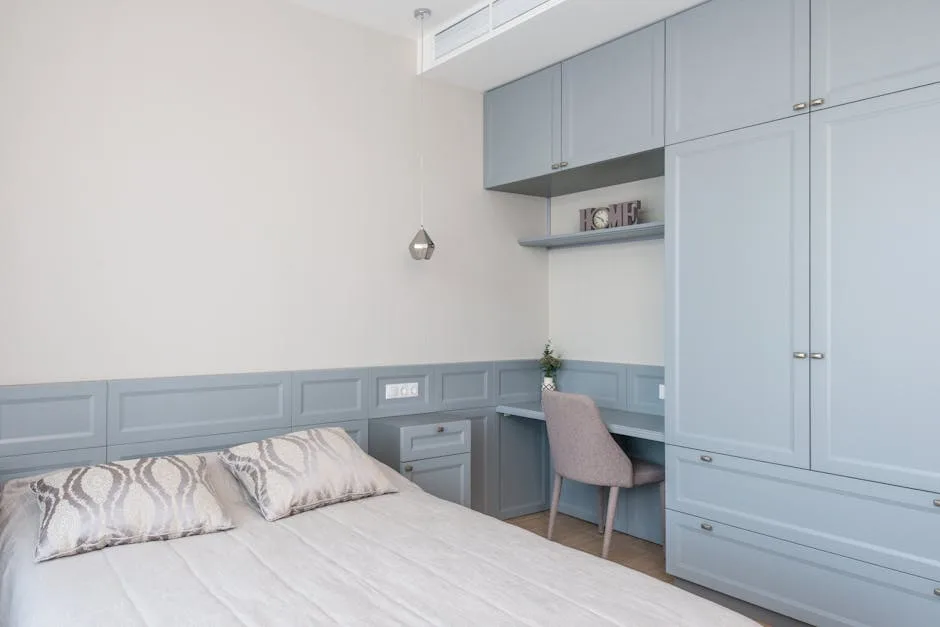
Freestanding desks are designed to work anywhere, which means they’re optimized for nothing in particular. They have legs that eat floor space underneath without providing storage. They have side clearances that waste three or four inches on each edge. They sit at a fixed depth that may be too shallow for a monitor or too deep for a narrow wall. And they look exactly like what they are: furniture that was bought somewhere and moved into a room.
A built-in uses the entire wall. Every inch from corner to corner, floor to shelf height, is accounted for. There’s no dead space at the edges, no gap between the desk side and the adjacent wall where things fall and never come out. The footprint a freestanding desk ignores — the vertical space above it, the floor space below it — a built-in converts into shelving, drawers, or cable management structure.
The financial case splits two ways, and I want to be specific rather than vague about it:
- IKEA-hacked built-in using KALLAX units as a base with a LINNMON or butcher-block top: $150–$600 in materials, depending on how much shelving you add and whether you finish it with paint or trim
- Custom millwork from a local carpenter: starts around $800 and can reach $3,000 or more for complex rooms with non-standard angles, high-end finishes, or integrated cabinetry
- Semi-custom flat-pack systems (IKEA SEKTION, BILLY with extensions, or brands like Semihandmade): typically $400–$1,200 and hit a middle ground between DIY and full custom
- Floating shelf desk with bracket support: the lowest-cost option at $80–$250, suitable for rooms where under-desk storage isn’t critical
The gap between those options is large enough that the right approach depends entirely on the room and the budget — but even the IKEA route, done carefully, produces something that reads as intentional rather than improvised.
Houzz research from the post-2020 period documented a 37% increase in home office renovation project inquiries, with built-in storage and desk integration ranking as the most-requested features in bedroom remodels. That’s not surprising. People who spent eighteen months working from the edge of their mattress developed strong opinions about what they actually needed.
The resale angle is worth mentioning once: a well-executed built-in desk is a selling point in a bedroom, particularly in urban markets where buyers and renters are hunting for functional space. A freestanding desk that was photographed in the listing and removed before closing is invisible. Architecture stays.
Key advantages over freestanding options:
- No wasted floor clearance under the surface — drawers, shelving, or open storage fills that volume
- No awkward gap between desk edge and wall
- Visual continuity with the room makes the space feel larger, not smaller
- Lighting and cable management can be integrated rather than retrofitted
- Surface depth can be customized to the wall — 18 inches works where a standard 24-inch desk would block a doorway
- The whole unit can match trim, baseboard height, and wall color so it disappears into the room
Takeaway: If you’re committing to a bedroom workspace, commit to something that’s built for the room. A freestanding desk in a tight space is a compromise. A built-in is a solution.
3. How to Find and Use Dead Space in Your Bedroom for a Built-In Desk
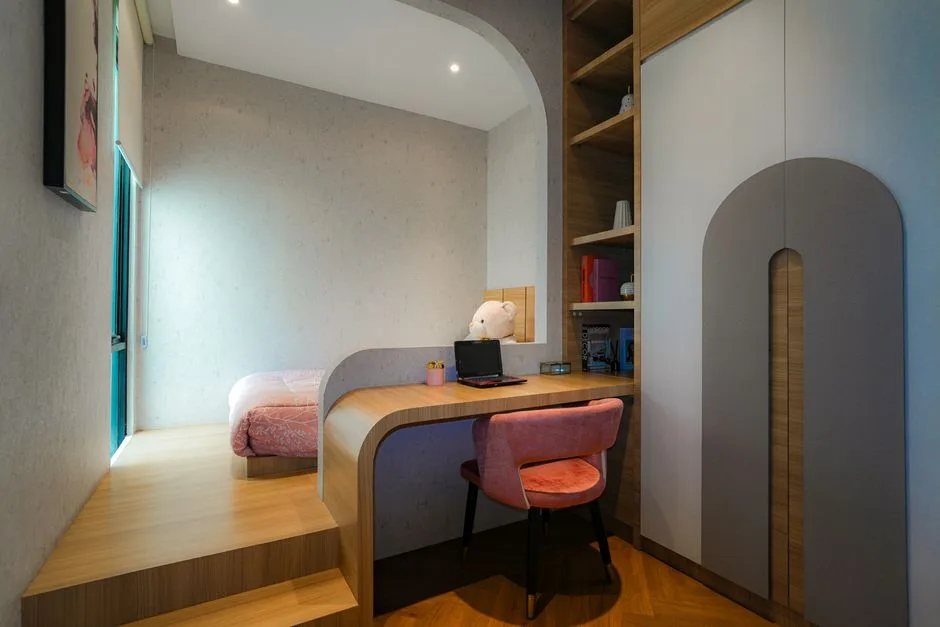
Most people measure their bedroom once, decide there’s no room, and stop there. What they measured was occupied space — the footprint of existing furniture. The more useful audit is measuring unused space: the wall behind the door, the corner beside the window, the alcove created by a chimney breast, the wall segment between two pieces of furniture that’s too narrow for a dresser but wide enough for a desk.
Interior designers commonly describe what they call the “dead triangle” — the floor area in corners that’s psychologically present but functionally inaccessible when furniture is arranged along walls. A corner built-in converts that dead triangle into working surface, and in rooms under 150 square feet, that reclaimed area can represent 12–18 square feet of perceived floor space because the built-in sits flush with the walls rather than projecting into the center.
The under-window placement is one of the most effective configurations for a small bedroom built-in desk. The window provides natural light from above rather than behind or beside, which reduces screen glare without blocking the view. A desk surface that runs wall-to-wall beneath the window — even at a shallow 16-inch depth — gives you a full working surface while the wall on either side of the window can carry shelving columns up to ceiling height. This placement also means the desk faces away from the bed by default, which addresses the sleep-disruption concern without any additional planning.
Common dead-space locations worth measuring:
- The wall behind the bedroom door — often 24–36 inches wide and completely unused
- The corner diagonal to the bed, which is usually the last place furniture gets placed
- The chimney breast alcove, if the room has one — a natural built-in niche that’s already partially enclosed
- The wall beside a closet, between the closet door frame and the room corner
- The stretch of wall above a low radiator, where furniture typically can’t sit flush — a floating desk surface on brackets clears the radiator entirely
- The foot-of-bed wall, particularly in rooms where the bed sits against the opposite wall and leaves 3–5 feet of clear floor
How to do the actual audit:
- Empty the room mentally — sketch the walls without furniture on a piece of paper
- Mark every interruption: doors (including swing arc), windows, outlets, light switches, radiators, vents
- Measure every uninterrupted wall segment, even the short ones
- Note ceiling height — anything over 8 feet dramatically improves vertical storage potential
- Identify which segments have natural light nearby, which face the bed directly, and which are already visually “dead” from every seating or lying position in the room
A wall segment as narrow as 30 inches can accommodate a functional single-monitor workstation if the depth is right and the overhead storage is properly planned. The width constraint is rarely the actual problem — it’s usually depth and the assumption that a desk has to look like a desk.
Takeaway: The space for a built-in desk in a small bedroom almost always exists. The audit is the design work. Most people skip it.
4. Built-In Desk Configurations That Actually Work in Small Bedrooms
There’s no single right answer here — the configuration that works depends on the room’s layout, the occupant’s workflow, and how much of the room the desk is allowed to visually occupy. But there are four configurations that come up repeatedly because they solve the most common spatial constraints.
The Alcove Desk
If the room has a chimney breast, a recessed section of wall, or an irregularly shaped corner, build into it. The walls of the alcove become the desk’s sides, which means no additional structure is needed to enclose the workspace. Depth typically runs 18–24 inches in a standard alcove — sufficient for a monitor, laptop, or dual-screen setup depending on the alcove size. Floating shelves above the surface use the vertical height without adding visual weight. This is the lowest-complexity option for a DIY build because the structure is already there.
The Corner L-Shape
Two surfaces meeting at a corner, typically one longer run and one shorter return. The corner itself — which would otherwise be dead space — becomes the most functional part of the desk, since it’s the central reach zone where primary work happens. The return can serve as a secondary monitor position, printer shelf, or reference surface. In a small bedroom, the L-shape needs careful depth management: 18 inches on each leg keeps the desk from projecting too far into the floor plan, while still providing meaningful surface area.
The Wall-to-Wall Surface with Overhead Storage
A single surface that runs the full length of one wall, from corner to corner or baseboard to door frame. This reads as architecture almost immediately because it spans the full wall the same way a window does. Depth can vary across the run — deeper at the primary work zone, shallower at the ends where the surface transitions to open shelving or display. Above the surface, a full-height shelving system carries books, equipment, and storage boxes without occupying any floor space.
The Murphy Bed + Desk Combination
For rooms under 120 square feet where the bed itself is the space problem, a wall bed with an integrated desk surface is worth serious consideration. When the bed folds up, the desk surface either folds down in the same motion or remains accessible alongside the folded bed. Several manufacturers (Resource Furniture, Clei, IKEA’s SVALNAS system with modifications) produce systems where both functions coexist on a single wall panel. The cost is higher — typically $2,000–$6,000 installed — but the spatial math is different from any other configuration.
Configuration comparison at a glance:
| Configuration | Best For | Minimum Wall Width | Approx. Surface Area |
|---|---|---|---|
| Alcove desk | Rooms with natural recesses | 24 inches | 12–20 sq ft |
| Corner L-shape | Rooms with one open corner | 48 inches per leg | 20–30 sq ft |
| Wall-to-wall surface | Rooms with one clear long wall | 60 inches | 25–40 sq ft |
| Murphy bed + desk | Rooms under 120 sq ft | 60 inches | 15–20 sq ft |
5. Materials, Finishes, and the Details That Make a Built-In Look Intentional
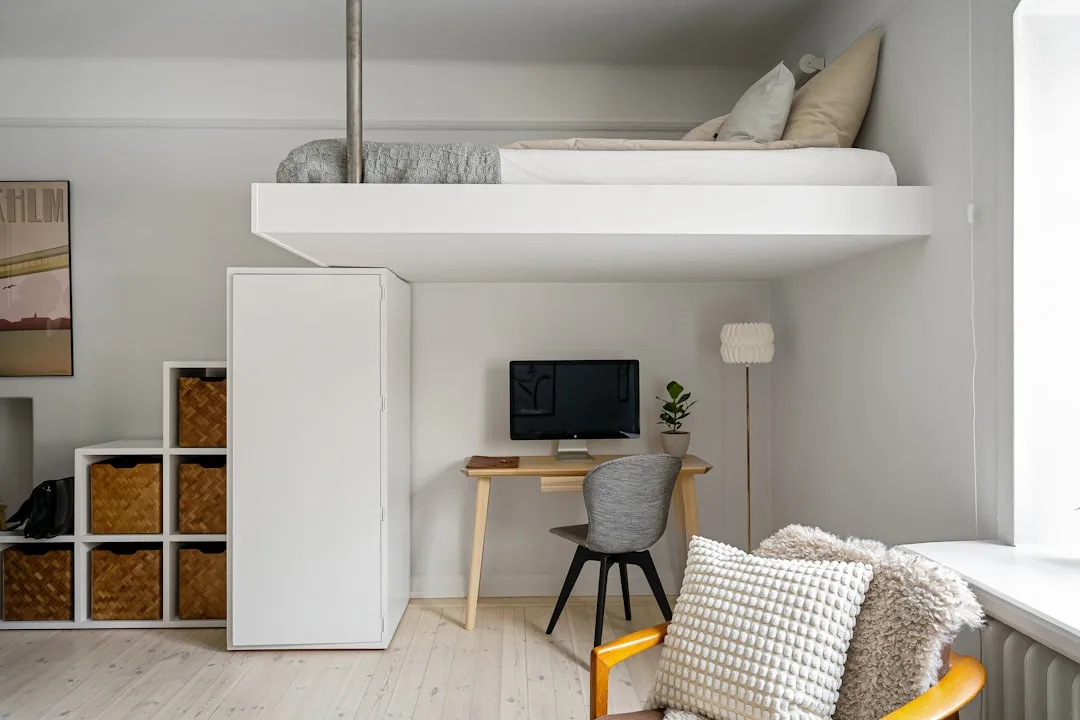
The difference between a built-in that looks like a professional installation and one that looks like a DIY project with ambitions is almost always in the finishing details — not the underlying construction.
Surface materials worth considering:
- Butcher block (maple or birch): Warm, durable, sands and refinishes well. Works with both Scandinavian and traditional room styles. Typically $8–$15 per linear foot in standard depths.
- MDF with paint finish: The cleanest, most architectural look. MDF takes paint without grain showing, which is why it’s used for built-ins in high-end remodels. Prone to moisture damage in humid rooms — use primer designed for MDF.
- Plywood with veneer edge banding: More structurally rigid than MDF, lighter than solid wood. Birch plywood finished with oil or lacquer is a popular choice for modern minimalist rooms.
- Laminate-faced particleboard (IKEA standard): Lowest cost, surprisingly durable for desk surfaces, limited finish options, and edges need banding to look intentional.
The finishing details that matter most:
- Scribing the back panel or side panels to the wall, rather than leaving a visible gap
- Running baseboard trim continuously across the front of any base cabinets so the unit appears to grow from the floor
- Painting the built-in the same color as the wall, or one shade darker for definition without visual separation
- Recessing the task light into the underside of the overhead shelf rather than clipping a lamp onto the surface
- Running cable management channels through the surface or back panel before installation, not afterward
What to avoid:
- Mismatched hardware across the unit — choose one handle style and stick to it
- Open shelving at eye level directly above the work surface in a bedroom — it creates visual clutter that’s hard to ignore from the bed
- Glossy surfaces on the desk top — they show every fingerprint and reflect screen light back into your eyes
6. Renter-Friendly Approaches to a Built-In Desk in a Small Bedroom
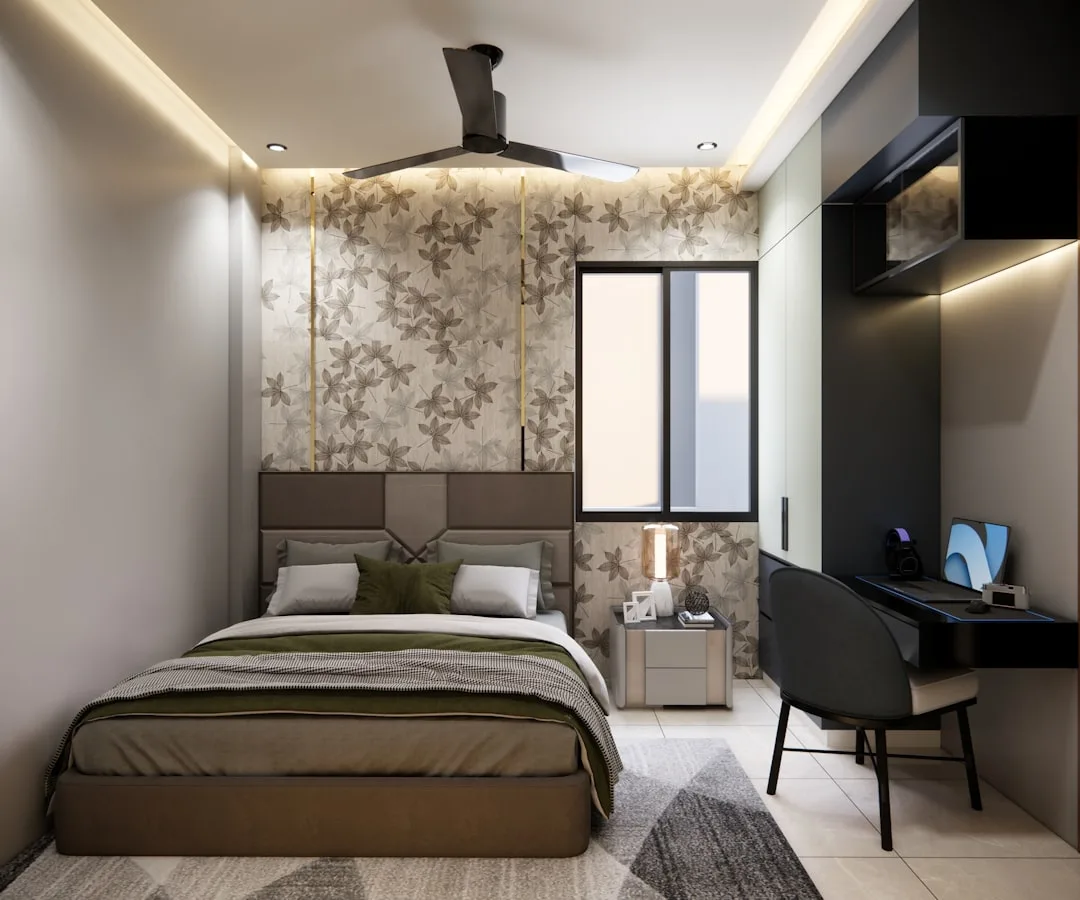
A full custom built-in requires wall anchoring, and in many rental situations that means asking permission or risking deposit deductions. But the visual and functional result of a built-in can be approximated without permanent modification — the key is using weight and footprint to create stability rather than relying on wall fasteners.
Approaches that work for renters:
- Freestanding shelf units used as built-in bases: IKEA KALLAX or BILLY units pushed into a corner and topped with a continuous surface panel look architecturally intentional if the top is cut to span wall-to-wall and the units are stabilized with anti-tip furniture straps through the back (which typically leave no visible damage on removal)
- Heavy floating desk on French cleats: French cleats distribute load across multiple wall anchors, and small-diameter anchor holes in drywall are typically considered normal wear and tear in most lease agreements. Confirm this with the landlord before proceeding.
- Tension-mounted shelving systems: Products like String Furniture or VITSΠ606 mount with floor-to-ceiling tension poles rather than wall anchors. Expensive, but genuinely non-destructive and visually clean.
- Modular furniture positioned against walls: A desk surface on adjustable-height legs, pushed flush against the wall with shelf towers on each side, achieves the wall-to-wall look without any anchoring if the towers are heavy enough to be stable
The renter compromise is almost always in the overhead shelving — truly integrated overhead storage requires wall anchoring at the top. The workaround is keeping overhead storage within the footprint of the base unit, which limits height but maintains stability without fasteners.
Frequently Asked Questions
What’s the minimum room size for a built-in desk in a small bedroom?
There’s no hard minimum, but rooms under 90 square feet become genuinely difficult unless the desk is the only furniture on one wall. The more useful question is wall availability — a 100-square-foot room with one clear 6-foot wall has more usable desk potential than a 150-square-foot room where every wall is interrupted by a door, window, or closet. The desk surface itself can be as shallow as 14 inches and still function for laptop work.
Will a desk in my bedroom hurt my sleep?
It can, but the design choices matter more than the presence of the desk itself. The factors most linked to sleep disruption are direct sightlines to the workspace from the bed, screen light visible while lying down, and work materials that are visible and mentally activating at night. A built-in desk oriented away from the bed, with a task light on a separate switch and a simple panel or curtain that can close off the surface, removes most of those variables.
How deep does a built-in desk need to be?
It depends on what you’re putting on it. Laptop-only work is comfortable at 16–18 inches. A single external monitor needs 20–22 inches to sit at a proper viewing distance. A dual-monitor setup is more comfortable at 24 inches. The advantage of building a custom surface is that depth can vary across the run — deeper at the primary work zone, shallower where the surface transitions to storage or display.
Can I do this myself, or do I need a carpenter?
An IKEA-based built-in — base units topped with a custom-cut surface panel, with paint and trim to integrate it — is within reach for anyone comfortable with basic tools, a circular saw or track saw, and a few weekends. The finishing work (scribing panels to walls, running continuous baseboard, painting the whole unit) takes more time than the construction. Full custom millwork with face frames, inset doors, and complex angles is carpenter territory unless you have significant woodworking experience.
What’s the best way to handle cables in a built-in desk?
Plan cable routing before installation, not after. The most functional approach is a cable channel routed through the back panel of the desk surface, connecting to a power strip mounted inside a base cabinet or on the underside of the surface. Grommets in the surface let cables pass through without hanging over the edge. If the desk is already built, adhesive cable raceways in a color that matches the wall finish are the cleanest retrofit option — they’re far less visible than cable clips or exposed cord bundles.
Does a built-in desk add value to a home?
In most urban and suburban markets, yes — particularly when the execution is clean and the desk is positioned in a room where buyers or renters are likely to need a home office. A poorly finished built-in can work against you, but a well-integrated workspace that reads as architecture rather than furniture is consistently noted as a positive feature in listing feedback. The effect is stronger in smaller homes and apartments where dedicated office space doesn’t exist elsewhere.
What’s the minimum room size for a built-in desk in a small bedroom?
There’s no hard minimum, but rooms under 90 square feet become genuinely difficult unless the desk is the only furniture on one wall. The more useful question is wall availability — a 100-square-foot room with one clear 6-foot wall has more usable desk potential than a 150-square-foot room where every wall is interrupted by a door, window, or closet. The desk surface itself can be as shallow as 14 inches and still function for laptop work.
Will a desk in my bedroom hurt my sleep?
It can, but the design choices matter more than the presence of the desk itself. The factors most linked to sleep disruption are direct sightlines to the workspace from the bed, screen light visible while lying down, and work materials that are visible and mentally activating at night. A built-in desk oriented away from the bed, with a task light on a separate switch and a simple panel or curtain that can close off the surface, removes most of those variables.
How deep does a built-in desk need to be?
It depends on what you’re putting on it. Laptop-only work is comfortable at 16–18 inches. A single external monitor needs 20–22 inches to sit at a proper viewing distance. A dual-monitor setup is more comfortable at 24 inches. The advantage of building a custom surface is that depth can vary across the run — deeper at the primary work zone, shallower where the surface transitions to storage or display.
Can I do this myself, or do I need a carpenter?
An IKEA-based built-in — base units topped with a custom-cut surface panel, with paint and trim to integrate it — is within reach for anyone comfortable with basic tools, a circular saw or track saw, and a few weekends. The finishing work (scribing panels to walls, running continuous baseboard, painting the whole unit) takes more time than the construction. Full custom millwork with face frames, inset doors, and complex angles is carpenter territory unless you have significant woodworking experience.
What’s the best way to handle cables in a built-in desk?
Plan cable routing before installation, not after. The most functional approach is a cable channel routed through the back panel of the desk surface, connecting to a power strip mounted inside a base cabinet or on the underside of the surface. Grommets in the surface let cables pass through without hanging over the edge. If the desk is already built, adhesive cable raceways in a color that matches the wall finish are the cleanest retrofit option — they’re far less visible than cable clips or exposed cord bundles.