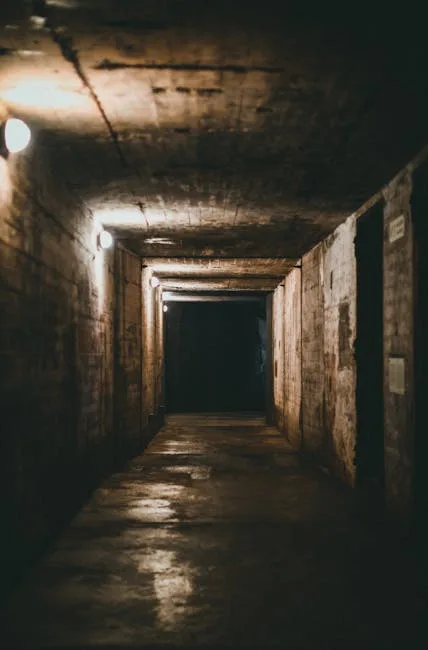
The average homeowner walks through their basement entryway dozens of times a week without ever applying a single basement entryway idea to the space — and it shows in every square foot below. If you’ve been searching for basement entryway ideas that actually account for how these spaces work in real homes, the first thing to understand is why this specific threshold gets ignored while every other entry in the house gets attention.
Quick Answer
The average homeowner walks through their basement entryway dozens of times a week and has never once made a single design decision about it — and it shows in every square foot of the space below.
I know this because I spent eleven years walking into other people’s homes and doing the quiet triage designers do in the first thirty seconds. The basement entry was almost always the most honest part of the house. Not because people didn’t care — but because it was the first thing they stopped seeing. It became invisible by repetition, and invisible spaces don’t get budgets. They get boxes of holiday decorations stacked against unpainted drywall and a single bare bulb hanging from a junction box that someone swore was temporary in 2009.
This article is not about turning your basement stairwell into a showroom. It’s about treating it as what it actually is — one of the highest-traffic thresholds in your home — and making decisions that match that reality.
Why Most Basement Entryways Feel Like an Afterthought (And What That Costs You)
In This Article
- Why Most Basement Entryways Feel Like an Afterthought (And What That Costs You)
- Interior vs. Exterior Basement Entry: The Design Split Everyone Ignores
- What to Do With Open Space in a Basement Entry Zone
- Lighting in a Basement Entry: The One Variable That Changes Everything Else
- The Material Choices That Hold Up in a High-Traffic Basement Entry
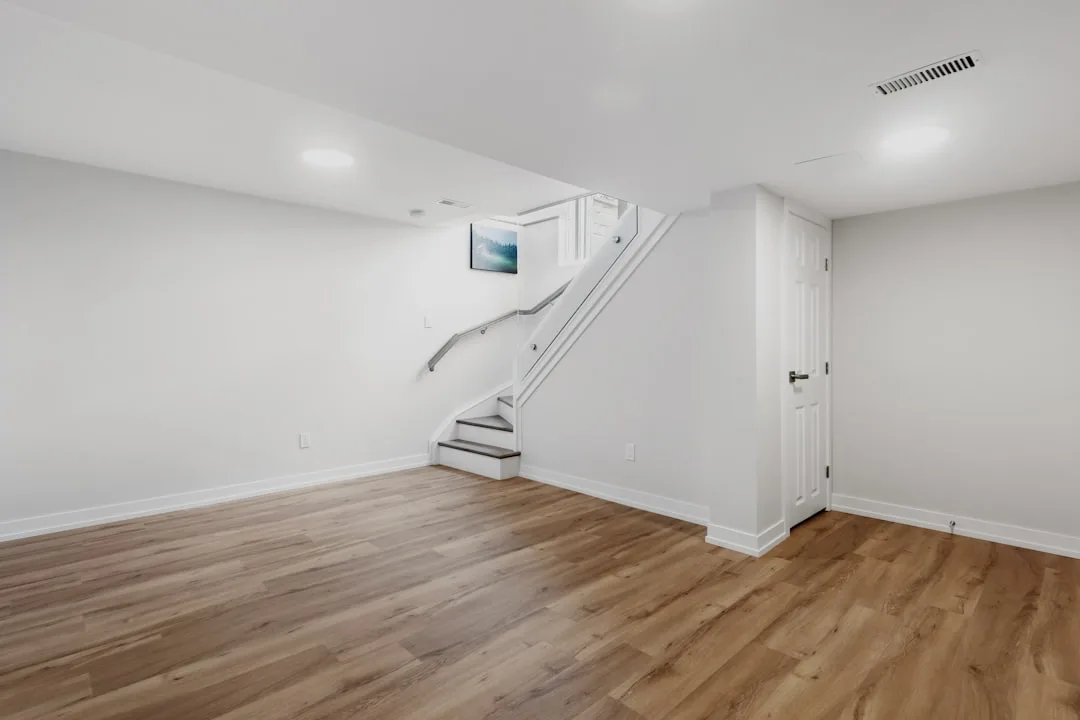
Families with basements use those stairs constantly. Kids moving between floors, laundry runs, workout sessions, guests heading to a rec room or bar area — the basement entry absorbs enormous foot traffic while receiving almost none of the design attention given to a front foyer or even a hallway bathroom. The result is a space that communicates something nobody intends to communicate: that everything below the first floor is provisional, unfinished, and less-than.
That psychological effect is real. When people walk into a space that drops in material quality — rough drywall after smooth plaster, bare concrete after hardwood, a flickering fluorescent after recessed lighting — they register the shift before they can name it. The ‘downgrade’ effect at a basement entry sets the tone for how the entire basement feels, regardless of how much money was spent finishing the actual rooms below.
There’s a financial argument here too, not just an aesthetic one. According to the National Association of Realtors, finished basement spaces that include a defined entry point recoup up to 70% of renovation costs at resale — and that figure drops when the entry itself reads as neglected. Buyers don’t tour basements the way they tour kitchens. They glance down the stairs, make a judgment in about four seconds, and move on. What they see at the top of those stairs — and in the first few feet of descent — shapes the entire impression.
Three specific deficiencies appear, almost without exception, in basement entries that feel like afterthoughts. There’s no natural light, no defined flooring transition, and no ceiling height accommodation — meaning the fixtures and finishes were chosen without any reference to the compressed vertical space that characterizes almost every basement stairwell. These aren’t small oversights. They’re the three variables that dominate first impressions in any enclosed entry.
Actionable takeaway: Before spending a dollar, photograph your basement entry from the top of the stairs and from the bottom landing. You will immediately see what a guest sees — and it’s almost certainly not what you’ve been walking past for years.
Interior vs. Exterior Basement Entry: The Design Split Everyone Ignores
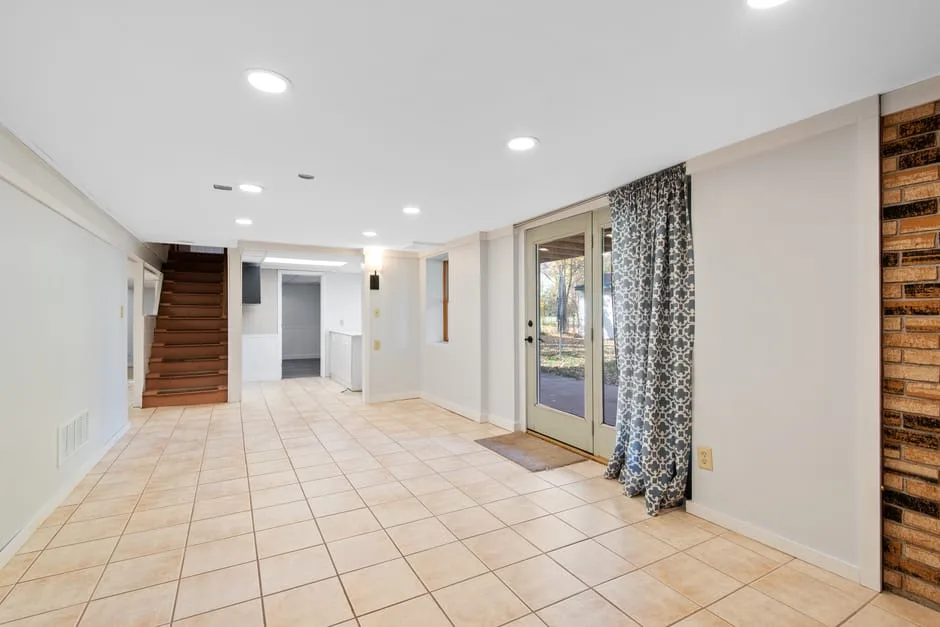
Most basement entryway ideas content — and I’ve read enough of it to have genuine opinions — treats every basement entry as though it’s the same situation. It isn’t. The solutions that work for an interior stairwell descending from a main floor are completely wrong for a bulkhead door opening from the backyard. Applying the same advice to both is how people end up with beautiful indoor rugs rotting at the base of exterior stairs.
There are three distinct entry types, and they require different frameworks entirely.
Interior stairwell entries — the most common configuration — descend from a door off the kitchen, hallway, or garage. These need vertical design thinking because the visual field is narrow and tall. Wall treatment matters enormously here. So does stair riser design, overhead lighting sequenced down the stairwell, and a defined landing zone at the bottom that signals arrival rather than confusion.
Exterior entries — bulkhead doors, walk-up areaway stairs, or ground-level walk-out doors — function more like a service entrance and need to be treated accordingly. Weatherproofing, drainage consideration, and a hard transition from outdoor to indoor materials are non-negotiable. This is where I’ve seen the most expensive mistakes: someone installs a beautiful LVP landing without addressing the fact that water pools at the base of their areaway stairs every spring. The floor was ruined in fourteen months.
Approximately 30% of U.S. homes have a walk-out or walk-up exterior basement entrance — yet the overwhelming majority of online content focuses on interior stairwells only. That’s a significant gap for a significant portion of homeowners.
Walk-out and split-level entries are the hybrid case, and they deserve to be treated as a true secondary front door. This means:
- Coat hooks or a wall-mounted rack rated for outdoor gear
- A bench or low shelf for shoes — not decorative shoes, actual muddy ones
- Weather-resistant flooring that handles tracked-in moisture
- A defined threshold mat with drainage backing
- Lighting that works as navigation, not just ambiance
Knowing which entry type you’re working with before purchasing any fixture or furniture is the single most important decision in this process. Everything else follows from it.
Actionable takeaway: Identify your entry type this week — interior, exterior, or hybrid — and don’t purchase a single item until you’ve done that categorization. It will eliminate at least half the mistakes before they happen.
What to Do With Open Space in a Basement Entry Zone
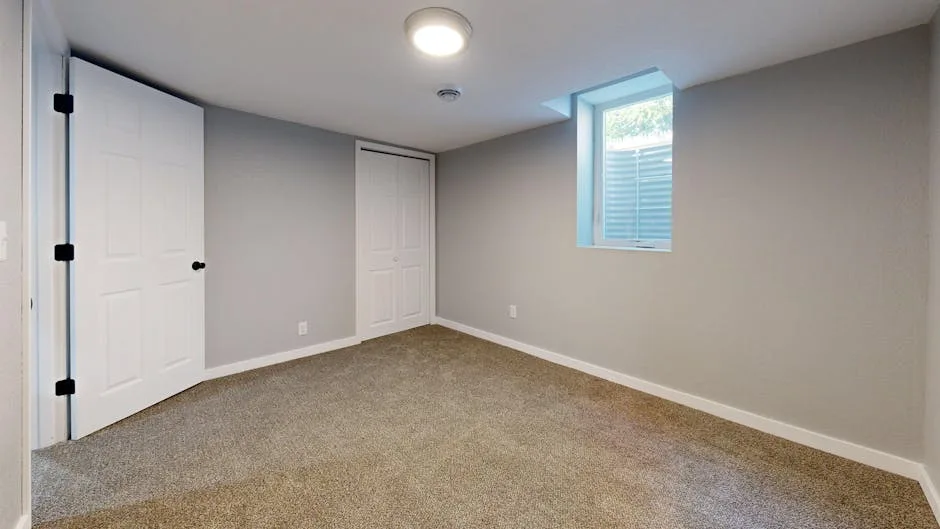
Open space in a basement entry tends to get treated one of two ways: ignored completely or filled with whatever didn’t fit elsewhere in the house. Neither approach produces anything livable. What actually works is the concept of micro-zones — deliberately defined areas within a small footprint that each serve a specific function, even if those areas are only three feet wide.
Every basement entry, regardless of size, benefits from three defined elements: a drop zone, a visual anchor, and a flooring transition. The drop zone is functional — hooks, a tray for keys, a bench if the square footage allows it. The visual anchor is what your eye lands on when you reach the bottom of the stairs — a mirror, a piece of art, a statement light fixture. The flooring transition signals that you’ve arrived somewhere specific, not just stopped falling downward.
For entries with a landing wider than six feet, a narrow console table or floating shelf along one wall adds storage and surface area without eating into the traffic path. The key measurement is fourteen inches of depth or less — anything deeper and it starts functioning as a barrier rather than a surface. Pair it with a pendant or wall sconce mounted at eye level rather than ceiling height, and the vertical compression of a low-ceiling basement entry suddenly reads as intentional rather than cramped.
For tighter entries — landings under five feet wide — the console table disappears and the drop zone becomes vertical: two to three wall-mounted hooks at different heights, a narrow floating shelf above them for keys and mail, and a single piece of art or a mirror below the shelf line. This arrangement keeps the floor clear, which matters more in a small entry than almost any other design decision. A clear floor reads as larger. A floor with even one piece of furniture sitting on it reads as cluttered.
The flooring transition deserves its own attention because it’s the most skipped element in most basement entryway ideas. People either continue whatever flooring is in the basement up the stairs and call it done, or they leave bare concrete at the landing and wonder why the space feels unresolved. The answer is a defined material change at the exact point where the last stair tread meets the landing — even if both materials are similar in color. A border tile, a change from LVP to a patterned tile, or even a well-chosen area rug anchored under a console table leg all accomplish the same thing: they tell your brain that you’ve arrived somewhere.
Actionable takeaway: Measure your landing width before buying anything. Under five feet means vertical-only storage solutions. Over six feet opens up surface options. Between five and six feet is the zone where a bench — ideally with under-seat storage — becomes your best single investment.
Lighting in a Basement Entry: The One Variable That Changes Everything Else
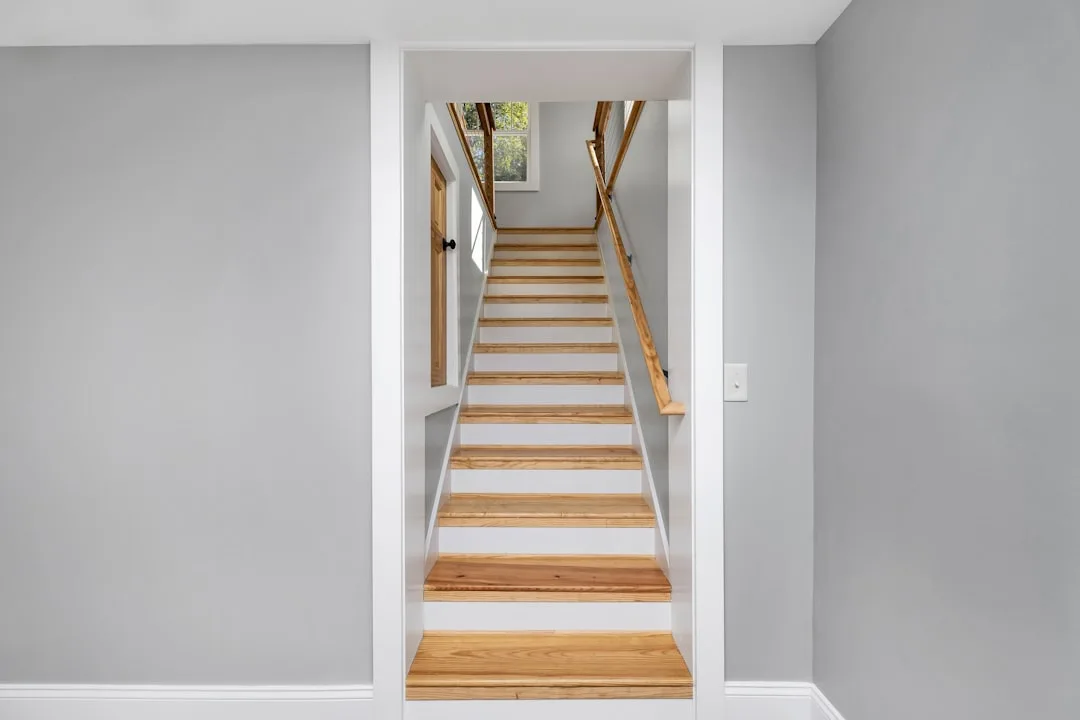
Bad lighting in a basement entry doesn’t just make the space look dim. It makes the space feel unsafe, which is a very different problem. Stairwells are inherently higher-risk zones — uneven surfaces, directional descent, often no natural light source — and the lighting has to solve for navigation first, atmosphere second.
The most common mistake is a single overhead fixture centered on the landing. This creates one bright spot and leaves the stair treads themselves in shadow, which is exactly backwards from a safety standpoint. What you want is light sequenced along the descent: a fixture at the top of the stairs, some form of tread lighting or wall-mounted sconces at mid-stair height, and a fixture at the landing that marks arrival.
Tread lighting is the most underused tool in basement entryway ideas. Recessed LED step lights mounted into the stair risers cost between $15 and $40 per tread, require only low-voltage wiring, and solve the shadow problem completely. They’re also visible in the peripheral vision of someone descending in the dark — which matters when someone is carrying laundry at midnight and doesn’t want to turn on a bright overhead light that wakes up the whole house.
For ceiling height under seven feet at the landing — which covers most basement entries — flush-mount fixtures are not just acceptable, they’re correct. A pendant hung in a seven-foot ceiling isn’t atmospheric, it’s a head hazard. Recessed cans or a quality flush-mount with a warm color temperature (2700K to 3000K) will do more for the feel of the space than almost any other single purchase.
Natural light, where it exists — a small egress window or a glass panel in a walk-out door — should be treated as the primary light source and everything artificial should be designed around it, not in competition with it. If you have a window at the landing, a light-reflecting mirror mounted opposite it doubles the perceived brightness without adding a single fixture.
The Material Choices That Hold Up in a High-Traffic Basement Entry
Basements move. Not metaphorically — literally. Concrete slabs shift seasonally, humidity levels fluctuate more dramatically than on upper floors, and the temperature differential between a finished basement and an attached garage entry can cause expansion and contraction in flooring materials that destroys installations that would last decades on a main floor.
The flooring materials that consistently perform well in basement entries, ranked by durability in high-moisture conditions:
- Porcelain tile — the most durable option, completely moisture-resistant, handles temperature variation without movement. The downside is cost and the cold underfoot factor, which matters in entries where people remove shoes.
- Luxury vinyl plank (LVP) with a rigid core — not standard LVP, specifically rigid core (also called SPC or WPC). Flexible LVP will telegraph every imperfection in a concrete subfloor and eventually buckle in moisture-prone areas. Rigid core won’t.
- Sealed concrete — the most practical choice for exterior entries and high-moisture situations. A good epoxy or polyurethane seal over existing concrete costs a fraction of new flooring and performs better than almost anything laid on top of a problematic slab.
- Engineered hardwood — acceptable in climate-controlled interior entries with stable humidity, not acceptable near exterior doors or in entries adjacent to unfinished space.
For walls, paint finish matters more than color choice. Eggshell or satin finish in a basement entry holds up to scuffs, cleans easily, and reflects slightly more light than flat paint — which is worth something in a space that’s usually light-starved. Matte and flat finishes look beautiful in photographs and terrible after six months of actual use in a high-traffic entry.
Actionable takeaway: Before selecting any flooring for a basement entry, do a moisture test. Tape a twelve-inch square of plastic sheeting to your concrete slab, seal all four edges, and wait 24 hours. Moisture beading under the plastic means you need a moisture barrier or a fully waterproof flooring choice, full stop.
Frequently Asked Questions About Basement Entryway Ideas
What’s the fastest basement entryway idea that actually makes a visible difference?
Lighting. Specifically, replacing a single overhead fixture with recessed step lights on the stair treads and a warm-toned flush mount at the landing. You can complete this in a weekend for under $200 in materials, and the difference in how the space reads — both in safety and atmosphere — is immediate. Paint is the second fastest, but only if you also change the finish from flat to satin.
How do I make a basement entry feel less claustrophobic without raising the ceiling?
Three things work: a mirror mounted at eye level at the landing (reflects depth), a vertical stripe of wallpaper or paint treatment on the stairwell wall (draws the eye upward rather than inward), and clearing the floor entirely. Furniture on the floor shrinks a space. Furniture on the wall — hooks, shelves, mounted racks — preserves the perception of floor area.
What’s the best flooring for a basement entry that gets wet from an exterior door?
Sealed concrete or porcelain tile, full stop. Rigid-core LVP is acceptable if you use a drainage-backing threshold mat directly inside the door and address any pooling issues outside before installation. Never use standard LVP, engineered hardwood, or laminate within three feet of an exterior basement door in a climate with freeze-thaw cycles.
How much should a functional basement entryway makeover actually cost?
A fully functional, well-designed basement entry can be done for $400 to $800 in most cases — that covers new lighting, a coat of paint, basic wall-mounted storage, and a quality threshold mat. The number climbs to $1,500 to $3,000 if you’re replacing flooring or adding built-in bench seating. Full custom millwork and tile work can reach $5,000 to $8,000, but that level of investment makes sense only if the basement itself has been finished to a comparable standard.
Do basement entryway ideas work differently in older homes versus new construction?
Yes, in one important way: older homes frequently have steeper stair pitch and narrower tread width in basement stairwells, which limits what you can do with stair riser treatments and tread lighting. In a stairwell with less than nine inches of tread depth, recessed step lights may not fit without custom routing. Surface-mounted LED strip lighting along the stringer — the diagonal side board of the staircase — solves this and costs about the same. The design principles are identical; the execution adjusts to the geometry.
What’s the fastest basement entryway idea that actually makes a visible difference?
Lighting. Specifically, replacing a single overhead fixture with recessed step lights on the stair treads and a warm-toned flush mount at the landing. You can complete this in a weekend for under $200 in materials, and the difference in how the space reads — both in safety and atmosphere — is immediate. Paint is the second fastest, but only if you also change the finish from flat to satin.
How do I make a basement entry feel less claustrophobic without raising the ceiling?
Three things work: a mirror mounted at eye level at the landing (reflects depth), a vertical stripe of wallpaper or paint treatment on the stairwell wall (draws the eye upward rather than inward), and clearing the floor entirely. Furniture on the floor shrinks a space. Furniture on the wall — hooks, shelves, mounted racks — preserves the perception of floor area.
What’s the best flooring for a basement entry that gets wet from an exterior door?
Sealed concrete or porcelain tile, full stop. Rigid-core LVP is acceptable if you use a drainage-backing threshold mat directly inside the door and address any pooling issues outside before installation. Never use standard LVP, engineered hardwood, or laminate within three feet of an exterior basement door in a climate with freeze-thaw cycles.
How much should a functional basement entryway makeover actually cost?
A fully functional, well-designed basement entry can be done for $400 to $800 in most cases — that covers new lighting, a coat of paint, basic wall-mounted storage, and a quality threshold mat. The number climbs to $1,500 to $3,000 if you’re replacing flooring or adding built-in bench seating. Full custom millwork and tile work can reach $5,000 to $8,000, but that level of investment makes sense only if the basement itself has been finished to a comparable standard.
Do basement entryway ideas work differently in older homes versus new construction?
Yes, in one important way: older homes frequently have steeper stair pitch and narrower tread width in basement stairwells, which limits what you can do with stair riser treatments and tread lighting. In a stairwell with less than nine inches of tread depth, recessed step lights may not fit without custom routing. Surface-mounted LED strip lighting along the stringer — the diagonal side board of the staircase — solves this and costs about the same. The design principles are identical; the execution adjusts to the geometry.