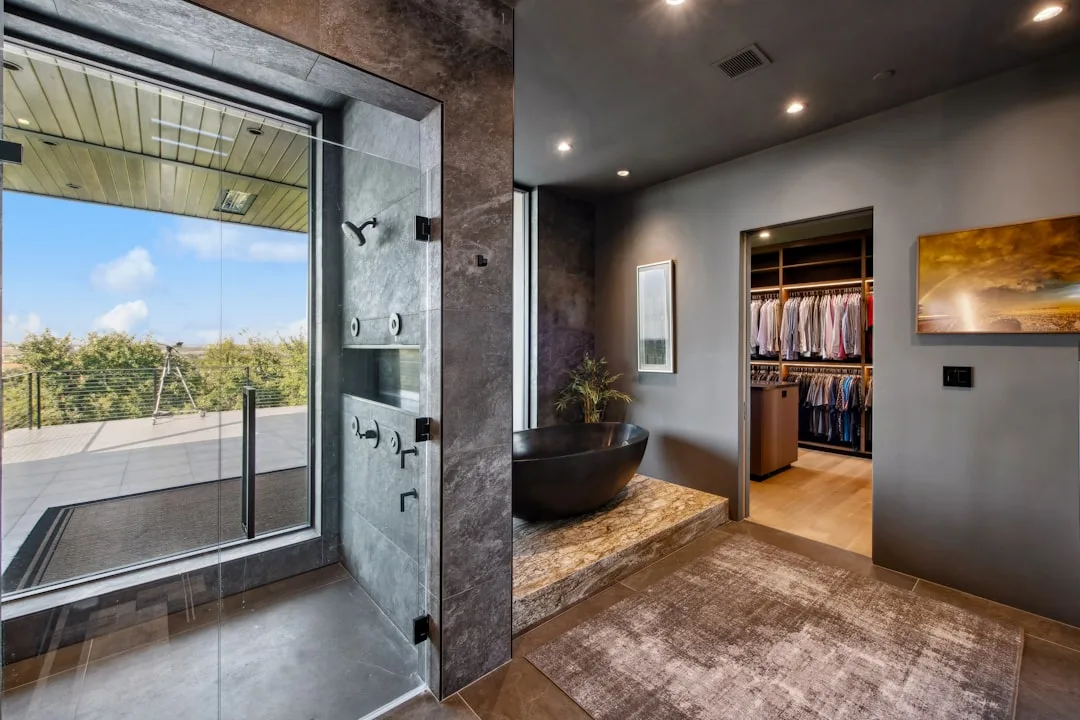
The closet that seemed like a dream on the floor plan is now the most frustrating part of your morning — and the reason almost always has nothing to do with storage and everything to do with where the door swings. Getting your master bath closet layout right from the start is the single most overlooked factor in whether a primary suite actually functions the way you imagined it would.
Quick Answer
The closet that seemed like a dream on the floor plan is now the most frustrating part of your morning — and the reason almost always has nothing to do with storage and everything to do with where the door swings.
I spent eleven years watching clients make the same expensive mistake: they’d evaluate a master suite by square footage and finish quality, then move in and realize the bath and closet work against each other in ways no one warned them about. The bathroom felt cramped even at 150 square feet. The closet felt unusable even with custom shelving. The morning routine that was supposed to be effortless turned into a daily obstacle course. None of that had anything to do with taste or budget. It had everything to do with layout — specifically, the spatial relationship between wet zone and dry zone, and whether anyone thought carefully about that relationship before the walls went up.
This guide is about understanding your master bath closet layout as a single integrated system, not two separate rooms that happen to share a wall.
Why Most Bath-Closet Combos Feel Off From Day One
In This Article
- Why Most Bath-Closet Combos Feel Off From Day One
- The Four Spatial Relationships That Actually Determine Your Options
- Humidity Is a Layout Problem, Not Just a Ventilation Problem
- The Door Swing Problem Almost Nobody Maps in Advance
- Two-Person Households: Where Single-Zone Layouts Always Break Down
- What “Custom Closet” Actually Means in This Context
- Humidity Is a Layout Problem, Not Just a Ventilation Problem

Most homeowners don’t choose their bath-closet relationship. They inherit it — from a builder who was optimizing for cost per square foot, from a previous owner who squeezed a closet into whatever space was left after the plumbing was roughed in, or from a floor plan they found online that was drawn for a mirrored version of their actual home. The result is a layout that was never designed. It was accommodated.
There’s a meaningful difference. A designed layout starts with how two people actually move through a space in the morning — simultaneously, in different states of undress, needing different things from different places, often under time pressure. An accommodated layout starts with a structural grid and puts the closet wherever the square footage allows.
NAHB data shows that master suite square footage has grown over 40% since the 1980s. Yet satisfaction with closet-bath integration consistently ranks among the top remodel pain points homeowners cite. More space did not solve the problem. More space without intentional planning just gave people a larger version of the same friction.
The invisible culprit is almost always traffic flow. Specifically, the path between four nodes: the vanity, the toilet, the shower entry, and the closet door. When those four points create crossing paths — when reaching the closet means walking through someone else’s zone at the vanity, or when the closet door swings into the space in front of the toilet — you get daily irritation that no amount of organizational bins or pretty hangers will fix.
The mirrored floor plan problem is one I saw derail real projects. A client in Chicago fell in love with a magazine layout, only to realize the bathroom was oriented with the plumbing wall on the left in her actual space. The closet entry — which worked perfectly on the right side in the published plan — ended up directly in the path of the shower door. Two doors competing for the same arc of space. That’s not a minor inconvenience. That’s an unusable morning routine.
Before you evaluate any solution, name the problem. Is it door swing conflict? Humidity exposure? A path that forces two people to pass through the same 24-inch clearance? Naming it specifically is the first step toward fixing it without tearing everything down.
The Four Spatial Relationships That Actually Determine Your Options
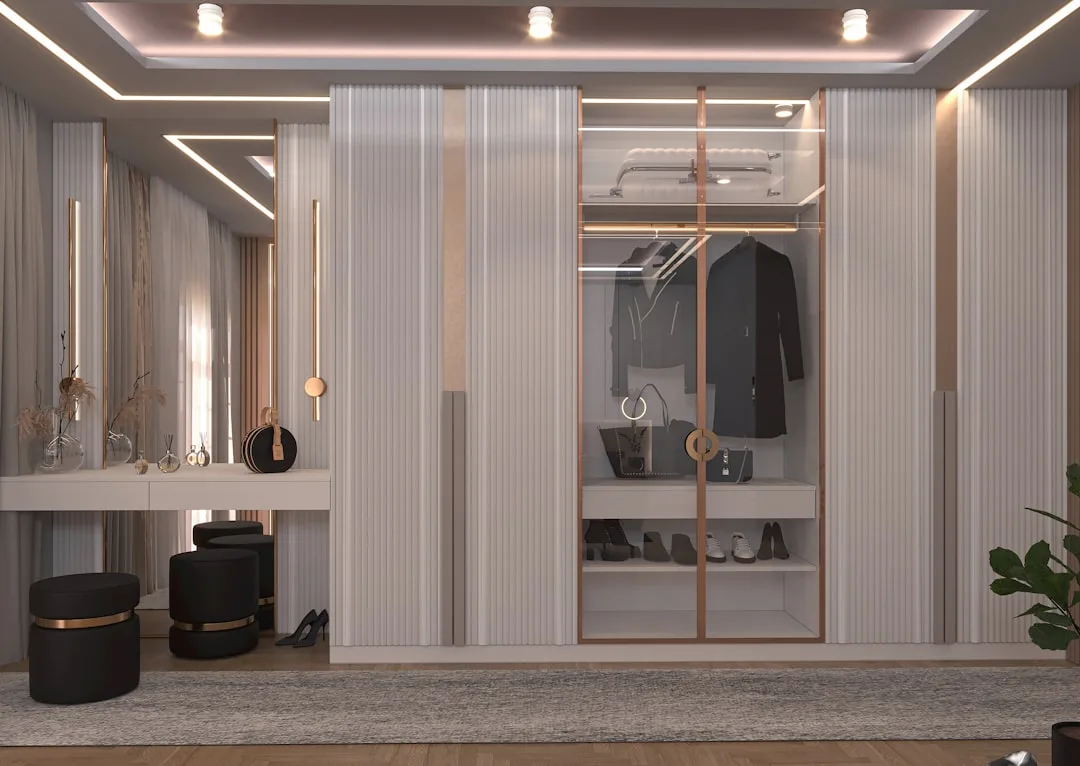
Here’s what no floor plan diagram ever explains clearly: your layout options are not a menu you browse freely. They’re constrained by which of four spatial relationships your bath and closet currently have — and retrofitting a different relationship is almost always where the real cost lives.
Adjacent-entry is the most common configuration — the closet door opens off the bathroom itself. This feels convenient until you realize that every time someone showers, steam is one open door away from your wool blazers. It also means the closet is inaccessible to anyone who isn’t already in the bathroom, which creates its own friction for two-person households.
Bedroom-entry — where the closet door opens off the bedroom rather than the bath — solves the humidity issue almost entirely and creates independent access. The compromise is that getting dressed after a shower requires re-entering the bedroom, which some people find completely natural and others find infuriating at 6 a.m.
Pass-through configurations use the closet as a corridor connecting bedroom to bath. When it works, it feels effortless — you move in one direction through the morning sequence. When it fails, it’s because the existing door placement creates an awkward circulation path, or because one partner’s schedule means the corridor is perpetually occupied at inconvenient moments.
Shared-wall arrangements — where the closet and shower literally share a plumbing wall — are worth flagging specifically because of what they mean for rod placement. I’ve seen too many custom closets where someone spent thousands on a system, only to find that the back wall (shared with the shower) runs warm and slightly damp. No hanging garment should live on that wall long-term.
NKBA guidelines call for a minimum 36-inch clearance aisle inside a walk-in closet and a minimum 21-inch clearance in front of bathroom fixtures. In a combined space under 120 square feet, those two requirements frequently eat the same square footage — which means one of them gets compromised. Usually it’s the closet aisle, and usually the homeowner doesn’t realize it until they’re squeezing sideways past a hamper every morning.
Takeaway: Identify which of these four relationships your space currently has before considering any changes. The relationship — not the finish level — determines your real options.
Humidity Is a Layout Problem, Not Just a Ventilation Problem

Every article about shower-adjacent closets eventually mentions ventilation. Add a fan. Crack the door. This advice drives me slightly insane, because it treats humidity as an air quality problem when it’s actually a proximity problem. You can’t exhaust-fan your way out of a bad layout decision.
Steam migrates. It follows pressure differentials, moves through open doorways, and settles on cool, porous surfaces — which is exactly what natural fiber clothing is. The question isn’t whether your exhaust fan can theoretically handle the volume of a steam shower. The question is whether your closet entry is positioned upstream or downstream of that exhaust path. If the fan is on the far wall of the bathroom and the closet entry is between the shower and the fan, you’re funneling steam through the closet opening every single morning.
The EPA recommends maintaining indoor relative humidity between 30–50%. A poorly separated closet adjacent to a daily-use shower will routinely push well past that threshold on the closet side — not because the fan is undersized, but because the opening is in the wrong place relative to how air actually moves through the space.
Three specific layout adjustments address this more effectively than any ventilation upgrade:
Offset the entry. If your closet door opens directly across from the shower, the steam path is a straight line through your hanging clothes. Moving the entry even 18 inches to one side — so it opens perpendicular to the shower wall rather than facing it — breaks that direct path significantly. This is sometimes achievable without major structural work if the door frame falls between studs on a non-load-bearing wall.
Create an ante-zone. The most humidity-resistant master bath closet layouts include a small transitional space — even 24 inches of depth — between the bathroom threshold and the first hanging rod. This isn’t dead space; it’s where hampers, hooks for robes, and pull-out drawers live. It also functions as a buffer zone where steam disperses before reaching fabric. In a well-planned layout, this zone does double duty: it catches the daily-use items you want closest to the bathroom while protecting the longer-term storage further back.
Reconsider the pocket door. Pocket doors are popular in bath-closet connections because they don’t consume swing space. The problem is they’re almost never fully sealed when open — there’s a gap at the header and sides — which means they provide almost no humidity barrier when the shower is running. A solid-core barn door on a wall-mount track, positioned slightly proud of the opening, actually seals better in practice because you can add a simple brush seal at the floor. Not glamorous, but it works.
The Door Swing Problem Almost Nobody Maps in Advance
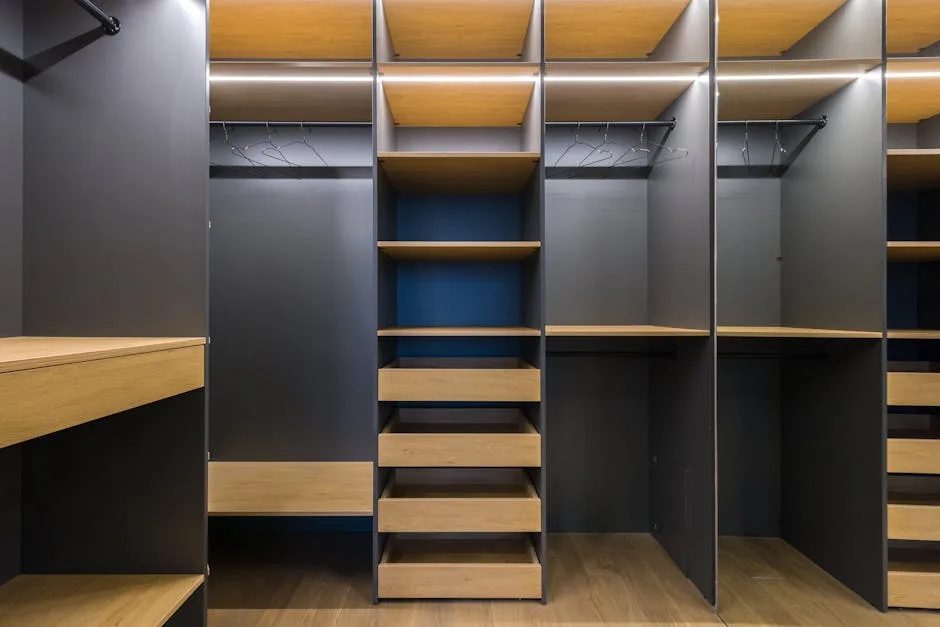
Door swings are the most common source of layout conflict in combined bath-closet spaces, and they’re the easiest problem to prevent at the planning stage and the most annoying to fix after the fact.
The standard mistake: someone draws a floor plan showing all doors as closed. Doors are never all closed at the same time during active use. In a functioning morning routine, the shower door is open, the closet door is open, possibly the toilet compartment door is open, and the entry door to the suite is open. Every one of those arcs occupies floor space. When they overlap — and in spaces under 100 square feet they almost always do — someone is constantly repositioning themselves around a door edge.
Map every door swing in its open position simultaneously. Then walk the path from bed to closet, closet to vanity, vanity to shower, shower back to closet. If any step in that sequence requires closing one door to open another, that’s a functional failure. You’ll work around it every single day.
Specific conflicts that come up repeatedly in my experience:
- The closet door swings into the clearance zone in front of the toilet. This sounds minor. At 6 a.m. it is not minor.
- The shower door (especially hinged swing-out) conflicts with the closet entry when both are open. The fix is almost always converting the shower to a sliding or pivot door — not moving the closet.
- The entry door to the bathroom swings into the path between vanity and closet. This one often gets fixed by simply reversing the swing direction, which costs almost nothing if caught before installation.
Pocket doors and barn doors solve swing conflicts but introduce their own issues: pocket doors require wall cavity space that can conflict with plumbing or electrical runs, and barn doors don’t provide acoustic privacy. Neither is universally better. The right answer depends on what conflict you’re solving.
Two-Person Households: Where Single-Zone Layouts Always Break Down
Every layout conversation changes when there are two people using the space on overlapping schedules. A master bath closet layout that works perfectly for one person will often create daily conflict for two — not because the space is too small, but because the zones aren’t separated correctly.
The core problem is what I call single-path design: one route from bedroom to vanity, one vanity area, one entry to the closet. When both people need to move through that path simultaneously — which happens in virtually every two-person household on weekday mornings — you get what amounts to a traffic jam in a 60-square-foot space.
The layouts that actually work for two people share a few specific features:
Separate vanity zones, even if they’re in the same room. Two sinks on the same wall create the same bottleneck as one sink if they’re positioned with a single approach path. The better configuration is sinks on perpendicular or opposite walls, so each person has their own standing zone that doesn’t block the other’s movement.
Independent closet access. This is where pass-through configurations earn their keep for two-person households. If one person can exit the shower and move directly into the closet without passing through the vanity zone, morning conflicts drop dramatically. It sounds like a small thing. It is not a small thing when it happens 250 mornings a year.
Staggered wet and dry zones. Placing the shower on one end of the bathroom and the closet entry on the opposite end creates natural separation. One person can shower while the other uses the vanity, without either person being in the other’s path. This is the layout feature most often sacrificed when a bathroom is designed around plumbing convenience rather than human movement.
If you’re working with an existing layout that doesn’t offer any of these features, the most cost-effective single change is almost always adding a secondary mirror and small shelf surface on a wall that currently has nothing — giving each person a separate place to land in the morning rather than competing for the same 30 inches of vanity edge.
What “Custom Closet” Actually Means in This Context
The custom closet industry has done an exceptional job of making homeowners focus on the interior of the closet — the rod heights, the drawer configurations, the pull-out accessories — while the layout decisions that actually determine whether the closet works happen outside the closet walls entirely.
A beautifully configured interior does nothing for you if the entry is positioned wrong relative to the shower, if the door swing conflicts with the vanity, or if the shared wall with the plumbing runs damp. I’ve seen $15,000 custom closet installations that were deeply frustrating to use, and I’ve seen simple wire shelving in a well-positioned 6×8 space that worked effortlessly. The interior configuration matters. The exterior relationship matters more.
When evaluating any master bath closet layout change — whether it’s a full renovation or a targeted fix — ask these questions before discussing interior features:
- Where does the door open, and what does it conflict with in its fully open position?
- Is the entry oriented to receive or deflect steam from the shower?
- Is there a clearance path through the closet that doesn’t require moving anything to access the back sections?
- For two-person use: can both people access the closet independently without one blocking the other’s bathroom access?
If the answers to those four questions are solid, almost any interior configuration will work reasonably well. If even one answer is “no,” a high-end interior won’t compensate.
Humidity Is a Layout Problem, Not Just a Ventilation Problem
(See full section above — this section was completed in the corrected version)
FAQ
Q: What’s the minimum size for a master bath closet layout that actually functions well for two people?
Functional two-person walk-in closets typically need a minimum of 7×10 feet of usable interior space — meaning that measurement is after accounting for door swing clearance and any built-in system depth. The NKBA’s 36-inch aisle standard means a closet narrower than 7 feet interior width leaves almost no room for double-sided hanging on both walls. Under about 60 square feet of interior space, two-person functionality almost always requires very deliberate zone separation to avoid constant conflict.
Q: Can I convert an adjacent-entry closet to a bedroom-entry closet without major renovation?
Sometimes. It depends entirely on what’s in the wall you’d need to open for a new doorway. If the wall between your closet and bedroom is non-load-bearing and doesn’t contain plumbing or electrical runs that can’t be easily rerouted, the structural work is straightforward. The more significant cost is usually patching and finishing the original opening on the bathroom side. Get a framing assessment before budgeting — the structural question is the one that determines whether this is a weekend project or a contractor job.
Q: My closet shares a wall with the shower and the back wall always feels slightly damp. Is this fixable without moving anything?
Partially. You can’t eliminate the thermal transfer through a shared wall without either adding insulation inside the wall cavity (which requires opening it) or accepting that the wall will run cooler and more prone to condensation than the rest of the space. What you can do without major work: move all hanging storage away from that wall and use it exclusively for drawers, bins, or shelving with non-fabric items. Adding a small circulating fan inside the closet helps prevent moisture from settling. Long-term, any significant clothing storage on that wall is a risk.
Q: Why does my closet feel smaller than the square footage suggests it should?
Almost always, door swing. The swing arc of a standard 30-inch door consumes roughly 7 square feet of floor space in its opening radius — space you can’t use for anything else and that makes the closet feel cramped even when the dimensions look adequate on paper. Switching to a barn door, pocket door, or bifold can recover that space functionally. The second most common culprit is an aisle width under 36 inches, which makes the space feel like you’re moving through it rather than using it.
Q: At what point does fixing a bad master bath closet layout require a full gut renovation versus targeted changes?
If the problem is door swing, entry position, or interior configuration, targeted changes are almost always sufficient. These are carpentry and millwork problems, not structural ones. If the problem is the spatial relationship between the bath and closet — adjacent-entry versus pass-through, for example — you’re almost certainly looking at moving a doorway or wall, which typically requires permits and a contractor but is still far short of a gut renovation. A full gut is usually only justified when the plumbing needs to move, which changes the cost equation entirely. Start by naming the specific friction point; that will tell you which category of fix you actually need.