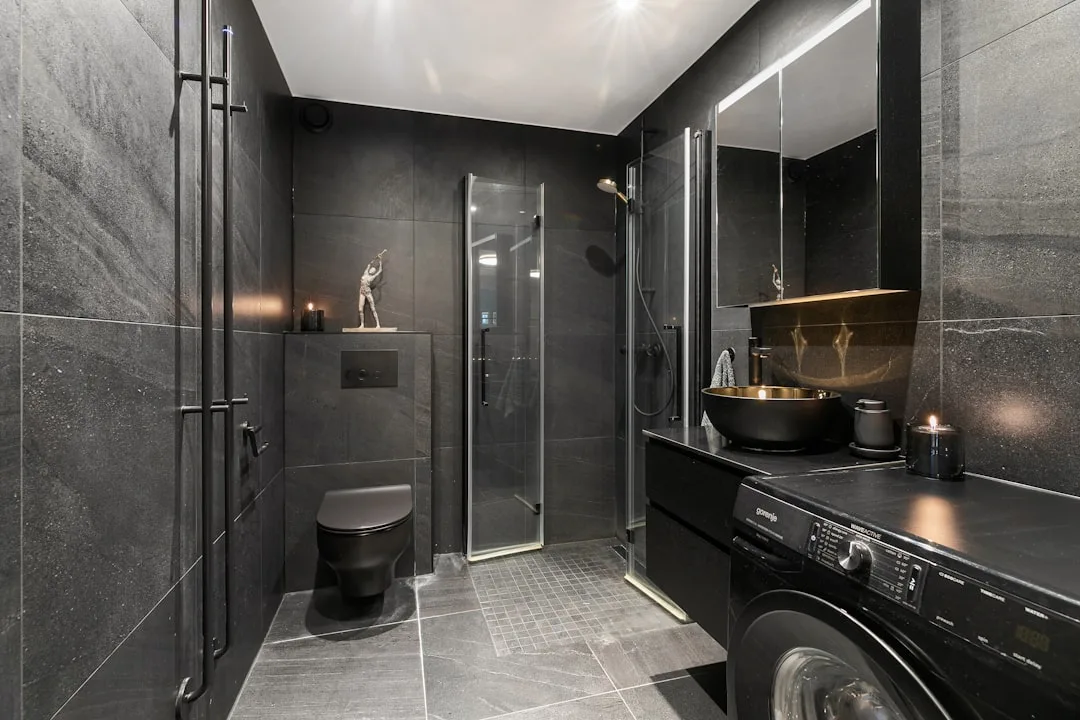
The average American bathroom is smaller than a parking space — yet most storage advice assumes you have room to spare. The tips circulating across every home improvement site were written, implicitly, for bathrooms that already have somewhere to put things. If your vanity zone is measuring under 50 square feet and you’re stacking products on the back of the toilet tank because you have nowhere else to put them, generic advice isn’t just unhelpful. It actively wastes your time. Effective bathroom cabinet storage in a small space requires a fundamentally different approach than what most guides offer — one built around efficiency per square inch rather than aesthetics first. The nine strategies below came directly out of real constraints: tight rooms, limited budgets, and walls that couldn’t be moved.
Quick Answer
The average American bathroom is smaller than a parking space — yet most storage advice assumes you have room to spare.
What follows is a different approach. Built from real project experience — including more than a few setups I’d do differently now — this guide treats your tight bathroom not as a problem to apologize for, but as a specific spatial condition that has specific solutions.
Why Most Tight Bathrooms Stay Cluttered (It’s Not a Size Problem)
In This Article
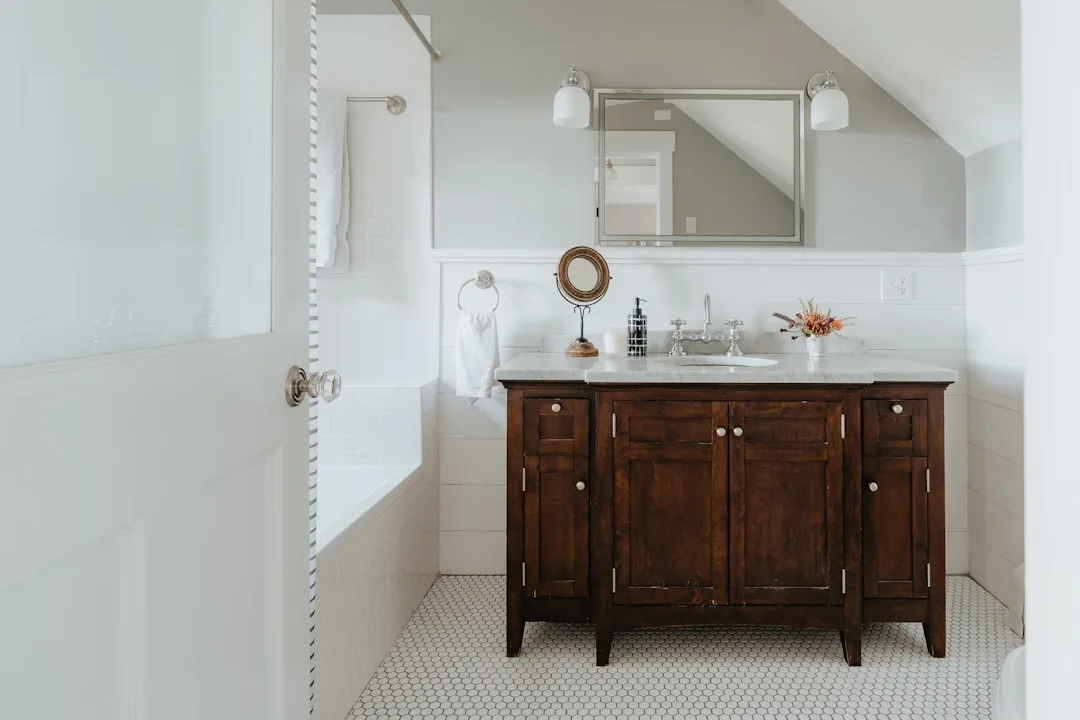
Most people blame the square footage. The bathroom is too small, full stop, and there’s nothing to be done except tolerate the chaos or move. I spent years watching clients in 40-square-foot bathrooms feel defeated before we ever touched a single cabinet — and almost every time, the problem wasn’t the room. It was the planning that happened before anything was purchased.
The real issue is that people add storage without first auditing what actually needs to live in the bathroom. Bathrooms under 50 square feet account for the majority of residential bathroom remodels, yet most storage products are designed for standard 5×8-foot layouts — roughly 80 square feet — that include a dedicated linen closet, a double vanity, and generous wall clearance. The National Kitchen and Bath Association has noted that bathrooms under 50 sq ft represent over 60% of all residential bathroom remodel projects. The products filling big-box shelves were not designed for this majority.
Before you buy anything, separate your items into two categories. Daily-use items — toothbrush, face wash, whatever you touch every morning and night — and occasional-use items — the backup razors, the box of cotton rounds you’re halfway through, the dry shampoo you use twice a month. Most people store everything at the same level of accessibility, which means the space gets consumed by items that don’t need prime real estate.
This is zone thinking. It isn’t complicated, but almost nobody does it before walking into a hardware store.
- Daily zone: Counter height, first drawer, front of any cabinet
- Weekly zone: Mid-shelf, back of vanity cabinet
- Occasional zone: Above eye level, under-sink rear, secondary cabinet
The single most useful thing you can do before touching any storage product is spend fifteen minutes pulling everything out of your bathroom and asking whether each item actually belongs there. You may discover you’re storing a month’s supply of something you use once a week. That discovery — not a new shelf — is what solves the clutter.
A few items that consistently show up in bathroom audits but don’t belong there:
- Backup paper towels or toilet paper beyond a two-roll reserve
- Medications that should be stored in a cool, dry location — not a steam-filled room
- Hair tools used less than once a week (a bedroom hook or drawer works just as well)
- Full-size backup product bottles that belong under a sink elsewhere in the home
- Decorative items that consume counter space without serving a daily function
Removing these categories before buying a single organizer frees up more usable space than most products add. It’s the step almost every storage guide skips because it doesn’t involve purchasing anything.
Actionable takeaway: Before buying anything, list every item currently in your bathroom and mark it D (daily), W (weekly), or O (occasional). This list drives every storage decision that follows.
What Are Good Storage Options for a Small Bathroom? (Start Here)
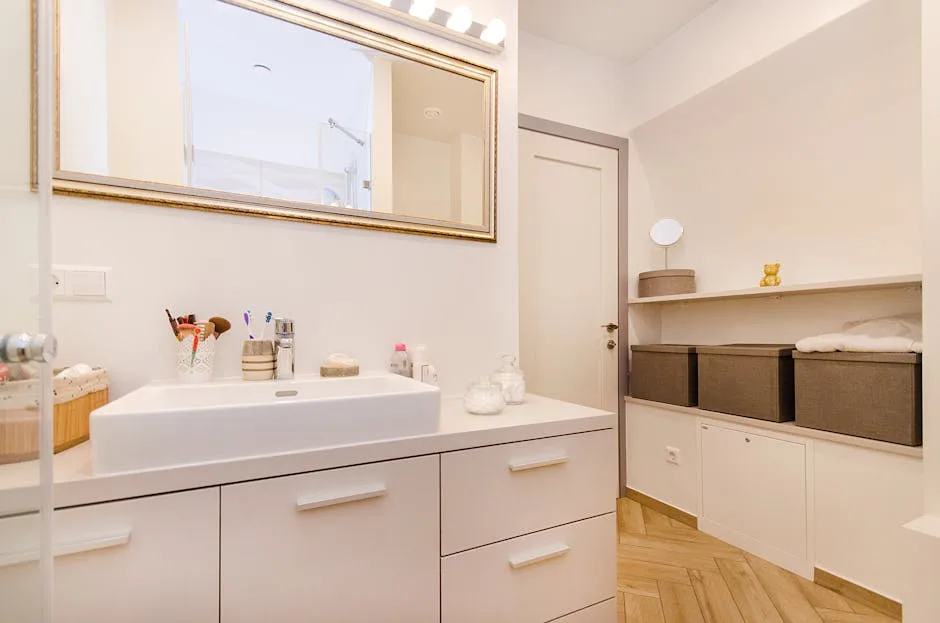
Not all storage solutions are created equal per square inch — and in a tight vanity zone, the efficiency of a solution matters more than its visual appeal. I used to choose pieces because they looked right in the space. That approach cost one client a $300 wall unit that looked stunning and held almost nothing useful.
Think in tiers. Built-in or semi-permanent solutions are almost always the most efficient use of wall space. They work with the room’s architecture rather than sitting on top of it. Furniture-based storage — a freestanding tower, a rolling cart — comes second. Accessory-level additions — hooks, over-door organizers, drawer inserts — come third. Most people skip straight to the third tier because it’s cheapest and requires no installation, then wonder why the bathroom still feels impossible.
Here’s a useful benchmark: a recessed medicine cabinet with interior shelving can store up to 30 individual items in less than 2 square feet of wall footprint, with zero counter loss. That single statistic should reorient how you think about what’s worth installing versus what’s worth skipping.
Recessed vs. surface-mount medicine cabinets deserve specific attention. Surface-mount cabinets project 3–5 inches into the room — in a narrow bathroom, that projection creates a subtle but real sense of compression, and it reduces usable elbow room at the sink. A recessed cabinet — one that sits inside the wall cavity between studs — gives you the same storage without sacrificing any of that projection. The tradeoff is installation labor and potentially hitting plumbing or wiring behind the wall, which is worth checking before you start cutting.
Slim-profile pull-out towers — typically 8 to 12 inches wide — are one of the most underused options I’ve seen. The gap between a vanity and a wall, or between a vanity and a toilet, looks like nothing. It’s frequently 6 to 12 inches. A narrow rolling tower fits exactly there, adding significant vertical storage in a slot most people leave empty.
Mirrored cabinet combos — mirror on the exterior, shelving inside — serve three functions simultaneously: reflection, light amplification, and concealed storage. In a small room, anything that multitasks earns its place.
When it comes to bathroom cabinet storage in a small space specifically, the organizing principle that outperforms everything else is this: evaluate every solution by how much it stores relative to the floor and wall footprint it consumes. A solution that holds 20 items and consumes 4 square feet of wall beats one that holds 10 items and consumes 2 square feet — even though the second one is technically more compact. Total capacity relative to total footprint is the metric that matters.
A quick-reference breakdown of common solutions by efficiency tier:
| Solution | Approx. Wall/Floor Footprint | Estimated Item Capacity | Efficiency Rating |
|---|---|---|---|
| Recessed medicine cabinet | 1.5–2 sq ft wall | 25–35 items | Very High |
| Slim pull-out tower (8–10″) | 0.5–0.7 sq ft floor | 30–50 items | Very High |
| Surface-mount cabinet | 2–3 sq ft wall | 20–30 items | Medium |
| Over-door organizer | 0 sq ft floor | 12–20 items | High |
| Countertop organizer | 0.5–1 sq ft counter | 8–15 items | Low–Medium |
| Freestanding shelf tower | 2–3 sq ft floor | 30–50 items | Medium |
Actionable takeaway: If you can only make one structural change, install a recessed medicine cabinet. The efficiency-per-square-inch ratio beats every other option at this scale.
The 9 Smartest Cabinet and Storage Moves for a Tight Vanity Zone
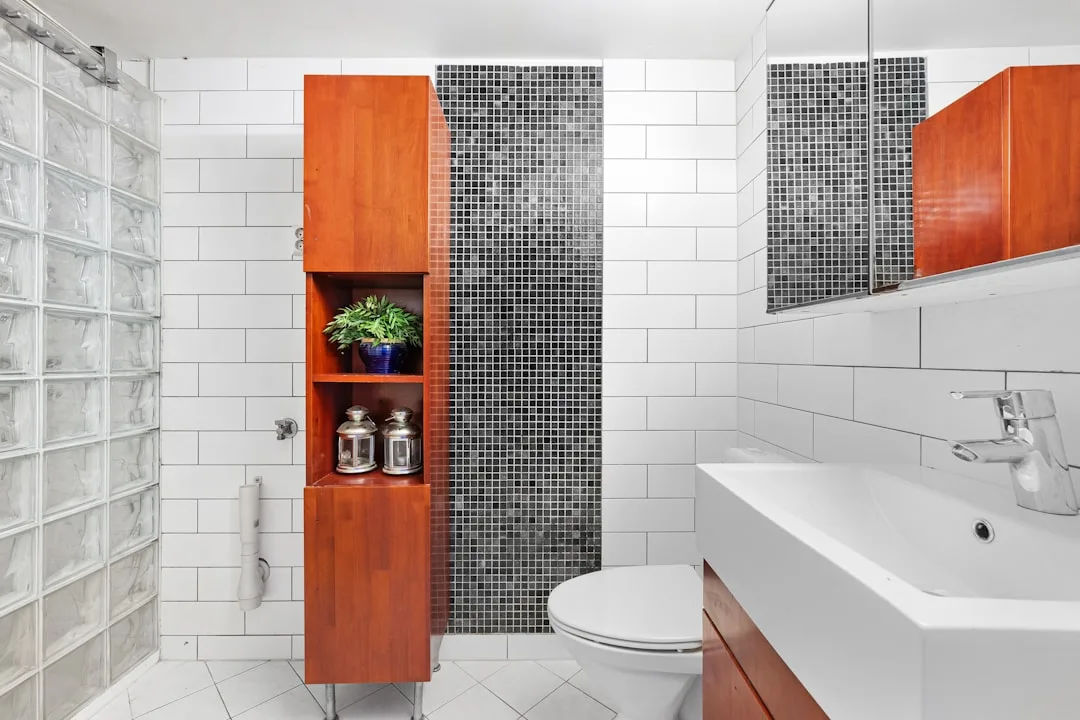
1. Recessed Wall Niche Between Studs
Standard residential construction spaces studs 16 inches on center, which means the open bay between them is 14.5 inches wide. That bay, typically 3.5 inches deep, is enough for a recessed open-shelf niche — no door required, no projection into the room, no footprint consumed. Install one between the studs above your toilet or beside the vanity mirror, and you’ve added functional shelf space that architecturally belongs to the wall. The one thing to verify before cutting: no plumbing, no wiring, no fire blocking in that bay. A stud finder with live-wire detection handles this in under five minutes.
What fits in a 14.5″ × 3.5″ niche:
- Single-layer row of small bottles (face serums, contact solution, small deodorant)
- A dedicated shelf for daily medications in a labeled container
- Rolled hand towels stacked two deep
- A small plant that tolerates humidity
Niches also work particularly well in shower wet walls for shampoo and soap — same principle, slightly deeper cut if your wall allows it.
2. Full-Height Cabinet Flanking the Vanity
Most vanity zones have dead wall space on either side of the sink that goes completely unused. A floor-to-ceiling cabinet column — even one that’s only 9 to 12 inches deep — turns that vertical run into serious storage without consuming floor area beyond its own footprint. Standard base cabinets are 24 inches deep; a 12-inch-deep column cabinet stores just as much in height-oriented categories (cleaning products, stacked towels, hair tools) while projecting half as far into the room.
Key considerations when adding a flanking column:
- Match door style to existing vanity — mismatched hardware creates visual noise that makes a small room feel more chaotic, not less
- Use full-overlay doors — they conceal the cabinet box edges and read as a cleaner, less bulky unit
- Install adjustable shelves — fixed shelves that don’t match your actual items are the most common reason built-ins underperform
- Add interior pull-out bins — for under-sink-style items (cleaning products, backup stock), a pull-out bin beats reaching past other items to the back of a shelf
3. Drawer Organizers That Actually Match Your Items
Bathroom drawers are one of the highest-potential storage zones in any vanity — and one of the most consistently wasted. The problem isn’t the drawer. It’s that most people drop items in without any internal organization, then have to dig through everything every morning. An unorganized drawer that holds 20 items effectively functions as a drawer that holds 5 — because you can only quickly access whatever is on top.
Modular drawer inserts — the kind where you select individual compartment sizes and arrange them to fit your exact items — outperform pre-configured inserts by a significant margin. Before purchasing anything, measure your drawer interior dimensions and physically lay out your daily-use items on a flat surface. Then buy inserts that fit those specific items, not generic ones you hope will work.
Items worth giving dedicated compartments:
- Razor and replacement heads (kept separate to protect edges)
- Hair ties and bobby pins (a small magnetic tray prevents scatter)
- Daily medications (labeled, front-row placement)
- Cotton rounds and swabs in a contained stack, not a loose pile
- Lip and eye products standing upright in a narrow insert, not flat
A drawer organized this way stores the same number of items in less depth — because items are visible and reachable without moving anything else.
4. Slim Pull-Out Tower in Dead-Gap Spaces
The gap beside a toilet, between a vanity and a wall, or between two fixtures is almost never used intentionally. It reads as leftover space — too narrow for furniture, too awkward to shelve. A slim pull-out tower, typically 6 to 10 inches wide with full-extension casters, fits exactly in these gaps and adds multiple shelves of vertical storage in a slot that was previously contributing nothing.
What to look for when selecting a pull-out tower for bathroom cabinet storage in a small space:
- Caster quality matters — cheap plastic casters jam on uneven grout lines; look for rubberized wheels rated for at least 30 lbs
- Shelf depth should match the gap — a 6-inch-deep gap needs a 5.5-inch tower, not a 7-inch one that has to sit outside the gap
- Rust-resistant materials only — humidity will destroy particleboard and non-coated metal within 18 months
- Handle or pull at the top — a tower without an obvious pull point gets left closed because it’s awkward to open
Items that work well on pull-out tower shelves: single-layer bottles, folded hand towels, first aid basics, cleaning sprays (if placed low for stability).
5. Over-Door Organizer on the Bathroom Door Interior
The interior face of a bathroom door is frequently the most underused surface in the entire room. A well-selected over-door organizer adds storage without touching a single wall, requires no installation tools, and comes off completely if you move or change your mind. In a tight bathroom, this surface is worth treating as a primary zone rather than an afterthought.
Matching the organizer type to your needs:
- Clear pocket organizers — best for small, flat items: travel-size products, hair accessories, first aid supplies
- Wire rack organizers with deep baskets — best for bottles, small appliances like a compact hair dryer, cleaning sprays
- Hooks-only configurations — best for robes, towels, and reusable bags; keeps them off the back of the toilet or a chair
The main failure mode with over-door organizers is overloading them with items that are too heavy for the door’s hinges, or selecting an organizer depth that causes the door to brush the vanity or toilet when opening. Measure your door clearance before purchasing — the distance from the door’s interior face to the nearest obstruction at full swing tells you your maximum organizer depth.
6. Vertical Shelf Risers Inside Existing Cabinets
If you have an existing under-sink cabinet with a single fixed shelf — or no shelf at all — you’re using roughly half its vertical capacity. The space between shelves in most stock bathroom cabinets is 10 to 14 inches, which is far more vertical clearance than most items actually need. A stackable shelf riser, or an adjustable tension shelf that installs without hardware, doubles the usable layers inside the existing cabinet footprint without modifying the cabinet itself.
This is one of the highest-return moves available for bathroom cabinet storage in a small space because it costs almost nothing and requires no tools.
Items that respond well to risers:
- Spray bottles (store upright in back row, riser level in front)
- Skincare bottles organized by step (cleanse, treat, moisturize — each on its own level)
- Stacked towel sets separated by type
- Cleaning products in a two-tier arrangement so nothing is hidden behind anything else
The only caution: measure your cabinet interior height before purchasing a riser. A riser that’s 6 inches tall needs at least 13 inches of vertical clearance to hold anything useful on both levels.
7. Magnetic Strips and Wall-Mounted Tool Holders
A magnetic strip — the kind typically sold for kitchen knives — mounts to any wall with two screws and holds metal items without consuming drawer or shelf space. In a bathroom context, this means nail scissors, tweezers, bobby pins, metal hair clips, and small tool items that currently live loose in a drawer where they’re impossible to find. Mount one inside a cabinet door to keep it concealed, or on an open wall section beside the vanity for easy daily access.
Beyond magnetic strips, consider:
- Suction-cup toothbrush holders — mount directly to mirror or tile with no drilling, hold brushes vertically so they dry properly
- Adhesive razor holders — keep razors off wet surfaces, which extends blade life and reduces rust
- Small adhesive hooks rated for humid environments — for hair ties, loofahs, small baskets
- Cabinet-door-mounted hair tool holders — purpose-built sleeves that store a flat iron or curling wand with its cord, inside the cabinet door where heat dissipates safely
The common thread: surface-mounted and door-mounted hardware moves storage off counters and out of drawers without consuming any footprint. In a room measured in single-digit square feet, that reallocation matters.
8. Mirrored Medicine Cabinet Replacing a Flat Mirror
If your bathroom currently has a flat mirror glued or mounted directly to the wall, replacing it with a mirrored medicine cabinet is the single highest-efficiency upgrade available. You lose nothing — the mirror stays, the reflection stays, the visual sense of depth stays — and you gain a fully enclosed storage cavity behind the surface you were already using.
Standard recessed medicine cabinets run 14 to 24 inches wide and 24 to 36 inches tall, with 3 to 5 adjustable interior shelves. That’s enough capacity for the entire daily-use zone of most single-person or couple bathrooms, clearing the counter and two drawers simultaneously.
Surface-mount versions are available if wall cavity access is not possible — they project 3 to 4 inches forward but still deliver the same storage capacity. In a bathroom where counter clutter is the primary problem, the slight projection is a worthwhile trade.
What to store inside:
- All daily-use items: toothbrush accessories, face products, prescriptions
- Contact lens supplies, glasses, eye drops
- Items that need to be visible daily: medications with a specific schedule
- Small grooming tools: nail file, tweezers, small scissors
9. Under-Sink Organization System (Not Just a Liner)
Most under-sink cabinets are treated as overflow storage — a place where things go to be forgotten. The plumbing running through them makes the space awkward, and most people never design around it. That’s a mistake. The under-sink zone, properly organized, can handle a significant portion of the weekly and occasional storage load, freeing the prime zones for daily items.
The key is designing around the pipe, not ignoring it. Products built specifically for under-sink use account for the P-trap and drain pipe with a notched rear or a two-section layout that wraps around the obstruction.
A complete under-sink system should include:
- Two-tier pull-out organizer that fits around the drain pipe on each side
- Stackable bins for backup stock — one per category: hair, skin, cleaning
- Door-mounted caddy on the interior cabinet door for sponges, gloves, small spray bottles
- Tension rod across the interior width — hang spray bottles upside down from their triggers, freeing the floor of the cabinet entirely
- Labels on every container — the under-sink zone fails when items get stacked in front of other items; labels force a system that keeps everything findable
One tension rod hung about 8 inches from the top of the under-sink cabinet interior can hold four to six spray bottles simultaneously, converting vertical space that typically goes unused into a dedicated cleaning supply zone.
Frequently Asked Questions
How do I add bathroom cabinet storage in a small space without doing any drilling or construction?
The most effective no-drill options are over-door organizers on the bathroom door interior, adhesive hooks rated for humid environments (look for a humidity or bath-specific label on the packaging), slim pull-out towers that fit into floor-level gaps, and tension rods inside existing cabinets. Combined, these four approaches can add significant storage without a single hole in the wall. The over-door organizer alone — on both the bathroom door and the interior of any cabinet door — can add 20 to 40 items of accessible storage with no tools required.
What’s the most common mistake people make when organizing a small bathroom?
Buying storage products before auditing what actually belongs in the bathroom. Most small bathrooms are storing items that don’t need to be there — backup stock that belongs in a hall closet, medications that shouldn’t be in a humid room, decorative pieces that consume counter space without serving a daily function. Removing those items before purchasing anything creates more usable space than most organizers add.
Is a recessed medicine cabinet worth the installation effort in a rental?
Generally, no — unless your landlord approves the wall modification. For renters, a surface-mount medicine cabinet is a better option. It installs with standard wall anchors rather than cutting into the wall cavity, can be removed and patched when you move out, and delivers the same interior storage capacity as a recessed model. The tradeoff is the 3–4 inch forward projection, which is a minor issue in most bathrooms.
How do I make a small bathroom look less cluttered even after adding storage?
Conceal rather than display. Open shelves look minimal when they’re styled intentionally, but in a working bathroom they tend to collect visual chaos quickly. Closed-front cabinets, drawers with flat-front faces, and baskets with lids all store the same items while eliminating the visual noise of labels, bottle shapes, and product colors competing for attention. If you use open shelving, limit displayed items to three to five per shelf maximum and remove anything that doesn’t contribute to the daily function of the room.
What’s the best storage solution if I only have counter space and no cabinet at all?
Start with a countertop organizer that uses vertical height efficiently — a rotating carousel, a tiered riser, or a small drawer unit — rather than spreading items flat across the counter. Then look above: a floating shelf at eye level beside the mirror is one of the cheapest and most effective ways to move items off a counter permanently. If the wall above the vanity allows it, a surface-mount medicine cabinet is the highest-capacity single upgrade available. Finally, check whether there’s an over-door opportunity on the bathroom door — this adds storage without touching the counter or the walls at all.