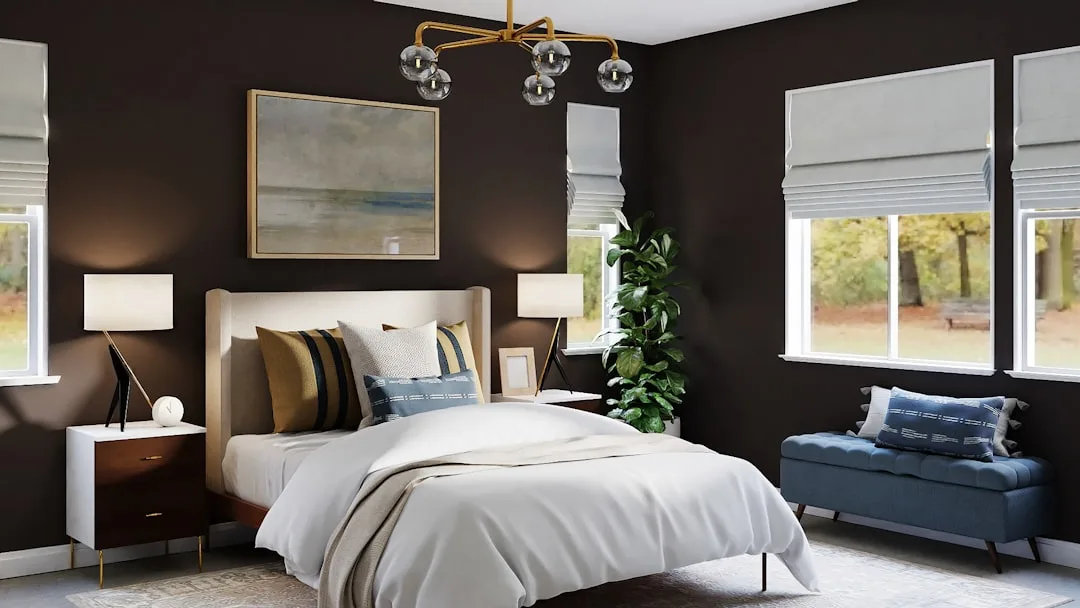
The average secondary bedroom in a U.S. home is just 132 square feet — roughly the size of a one-car parking space — yet the reason most feel suffocating has nothing to do with square footage and everything to do with placement order. If you’ve ever struggled with bedroom furniture arrangement in a small room, you already know the feeling: the space looked workable on paper, but once everything was in, it felt like a storage unit someone was sleeping in. The National Association of Home Builders reports that master bedrooms in new construction average around 309 square feet, but that number is almost irrelevant to most people, because secondary bedrooms — the ones teenagers sleep in, the ones guests suffer through, the ones that get converted into offices and back again — average just 132 square feet. That is the room everyone is actually struggling with. And in eleven years of arranging furniture for real people in real apartments across Chicago and New York, I watched the same bad decisions repeat in nearly every one of them.
Quick Answer
The average secondary bedroom in a U.S. home is just 132 square feet — roughly the size of a one-car parking space — yet the reason most feel suffocating has nothing to do with square footage and everything to do with placement order.
Not bad taste. Bad sequencing.
The furniture itself was often fine. What made rooms unlivable was the order in which decisions got made — the bed went against the longest wall because that felt logical, then the dresser got crammed wherever it fit, then the nightstands got squeezed in, and suddenly there was no room to open the closet without moving a chair. This is a planning problem. It has a solution. These nine rules are that solution, built from actual rooms that didn’t work until they did.
Why Most Cramped Bedrooms Are a Planning Problem, Not a Space Problem
In This Article
- Why Most Cramped Bedrooms Are a Planning Problem, Not a Space Problem
- 1. Map Your Fixed Points Before Touching a Single Piece of Furniture
- 2. Assign the Bed a Role, Not Just a Wall
- 3. Treat Clearance Numbers as Non-Negotiable Minimums
- 4. Float Furniture Away From Walls — Counterintuitively
- 5. Establish a Single Visual Anchor and Build Outward
- 6. Use the Vertical Dimension Intentionally
- 7. Respect the Traffic Corridor Before Everything Else
- 8. Match Furniture Scale to Room Scale — Ruthlessly
- 9. Test the Layout on Paper Three Times Before Moving Anything
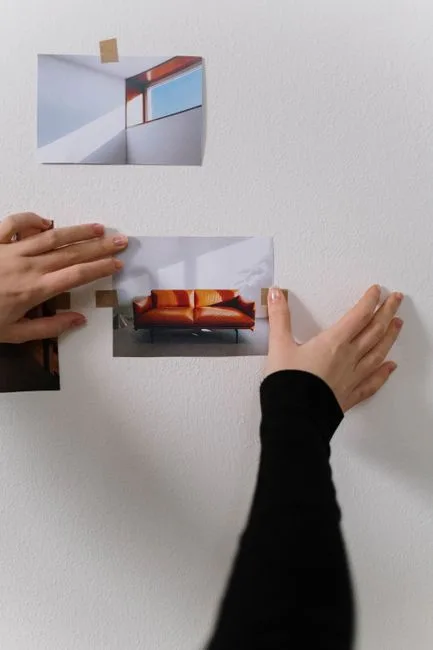
Most people treat bedroom furniture arrangement in a small room as a spatial puzzle — you have pieces, you have a box, you figure out where they fit. That framing is exactly what creates the problem. Because fitting furniture into a room and arranging furniture in a room are two completely different activities, and only one of them produces a space you actually want to be in.
The real culprit is placement order. When you decide where the bed goes before you’ve mapped your door swings, your HVAC vents, your natural light sources, and your closet clearance zones, you’re essentially solving a math problem while skipping the first three steps. You’ll get an answer, but it won’t be right.
Here’s the sequencing failure I saw most often: a client would position the bed first — usually on instinct — and then try to fit everything else around it. The bed became an unmovable anchor not because its position was correct, but because it was heavy and they’d already made the decision. Everything after that was compromise. A dresser blocking a window. A nightstand you couldn’t reach without climbing over your partner. A closet door that only opened halfway because a chair was in the way.
The concept that changes this is what I call clearance zones — the non-negotiable buffer areas around each piece of furniture that determine whether a room is usable, not just furnished. Before any piece enters a room, its clearance zone should be drawn on paper first. If the zones overlap, something has to move. That decision is infinitely easier to make on graph paper than after you’ve scratched your hardwood floors.
One more thing: small rooms punish imprecision more than large ones. In a 300-square-foot master, you have margin for error. In 132 square feet, a single bad placement decision can make the entire room feel like a mistake. The rules below are designed to eliminate those decisions before they happen.
Start with the plan. The furniture comes second.
1. Map Your Fixed Points Before Touching a Single Piece of Furniture
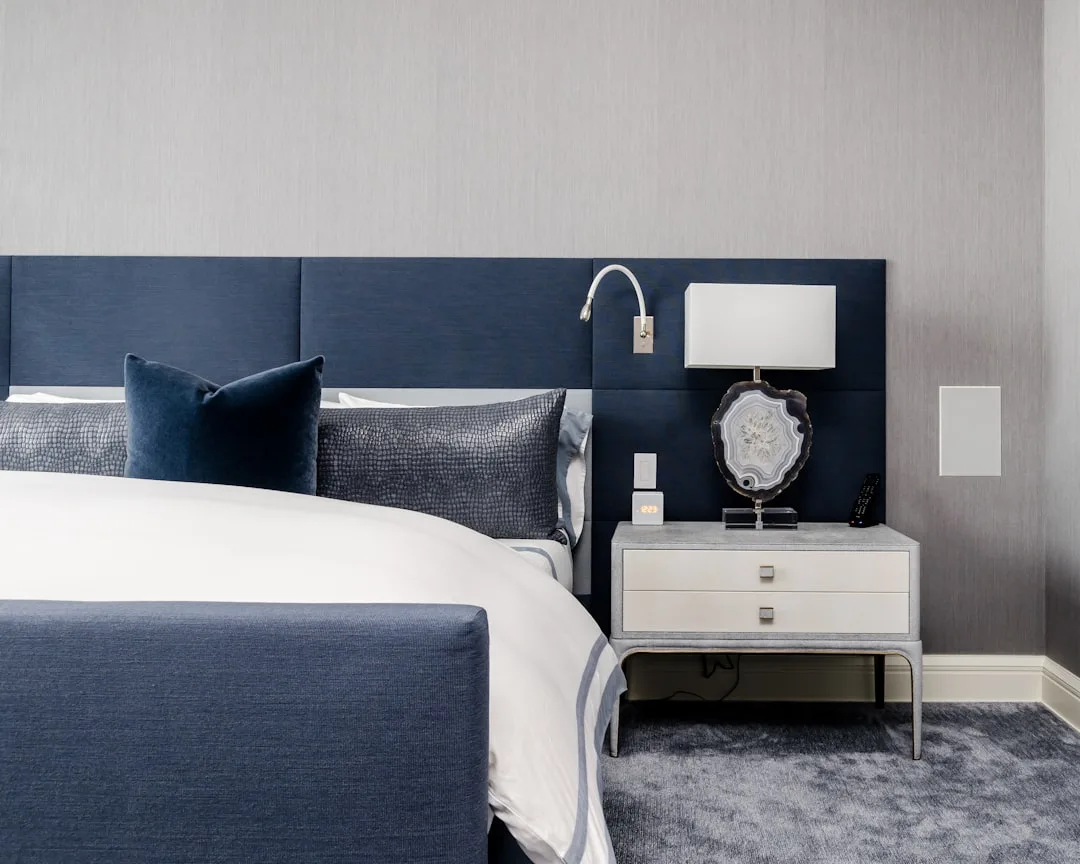
Before anything moves, before you even think about what goes where — draw the room. Not a rough sketch. A to-scale floor plan, either on quarter-inch graph paper or using a free tool like RoomSketcher or the IKEA Room Planner. This step sounds tedious because it is, slightly. It also eliminates the single most common cause of furniture regret I ever witnessed in client homes: the discovery, after moving a queen bed across a room, that the outlet is now behind the headboard and there’s no way to plug in a lamp.
Mark your fixed points in this order:
- Door swing arcs — A standard 32-inch interior door with a 90-degree swing eliminates roughly 7 square feet of floor space from practical use. That’s equivalent to a medium-sized nightstand footprint, gone before you’ve placed a single piece of furniture. Mark the full arc, not just the door frame.
- Windows — Note which direction they face. North-facing windows give flat, consistent light. South-facing flood the room. East windows make mornings bright and afternoons dim. This matters for where you’ll want to sit, read, and what furniture can comfortably live in direct sun.
- HVAC vents and radiators — Covering a floor vent with a dresser is a mistake I’ve seen at least forty times. It overworks your system and creates a cold dead zone on the other side of the room.
- Closet door type — Bifold, sliding, or swing? Each has a completely different clearance profile that dictates where adjacent furniture can and cannot go.
- Outlets and cable ports — Every bed needs power within reach. Every desk does too. Mark them all.
Once your fixed points are mapped, what remains is your actual workable area — which is almost always smaller than the room’s dimensions suggest, and that’s before a single piece of furniture enters the picture.
Actionable takeaway: Spend 30 minutes drawing your floor plan before anything else. The time you spend mapping saves hours of moving furniture and days of living in a layout that doesn’t work.
2. Assign the Bed a Role, Not Just a Wall
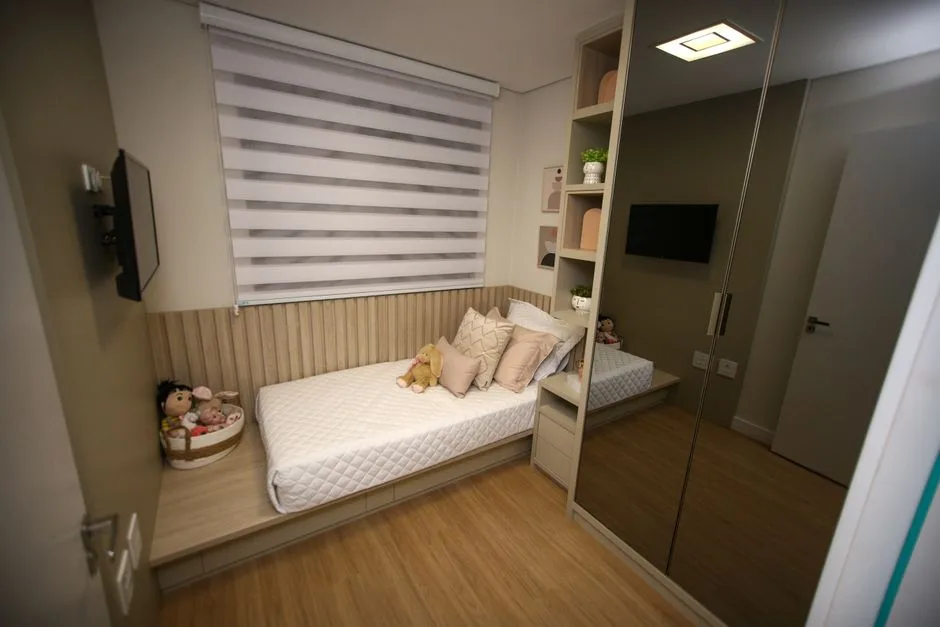
Here’s the advice you’ll find everywhere: put the bed on the longest wall. I followed this instinct myself in the early years, and I watched it produce mediocre rooms at best and genuinely unpleasant ones at worst. The longest wall is a geometric fact about your room. It tells you nothing about how the room will feel to live in.
The bed is the primary anchor of any bedroom — everything else is positioned in relation to it. Which means where the bed goes determines how the entire room functions. That decision deserves more than “it’s the longest wall.”
Two principles that actually hold up in practice:
First, the bed should have a clear sightline to the primary entry point of the room — meaning you can see the door from a lying position without craning your neck. This isn’t mysticism. Research published in the Journal of Environmental Psychology found that spatial control — the sense of being able to survey a room from a stable, fixed position — measurably reduces cortisol levels during rest. The practical translation: sleeping with your back to the door, or in a position where you can’t see it, creates low-grade subconscious alertness that interrupts rest. I had a client in Wicker Park who couldn’t figure out why she kept sleeping badly in her new apartment. We rotated the bed 90 degrees so she faced the door. She slept better. It cost nothing.
Second, orient the bed so that at least one long side — ideally both — has a minimum 24-inch clearance for walking. In tight bedroom furniture arrangement for a small room, that number gets pressure-tested constantly. Twenty-four inches feels narrow when you measure it, but it’s the difference between a room that functions and one that forces you to shuffle sideways every morning. If your layout only allows one clear side, make it the side you sleep on most. The other side can live closer to the wall, with a wall-mounted light substituting for a nightstand.
Actionable takeaway: Before committing the bed to any wall, lie down and mentally trace your morning routine — getting up, reaching for your phone, accessing the closet. If anything in that sequence requires climbing over furniture or squeezing through a gap, the placement is wrong.
3. Treat Clearance Numbers as Non-Negotiable Minimums
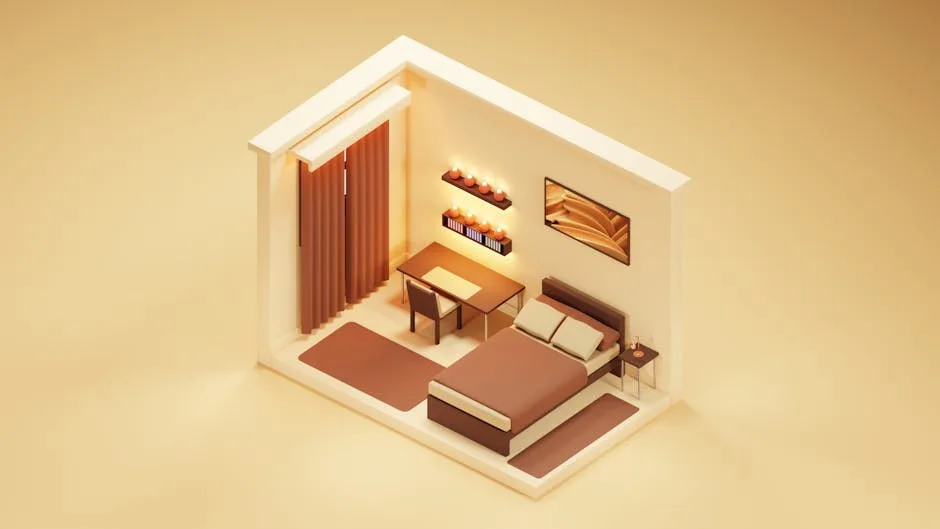
This is where most bedroom furniture arrangement in small room projects fails in execution. People know clearance matters in the abstract. They don’t apply actual numbers. Here are the ones that hold up across hundreds of real rooms:
- Bed to wall (walking side): 24 inches minimum, 30 inches preferred
- Bed to dresser: 36 inches minimum — enough to fully open a drawer and stand behind it
- Closet door clearance: Swing doors need full door-width clearance; bifolds need 18–24 inches; sliding doors need nothing, but lose interior accessibility at the edges
- Entry door swing: No furniture within the door’s arc, ever
- Desk chair pull-out: 36 inches from desk front to nearest obstruction
Write these numbers on your floor plan. Physically. Then draw them as shaded zones. Whatever floor space remains unshaded is your maneuvering room. In a 132-square-foot room, that remaining space is often surprisingly small — sometimes just a narrow corridor from door to bed. That’s not failure. That’s information. It tells you exactly which furniture pieces are non-negotiable and which ones need to be reconsidered before they come through the door.
Actionable takeaway: If drawing clearance zones on your floor plan leaves you with overlapping shaded areas, you have too much furniture for the room — not a layout problem. Solve the furniture quantity problem before solving the placement problem.
4. Float Furniture Away From Walls — Counterintuitively

Every instinct says push furniture against walls to maximize floor space. In large rooms, that logic creates a different problem: furniture arranged around the perimeter leaves a dead void in the center. But in small rooms, the instinct is correct — partially. The mistake is applying it universally, without exception.
The one piece that benefits most from being pulled slightly away from the wall is the bed. Even 3–4 inches off the wall changes the visual weight of the room dramatically. It stops the bed from looking like it’s been pushed out of the way, which — psychologically — makes the room feel like it has less space, not more. A bed that floats slightly reads as intentional placement. A bed flush to the wall reads as accommodation.
For everything else in a tight space: yes, walls are your friends. A dresser flush against a wall, a desk tucked into a corner, shelving mounted directly to the surface — all of these free floor space without sacrificing storage. The combination of one intentionally floated piece (the bed) surrounded by wall-anchored pieces creates the illusion of a deliberate layout rather than a cramped one.
Actionable takeaway: Pull the bed 3–4 inches from the wall it backs against. Anchor everything else as close to walls and corners as clearance allows.
5. Establish a Single Visual Anchor and Build Outward
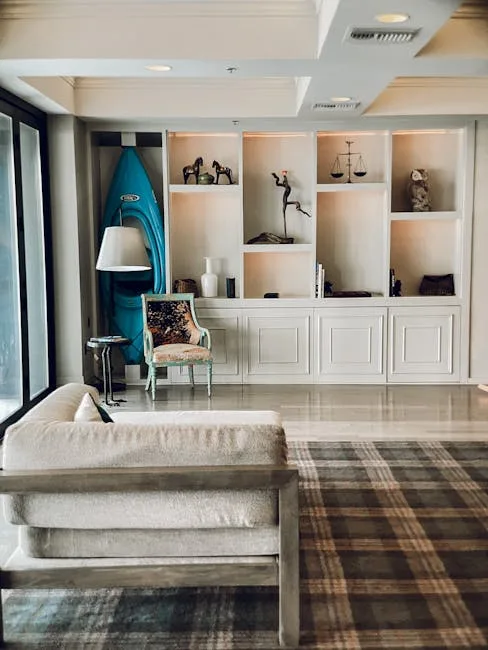
In any successful bedroom furniture arrangement for a small room, there is always one piece that commands visual attention and one direction the eye naturally travels first when entering. In a bedroom, that piece is almost always the bed — specifically, the wall behind the headboard. This is your anchor wall.
Once you’ve identified it, everything else in the room should either support or recede from it visually. A tall dresser on the anchor wall competes with the bed and creates visual noise. That same dresser on an adjacent wall becomes a supporting element. Lower furniture near the anchor wall, taller furniture on side walls — this is the principle that makes small rooms feel considered rather than cluttered.
The practical version of this rule: once the bed placement is confirmed, don’t place any piece taller than the mattress height within the immediate sightline of someone entering the room. Keep that sightline clear, and the room reads as open even when it isn’t.
Actionable takeaway: Stand in your doorway and take a photo. Whatever you see first becomes your anchor point. Every subsequent placement decision should ask: does this support that anchor or compete with it?
6. Use the Vertical Dimension Intentionally

Floor space in a 132-square-foot bedroom is finite. Wall space, for most practical purposes, is not. Yet the most common mistake in small bedroom arrangement is treating the room as a two-dimensional problem — moving furniture around the floor plan while ignoring everything above the 36-inch mark.
The vertical dimension gives you back storage without consuming clearance zones. Specifically:
- Floating nightstands replace floor-standing ones, freeing roughly 2–3 square feet of clearance per side
- Wall-mounted shelving above the dresser doubles storage without adding to the dresser’s floor footprint
- Tall, narrow bookcases (12–14 inches deep) along non-primary walls add significant storage while consuming less floor area than low, wide alternatives
- Over-door organizers on closet doors reclaim the interior of the closet without affecting any clearance zone
The ceiling height matters here. Standard 8-foot ceilings give you roughly 4.5 feet of wall space above typical furniture height — enough for two shelving tiers comfortably. Nine-foot ceilings open that to nearly 6 feet. In either case, that vertical space is almost always underused in rooms where floor space is at a premium.
Actionable takeaway: For every piece of storage furniture you’re considering adding to the floor plan, ask whether the storage need could be met by going vertical instead. In most cases, it can.
7. Respect the Traffic Corridor Before Everything Else
A traffic corridor is the unobstructed path between the room’s entry point and its primary use zone — in a bedroom, that means from the door to the bed, and from the bed to the closet. This corridor is non-negotiable. It cannot be interrupted by furniture legs, open drawers, or chair backs. It needs to be at minimum 24 inches wide throughout its length, and ideally 30.
In practice, establishing the traffic corridor before finalizing any furniture position means drawing a line on your floor plan from door to bed to closet and confirming that no clearance zone from any furniture piece crosses it. When it does — and in 132 square feet, something usually does — the offending piece moves first, regardless of how good its position might look in isolation.
The reason this rule comes before final placement decisions rather than after is simple: traffic corridors are discovered late when you’re working from instinct, and discovered early when you’re working from a plan. Discovering them late means you’ve already committed to a layout that requires either living with an obstructed path or moving everything again.
Actionable takeaway: Draw your traffic corridor on your floor plan before placing any secondary furniture. Treat it as a clearance zone with its own non-negotiable boundaries.
8. Match Furniture Scale to Room Scale — Ruthlessly
A queen bed in a 10×13 room isn’t automatically a mistake. A queen bed plus a full dresser plus two nightstands plus a desk plus a chair in a 10×13 room almost certainly is. The problem isn’t any individual piece — it’s the cumulative footprint of furniture that was each selected at standard residential scale without accounting for how much of that scale the room could actually absorb.
The useful exercise here is a footprint audit before purchase, not after. Add up the floor footprint of every piece you intend to put in the room. Industry guidelines for bedroom furniture arrangement in a small room suggest that furniture footprint should not exceed 50–60% of total floor area if you want the space to feel livable rather than just furnished. In 132 square feet, that means roughly 66–79 square feet of furniture footprint maximum — which sounds like a lot until you add up a queen bed (42 sq ft), a standard 6-drawer dresser (8 sq ft), two nightstands (6 sq ft combined), and a small desk (9 sq ft). That’s already 65 square feet before the chair that goes with the desk.
Scale-appropriate alternatives that perform the same function with less footprint:
- A full bed instead of queen saves roughly 8 square feet of floor space — enough for a small desk
- A 4-drawer dresser instead of 6-drawer saves 3–4 square feet and rarely represents a meaningful storage reduction
- Wall-mounted floating nightstands instead of freestanding ones: 0 square feet of floor footprint versus 3 square feet per side
Actionable takeaway: Calculate your furniture footprint before committing to any layout. If it exceeds 60% of total floor area, identify which pieces can be scaled down, replaced with wall-mounted alternatives, or removed entirely.
9. Test the Layout on Paper Three Times Before Moving Anything
The final rule is process, not placement. Every bedroom furniture arrangement for a small room that I’ve seen succeed — truly succeed, where a client stopped noticing the room’s size and started enjoying it — went through at least three distinct layout iterations on paper before a single piece of furniture moved.
The first iteration is instinctive: you place things where they feel right. This layout almost never works, but it’s valuable because it reveals your assumptions.
The second iteration applies the rules from this list: clearance zones, traffic corridors, scale audit, vertical alternatives. This layout is usually significantly better, but it often has one element that feels correct on paper and wrong in practice.
The third iteration addresses what the second one revealed. Sometimes it’s minor — moving the dresser 6 inches to clear a door swing. Sometimes it’s significant — replacing a freestanding dresser with a wall-mounted system entirely. Either way, the third iteration is where the room stops being a problem you’re solving and starts being a space that works.
The paper test costs nothing. Moving furniture costs time, effort, and in hardwood-floored apartments, sometimes money. Run the iterations on the plan.
Actionable takeaway: Commit to three separate layout attempts on your floor plan, with at least a day between the second and third. Distance from the problem produces solutions that proximity doesn’t.
These nine rules emerged from real rooms, real constraints, and real people who needed their 132 square feet to function as more than just a place to store a bed. Bedroom furniture arrangement in a small room is a solvable problem — but only if you treat it as a planning challenge before it becomes a physical one.