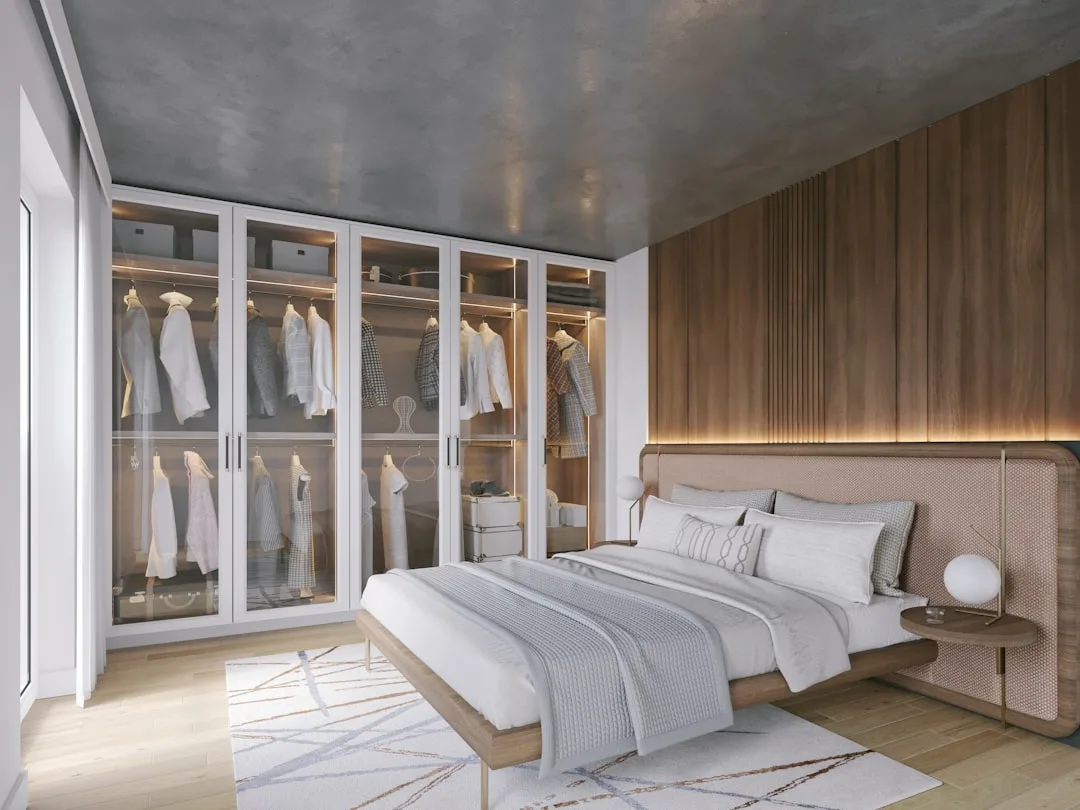
Before 1940, most American bedrooms were built without closets — not as an oversight, but because closets were taxed as additional rooms in several states, making their absence a deliberate architectural decision that shaped how an entire generation lived with their belongings. They used armoires. Wardrobes. Hooks and trunks and fabric-hung rails. The idea that a bedroom requires a built-in closet is, historically speaking, a very recent expectation — one that the housing stock hasn’t actually caught up with, and one that designers working in older cities have been quietly ignoring for decades. If you’re working through bedroom closet organization without a closet, you’re not solving an unusual problem — you’re solving the same problem most of the world’s designers have been solving for centuries.
Quick Answer
Before 1940, most American bedrooms were built without closets — not as an oversight, but because closets were taxed as additional rooms in several states, making their absence a deliberate architectural decision that shaped how an entire generation lived with their belongings.
I spent eleven years doing residential interiors in Chicago and New York. A significant portion of the apartments I walked into had no closets at all, or closets so small they functioned as jokes — a 24-inch recess behind a door that builders generously labeled “storage.” What I learned in those rooms is the same thing that European and Japanese designers figured out long before American design culture did: the absence of a built-in closet forces you to design your storage intentionally, and intentional storage almost always looks better than the alternative.
This isn’t a workaround article. It’s a design education.
Why Closet-Free Bedrooms Are More Common Than You Think
In This Article
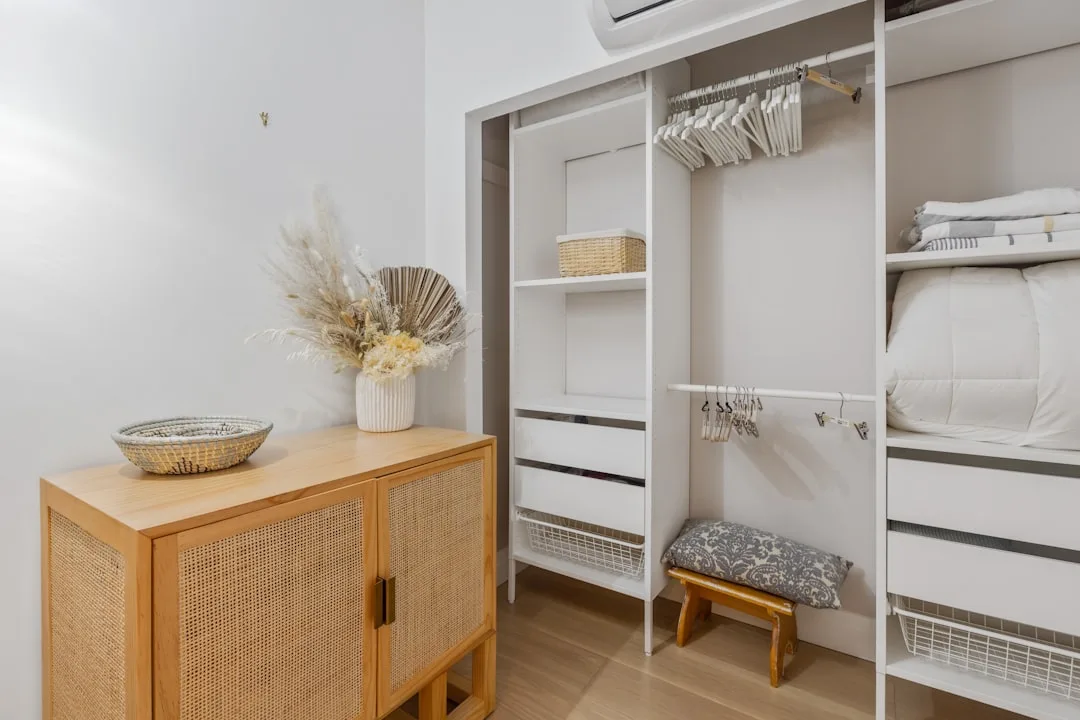
Most people who live without a bedroom closet feel vaguely embarrassed about it, as if they’re managing a deficiency rather than living in a building type that represents a substantial portion of the American housing inventory. U.S. Census housing data shows that millions of housing units built before 1960 have no dedicated closet space in bedrooms — not missing closets, not removed closets, but bedrooms that were never designed to include them. Studio apartments, converted lofts, pre-war bungalows, brownstones, and historic walk-up buildings all share this structural reality.
Interior designers increasingly view open wardrobe systems as a deliberate aesthetic choice. Not a workaround. Not a compromise. The pattern I kept seeing, across dozens of projects in older Chicago buildings, was that clients with open wardrobe systems were more organized than clients with traditional closets — because the visibility created accountability. Nothing hides. Nothing gets forgotten in a corner. The wardrobe becomes part of the room’s visual identity rather than something concealed behind a door that’s always half-open anyway.
The stigma around closet-free bedrooms is also culturally specific. Scandinavian design, Japanese interior philosophy, and most of Southern European residential design have long treated freestanding wardrobe systems as the normal solution — not a fallback. The closed, built-in American closet is, in global terms, an outlier.
What this means practically: if your bedroom has no closet, you are not behind. You are working with a format that most of the design world never abandoned.
The first thing to stop doing is looking for a substitute closet. A wardrobe that tries to mimic the functionality of a built-in closet in a box — matching doors, interior rods, the whole simulation — will almost always disappoint you spatially and aesthetically. The better approach is to distribute your storage across the room intentionally, which starts with understanding what a closet actually does and whether you actually need all of it.
> Takeaway: Recognize that closet-free bedrooms are a structural category, not a personal failure — then start designing for the room you actually have.
The First Step: Auditing What You Actually Own Before Buying Anything
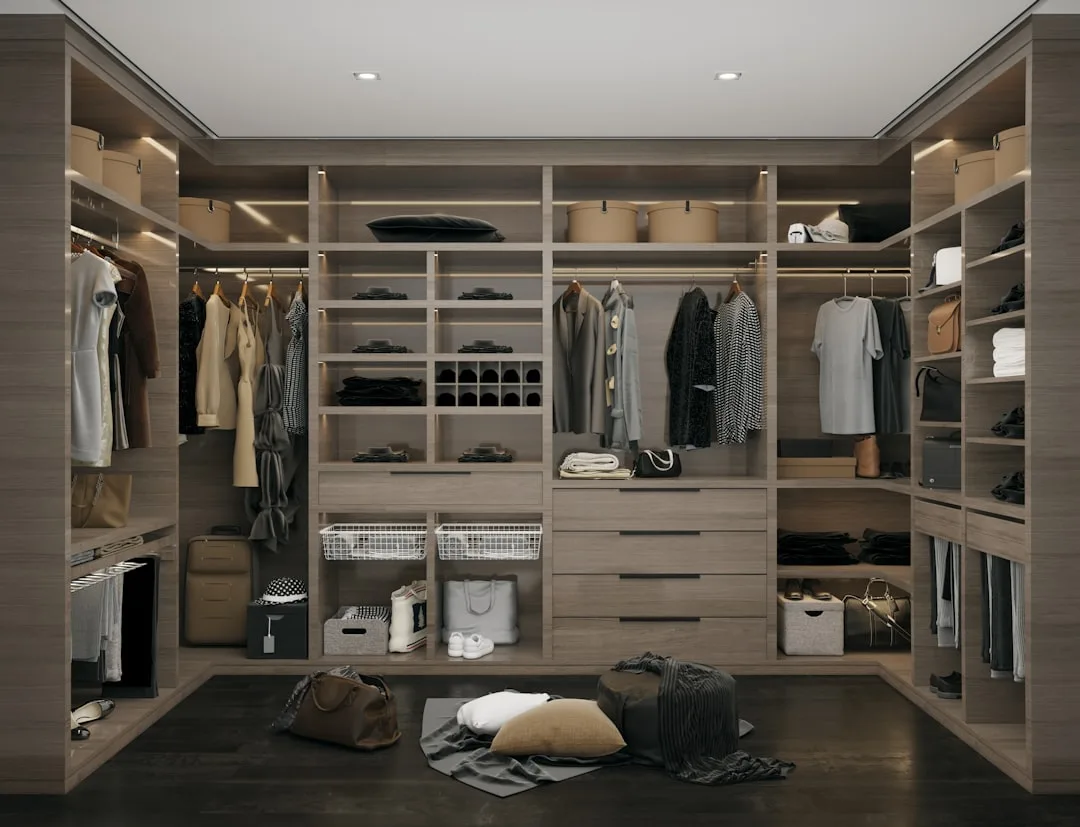
Every closet-organization article I’ve ever read starts with the products. The shelving systems, the bins, the drawer organizers. I made this mistake with a client in Lincoln Park years ago — we bought a beautiful floor-to-ceiling modular system, installed it, and discovered within three weeks that her wardrobe was simply too large for any open system to hold without looking chaotic. The storage wasn’t the problem. The volume was.
A UCLA Center on Everyday Lives of Families study found that the majority of American homes have clothing and personal belongings that exceed their storage capacity. This is not a storage problem. It is a volume problem. And no shelving unit solves a volume problem.
The 80/20 principle applies directly to wardrobes: most people wear roughly 20% of their clothing 80% of the time, yet organize — and shop for storage — around 100% of it. That math has consequences. Before you purchase a single rod, shelf, or drawer unit, you need to understand what you’re actually storing.
The audit I recommend has four categories:
- Daily use — items you reach for multiple times a week without thinking
- Weekly rotation — seasonal staples, work pieces, occasion-specific items you wear regularly
- Seasonal storage — anything that’s off-cycle for the current season and doesn’t need to be accessible
- Archival — items you’re keeping for sentimental or practical reasons but rarely or never wear
Once you’ve sorted into those four piles, measure them. Physically. Count your hanging pieces and measure the linear footage they occupy. Stack your folded items and measure the cubic footage. Line up your shoes. This sounds tedious. It is. Do it anyway, because the number of people who buy an undersized wardrobe system and then wonder why it doesn’t work is — in my experience — nearly everyone.
The audit also gives you permission. Permission to let go of the seasonal pile that’s two-thirds items you wouldn’t actually wear again. Permission to move archival pieces out of your bedroom entirely — into a hall closet, under a bed in a guest room, into proper off-site storage if you have it.
Specific numbers that help during this process:
- A standard hanging rod holds approximately 36–40 garments per linear foot when packed, and around 20–24 when hung with breathing room
- Folded t-shirts, stacked vertically in a drawer, average about 8–10 shirts per linear foot of drawer space
- An average adult wardrobe requires between 4 and 6 linear feet of hanging space — but that’s a median, and plenty of wardrobes run considerably higher
- Shoes take up more space than most people estimate: a pair of flat shoes in a box occupies roughly 0.5 cubic feet; boots can triple that
These numbers exist so you stop guessing and start planning. The difference between a bedroom closet organization without a closet that looks curated and one that looks chaotic is almost always that the person who designed the curated version measured first.
> Takeaway: Measure your actual wardrobe volume — hanging, folded, and shoes separately — before purchasing anything. The number will tell you which storage system you need.
Mapping Your Room: Zones That Replace What a Closet Does
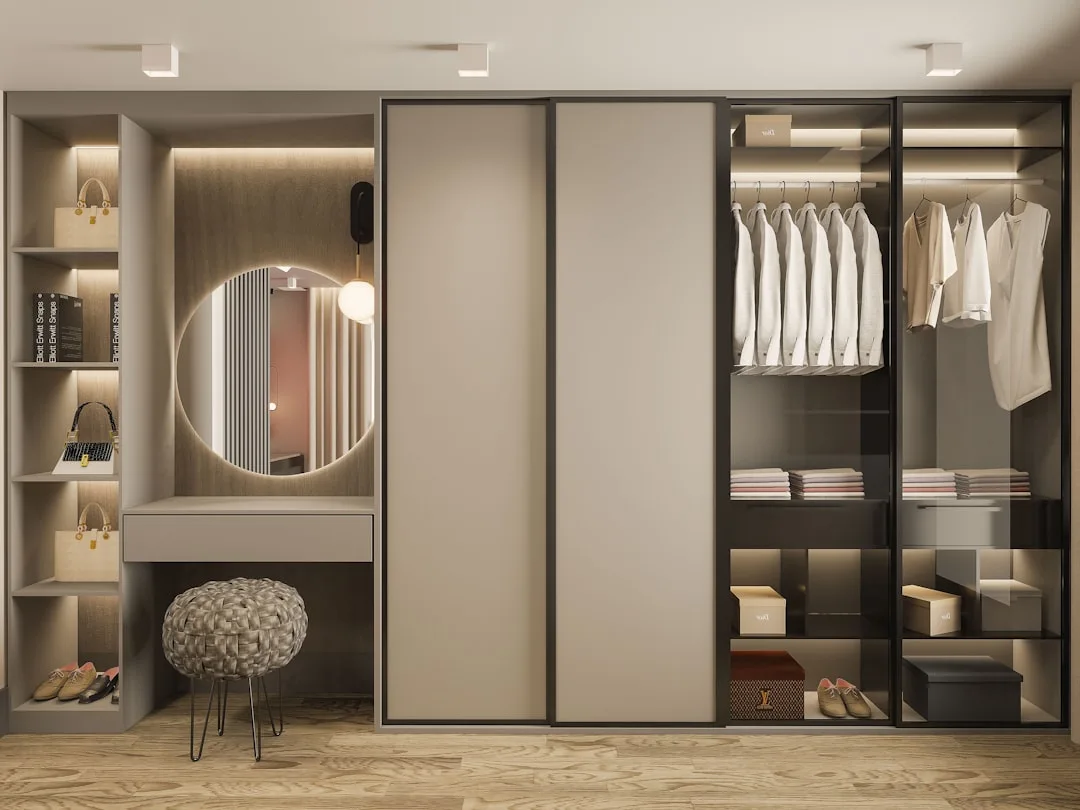
A closet is not one thing. It performs four discrete functions — hanging, folding, concealing, and categorizing — and the reason most open-wardrobe setups look chaotic is that people try to do all four in one place, the same way a built-in closet does. A room doesn’t work that way. A room has zones.
The functional zoning approach I used in most of my no-closet projects goes like this: identify every underused surface and wall in the room, assign each one a primary storage function, and design around those assignments rather than around a single furniture piece. The back of the door handles daily-access items — the bag you carry every day, the jacket you grab most mornings. The corner wall handles the primary hanging zone.
A practical zone breakdown for most bedroom sizes:
- The primary wall zone — your longest uninterrupted wall, ideally opposite or perpendicular to the bed, reserved for your main hanging and shelving system
- The door zone — back-of-door hooks, over-door organizers, or a mounted rail for daily-grab items only; limit this to five or six pieces maximum or it becomes visual noise
- The low-traffic corner — floor-standing shoe storage, a small dresser, or a bench with under-seat storage for seasonal or less-accessed items
- The vertical opportunity — the wall space above eye level that most people ignore entirely; shallow shelving here handles folded items, baskets, and off-season pieces in labeled containers
- The under-bed zone — flat, wheeled storage containers for true seasonal items: extra bedding, heavy sweaters, off-season shoes
When these five zones work together, they collectively exceed what a standard reach-in closet provides in terms of accessible volume. The difference is that the organization is visible, which means it has to be maintained — but that visibility is also what keeps the system honest and, when done with attention to materials and consistency, genuinely attractive.
> Takeaway: Treat your bedroom walls and underused surfaces as a distributed storage system rather than searching for one piece of furniture to do everything at once.
Freestanding Wardrobe Systems: What Actually Works
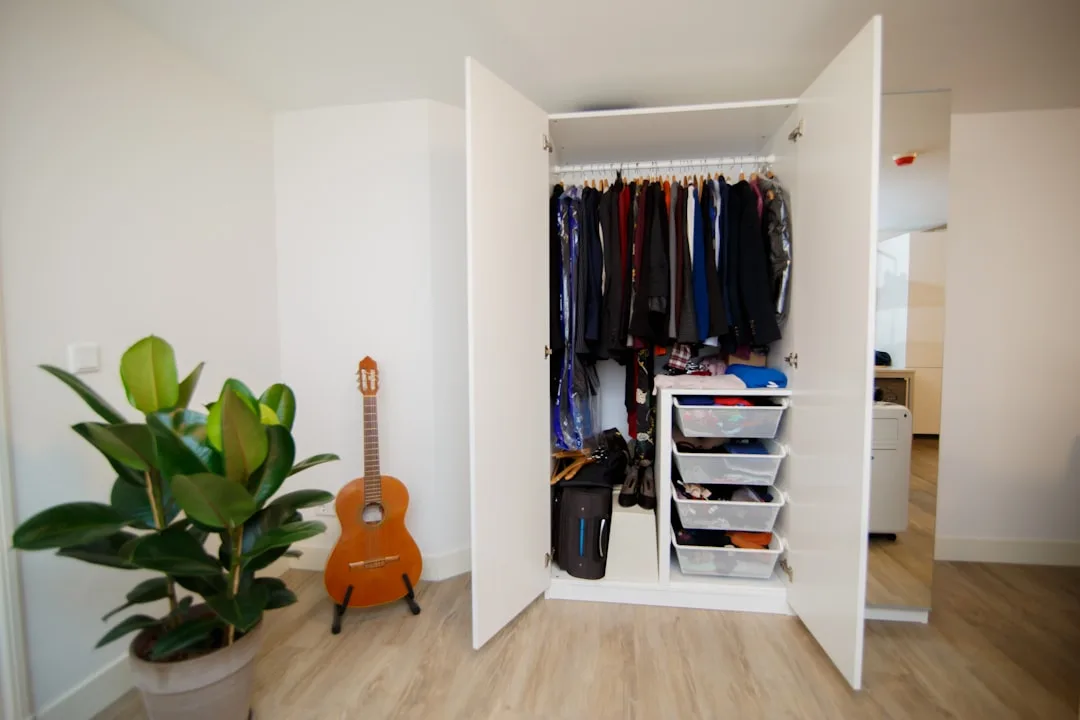
The freestanding wardrobe market has expanded significantly in the past decade, largely because urban housing trends pushed demand upward. What’s available now ranges from flat-pack systems that look like flat-pack systems to genuinely well-constructed modular furniture that reads as intentional design. Knowing the difference matters before you spend money.
Systems worth considering, and what they’re best suited for:
- Open rail systems (single or double hanging rod on a freestanding frame) work best for smaller wardrobes where the total hanging count stays under 50 pieces. They’re inexpensive, easy to reconfigure, and visually light. They fail when overloaded.
- Modular cube shelving (KALLAX-style and its better-quality equivalents) handles folded items and shoes well, accepts drawer inserts and door fronts, and can be combined with hanging rails. The limitation is that the proportions are fixed — you’re working within the module dimensions, not your actual space.
- Freestanding wardrobe cabinets with doors offer the concealment that open systems don’t. They work well for people who need to hide visual disorder or who share a bedroom and have different organizational tolerances. The trade-off is that they’re heavy, hard to reconfigure, and tend to dominate smaller rooms.
- Custom-built or semi-custom systems — from companies like IKEA PAX configured intentionally, or from mid-range custom millwork shops — offer the best outcome for rooms where the storage needs are complex. They’re also the highest investment, but for a primary bedroom you’ll live in for years, the math usually works.
The material and finish consistency matters more in an open wardrobe context than it does inside a closet. When storage is visible, mismatched systems — a chrome rail next to a pine shelf next to a fabric cube — read as temporary and unfinished even when each individual piece is functional. Committing to a single material family, whether that’s natural wood, painted MDF, or metal, makes the whole arrangement look deliberate.
FAQ
Can I do bedroom closet organization without a closet in a small bedroom — under 150 square feet?
Yes, and small bedrooms often benefit most from this approach because it forces prioritization that larger rooms allow you to avoid. In rooms under 150 square feet, vertical storage becomes essential: floor-to-ceiling shelving on a single wall, a tall wardrobe cabinet, or a lofted bed with storage underneath. The key constraint is that furniture footprint has to earn its place — every piece needs to perform multiple functions or take up very little floor space. A narrow open rail system combined with a small dresser and under-bed rolling storage is often the most effective combination for genuinely tight rooms.
What’s the best furniture for bedroom closet organization without a closet?
There’s no single best piece — it depends on your wardrobe volume and the room’s dimensions. That said, the combination that works most reliably across different room sizes is a modular open shelving unit (for folded items, shoes, and accessories) paired with a freestanding single or double hanging rail for garments. This pairing keeps costs manageable, stays reconfigurable as your needs change, and doesn’t overwhelm the room visually. For anyone storing more than 60 hanging pieces, a wardrobe cabinet with interior rods is worth the added footprint.
How do I keep an open wardrobe system from looking messy?
Three things: consistent hangers, color organization within categories, and a hard rule about the maximum number of items each section holds. Matching hangers alone — switching from a mix of wire, plastic, and wood to a single type — creates visual cohesion that reads as intentional from across the room. Color-organizing within each category (not across your whole wardrobe, just within shirts, within pants, and so on) keeps the visible surface readable without feeling over-designed. And setting a physical limit — if a section is full, something leaves before something new is added — prevents the gradual accumulation that turns any open system into chaos over time.
Is bedroom closet organization without a closet possible if I share the bedroom with a partner?
Absolutely, and shared no-closet bedrooms benefit from treating each person’s storage as a separate zone rather than trying to integrate everything into one system. Assign each person a dedicated section of wall or a dedicated piece of furniture, and let the organizational logic within each zone reflect that person’s habits. The visual consistency should come from using matching materials across both zones, not from forcing identical organizational systems on two people who may fold differently, hang differently, or need different ratios of hanging to folded storage.
What do I do with items that don’t fit any open storage system — bulky coats, luggage, sports equipment?
These items need to live somewhere other than your bedroom, and that’s actually the correct answer rather than an evasion. Bulky coats belong near the entry — a hall closet, a coat rack by the front door, or a mudroom bench if your layout allows it. Luggage stores flat under a bed, inside an ottoman, or stacked in a utility closet. Sports equipment rarely belongs in a bedroom at all. The discipline that no-closet bedrooms require is being honest about which items actually belong in a sleeping room and routing everything else to a more appropriate location in the home.
Can I do bedroom closet organization without a closet in a small bedroom — under 150 square feet?
Yes, and small bedrooms often benefit most from this approach because it forces prioritization that larger rooms allow you to avoid. In rooms under 150 square feet, vertical storage becomes essential: floor-to-ceiling shelving on a single wall, a tall wardrobe cabinet, or a lofted bed with storage underneath. The key constraint is that furniture footprint has to earn its place — every piece needs to perform multiple functions or take up very little floor space. A narrow open rail system combined with a small dresser and under-bed rolling storage is often the most effective combination for genuinely tight rooms.
What’s the best furniture for bedroom closet organization without a closet?
There’s no single best piece — it depends on your wardrobe volume and the room’s dimensions. That said, the combination that works most reliably across different room sizes is a modular open shelving unit (for folded items, shoes, and accessories) paired with a freestanding single or double hanging rail for garments. This pairing keeps costs manageable, stays reconfigurable as your needs change, and doesn’t overwhelm the room visually. For anyone storing more than 60 hanging pieces, a wardrobe cabinet with interior rods is worth the added footprint.
How do I keep an open wardrobe system from looking messy?
Three things: consistent hangers, color organization within categories, and a hard rule about the maximum number of items each section holds. Matching hangers alone — switching from a mix of wire, plastic, and wood to a single type — creates visual cohesion that reads as intentional from across the room. Color-organizing within each category (not across your whole wardrobe, just within shirts, within pants, and so on) keeps the visible surface readable without feeling over-designed. And setting a physical limit — if a section is full, something leaves before something new is added — prevents the gradual accumulation that turns any open system into chaos over time.
Is bedroom closet organization without a closet possible if I share the bedroom with a partner?
Absolutely, and shared no-closet bedrooms benefit from treating each person’s storage as a separate zone rather than trying to integrate everything into one system. Assign each person a dedicated section of wall or a dedicated piece of furniture, and let the organizational logic within each zone reflect that person’s habits. The visual consistency should come from using matching materials across both zones, not from forcing identical organizational systems on two people who may fold differently, hang differently, or need different ratios of hanging to folded storage.
What do I do with items that don’t fit any open storage system — bulky coats, luggage, sports equipment?
These items need to live somewhere other than your bedroom, and that’s actually the correct answer rather than an evasion. Bulky coats belong near the entry — a hall closet, a coat rack by the front door, or a mudroom bench if your layout allows it. Luggage stores flat under a bed, inside an ottoman, or stacked in a utility closet. Sports equipment rarely belongs in a bedroom at all. The discipline that no-closet bedrooms require is being honest about which items actually belong in a sleeping room and routing everything else to a more appropriate location in the home.