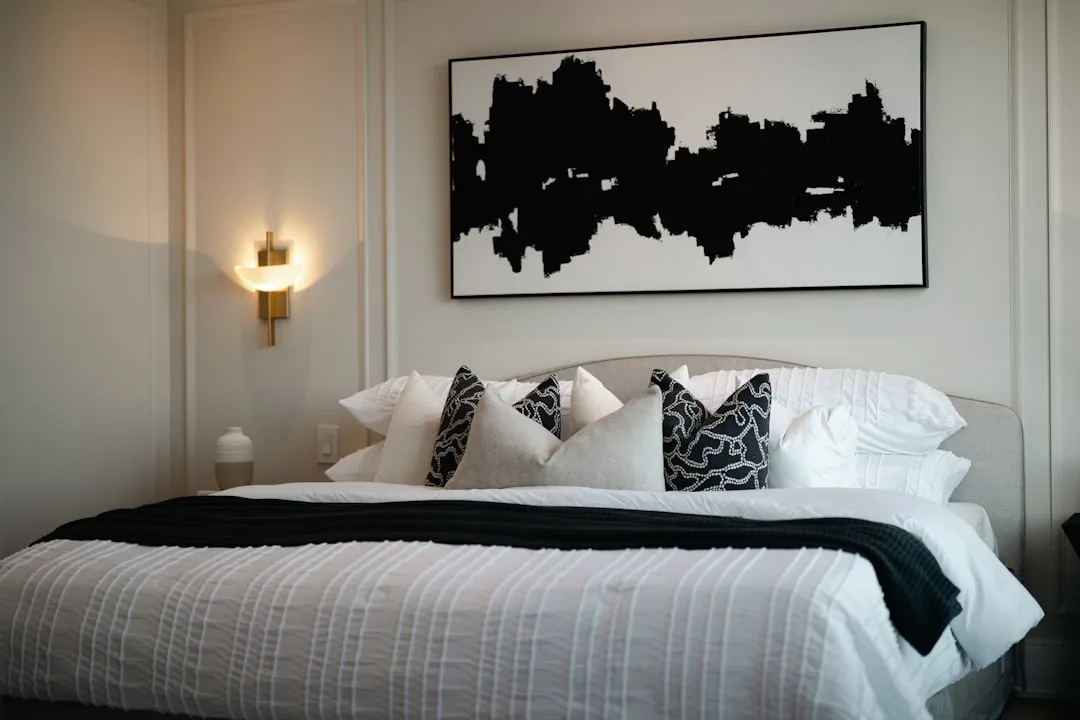
Most people searching for bedroom wall decor above bed ideas make the same two mistakes before they ever pick up a hammer — the art goes up too high and it’s too small — and no amount of swapping styles or frames will fix a placement problem.
Quick Answer
Most bedroom walls above the bed look wrong for the same two reasons — the art is hung too high and it is too small — and no amount of swapping styles or frames will fix a placement problem.
That’s the part nobody tells you when you’re standing in the middle of IKEA holding a canvas. You can have beautiful taste, a real eye for color, and a generous budget, and still end up with a wall that looks like a hotel room that gave up halfway through. The fix isn’t finding better art. It’s understanding why the wall above your bed behaves differently from every other wall in your home — and making decisions based on that reality.
What to Put on a Bedroom Wall Above a Bed: Your Real Options
In This Article
- What to Put on a Bedroom Wall Above a Bed: Your Real Options
- The 2/3 Rule for Wall Art — What It Actually Means (and When to Break It)
- How High to Hang Art Above a Bed — The Number Competitors Keep Getting Wrong
- The Most Common Mistakes (And What They Actually Look Like)
- Specific Format Recommendations by Bed and Room Type
The wall above your bed isn’t just another decorating surface. It occupies roughly 60–70% of a person’s visual field when lying down, which makes it the single highest-impact decorating decision in the entire bedroom — more consequential than the rug, the lighting, or the furniture arrangement combined. Every other wall in your home gets glanced at. This one gets studied for eight hours a night.
That’s why the choice of what goes there deserves more than a mood board scroll.
Before you pick anything, it helps to think in terms of commitment level, because what works for a renter is completely different from what works for someone who owns their walls:
- Permanent options — painted accent walls, applied wallpaper murals, tiled or shiplap installations. These have the highest visual impact and the most staying power, but they’re also the hardest to reverse.
- Semi-permanent options — large single canvases, gallery walls, upholstered fabric panels, oversized mirrors. These involve hardware and some wall damage, but they’re removable and repositionable.
- Flexible options — leaning shelves, tapestries, removable wallpaper panels, adhesive hanging systems. These are ideal for renters, frequent redecorators, and anyone still figuring out their style.
Within each category, four specific factors should be driving your decision before aesthetics even enter the conversation: the width of your bed, the height of your ceiling, whether you have a headboard (and how tall it is), and the available natural or artificial light hitting that wall. These aren’t minor details. They determine format, scale, and placement — which means they determine whether the finished result looks intentional or accidental.
When you’re planning bedroom wall decor above bed, these structural decisions are what separate results that look designed from results that look decorated.
Actionable takeaway: Before you buy anything, write down your bed width, ceiling height, and headboard height. These three numbers will eliminate at least half your options — and that’s a good thing.
The 2/3 Rule for Wall Art — What It Actually Means (and When to Break It)

You’ve seen this rule mentioned everywhere. Most sources repeat it like a fortune cookie: “art should fill two-thirds of the wall space.” That’s actually not what it says — and the misquotation causes real problems.
The 2/3 rule applies to the width of the bed or headboard, not the full wall width. This distinction matters enormously. A queen bed sits 60 inches wide, which means two-thirds equals 40 inches — so a single piece or a gallery grouping should measure at least 40 inches across. A standard king bed runs 76 inches wide, pushing that minimum to about 51 inches. A twin or full drops the requirement significantly.
The wall itself might be 10 feet wide. If you use the wall as the reference point instead of the bed, you’ll end up hanging something that looks proportional to the room but entirely disconnected from the furniture below it.
Here’s the visual logic that makes the rule work: art that’s too narrow creates a floating, unanchored effect — the piece looks like it wandered up there by accident. Art that’s too wide competes with the bed frame rather than supporting it, turning what should be a unified moment into a visual argument.
When the rule doesn’t apply:
- Very low ceilings (under 8 feet): Go wider than two-thirds to emphasize horizontal movement. Wide art stretches the room; art that’s merely proportional to the bed won’t do any compensating work.
- Statement headboards: A tall, upholstered headboard with strong visual presence already fills that wall zone. A headboard above 48 inches may need nothing above it, or only something very restrained — a small pair of sconces, a single modest print. Adding bold art above a statement headboard creates competition.
- Full gallery walls in maximalist rooms: The grouping as a whole should still meet the two-thirds width of the bed, but individual pieces within the arrangement can vary freely.
Actionable takeaway: Measure your bed width right now, multiply by 0.67, and write that number on a piece of tape you stick to the wall before you hang anything. That number is your minimum width. Don’t go smaller.
How High to Hang Art Above a Bed — The Number Competitors Keep Getting Wrong

The 57-inch rule is everywhere. It’s also wrong for above-bed placement, and understanding why will save you the frustration of following directions precisely and still ending up with art that looks disconnected from your room.
The 57–60 inch center-height rule comes from museum and gallery practice — it places the center of a piece at the average standing eye level of an adult. That makes perfect sense when you’re mounting art on an open wall where people walk past it. It makes no sense above a bed, because nobody is standing in front of your headboard.
The correct formula for above-bed placement: hang your art so the bottom edge sits 6–8 inches above the top of the headboard. If you don’t have a headboard, measure 6–8 inches above the top of your pillows when the bed is made. That gap keeps the relationship between the furniture and the art tight and intentional — it signals that the two elements belong to each other.
Why 6–8 inches specifically? Below 6 inches feels cramped, especially if you sit up in bed and read. Above 8 inches on a standard 8-foot ceiling, the art starts to float — it reads as wall decor that happens to be above a bed rather than decor designed for the space.
For rooms with very tall ceilings — 9 feet and above — the rules shift:
- Extend the gap to 10–12 inches
- Scale the art up to fill the vertical space; a piece that would be perfect in a standard room will look stranded in a tall-ceiling space
- Consider a two-piece vertical arrangement or a tall mirror to bridge the wall zone rather than leaving a disconnected band of blank wall above a normal-sized canvas
What this means in real numbers: If you have a 48-inch upholstered headboard and an 8-foot ceiling, the bottom of your art should be at roughly 55–56 inches from the floor. Apply the 57-inch center rule to a 24-inch tall canvas and you’d hang the bottom edge at 45 inches — too low by a foot, and visually awkward.
Actionable takeaway: Stop measuring from the floor entirely. Measure from the top of the headboard, add 6–8 inches, and mark that point on the wall with painter’s tape before you put a single nail in. This single change fixes the most common complaint people have about bedroom wall decor above bed — that the art looks like it’s floating in space with no connection to the furniture below it.
The Most Common Mistakes (And What They Actually Look Like)
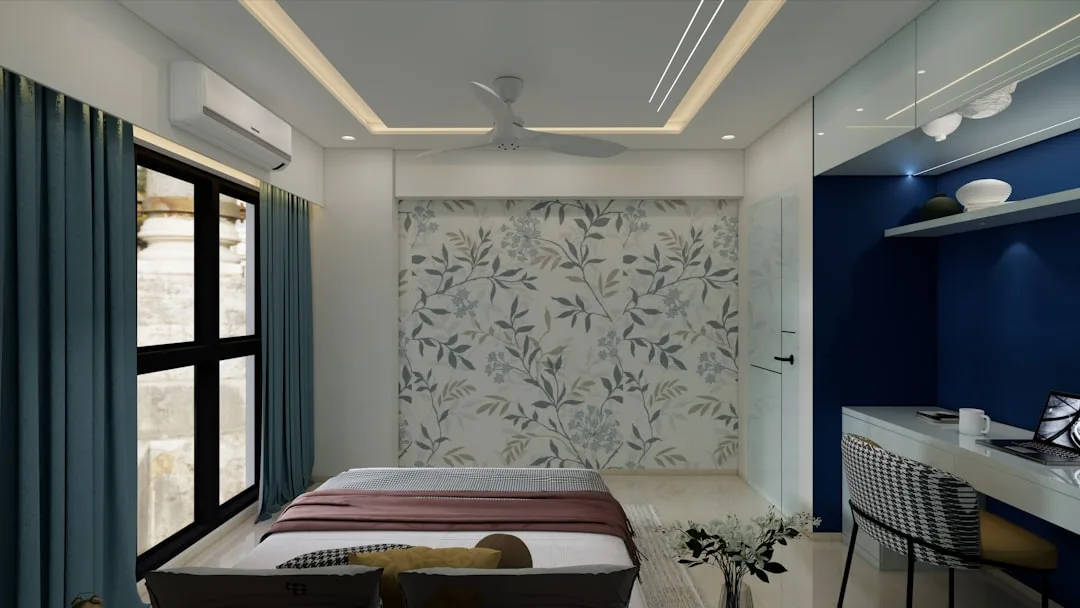
It helps to name the specific failure modes, because most people recognize them only after they’ve already committed to a bad decision.
Too-small single piece: The most common mistake in any bedroom. A 16×20 canvas above a king bed doesn’t just look small — it looks apologetic. The bed reads as the dominant object in the room without any visual counterweight above it. The canvas ends up looking like a placeholder, something you hung temporarily and forgot to replace.
Gallery wall with no anchor: Gallery walls above beds fail when they’re assembled the same way they’d be assembled on a living room wall — starting from a corner, growing outward, adding pieces until the wall feels full. Above a bed, the arrangement needs a clear visual center that lands directly above the midpoint of the bed. Everything else in the grouping radiates from that point. Without a center anchor, the eye has nowhere to land.
Hanging too high: This is the 57-inch rule problem described above, but it shows up in another way too: people eyeball the height because they want the art to feel prominent, and “prominent” feels like “high.” The result is art that sits in the upper third of the wall with a full foot of empty space between it and the headboard. The bed and the wall become two separate, unrelated design decisions sharing the same room.
Mismatched scale in a gallery arrangement: Mixing one very large piece with several very small pieces — say, a 30×40 anchor flanked by 5×7 prints — creates visual noise rather than visual interest. The scale jumps are too extreme. A better approach: vary sizes within a narrower range, such as a 24×30 anchor with supporting pieces in the 11×14 to 16×20 range.
Ignoring the headboard entirely: The headboard is part of the composition whether you treat it that way or not. If you have a tall, dark, heavily carved headboard and you hang light, minimal Scandinavian prints above it, the two elements fight each other. The most successful above-bed arrangements treat the headboard as the visual foundation and build upward from its style, scale, and tone.
Specific Format Recommendations by Bed and Room Type

Rather than generic advice, here’s what actually works for the most common configurations:
Queen bed, 8-foot ceiling, no headboard:
One horizontal canvas or print measuring 40–48 inches wide and 24–30 inches tall. Alternatively, a triptych arrangement with the same total width. Bottom edge at 26–28 inches from the floor (accounting for standard pillow height plus the 6–8 inch gap).
King bed, 8-foot ceiling, upholstered headboard (48 inches tall):
A single large horizontal piece measuring 52–60 inches wide, or a gallery arrangement with the same footprint. Bottom edge at 55–56 inches from the floor. Avoid anything taller than 24–28 inches or it will hit the ceiling zone uncomfortably.
Queen bed, 10-foot ceiling, no headboard:
This is where a large-format vertical piece or a two-piece stacked arrangement earns its keep. A single 36×48 canvas, or two horizontally oriented pieces stacked with a 2-inch gap between them, both centered on the bed midpoint. The vertical space above a standard piece needs to be acknowledged — either fill it intentionally or install a shelf or ledge below the art to visually close the gap between art and bed.
Twin bed, 8-foot ceiling (children’s room or small guest room):
Scale down accordingly — a 24–30 inch wide piece is correct here, not a gallery wall. Children’s rooms often benefit from a single bold print or a small three-piece set rather than a full gallery arrangement, which can feel busy in a smaller space.
Platform bed with no headboard, minimalist aesthetic:
This is the configuration where a large-scale single piece does the most work. Without a headboard providing visual grounding, the art itself has to anchor the wall zone. Go larger than you think you need — a 48×36 or even 60×40 horizontal canvas creates the foundation that the missing headboard would otherwise supply.
FAQ
How far above the bed should I hang wall art?
The bottom edge of your art should sit 6–8 inches above the top of your headboard. If you don’t have a headboard, measure 6–8 inches above the top of your pillows when the bed is made. Rooms with ceilings above 9 feet can extend that gap to 10–12 inches to account for the additional vertical space.
What size art is right for above a queen bed?
Apply the two-thirds rule to your bed width, not your wall width. A queen bed is 60 inches wide, so your art — whether a single piece or a gallery grouping — should span at least 40 inches across. A common sweet spot for a queen is a single horizontal canvas between 40 and 48 inches wide, or a triptych that adds up to the same total width.
Is it okay to leave the wall above the bed completely blank?
Yes, in specific cases. A statement headboard above 48 inches — particularly one with strong texture, pattern, or height — can hold the wall on its own. Minimalist rooms with highly curated furniture often benefit from a blank wall above the bed. The test: stand at the foot of your bed and look at the wall. If it reads as a deliberate choice, it works. If it reads as something you haven’t gotten around to yet, it doesn’t.
What’s the best approach to bedroom wall decor above bed in a rental where I can’t make holes?
Removable wallpaper panels are the highest-impact option — a single large-scale mural panel centered above the bed creates the same visual effect as permanent wallpaper without the commitment. Adhesive hanging systems like Command strips work for lighter pieces up to about 16×20. For heavier pieces, leaning a large canvas on a floating shelf (installed with removable adhesive) gives you more flexibility. Tapestries hung from tension rods or removable curtain rod brackets also work well for adding texture and warmth without wall damage.
Can I mix different frame styles in a gallery wall above the bed?
Yes, but with constraints. Mixing frame materials (wood, metal, natural) works when the finishes share a tonal family — all warm tones, all cool tones, or all natural/neutral. Mixing frame widths works when the wider frames surround larger pieces and thinner frames surround smaller ones, following the visual logic rather than fighting it. What tends to fail: combining very ornate frames with very minimal ones, or mixing black frames with gold frames and natural wood all in the same arrangement. Pick two frame styles at most and stay consistent with how you apply them.
What to put on a bedroom wall above a bed?
How far above the bed should I hang wall art?
What is the 2/3 rule for wall art?
The bottom edge of your art should sit 6–8 inches above the top of your headboard. If you don’t have a headboard, measure 6–8 inches above the top of your pillows when the bed is made. Rooms with ceilings above 9 feet can extend that gap to 10–12 inches to account for the additional vertical space.
How to decorate an empty wall above a bed?
What size art is right for above a queen bed?
What is the rule for wall art above a bed?
Apply the two-thirds rule to your bed width, not your wall width. A queen bed is 60 inches wide, so your art — whether a single piece or a gallery grouping — should span at least 40 inches across. A common sweet spot for a queen is a single horizontal canvas between 40 and 48 inches wide, or a triptych that adds up to the same total width.