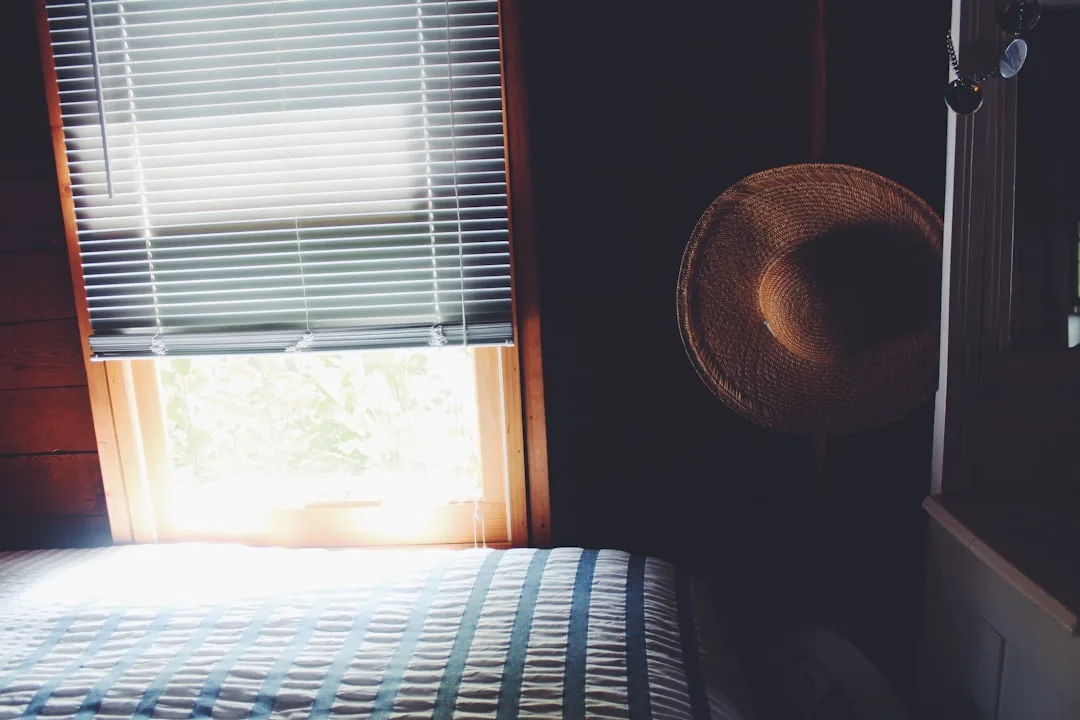
The moment you turn on your bedroom light at night, most “privacy” curtains stop working — and almost no one selling them will tell you that. If you’ve been searching for bedroom curtain ideas for privacy that actually hold up after dark, you’re asking the right question — because most guides stop at daytime solutions and leave the harder problem completely unaddressed.
Quick Answer
The moment you turn on your bedroom light at night, most ‘privacy’ curtains stop working — and almost no one selling them will tell you that.
That’s not a scare tactic. It’s physics. The sheer panel that gave you perfect privacy all afternoon becomes transparent the second it’s brighter inside your room than outside. You’re no longer looking through fabric. You’re displaying yourself through a lit screen, visible from the street at distances up to 50 feet. That’s the gap most bedroom curtain guides never bridge — and it’s exactly why so many bedrooms end up either shrouded in blackout fabric or embarrassingly exposed after dark.
There’s a much smarter middle ground. It involves understanding how light actually moves through fabric, which window treatments work for your specific privacy problem, and why the “just layer sheers and blackout panels” advice you see repeated everywhere is often the wrong answer for real bedrooms with real light conditions.
Here’s what your windows are actually missing.
Why Most Bedroom Window Treatments Fail at Privacy (And What to Do Instead)
In This Article
- Why Most Bedroom Window Treatments Fail at Privacy (And What to Do Instead)
- What Curtains Let You See Out But Not In — The Science Behind One-Way Privacy Fabrics
- Current Trends in Bedroom Window Coverings (And Which Ones Are Worth Your Money)
- How to Layer Bedroom Curtains for Privacy Without Losing Natural Light
- Bedroom Curtain Ideas for Privacy by Window Type
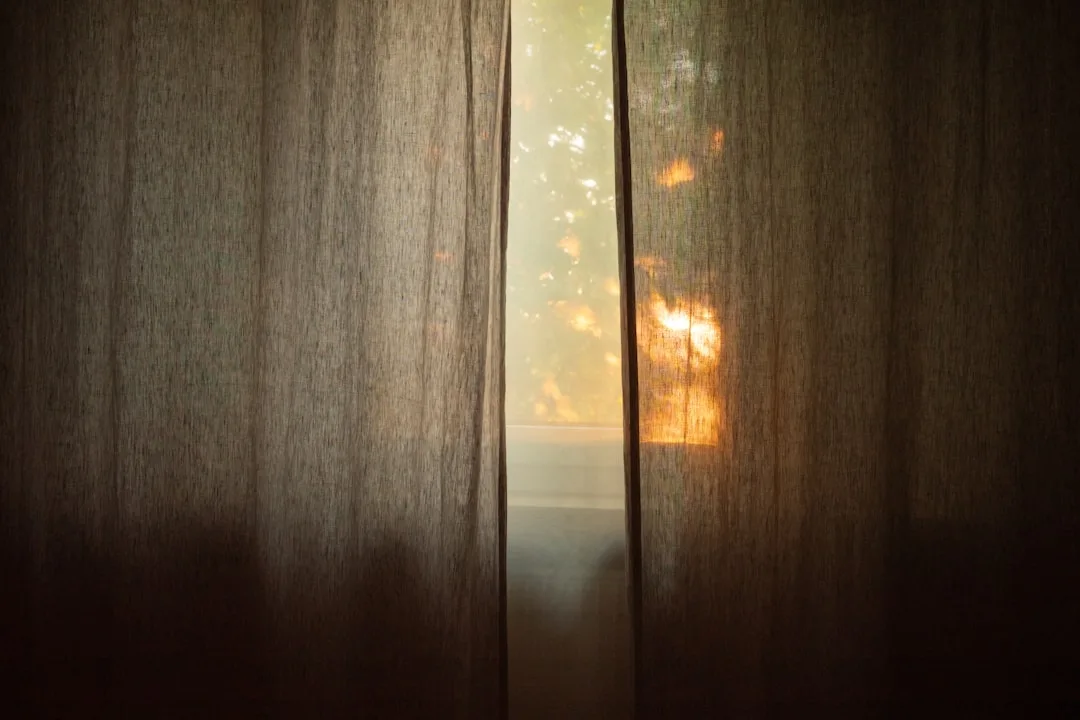
Most people approach bedroom privacy like it’s a binary choice: blackout curtains that turn your room into a cave, or bare windows that turn it into a fishbowl. Both are failures of imagination — and often of information.
The standard advice you’ll find on every curtain retailer’s blog is to “layer a sheer with a blackout panel.” In theory, the sheer gives you daytime diffusion and the blackout gives you nighttime darkness. In practice, this system breaks down quickly in real bedrooms because the angle of incoming light changes everything.
A south-facing bedroom window in the afternoon receives direct sunlight at a low, raking angle that blows straight through most sheer fabrics regardless of their thread count. A street-level window facing a lit sidewalk at 10 PM has its privacy completely reversed by a single bedside lamp. The layered approach solves neither problem cleanly because it was designed for idealized conditions, not for how people actually live in their rooms.
Street-level bedrooms and elevated bedrooms need completely different solutions:
- Street-level windows (ground floor, below eye level from passersby): The critical exposure zone is the lower half of the window. A full-length sheer does nothing for the section most visible from the sidewalk. Consider a café curtain on a tension rod at mid-window height combined with a solar shade above — this covers the high-exposure lower zone without blocking light from the upper half.
- Elevated windows (upper floors, overlooked from neighboring buildings or hillside streets): The threat comes from above, which means standard bottom-coverage strategies leave you fully exposed. Top-down/bottom-up cellular shades are specifically engineered for this scenario — they allow you to lower coverage from the top while keeping the lower portion open.
- Corner windows (two adjacent walls meet at glass): Exposure is multiplied because there’s no wall to anchor sightlines. Wrap-around curtain rod systems that extend well past both window edges are the minimum requirement here.
- Bay windows: The angled side panels create acute viewing angles that standard flat curtains completely miss. Inside-mount Roman shades on each individual facet of the bay are almost always more effective than a single curtain rod bridging the opening.
The American Lighting Association has documented that rooms lit from inside at night are visible from outside at distances up to 50 feet even through light-filtering fabrics — a fact that most curtain guides never mention because it complicates the product pitch. Acknowledging this completely changes how you should shop for bedroom window treatments. Daytime privacy and nighttime privacy are two separate engineering problems that usually require two separate solutions.
The four most common bedroom privacy failures — and what’s actually causing them:
- The sheer-only mistake: Sheers rated “privacy” by manufacturers are tested in flat, controlled light. Your bedroom isn’t a test environment. Sheers fail at night, in direct sun at low angles, and when your interior lighting is brighter than the ambient exterior.
- Insufficient curtain width: Curtain panels that barely cover the window frame create visible gaps at the edges. Each panel should measure 1.5 to 2 times the width of the window it covers, so panels overlap generously at the center and extend past the frame on each side.
- Wrong mounting height: Curtains mounted close to the window frame emphasize the window as a discrete object rather than treating it architecturally. Mounting the rod at ceiling height or within 4 inches of the ceiling extends the panel down the wall and eliminates the gap between curtain top and ceiling where light can leak.
- No side-return coverage: Standard flat curtain rods leave the sides of deep window reveals completely uncovered. An L-shaped or wrap-around return bracket brings the curtain edge flush to the wall, closing off lateral sightlines that standard installation ignores.
Actionable takeaway: Before buying anything, stand on the sidewalk outside your bedroom window at night with the light on inside. What you see is exactly what your neighbors see. That’s your actual privacy baseline — and it’s almost certainly worse than you thought.
What Curtains Let You See Out But Not In — The Science Behind One-Way Privacy Fabrics
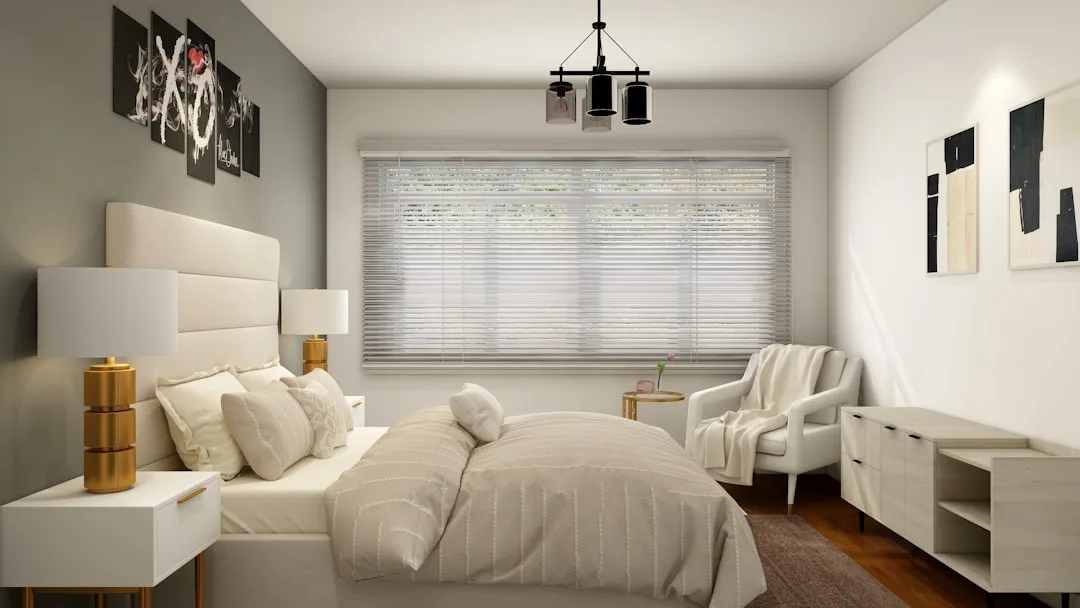
The closest thing to a genuinely one-way window treatment for a bedroom is a solar shade — specifically one made from solar screen fabric, the same open-weave vinyl material used in commercial roller shades.
Here’s how it works. Solar fabrics achieve one-way visibility through light differential, not through any optical trick or tinting. When the exterior is brighter than the interior — which is true during virtually every daylight hour — the fabric absorbs and scatters light from outside while allowing your eyes (adapted to the dimmer interior) to see through the weave. The moment that equation reverses at night, so does the privacy. This isn’t a flaw in the product. It’s the physics of light transmission, and understanding it tells you exactly when solar shades work and when they don’t.
The key specification to understand when shopping is the openness factor:
- 1% openness factor: The tightest weave available. Blocks approximately 99% of UV rays, maintains strong daytime privacy at typical residential setback distances, and provides the best glare reduction. Nearly opaque in appearance from outside during the day. Still not private at night.
- 3% openness factor: The most common balance point for residential use. Good daytime privacy, more visible texture and depth than 1%, allows slightly more natural light transmission.
- 5% openness factor: More of a view-through shade than a privacy shade. Better suited for living rooms or home offices where seeing out is the priority and privacy is secondary.
- 10% openness factor and above: Minimal privacy value in a bedroom context. These are appropriate for glare reduction on west-facing home office windows, not for bedroom curtain ideas for privacy. Don’t let a retailer talk you into these for a bedroom without understanding this distinction.
Hunter Douglas and Lutron product documentation confirm that 1% openness solar fabrics maintain daytime privacy at most residential setback distances — typically 15 to 30 feet — making them genuinely effective for the hours when you’re actually using your bedroom as a living space.
One underappreciated detail: fabric color on the interior-facing side matters more than most buyers realize. Darker interior-facing fabrics outperform lighter ones because they reflect less interior light back toward the glass, reducing the “glow” effect that makes you visible at night. A charcoal or bronze solar shade will maintain its daytime privacy slightly longer into dusk than a white or cream version of the same fabric.
How to evaluate solar shade samples before buying:
- Order physical samples, not just digital swatches. Hold the sample up to your window at different times of day.
- At midday with the sun behind the shade, look through it from inside. You should see the street clearly. That confirms one-way effect is working.
- At dusk, turn on your bedside lamp and hold the sample against the glass while someone stands outside. This is the real test.
- Compare dark-backed and light-backed versions of the same openness factor side by side — the performance difference is visible even with a small sample.
- Check the hem and edges of the sample for fraying or stiffness — these indicate fabric quality and will predict how the shade holds up after repeated rolling over months.
Woven wood shades occupy a different category. They’re not solar fabrics, but their irregular open weave creates a similar light-differential effect during the day. The view through them is obscured rather than clear, making them better for privacy than for actually seeing out — but they’re genuinely beautiful and pair well with a secondary blackout roller for night use.
Actionable takeaway: For a bedroom where daytime privacy and outdoor views are both priorities, specify a 1% openness solar roller shade in a charcoal or bronze colorway, then add a separate blackout roller on a dual bracket system for nighttime coverage.
Current Trends in Bedroom Window Coverings (And Which Ones Are Worth Your Money)
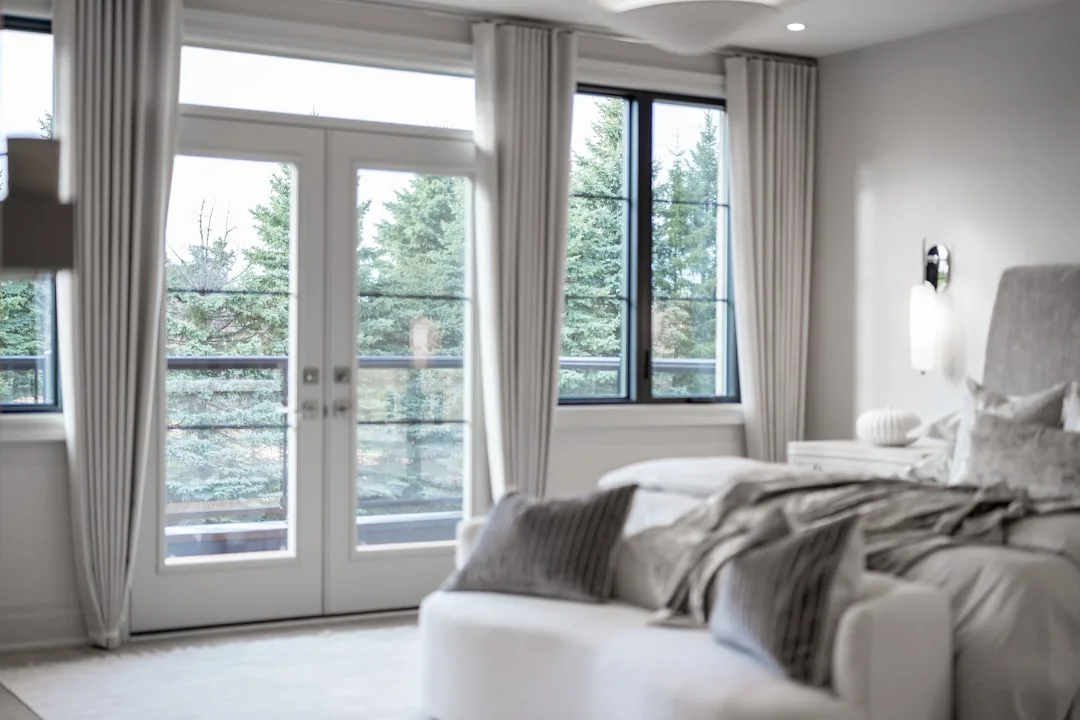
Bedroom window treatment design has been moving in a clear direction for the past three years, and it’s not toward more fabric. The shift is toward quieter, more architectural solutions that treat windows as structural features rather than opportunities for decorative flourish.
Here are the trends with genuine staying power — and the context that separates smart investments from expensive mistakes:
Motorized dual-shade systems have dropped significantly in price as Lutron Serena, IKEA’s FYRTUR, and similar mid-market options brought the technology out of the luxury-only tier. A motorized system on a dual bracket — one solar shade and one blackout — is now accessible at the $200–$400 per window range for standard sizes. The practical case for motorization in a bedroom is strong: you’re not fumbling with cords at 6 AM, both shades respond to a single app command or wall switch, and you can program them to respond to sunrise automatically. The privacy case is equally strong — automated schedules mean your blackout shade closes at a consistent time each evening rather than whenever you remember.
Linen and linen-look fabrics in full-length panels continue to dominate bedroom aesthetics in 2024 because they do something sheer polyester panels have never managed: they diffuse light softly rather than blocking or transmitting it. The texture interrupts the silhouette effect that makes sheer panels dangerous for privacy. Belgian linen in natural, oat, or warm greige tones is the highest-performing version; linen-cotton blends at the $25–$40 per panel price point deliver much of the same visual effect without the full investment.
What’s worth the money versus what’s mostly marketing:
- Worth it: Dual-bracket hardware systems. The difference between a $15 single bracket and a $45 dual-function bracket is the difference between one window treatment and two working in coordination. This is the mechanical infrastructure your whole setup depends on.
- Worth it: Blackout liner tape and side-channel tracks for existing curtains. If you already have curtains that look right but leak light at the edges, adhesive blackout tape on the back hem and clip-on side tracks can solve the problem without replacing what you have.
- Worth it: Custom-length panels if your ceilings are above 9 feet. Off-the-rack panels in 84″ or 96″ lengths leave a visible gap on taller walls that undermines the whole installation.
- Skip it: “Privacy” spray coatings sold as topical treatments for existing sheer fabric. These degrade with washing and don’t address the fundamental light-differential problem.
- Skip it: Double-rod decorative valances layered over privacy panels. They add visual complexity without adding any functional privacy, and they interrupt the clean floor-to-ceiling line that makes curtains read as architectural.
- Skip it: Thermal-lined curtains marketed primarily for energy efficiency when your actual problem is privacy. The thermal lining addresses insulation; it doesn’t necessarily make the fabric more opaque or address side-light leakage.
Room darkening versus true blackout — why this distinction matters more than brands:
Room darkening fabrics typically block 95–99% of light. They work well for lighter sleepers and for bedrooms that don’t receive direct early-morning sun. True blackout fabrics achieve 100% light blockage through multiple foam or acrylic layers bonded to the fabric backing. The difference is invisible in a dim room and obvious at 6 AM in July when the sun rises at 5:17 and your room darkening curtains glow faintly orange at every seam and gap.
If you’re using bedroom curtain ideas for privacy as your starting point but you also have a sleep quality problem, the solution is always true blackout plus side-channel tracks, not a better room darkening fabric. The tracks matter as much as the fabric.
How to Layer Bedroom Curtains for Privacy Without Losing Natural Light
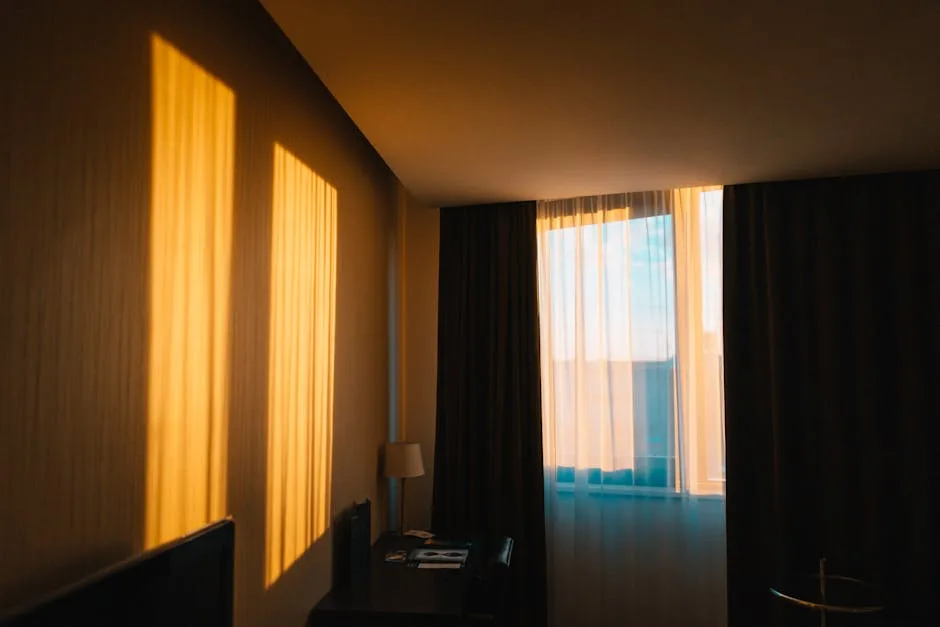
The layering principle is correct — it’s the execution that fails most bedrooms. The problem with standard “sheer plus blackout” advice is that it treats both layers as permanent, simultaneous solutions rather than as a switchable system.
A properly layered bedroom window system has three functional modes:
- Full open: Both layers retracted or tied back. Maximum light, zero privacy. Used when you need daylight and aren’t concerned about visibility (mid-morning in a high-floor bedroom, for example).
- Privacy layer only: Solar shade or linen panel deployed alone. Full daytime privacy with maintained natural light and outward view. This is the mode most bedrooms should be in during waking daylight hours.
- Full blackout: Both layers closed, solar shade and blackout panel together. Used for sleep, for daytime napping, or for nighttime privacy when you want the room fully lit inside.
How to set this up with off-the-shelf hardware:
- Use a double curtain rod or dual roller bracket at the window.
- Front position: decorative linen or textured panel in a neutral — this is your aesthetic layer and your daytime light diffuser.
- Back position: blackout roller shade or blackout panel — this is your nighttime and sleep layer.
- Both operate independently. You never have to choose between light and privacy during the day.
The five most overlooked installation details that undermine privacy after the curtains are hung:
- Gap at the ceiling: If your curtain rod is mounted more than 4 inches below the ceiling, light spills through the gap at the top and creates a glow visible from outside. Mount as close to the ceiling as your hardware allows.
- Gap at the floor: Curtains that puddle or touch the floor eliminate the bottom gap. Curtains that hover 1–2 inches above the floor create a light strip visible from the street at night. Aim for contact or a deliberate 0.5-inch clearance — not the 2-inch factory hem standard that most off-the-rack panels default to.
- Insufficient panel width: Each panel should cover 1.5x to 2x the window width. Panels that barely reach center when closed leave visible gaps at the overlap.
- No wall return: The curtain edge should reach the wall, not float in front of the window frame. Side returns of 4–6 inches are standard on good hardware; without them, sightlines enter from the sides of the panel.
- Wrong bracket projection: The bracket arm that holds the rod away from the wall needs to extend far enough that the panel falls in front of the window trim, not behind it. A 3–4 inch projection is standard for double-rod systems; less than 2 inches almost always creates trim interference.
Bedroom Curtain Ideas for Privacy by Window Type
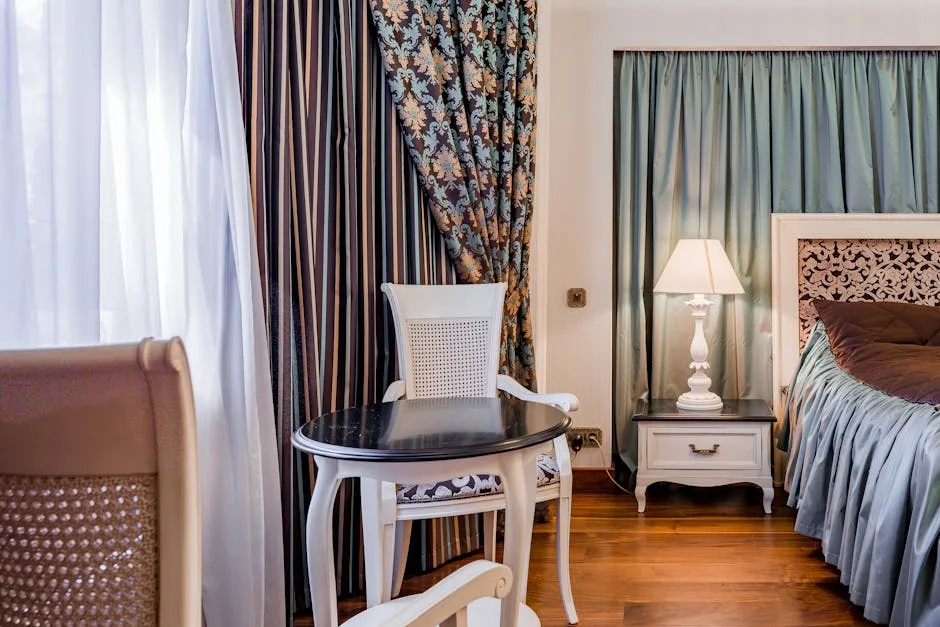
Not every bedroom window needs the same approach. The hardware, fabric, and layering strategy that works on a standard double-hung window fails on a floor-to-ceiling casement and is completely impractical on a skylight. Here’s how to match your solution to your specific window geometry.
Standard double-hung windows (the most common residential bedroom window):
- Full-length panels from ceiling to floor, regardless of window height. This is the single change that most transforms privacy and perceived room height simultaneously.
- 1% solar roller in charcoal as the primary daytime layer.
- Blackout panel or roller as the nighttime layer.
- Extend the rod 8–12 inches beyond the window frame on each side to allow panels to stack completely off the glass when open.
Floor-to-ceiling windows and sliding glass doors:
- These require a track system rather than a rod, as the combined weight of full-height panels typically bends or sags standard rod hardware over spans wider than 6 feet.
- Ripple fold panels on a ceiling-mounted track give the cleanest result — the even folds maintain consistent opacity across the full width.
- For a sliding door specifically, a bypass track system allows panels to stack independently without blocking the door opening.
Transom windows above standard windows:
- The transom is the most commonly ignored privacy gap in a bedroom. Light from inside your room exits through the transom at a high angle that’s visible from across the street and from upper floors of neighboring buildings.
- A matching blackout roller sized to the transom, operated independently of the main window treatment, closes this gap.
- Alternatively, if the transom is fixed glass and privacy rather than light control is the priority, frosted window film applied directly to the glass is a permanent, low-cost solution.
Skylights:
- Standard curtain hardware is irrelevant here. The solutions are: motorized blackout cellular shades designed specifically for pitched skylights (Velux makes the most comprehensive range), or blackout roller shades on ceiling-mounted tracks for flat skylights.
- Cellular shades for skylights trap air in their honeycomb structure, which does double duty as insulation — relevant because skylights lose more heat per square foot than any other glazed surface in a bedroom.
Casement windows that swing inward:
- Any treatment that mounts inside the frame will be destroyed by the operating mechanism of an inward-swinging casement. Outside-mount, ceiling-mounted, or wall-mounted hardware is mandatory.
- Plantation shutters are often the cleanest solution for inward-swinging casements because they fold completely flat to the side when the window is open, clearing the swing path entirely.
Frequently Asked Questions About Bedroom Curtain Ideas for Privacy
Do blackout curtains actually provide privacy, or just darkness?
Both — but the mechanism is different from what most people assume. A true blackout curtain prevents light from passing through the fabric in either direction. This means no one outside can see your silhouette or interior when the blackout panel is closed, regardless of how bright your room is inside. The privacy is a consequence of the light blockage, not a separate feature. Where blackout curtains fail on privacy is at the edges: gaps at the ceiling, floor, and sides allow light to escape and create the glowing-rectangle effect that makes your room readable from outside even with the curtains nominally closed.
Can I get privacy with curtains without making my bedroom dark during the day?
Yes, but you need to separate the two functions. A 1% openness solar shade provides strong daytime privacy while maintaining your view out and allowing diffused natural light in. It does not provide privacy at night. The correct system is a solar shade for daytime use plus a blackout layer that deploys separately at night — either a dual roller on the same bracket or a separate panel rod behind the solar shade.
What’s the best bedroom curtain option for a ground-floor window facing the street?
For street-level bedroom windows where the lower portion of the glass is most exposed, the most effective approach is a top-down/bottom-up shade on the primary layer. This allows you to lower coverage from the top (for light) while keeping the bottom section — which is most visible from the sidewalk — fully covered. Pair this with a secondary floor-length blackout panel for nighttime. A café curtain covering only the lower third of the window is a simpler alternative if the top-down functionality isn’t necessary.
Why do my “privacy” curtains feel see-through at night even though they looked fine in the store?
Because they were evaluated in a store environment where the interior and exterior light levels were roughly equal. The privacy effect of light-filtering and sheer fabrics depends entirely on it being brighter outside than inside. In the store, that condition probably held. At home, the moment you turn on a bedside lamp in a dark room, the equation reverses and the fabric becomes transparent from outside. This is normal physics, not a product defect — the solution is either a blackout layer for nighttime use or dimming your interior lighting to a level below the exterior ambient light when privacy matters.
How much should I expect to spend on a bedroom window treatment that actually works for privacy?
A functional two-layer system — solar shade plus blackout roller on a dual bracket — runs approximately $150–$400 per window for standard sizes using mid-market products from brands like Blinds.com, Select Blinds, or similar. Custom sizing for non-standard windows adds 20–40%. The hardware (dual bracket, quality rod or track) accounts for roughly 20% of that cost and is the piece most worth spending on, since it’s the part you can’t easily replace later without redoing the entire installation. Motorized versions of the same system start around $300–$500 per window at current mid-market pricing. Purely decorative linen panels from IKEA or H&M Home can be added to the front position for $30–$80 per panel without affecting the functional layers behind them.
What curtains can you see out but not in?
Do blackout curtains actually provide privacy, or just darkness?
What to use instead of curtains for a bedroom?
Both — but the mechanism is different from what most people assume. A true blackout curtain prevents light from passing through the fabric in either direction. This means no one outside can see your silhouette or interior when the blackout panel is closed, regardless of how bright your room is inside. The privacy is a consequence of the light blockage, not a separate feature. Where blackout curtains fail on privacy is at the edges: gaps at the ceiling, floor, and sides allow light to escape and create the glowing-rectangle effect that makes your room readable from outside even with the curtains nominally closed.
What is the current trend for bedroom window coverings?
Can I get privacy with curtains without making my bedroom dark during the day?
What does Martha Stewart use instead of curtains?
Yes, but you need to separate the two functions. A 1% openness solar shade provides strong daytime privacy while maintaining your view out and allowing diffused natural light in. It does not provide privacy at night. The correct system is a solar shade for daytime use plus a blackout layer that deploys separately at night — either a dual roller on the same bracket or a separate panel rod behind the solar shade.