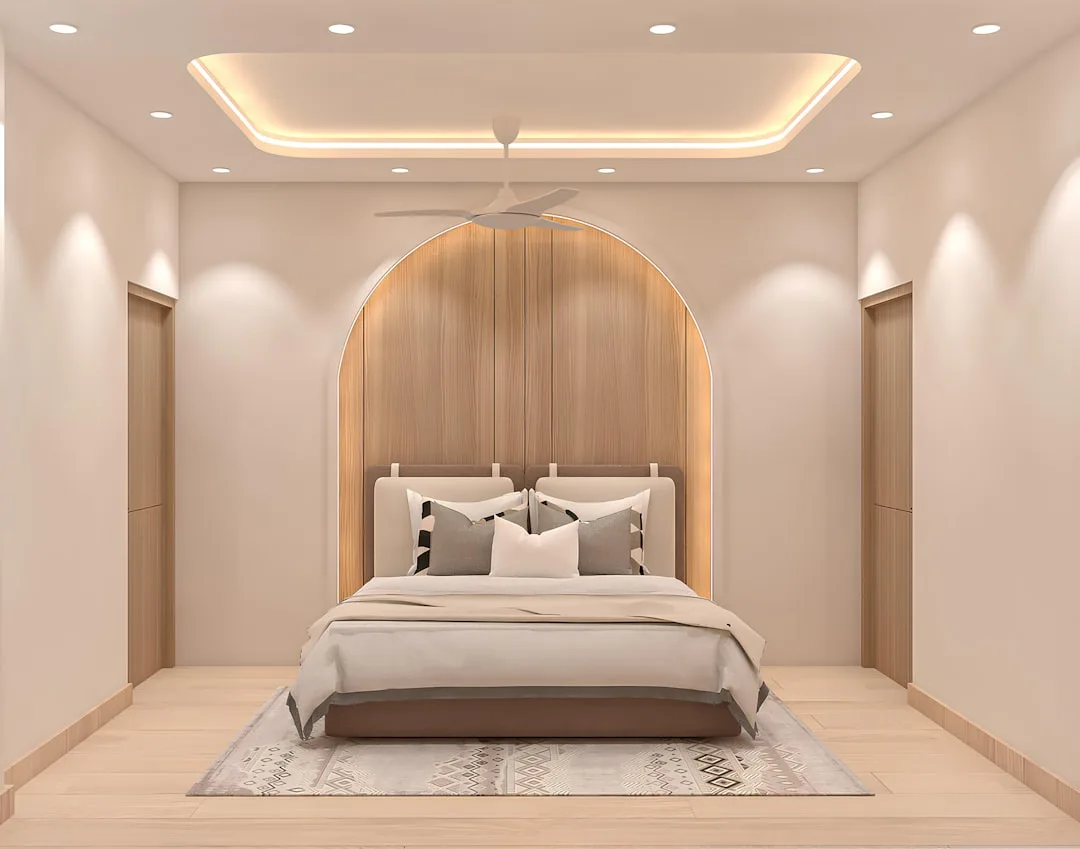
Bedroom lighting without overhead light is one of those design challenges that gets mishandled almost universally — and that’s a shame, because the constraint is actually an advantage in disguise. The bedroom in most interior design magazines has no overhead light — and that is not an accident or a budget constraint, it is a deliberate choice that sleep scientists, lighting designers, and hospitality architects all agree on. Luxury hotel rooms are designed without ceiling-mounted fixtures almost universally, because the hospitality industry figured out decades ago what residential design is still catching up to: overhead light in a bedroom is actively working against the room’s primary purpose. The absence of a ceiling fixture is not a problem to solve. It is an invitation to do something better.
Quick Answer
The bedroom in most interior design magazines has no overhead light — and that is not an accident or a budget constraint, it is a deliberate choice that sleep scientists, lighting designers, and hospitality architects all agree on.
Why Bedrooms Without Overhead Fixtures Are Actually a Design Advantage
In This Article
- Why Bedrooms Without Overhead Fixtures Are Actually a Design Advantage
- Map Your Bedroom’s Four Functional Zones Before You Buy a Single Bulb
- The Sleep Zone: Bedside Lighting That Works Harder Than a Table Lamp
- The Ambient and Task Zones: Solving the “It Still Feels Dark” Problem
- How to Layer All Four Zones Into a Coherent System
Most people treat a bedroom without overhead light the way they’d treat a flat tire — an inconvenience to patch as cheaply and quickly as possible. A floor lamp from Target, maybe two if the room feels dark. Done. What they end up with is a room that feels dim and slightly depressing, which they blame on the missing ceiling fixture, when the actual culprit is that they replaced one blunt instrument with another.
Here is what the instinct misses entirely: overhead lighting creates flat, directionless illumination that collapses visual depth in a room. When every surface is lit from the same angle, nothing has shadow. Nothing has dimension. The room looks like a photograph taken with a built-in flash — technically lit, visually dead.
The research makes the biological case just as clearly. The American Academy of Sleep Medicine links bright overhead light exposure in the two hours before bed to measurably delayed sleep onset, because the retina has light-sensitive cells that read overhead light as “mid-afternoon sun” and suppress melatonin accordingly. A ceiling fixture positioned directly above your eyeline as you lie in bed is one of the worst possible things for your sleep biology. The absence of one, handled correctly, is a genuine advantage.
Luxury bedrooms — the ones in hotels that cost $600 a night and make you want to immediately redecorate your house — almost never have a ceiling fixture over the bed. What they have instead is multiple layered sources at varied heights, all controllable, all warm. The result feels enveloping rather than exposed. That is achievable in a 180-square-foot apartment bedroom. It just requires treating lighting as a system rather than a single fixture problem.
The reframe is this: you do not have a lighting deficit. You have a blank canvas that forces intentional decisions most overhead-lit rooms never bother to make. Bedroom lighting without overhead light, done with a layered strategy, consistently outperforms ceiling-fixture rooms in both visual warmth and sleep quality — not despite the missing fixture, but partly because of it.
Actionable takeaway: Before you buy anything, photograph your bedroom at night with only your current lighting. Look at what’s dark, what’s washed out, and where the light sources actually are. That photograph is your diagnostic.
Map Your Bedroom’s Four Functional Zones Before You Buy a Single Bulb
Eleven years of walking into clients’ bedrooms taught me one reliable pattern: people buy lamps based on what looks good in a product photo, place them where there’s available surface space, and then wonder why the room still feels wrong. The lamp is rarely the problem. The absence of a spatial strategy is.
Before any fixture purchase, break your bedroom into four zones — not as an abstract exercise, but as a physical mapping of how you actually use the room.
The sleep zone covers the bed and the two feet on either side of it. This is where you read, wind down, wake up, and spend more horizontal hours than anywhere else in your life. Lighting here must be warm, dimmable, and positioned so it never shines directly into your eyes when you’re lying down. This zone has the strictest requirements of the four.
The task zone is wherever you get dressed, groom, or work. If you have a vanity, a full-length mirror, or a desk in your bedroom, that area needs its own lighting logic entirely — different color temperature, different intensity, different purpose than the sleep zone. Treating these as the same zone is the error I see most often, and it causes both zones to underperform.
The ambient zone is the open floor space, the middle of the room, the areas that don’t have a specific activity tied to them but still need fill light to prevent the room from feeling cavernous after dark. This is where most bedrooms have nothing — and where most of the “it always feels dark” complaints originate.
The accent zone covers anything with visual merit: artwork, a plant with interesting structure, architectural details, open shelving. This zone is optional in the sense that ignoring it won’t make your room dysfunctional — but including it is what separates a well-lit bedroom from one that genuinely looks designed.
Lighting designers recommend a minimum of three distinct light sources in any bedroom under 200 square feet, specifically to avoid the flat single-source shadows that make a room feel smaller and less habitable. Zone mapping ensures those sources are placed with purpose rather than dropped wherever a nightstand happens to be.
- Sleep zone: 1–2 sources, warm and dimmable, ideally positioned at shoulder height or below
- Task zone: 1 dedicated source, higher CRI (90+), positioned to eliminate shadow on your face or work surface
- Ambient zone: 1–2 fill sources, indirect preferred, pointed toward walls or ceiling to bounce light
- Accent zone: 1–3 directional sources, low wattage, used to create visual hierarchy in the room
Actionable takeaway: Draw a rough floor plan of your bedroom and label which zone each area falls into. You’ll immediately see which zones have no lighting plan — those are your first purchases, not your last.
The Sleep Zone: Bedside Lighting That Works Harder Than a Table Lamp
I once convinced a client to return two matching ceramic table lamps she’d already bought — $240 total, not a trivial amount — because they were going to do exactly the wrong thing for her sleep zone. She had a reading habit, a small nightstand, and a partner who went to bed an hour earlier than she did. The lamps would have lit the whole side of the room, cluttered the only surface space she had, and pointed light directly at her face at a 45-degree upward angle from the table. She was skeptical. We replaced them with two plug-in swing-arm sconces mounted at shoulder height, and within a week she told me the bedroom felt like a completely different room.
Wall-mounted plug-in sconces are the single highest-impact swap available to someone with no overhead light and no electrician. They mount with a single anchor, the cord routes along the wall or hides behind the headboard, and they free the entire nightstand surface. More importantly, they position the light source at exactly the right height — level with your shoulder when sitting up in bed — which means the light falls across your book or phone screen without ever pointing at your eyes when you recline.
The specific characteristics to look for in sleep zone lighting:
- Color temperature between 2200K and 2700K. This is the warm amber range that sits below the threshold where light meaningfully suppresses melatonin. Anything labeled “soft white” at 3000K is borderline. Anything labeled “bright white” or “daylight” is the wrong bulb entirely for this zone.
- A dimmer circuit or a bulb with built-in dimming. Fixed-brightness bedside lighting is a design failure regardless of how attractive the fixture is. You need full brightness for reading, 20 percent for winding down, and everything in between.
- A shade or diffuser that contains the beam. An exposed bulb, even a warm one, creates glare when you shift from sitting to lying down. Any shade that directs light downward solves this.
- Independent switching for each side of the bed. This is non-negotiable in a shared bedroom and genuinely useful even when you sleep alone.
If plug-in sconces feel like too much installation, clip-on reading lights with flexible gooseneck arms mounted to a headboard achieve most of the same geometry. They are less visually elegant but functionally sound, and they cost a fraction of even a modest table lamp. The geometry matters more than the fixture category.
What to avoid in the sleep zone:
- Torchiere floor lamps — they aim light at the ceiling and reflect it back as diffuse ambient light, which is fine for the ambient zone but creates no useful directionality for reading and lights the entire room equally
- Table lamps with wide translucent shades — the shade spreads light in a 270-degree radius, including directly at your partner and across the ceiling
- LED strips under the bed frame — visually interesting, but they light the floor and create an upward glow that can actually be more disruptive than a well-placed sconce
Actionable takeaway: Measure the height of your mattress top from the floor, then add 24 inches. That is the target mounting height for a wall sconce in your sleep zone — it will be at roughly shoulder height when you’re sitting up and out of your direct sightline when you’re lying down.
The Ambient and Task Zones: Solving the “It Still Feels Dark” Problem
Getting the sleep zone right is the first priority, but it accounts for maybe 40 percent of a bedroom’s total lighting. The other 60 percent is why rooms with perfectly good bedside lamps still feel dim, flat, or unfinished after dark.
The ambient zone problem is almost always the same: people have light sources at two heights — table level and floor level — and nothing that fills the upper half of the room. The upper walls and ceiling read as dark voids, which the eye interprets as a compressed, low-ceilinged space regardless of the room’s actual dimensions. The fix is indirect uplight, and it does not require expensive fixtures.
Effective ambient solutions for bedroom lighting without overhead light:
- Arc floor lamps with an upward-facing shade positioned in a corner push light toward the ceiling and bounce it back as soft, even fill. A single arc lamp in the far corner from the bed can transform how large a room feels after dark.
- Table lamps with opaque shades on a dresser or console create a secondary light source at eye level when standing, which fills the zone between bedside height and the ceiling.
- LED strip lighting on top of wardrobe units or behind a headboard — not underneath the bed, but elevated — creates an indirect glow that raises the apparent ceiling height.
- Plug-in torchieres placed in the ambient zone (not the sleep zone) do useful work here specifically because their ceiling-directed light is exactly what this zone needs.
The task zone deserves its own treatment because it has physiologically different requirements from every other zone in the room. Getting dressed requires enough light to distinguish navy from black. Applying makeup or grooming requires a color-accurate light source. Working at a desk requires enough intensity to sustain focus without eye strain. None of these needs are served by warm, dim ambient light.
Task zone specifics:
- Vanity lighting should bracket the mirror horizontally, not sit above it. An overhead vanity fixture casts downward shadows across the face that make color assessment nearly impossible. Side-mounted sconces or a lighted mirror with bulbs around the perimeter are the correct geometry.
- Desk lighting should produce 450–550 lumens at the work surface and sit to the left of the keyboard for right-handed users (or right for left-handed), positioned so your hand doesn’t cast a shadow on what you’re writing.
- Color Rendering Index (CRI) matters more in the task zone than anywhere else. A CRI of 90 or above means colors appear as they would in natural daylight. Anything below 80 makes color-dependent tasks — choosing clothing, applying makeup — significantly harder.
- A cooler color temperature in the task zone (3000K–3500K) versus the sleep zone (2200K–2700K) is the correct differentiation. The slight visual contrast also signals to your brain that these are functionally different spaces, which helps with the mental transition to wind-down later in the evening.
Actionable takeaway: If you dress or groom in your bedroom, the task zone lighting is the one place where warmer and dimmer is the wrong direction. Prioritize accuracy over atmosphere here, even if it means having a fixture that looks slightly out of place with the rest of the room’s aesthetic.
How to Layer All Four Zones Into a Coherent System
Having four distinct zones with appropriate fixtures is necessary but not sufficient. What separates a designed bedroom from a room that simply has a lot of lamps is controllability — the ability to shift the room’s lighting state to match what you’re actually doing at a given moment.
A bedroom should have at least three distinct lighting states:
Active state: Task zone on at full brightness, ambient zone at moderate intensity, sleep zone off or very dim. This is the state for getting dressed, working, or any activity that requires attention and energy.
Transition state: Task zone off, ambient zone at low-to-moderate intensity, sleep zone at moderate intensity. This is the 60–90 minutes before sleep — winding down, reading, conversation. Most of a bedroom’s evening life happens here.
Sleep preparation state: All zones off except sleep zone at 10–20 percent brightness. This is the 20–30 minutes immediately before sleep, when the goal is to give the eye as little stimulation as possible while still navigating the room safely.
Achieving these states without a smart home system or rewiring is simpler than it sounds:
- Smart bulbs in existing fixtures — brands like Philips Hue, LIFX, and Govee allow full dimming and color temperature control from a phone app or voice command, no new wiring required
- Plug-in dimmer modules that sit between the wall outlet and the lamp cord work with most incandescent and LED bulbs and cost between $12 and $25 each
- Lamps with built-in three-way switches offer low, medium, and high settings without any additional hardware
- A power strip with individual switches for multiple lamps allows you to turn several sources on and off from one location — a low-tech but highly functional solution for a nightstand
The goal is to be able to shift from active to transition to sleep preparation state without getting out of bed. If any lighting adjustment requires walking across the room, it will not happen consistently, and the system breaks down at the moment it matters most.
Actionable takeaway: Before purchasing any new fixtures, check whether your existing lamps are compatible with smart bulbs. Most standard E26 socket lamps are. Adding a $12 smart bulb to a lamp you already own is almost always the highest-value first step in building a controllable system.
Frequently Asked Questions
My bedroom has no overhead light and no natural light. Won’t layered lighting still feel dark?
A room without natural light has a different baseline, but the layered approach matters even more in that context, not less. The reason windowless or low-light rooms feel oppressive is almost always that they have one or two light sources that create deep shadows across most of the room. Adding indirect sources aimed at the ceiling and upper walls — even low-wattage ones — dramatically changes how the space reads. A 40-watt-equivalent LED aimed at a white ceiling in a dark corner contributes more perceived brightness than a 100-watt-equivalent lamp pointed directly at the floor. Perceived brightness is about surface coverage, not raw lumens.
Can I really replace every lamp with plug-in sconces, or is that going to look strange?
Plug-in sconces have improved significantly in the past decade. The cord management is the part people worry about most, and it is genuinely solvable: the cord can be routed along the wall in a cord channel painted to match, tucked behind a headboard, or run under a bed skirt to an outlet. Most people who worry about visible cords find that a cord channel takes about 20 minutes to install and is essentially invisible once painted. The fixtures themselves are available in every aesthetic from minimal matte black to rattan to antiqued brass — they do not look like a compromise solution.
What’s the best single fixture for a bedroom with no overhead light and no budget for a full system?
If the constraint is one fixture and one budget, a dimmable arc floor lamp with an upward-facing shade positioned in the corner farthest from the bed is the highest-value single purchase. It solves the ambient zone, raises the apparent ceiling height, doesn’t compete with the sleep zone, and creates enough fill light to make the room feel intentional rather than underfurnished. Add a single plug-in swing-arm sconce on the bedside wall when the budget allows, and you’ve covered the two highest-priority zones with two fixtures.
How do I handle bedroom lighting without overhead light in a rental where I can’t put holes in walls?
Plug-in sconces technically require a single anchor point, which most landlords permit or at least overlook given the minimal damage. If that’s genuinely off the table, the best no-damage alternatives are: a floor-standing swing-arm lamp (essentially a sconce geometry on a freestanding base), a headboard with integrated USB ports and built-in reading lights, or a tall arc lamp paired with clip-on reading lights that attach to the headboard. None of these require any wall penetration. The geometry is slightly less precise than a wall-mounted solution, but the functional difference is marginal.
Do I need smart bulbs, or can I manage this with regular lamps and manual switches?
Smart bulbs make the system significantly easier to use, but they are not required. The critical feature is dimmability — a bedroom lighting system with no dimming capability will always feel like a compromise because no single brightness level works for both active use and sleep preparation. Standard dimmable LED bulbs in lamps with built-in dimmers, or with plug-in dimmer modules, achieve the same functional result as smart bulbs for a fraction of the cost. The advantage of smart bulbs is convenience and the ability to schedule color temperature shifts — useful, but not essential for the core system to work.
My bedroom has no overhead light and no natural light. Won’t layered lighting still feel dark?
A room without natural light has a different baseline, but the layered approach matters even more in that context, not less. The reason windowless or low-light rooms feel oppressive is almost always that they have one or two light sources that create deep shadows across most of the room. Adding indirect sources aimed at the ceiling and upper walls — even low-wattage ones — dramatically changes how the space reads. A 40-watt-equivalent LED aimed at a white ceiling in a dark corner contributes more perceived brightness than a 100-watt-equivalent lamp pointed directly at the floor. Perceived brightness is about surface coverage, not raw lumens.
Can I really replace every lamp with plug-in sconces, or is that going to look strange?
Plug-in sconces have improved significantly in the past decade. The cord management is the part people worry about most, and it is genuinely solvable: the cord can be routed along the wall in a cord channel painted to match, tucked behind a headboard, or run under a bed skirt to an outlet. Most people who worry about visible cords find that a cord channel takes about 20 minutes to install and is essentially invisible once painted. The fixtures themselves are available in every aesthetic from minimal matte black to rattan to antiqued brass — they do not look like a compromise solution.
What’s the best single fixture for a bedroom with no overhead light and no budget for a full system?
If the constraint is one fixture and one budget, a dimmable arc floor lamp with an upward-facing shade positioned in the corner farthest from the bed is the highest-value single purchase. It solves the ambient zone, raises the apparent ceiling height, doesn’t compete with the sleep zone, and creates enough fill light to make the room feel intentional rather than underfurnished. Add a single plug-in swing-arm sconce on the bedside wall when the budget allows, and you’ve covered the two highest-priority zones with two fixtures.
How do I handle bedroom lighting without overhead light in a rental where I can’t put holes in walls?
Plug-in sconces technically require a single anchor point, which most landlords permit or at least overlook given the minimal damage. If that’s genuinely off the table, the best no-damage alternatives are: a floor-standing swing-arm lamp (essentially a sconce geometry on a freestanding base), a headboard with integrated USB ports and built-in reading lights, or a tall arc lamp paired with clip-on reading lights that attach to the headboard. None of these require any wall penetration. The geometry is slightly less precise than a wall-mounted solution, but the functional difference is marginal.
Do I need smart bulbs, or can I manage this with regular lamps and manual switches?
Smart bulbs make the system significantly easier to use, but they are not required. The critical feature is dimmability — a bedroom lighting system with no dimming capability will always feel like a compromise because no single brightness level works for both active use and sleep preparation. Standard dimmable LED bulbs in lamps with built-in dimmers, or with plug-in dimmer modules, achieve the same functional result as smart bulbs for a fraction of the cost. The advantage of smart bulbs is convenience and the ability to schedule color temperature shifts — useful, but not essential for the core system to work.