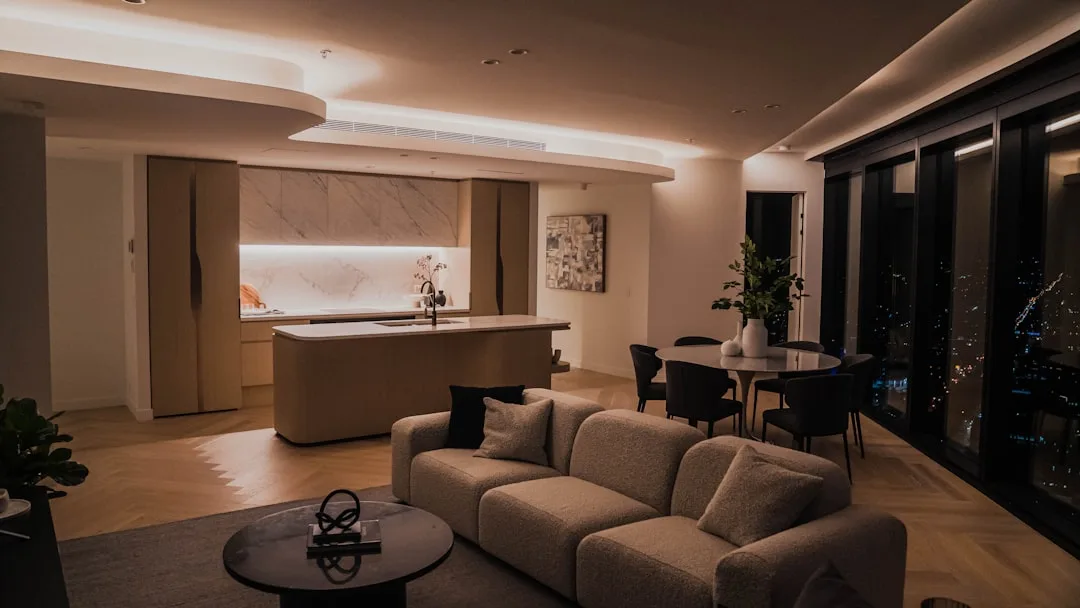
Finding the best lighting for small apartments is harder than it looks — and the average setup most renters end up with (one overhead fixture per room, a lamp or two from a big-box store) is actively making the space feel smaller. No amount of mirrors or string lights will fix the underlying problem.
That problem isn’t a lack of brightness. It’s a lack of perceived spatial volume. Those are two entirely different things, and confusing them is exactly why most small apartment lighting advice leaves you with a room that still feels like a box, just a brighter one.
Why Most Small Apartment Lighting Advice Fails You
Here’s what the usual guides get wrong: they treat lighting like a checklist. Add a floor lamp. Layer your ambient, task, and accent lighting. Hang string lights. Done. Except it isn’t done, because those tips were written for rooms with dedicated single functions, generous ceiling heights, and the freedom to hardwire new fixtures.
The average U.S. apartment clocks in at 941 square feet as of 2023, according to RentCafe — and a substantial portion of renters are working with studios or one-bedrooms where the living room, dining zone, bedroom, and sometimes home office share the same four walls. Generic layering advice doesn’t account for that reality. It doesn’t account for 8-foot ceilings, landlords who won’t let you touch the wiring, or a “bedroom” that’s also where you take Zoom calls.
The deeper issue is this: perceived room size is driven more by where light lands than by how much of it there is. A room lit only from the center feels smaller than one lit from the perimeter, even at identical lumen outputs. Most consumer guides skip this distinction entirely.
What they also skip:
- How room function changes the correct fixture type, bulb temperature, and lumen count — dramatically
- Why rental restrictions rule out most of the “best” fixtures they recommend
- That combined-use rooms require independently controlled lighting zones, not a single switched overhead circuit
The fix isn’t buying more lamps. It’s understanding how light interacts with the specific dimensions and uses of each room — and making targeted decisions based on that, not a generic product list.
The real goal is visual volume, not raw brightness. Every recommendation in this guide is built around that principle.
Understanding Light Quality Before You Buy a Single Bulb
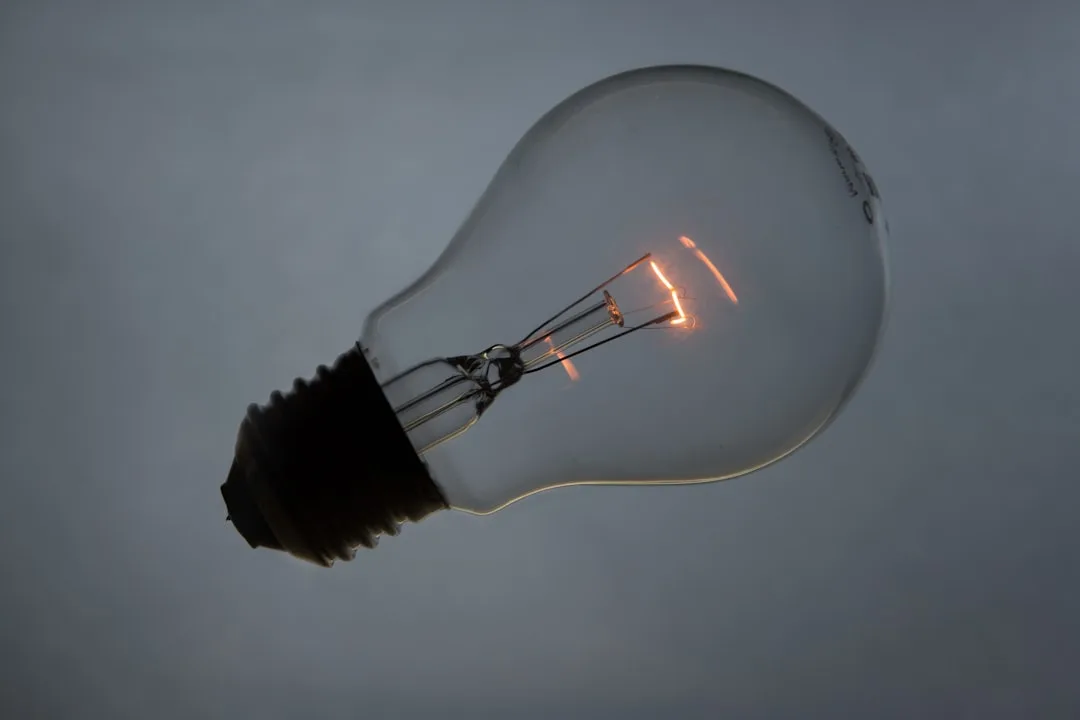
Walk into any hardware store and you’ll face a wall of bulbs with almost no useful guidance. Lumens, watts, Kelvins, CRI — the packaging assumes you either know what these mean or don’t care. You should care, especially in a small apartment where every surface is close together and every material choice is on display.
Two metrics matter more than any other: color temperature and CRI.
Color temperature, measured in Kelvin, controls how warm or cool your light reads. The range you want for a residential small space is 2700K to 3000K. That range produces the warm white light that reads as comfortable, human, and spatially soft. Go above 4000K — the range sold as “cool white” or “daylight” — and the light starts to read as clinical. Walls look flatter. Textures disappear. Hard surfaces like tile and laminate look harsh. In a small apartment full of hard surfaces and minimal square footage, that’s the last thing you want.
CRI, or Color Rendering Index, measures how accurately a light source renders colors compared to natural daylight. The scale runs to 100. Anything below CRI 80 distorts how colors and textures actually look — your warm-toned wood floors might read as muddy orange, your white walls could look slightly green or gray. Research from the Lighting Research Center shows that CRI above 90 improves perceived room comfort and spatial satisfaction — a metric almost no consumer-facing lighting guide bothers to mention. Look for bulbs rated CRI 90+ for living areas and bathrooms where accurate color reading matters most.
Then there’s the wattage confusion. Forget watts as a measure of light output — that metric belongs to incandescent bulbs that are largely off shelves now. Lumens are what matter.
Here’s a quick reference for how many lumens different rooms actually need:
- Living room: 10–20 lumens per square foot (a 150 sq ft living room needs 1,500–3,000 lumens total, distributed across multiple sources)
- Kitchen: 30–40 lumens per square foot for task areas
- Bathroom: 40–50 lumens per square foot at the mirror specifically
- Bedroom: 10–20 lumens per square foot for ambient, with targeted task lighting at 50+ lumens per square foot for reading zones
Your one action here: Before you buy another bulb, check the box for two numbers — Kelvin (aim for 2700K–3000K) and CRI (aim for 90+). If the packaging doesn’t list CRI, put it back.
The Best Lighting Approach for Small Living Rooms and Studios
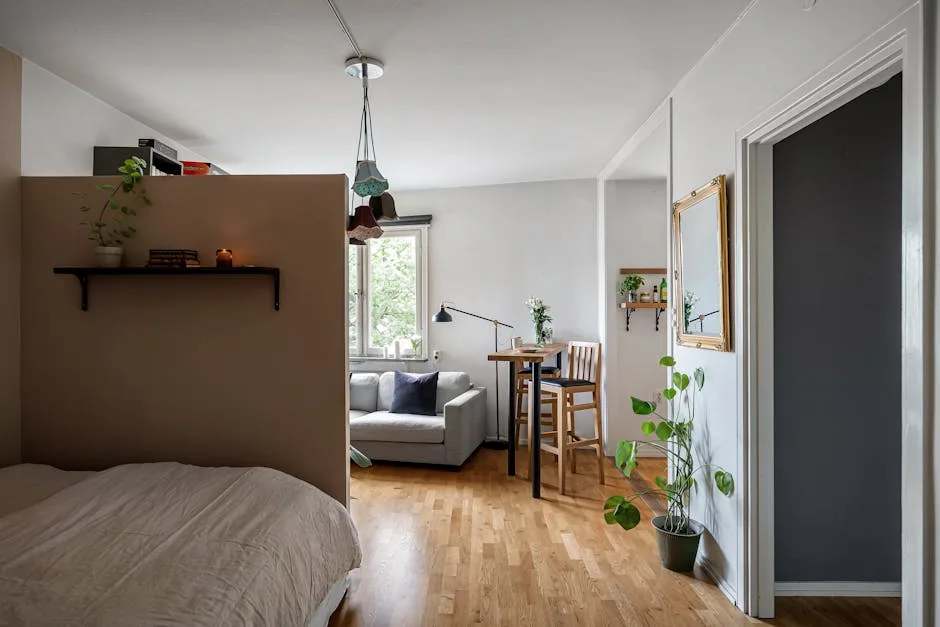
The living room is the hardest room to light well in a small apartment, and it’s exponentially harder in a studio where it’s also the bedroom, dining room, and possibly the home office. The temptation is to scatter lamps around — one in each corner, maybe one on the coffee table — and call it layered. That approach produces a lot of isolated pools of light that make a room feel choppy rather than spacious.
Research from the Human Centric Lighting Society shows that vertical surface illuminance — lighting walls rather than floors — increases perceived room size by up to 30%. That single finding should reshape how you think about every fixture you place.
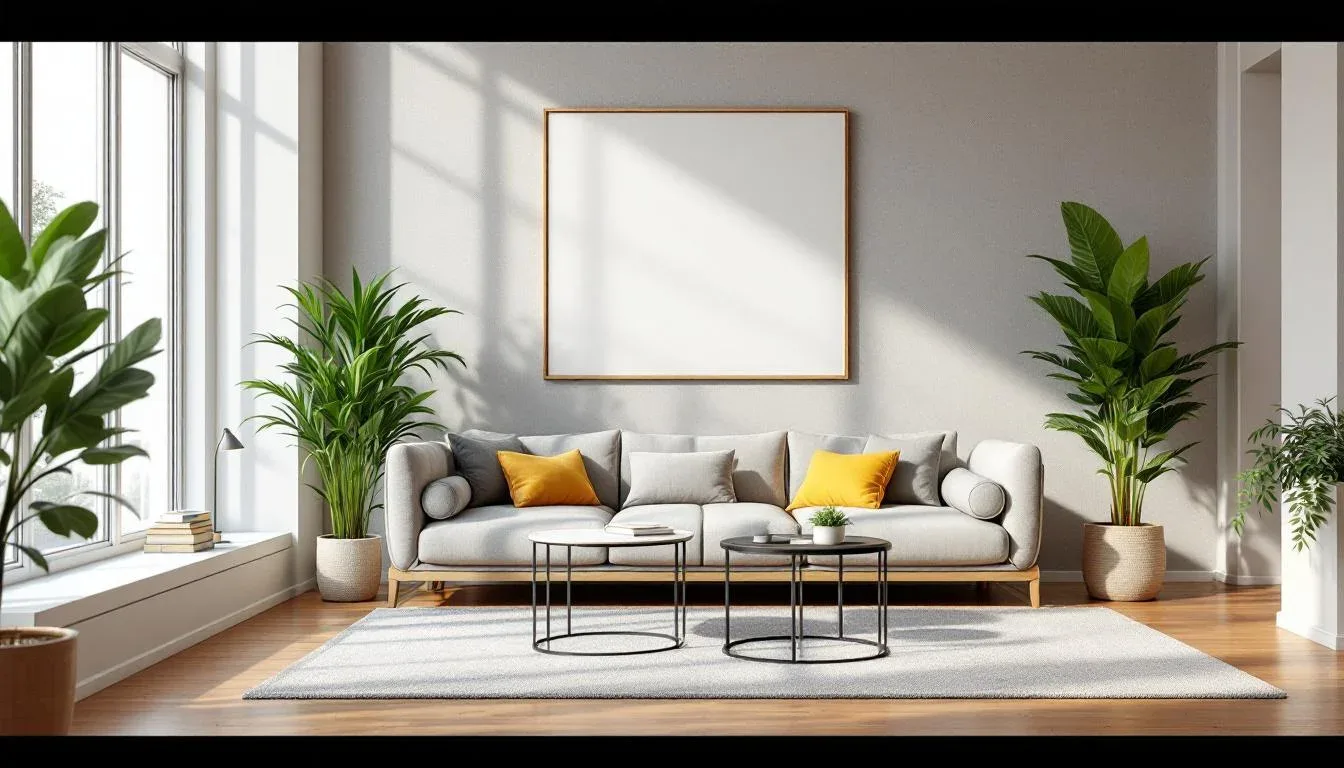
A wall-washing floor lamp in one corner does more for perceived room size than three table lamps combined. Torchiere-style floor lamps that direct light upward toward the ceiling, or arc lamps positioned to skim light across a wall, push the perceived boundaries of the room outward. The eye reads illuminated walls as farther away. The room feels larger even though nothing has changed structurally.
For studios specifically, the zone-lighting challenge is real. You need reading light for the couch, lower ambient light for the dining area, and a completely different temperature and intensity for the sleeping zone — all in one room, ideally without rewiring anything. The solution is smart plugs and dimmers rather than smart bulbs on a single circuit. Plug your floor lamp, your dining pendant, and your bedside light into separately controlled smart plugs (TP-Link Kasa EP25 plugs run about $17 each) and you can toggle zones independently from your phone or a voice assistant.
In a room under 300 square feet, here’s what actually works:
- One statement torchiere or arc floor lamp positioned in the corner that needs the most visual depth
- One dimmable pendant or swag light over the dining zone (more on installation in the rental section)
- One directional task lamp at the desk or reading chair — adjustable neck, not decorative
- Smart plugs on each, so no two zones need to be on simultaneously
Kitchen Lighting in a Small Apartment
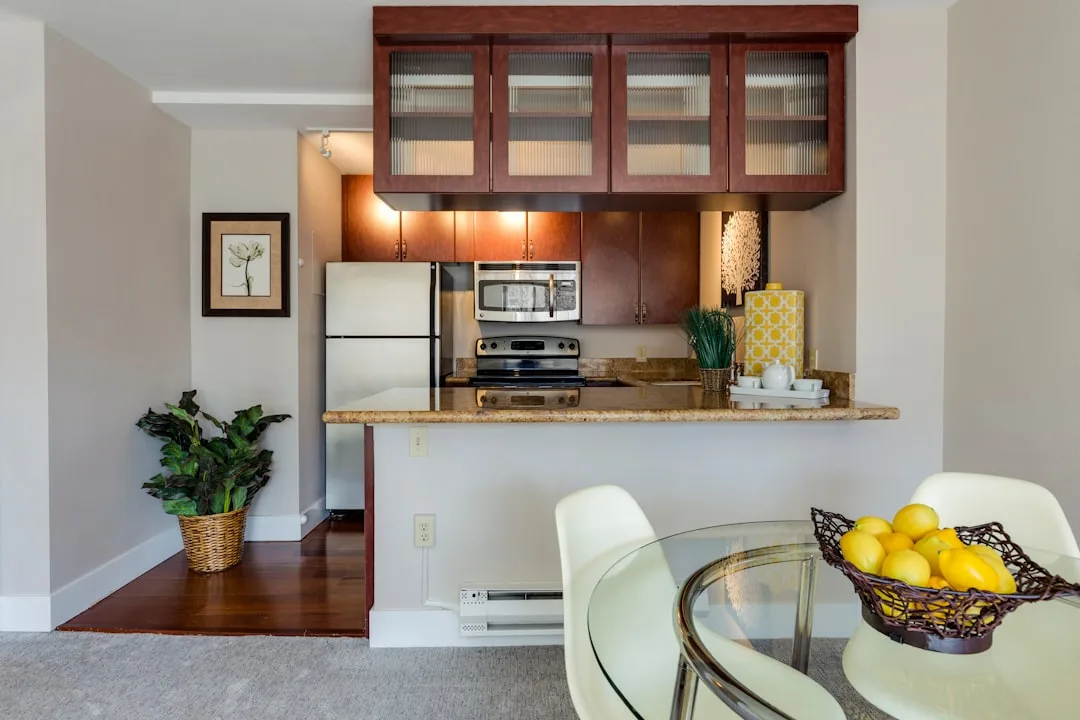
Small apartment kitchens are almost universally under-lit in the places that matter and over-lit in the places that don’t. The single recessed light or surface-mount fixture centered on the ceiling casts the most important work surfaces — countertops — into shadow, because your own body blocks the overhead source the moment you step up to cook.
The fix is under-cabinet lighting, and it’s one of the few upgrades that works in virtually every rental because it requires no electrical work. Plug-in LED strip lights or puck lights mounted beneath upper cabinets put light exactly where food prep happens. The Brilliant Evolution BRRC131 hardwired puck light has a plug-in version; Kasa’s under-cabinet strip lights are consistently rated well for color accuracy at 2700K and CRI 90.
A few specifics that make a real difference in small apartment kitchens:
- Use 3000K rather than 2700K under cabinets. The slightly cooler temperature improves contrast on cutting boards and makes it easier to see detail without reading as clinical.
- Avoid strips with visible hot spots. Cheaper LED strips create a dotted pattern on the wall behind them rather than a smooth wash of light. Look for “high-density” LED strips with at least 60 LEDs per meter.
- If you have open shelving, a small LED strip tucked behind the front lip of each shelf creates depth and makes the kitchen feel larger by illuminating what would otherwise be a dark recess.
For the overhead situation, if your kitchen has a basic surface-mount fixture and you’re allowed to swap bulbs, replace the default cool-white bulbs (often 4000K–5000K in builder-grade fixtures) with 3000K CRI 90+ LEDs immediately. That single change costs under $15 and visually transforms how the room reads.
Bathroom Lighting in a Small Apartment
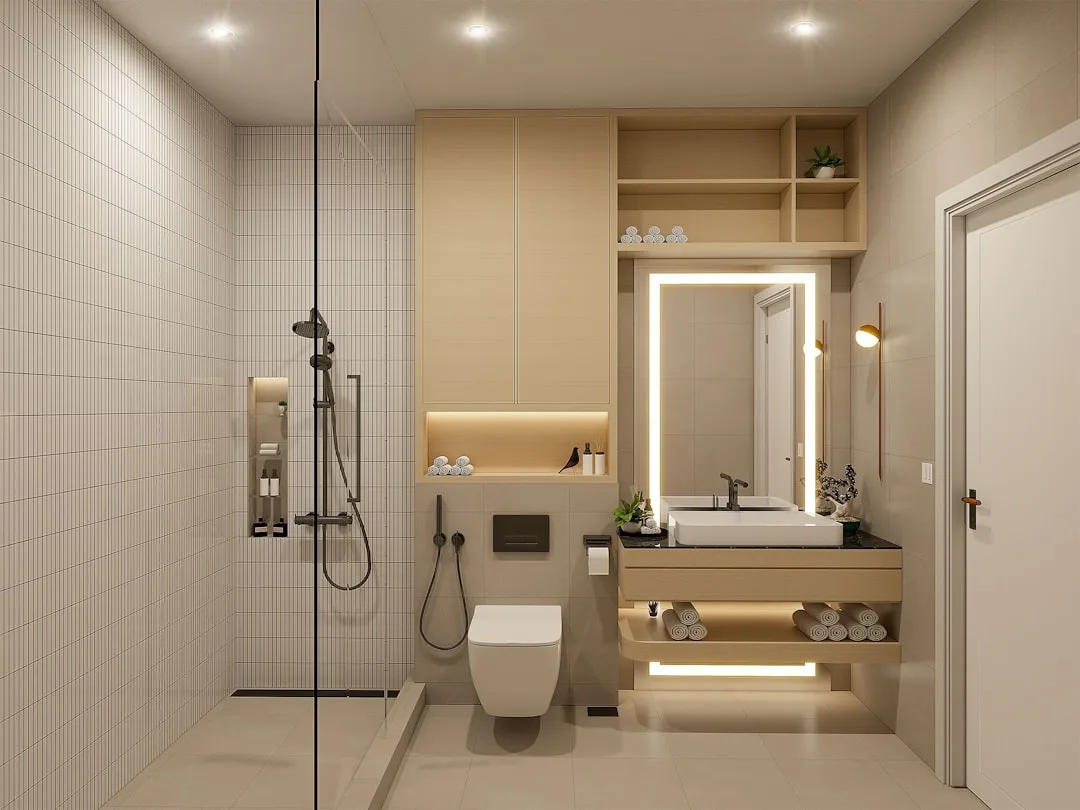
The best lighting for small apartments extends into the bathroom more meaningfully than most people realize — it’s one of the highest-stakes rooms per square foot because bad lighting here affects how you look and how the room reads simultaneously.
The universal failure is the builder-grade bar light mounted above the mirror. It lights the top of your head and casts your face in shadow. For grooming, makeup, or shaving, this is functionally useless. For perceived room size, a single overhead source in a small bathroom creates harsh shadows that shrink the visual field.
The correct approach is side lighting at face height. Sconces mounted on either side of the mirror at approximately eye level (60–65 inches from the floor to the center of the fixture) eliminate shadow and produce the even, diffused light that makes the face readable and the room feel larger. If you can’t hardwire sconces — which most renters can’t — plug-in wall sconces are a legitimate category now. The Plug-In Bathroom Sconce from Kichler and similar options from Progress Lighting route a cord along the wall behind the mirror or through a small hole in the vanity cabinet, and most landlords won’t object to a fixture that leaves no permanent alteration.
For the room overall:
- Aim for 40–50 lumens per square foot at the mirror zone specifically, not the room average
- Keep color temperature at 3000K — warm enough to be flattering, bright enough to be functional
- Add a dimmable overhead if your fixture allows it, so you can use the bathroom at night without blasting yourself with full light
Bedroom Lighting in a Small Apartment
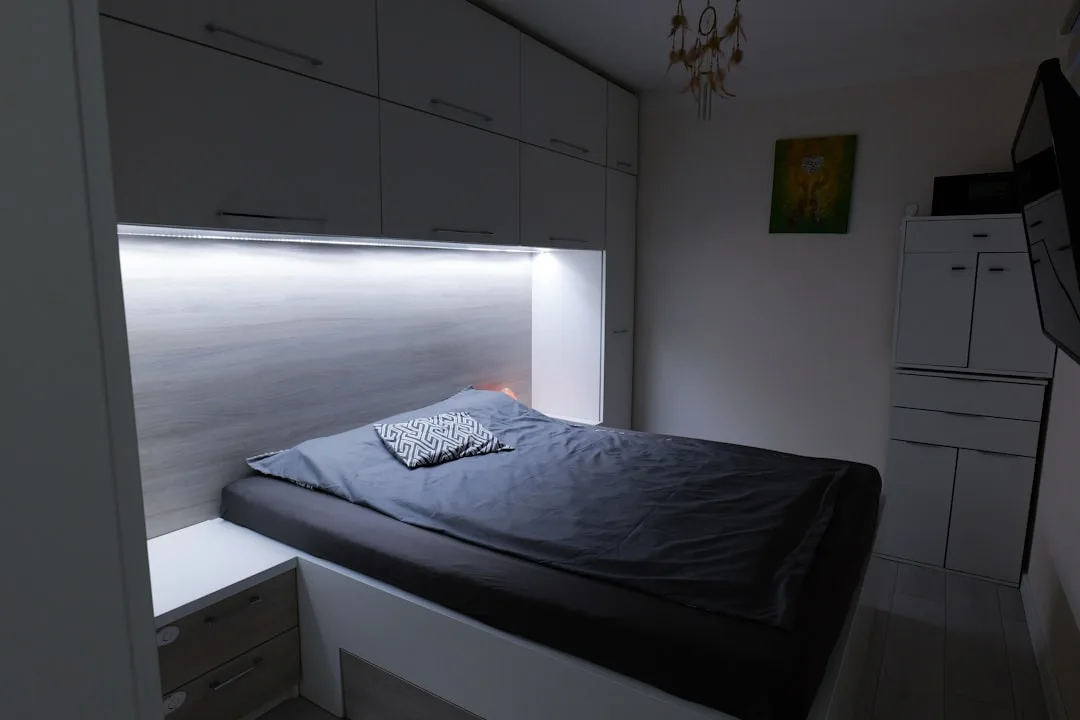
The bedroom is where most people get the overall lumen count right but the placement completely wrong. A single overhead fixture at full brightness is the wrong light for almost every activity that happens in a bedroom — reading, winding down, getting dressed, or working from a desk that lives in the sleeping zone by necessity.
The goal in a small apartment bedroom is maximum flexibility with minimum visual clutter. Every lamp cord draped across the floor, every fixture that needs a side table to sit on, costs you square footage. This is where wall-mounted bedside lighting earns its place.
Plug-in wall sconces next to the bed free up both nightstands entirely — or eliminate the need for nightstands at all, which is a legitimate option in a very small room. The Kenroy Home Oberon plug-in sconce and the Globe Electric brand’s plug-in swing-arm options both work well in rentals, with cords that run cleanly against the wall. At roughly $40–$70 each, they’re significantly cheaper than buying two bedside tables plus two lamps.
For a bedroom that doubles as a home office:
- Put the desk lamp on its own smart plug so the work zone can be lit independently of the rest of the room
- Use 3000K at the desk, 2700K at the bedside — the slight temperature difference signals the brain that the function of the space has shifted, which genuinely helps with the psychological difficulty of working and sleeping in the same room
- Avoid placing any upward-facing light source directly under a low ceiling fan — the strobing effect as blades pass the light source is visually fatiguing and more pronounced in rooms with 8-foot ceilings
Lighting for Rentals: What You Can and Can’t Do
The best lighting strategy in the world is useless if it requires hardwiring fixtures your landlord won’t allow. Rental lighting has real constraints, and working around them is a skill in itself.
What most leases actually prohibit:
- Hardwiring new fixtures or running new electrical
- Drilling into walls without permission (some leases; check yours)
- Replacing existing ceiling fixtures without written approval
What’s almost universally allowed:
- Swapping bulbs in existing fixtures (transformative and underused)
- Plug-in sconces and pendants that don’t require wall mounting
- Swag-style pendant lights that hang from a ceiling hook (removable, no wiring)
- LED strip lights with adhesive backing on furniture or under cabinets
- Smart plugs and plug-in dimmers on existing outlets
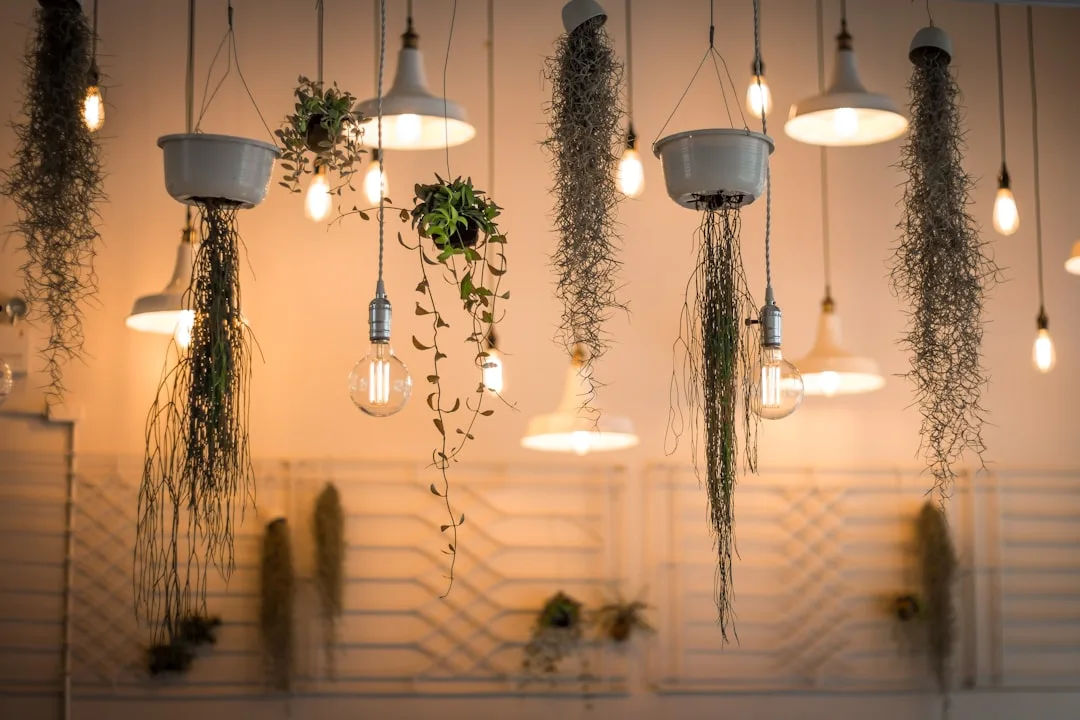
The swag pendant is worth a specific mention because it solves one of the most common small apartment problems — the dining zone that has no overhead light. A cord-and-canopy kit (IKEA’s SUNNEBY or similar) lets you hang a pendant from a ceiling hook over your table, routing the cord along the ceiling to the nearest outlet with a cord cover. The ceiling hook leaves a small hole that gets puttied on move-out. Total cost: $15–$40 depending on the shade you choose. Result: a properly positioned overhead dining light that makes the dining zone feel intentional and defined.
Frequently Asked Questions
What is the best lighting for small apartments on a tight budget?
The highest-impact change you can make for under $30 is replacing every bulb in your apartment with 2700K–3000K, CRI 90+ LEDs. Bulb color temperature affects how every surface in a room reads — walls, floors, furniture — and most apartments ship with builder-grade cool-white bulbs that actively flatten the space. Beyond bulbs, a single torchiere floor lamp ($40–$80) positioned in a dark corner does more for perceived room size than multiple table lamps combined.
How many lumens do I need in a small apartment?
Use the room-type formula: 10–20 lumens per square foot for living areas and bedrooms, 30–40 for kitchen task areas, and 40–50 at the bathroom mirror specifically. For a 150 sq ft studio, you’re looking at 1,500–3,000 lumens total, but distribution matters more than total output. Spread across multiple sources at the perimeter, that amount of light reads as far more spacious than the same lumens from a single central fixture.
Can I install new light fixtures in a rental apartment?
For hardwired fixtures, usually not without written landlord approval. But plug-in alternatives cover most of the same territory — plug-in wall sconces, swag pendants hung from ceiling hooks, under-cabinet LED strips, and clip-on or freestanding task lights handle nearly every scenario without touching the wiring. Swapping bulbs in existing fixtures is almost always permitted and is frequently the most impactful change available.
What color temperature is best for a small apartment?
2700K–3000K for all living areas, bedrooms, and bathrooms. This range produces warm white light that reads as comfortable and spatially soft, makes wall colors and textures look accurate, and avoids the flattening effect of cooler temperatures. Use 3000K specifically in kitchens and at bathroom mirrors where you need slightly more contrast for task work, and 2700K at bedside and in living areas where warmth and comfort are the priority.
Why does my apartment still feel small even with lots of lights?
Almost certainly a placement problem rather than a brightness problem. Light sources concentrated at the center of the room — especially a single overhead fixture — create a bright middle and dark perimeter, which is exactly the lighting condition that makes a room feel smaller. Moving light sources toward the walls, using torchieres or arc lamps that direct light upward and outward, and illuminating vertical surfaces rather than floors will increase perceived room size more effectively than adding more total lumens.