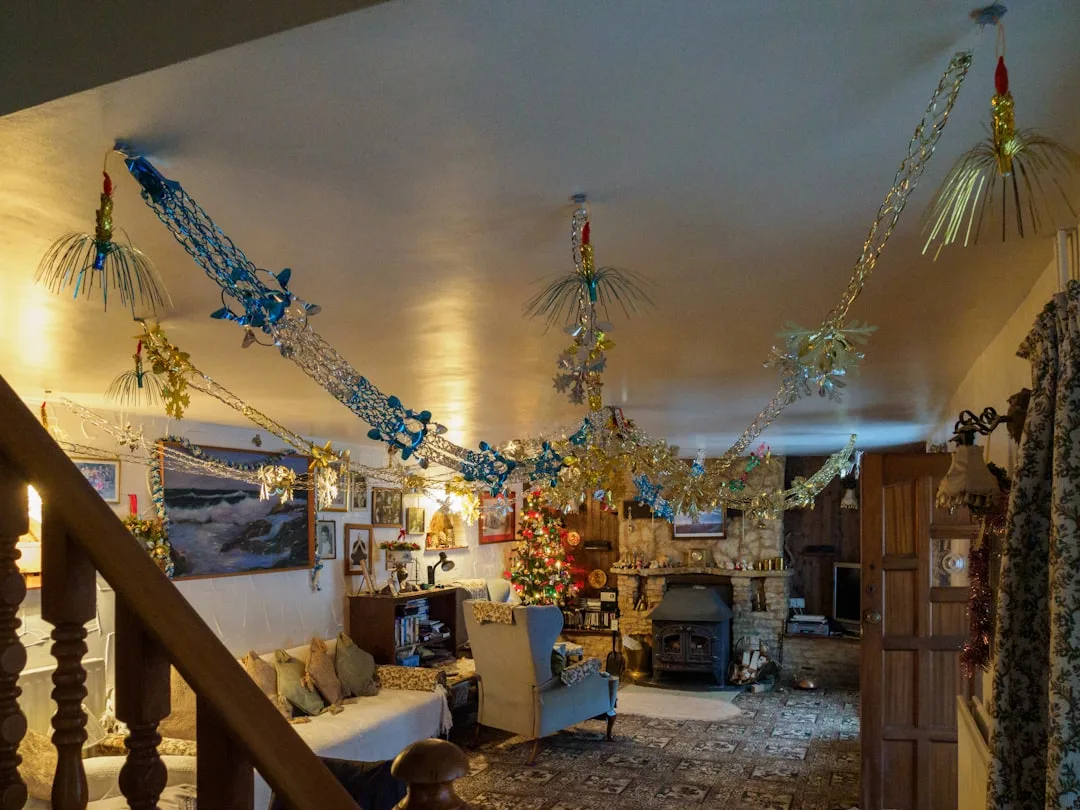
The ceiling is the only surface in your living room that every single guest looks at — and most Christmas decorating guides treat it as a place to hang leftover snowflakes after the tree is done. This isn’t a small oversight. It’s the reason so many rooms that are beautifully decorated at eye level still feel like something is off, like the design stopped before it was finished. Ceiling decoration for Christmas is the move that separates rooms that feel complete from rooms that feel like they stopped halfway — and it’s the one most people skip entirely. The ceiling is 20% of your room’s visible surface area, and in a room full of seated people, it’s closer to 40% of what’s actually in their sightline. Leaving it blank isn’t neutral. It’s absence.
Quick Answer
The ceiling is the only surface in your living room that every single guest looks at — and most Christmas decorating guides treat it as a place to hang leftover snowflakes after the tree is done.
How to Actually Decorate a Ceiling for Christmas (Without It Looking Like a School Hallway)
In This Article
- How to Actually Decorate a Ceiling for Christmas (Without It Looking Like a School Hallway)
- The Materials That Actually Work — And the Ones That Fail by January
- The Ceiling Trend That’s Actually Replacing the ‘Overhead Afterthought’ Mentality
- Room-by-Room Application: Ceiling Decoration for Christmas in Every Space
- Colors That Will Define Christmas Ceilings in 2026 — And the Ones Already Aging Out
Start with a number. Your ceiling height determines everything — which materials work, how heavy your installation can be, whether drops will feel dramatic or just dangerous to anyone over 5’10” walking through the door. Rooms under 9 feet need techniques that draw the eye upward without closing the space down: vertical drops that are narrow and tapered, garlands that hug a beam or a fixture rather than floating free. Rooms over 10 feet can handle what I’d call structural installations — wrought iron hoops wrapped in greenery, chandelier extensions, full canopy draping from a central hook. The height question comes first. Always.
The most-skipped step in every ceiling project is identifying your structural attachment points before you choose any decoration. Joists, beams, existing light fixture hardware, and ceiling medallions are your anchors. Everything else — the specific garland, the hoop diameter, the drop length — gets decided around what the ceiling will actually hold. I’ve watched people buy a 4-pound arrangement of fresh greenery and hang it from a 3M adhesive hook, and then wonder why it’s on the floor three days later. Work from structure outward.
Choose one focal zone and build from there. Above the dining table. The entryway threshold. The living room seating cluster. Pick one and make it intentional before touching any other part of the ceiling. The pattern I kept seeing in apartments that felt overdone wasn’t too much decoration — it was decoration that had no center of gravity. Every square foot competed equally for attention and nothing won.
One thing competitors keep pushing that I’d actively push back on: uniform hanging lengths. The instinct toward symmetry makes sense visually, but it reads as commercial. Asymmetric drop heights — a cluster of ornaments at 18 inches, another at 11 inches, a single long ribbon drop at 28 inches — create depth that you feel even when you can’t name it.
Texture before color. Always. Dried botanicals, velvet ribbon, linen twine, and aged brass hardware all read as considered. Plastic and foil tinsel read as temporary, because they are. The material choice signals intent before the eye has processed the shape.
Actionable takeaway: Before buying a single decoration, stand in the room with a tape measure and note your ceiling height, identify every existing attachment point, and mark one 4-foot zone you’re committing to as your focal installation.
The Materials That Actually Work — And the Ones That Fail by January
The material conversation matters more for ceiling decoration for Christmas than it does for almost any other part of the room, because ceiling installations are load-bearing in a way that a mantel arrangement is not. Weight, humidity response, and light interaction all behave differently at height, and most decorating guides skip past this entirely.
Fresh greenery is the highest-performing material for ceiling installations in terms of visual impact, but it comes with real constraints:
- Fresh cedar and eucalyptus can hold their structure and scent for 10–14 days in a cool, dry interior before they start dropping needles or browning at the tips
- Fresh pine and fir varieties degrade faster — usually 7–10 days — but the resinous scent they release in a warm room is difficult to replicate with anything else
- Fresh greenery should never be used with adhesive hooks regardless of the stated weight limit; the combination of organic weight, humidity variation, and gradual drying creates unpredictable load shifts that adhesive hardware isn’t designed to handle
- A standard 3-foot fresh cedar garland weighs between 1.5 and 2.5 pounds depending on density; a fresh hoop arrangement 18 inches in diameter can run 3–4 pounds with wiring and accents included
Dried botanicals are the stronger practical choice for installations that need to last the full season:
- Dried eucalyptus, pampas grass, lunaria (silver dollar plant), and dried orange slices all hold their form and color for 4–6 weeks without maintenance
- They weigh significantly less than fresh — a dried arrangement that matches the visual scale of a fresh one typically weighs 40–60% less
- Dried materials respond to warm, dry indoor heating air by becoming more brittle over time, which means they should not be installed directly above heat vents or fireplace openings
- The color palette of dried botanicals skews naturally warm and earthy, which aligns well with the direction ceiling color is moving for Christmas 2025–2026
Fabric and ribbon are underused in ceiling decoration for Christmas relative to how much visual return they offer per dollar spent:
- 5 yards of 4-inch wide velvet ribbon in a deep burgundy or forest green, hung in three asymmetric drops from a ceiling joist, costs under $20 and reads as expensive in person and in photographs
- Silk organza and gauze both catch and diffuse warm light in ways that no matte material can replicate — this is the specific property that makes tented ceiling installations photograph so differently from how they look in hardware store displays
- Linen twine as a suspension element instead of clear monofilament gives installations a more organic, considered look that integrates with the botanical materials it’s carrying
What to avoid, specifically:
- Foil tinsel garland: the reflectivity reads as cheap under warm light, it tangles during installation, and it sheds for the entire season
- Lightweight paper honeycomb ornaments: they warp with humidity and look dated in a way that’s accelerating, not fading
- Spray-painted natural materials: dried eucalyptus or pinecones that have been spray-painted gold or silver lose the texture and variation that made them worth using in the first place
The Ceiling Trend That’s Actually Replacing the ‘Overhead Afterthought’ Mentality
Something shifted in hospitality design about four years ago — the ceiling stopped being a utility surface and started being treated as the fifth wall. Hotels in Milan and Copenhagen were draping fabric from central hooks to wall perimeters, creating a tent effect that made a standard room feel like somewhere entirely different. That specific idea has now crossed from event and commercial design into residential spaces, and this holiday season it’s showing up in high-end editorial shoots in a way that signals mainstream arrival within 18 months.
Pinterest’s 2026 trend report flagged ‘maximalist canopy interiors’ as a top-rising search category, with a 312% year-over-year increase in saves related to fabric ceiling installations in residential settings. That’s not a niche movement.
The specific directions worth knowing for ceiling decoration for Christmas this year:
- Tented ceiling installations: lightweight fabric — unbleached linen, silk organza, or gauze — draped from a single central hook outward to wall perimeters using tension, not rigid structure. These photograph extraordinarily well and take about two hours to install with two people.
- Botanical cloud formations: fresh or dried eucalyptus, rosemary, cedar, and white amaryllis suspended in loose, irregular groupings rather than rigid wreaths. The key word is loose. The geometric wreath is aging out. The cloud is in.
- Chandelier couture: wrapping your existing light fixture instead of adding separate ceiling decor. Olive branch garland threaded through the arms of a chandelier. Dried orange slices on 20lb monofilament, hung from the fixture canopy at varying lengths. Black grosgrain ribbon with gold wiring woven through pendant hardware. This approach works because it integrates seasonal material with a permanent architectural element, and the result looks designed rather than added.
- Intentional negative space: leaving 70% of the ceiling completely bare and making one installation genuinely dramatic. This runs directly counter to the “fill every inch” approach that fills most competitor content, but a single 3-foot iron hoop wrapped in fresh cedar above a dining table reads stronger than a ceiling hung with 200 paper snowflakes.
The school hallway problem — which the title of this section is meant to address directly — happens when decoration is distributed evenly across a ceiling with no hierarchy. Schools do it because they need to cover space. You don’t.
Actionable takeaway: Pick one of these four directions and commit to it fully rather than mixing. The botanical cloud and the chandelier wrap are the lowest-hardware-investment starting points for first-timers.
Room-by-Room Application: Ceiling Decoration for Christmas in Every Space

The focal zone principle works differently depending on which room you’re working in. The dining room, the entryway, and the living room each have their own logic, and treating them the same way produces results that feel unresolved in each one.
The dining room is the highest-return room for ceiling decoration for Christmas investment, full stop. People sit in dining rooms, which means sightlines are lower and the ceiling occupies more of the visual field than in any other room in the house. The installation approach that works best here:
- Center the installation directly above the table, not above the center of the room — these are often different points, and centering on the table is always the right call
- Keep drop lengths at least 24 inches above the table surface to maintain sight lines across the table during conversation; 30 inches is safer if you’re using any arrangement with lateral spread
- A hoop installation — a 24 to 36 inch diameter wrought iron or brass ring wrapped in greenery — is the single most reliable dining room ceiling installation because it scales predictably, it’s structurally sound when hung from a joist-anchored hook, and it photographs cleanly from every angle
- Candles on the table and warm-toned greenery overhead create a light environment at the dinner table that genuinely cannot be replicated by any other decorating approach
The entryway is the first ceiling your guests see and the one that sets every expectation that follows. Entryway ceiling decoration for Christmas has specific constraints:
- Clearance is the primary concern; the minimum safe drop in an entryway used by adults is 7 feet from floor to the lowest point of any hanging installation, with 7’6″ preferred
- Entryways are typically transitional spaces — narrow and directional — which means ceiling decoration here should reinforce the direction of movement rather than stopping attention dead; a garland that runs along the axis of entry (from door toward the interior) reads better than one that hangs perpendicular to it
- Fragrance is more concentrated in entryway spaces due to lower volume and less airflow; fresh cedar, pine, or eucalyptus placed at the entryway ceiling creates a sensory arrival moment that no wall decoration can match
The living room is where most people over-complicate ceiling decoration for Christmas and where the negative space principle matters most:
- If your tree is already a strong vertical element, the ceiling does not need to compete with it; one installation above the seating area that coordinates with the tree materials (not matches — coordinates) is enough
- Low-ceiling living rooms under 8’6″ benefit from a single garland or botanical arrangement installed flush or near-flush against the ceiling rather than dropped down into the space; this draws the eye up without the visual weight that drops add
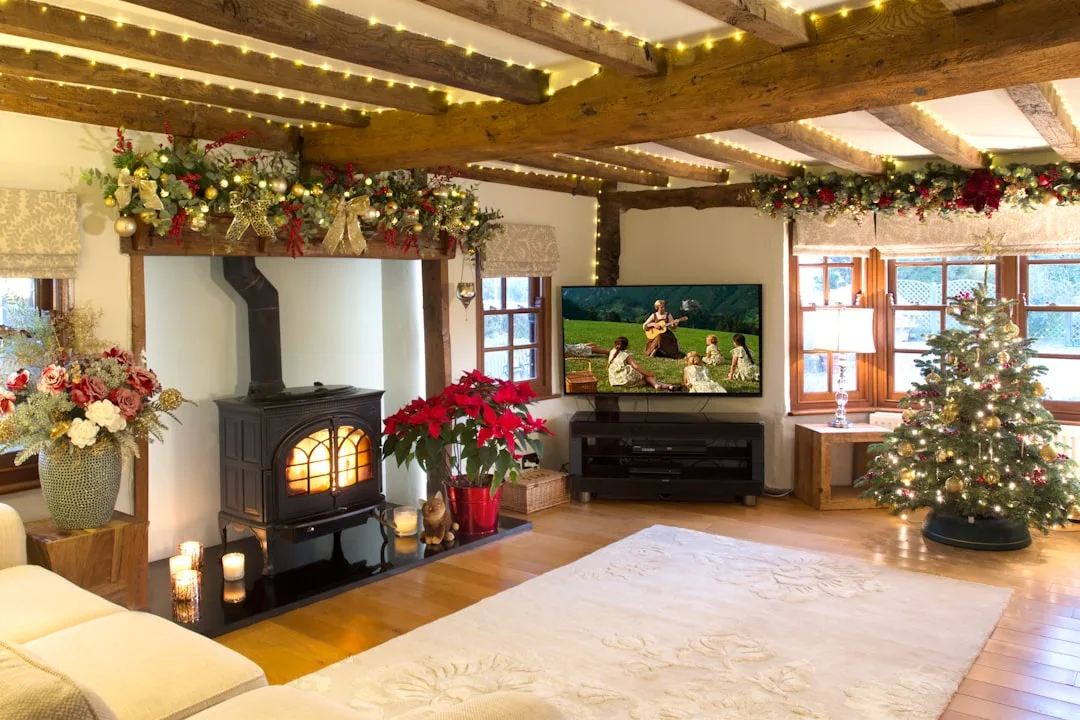
- Rooms with exposed beams are an exception to most of these rules — beams are natural attachment points and natural design elements, and wrapping them with greenery, ribbon, or string lights is one of the few ceiling decoration approaches where more coverage reads as intentional rather than busy
Colors That Will Define Christmas Ceilings in 2026 — And the Ones Already Aging Out
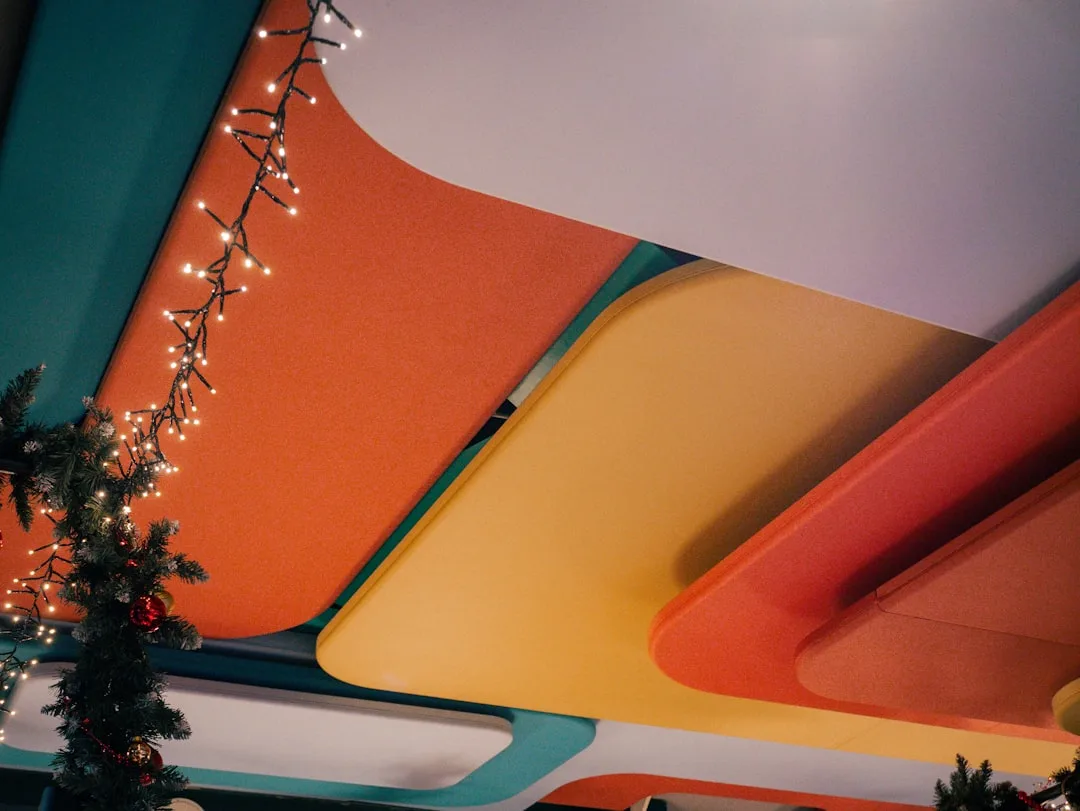
Icy blue-white. Rose gold. That very specific shade of cool silver that looked like a Restoration Hardware catalog and a Pinterest board had a child. These were the dominant Christmas palettes for most of the 2018–2024 window, and they photographed beautifully under cool overhead LED light — which is exactly the lighting condition that most real homes don’t actually have on Christmas Eve.
The direction that’s replacing all of it is grounded warmth. Pantone’s 2026 Color of the Year guidance and broader forecasting from WGSN both point toward earthy, saturated tones that reject the cool-toned minimalism that defined the previous era. For ceilings specifically, this translates to:
- Deep aubergine paired with antique gold hardware and aged brass hooks — this combination reads as jewel-toned and deliberate rather than seasonal and temporary
- Forest green in velvet ribbon and fresh cedar, against an off-white or warm cream ceiling — the contrast is high without being harsh, and it photographs well under both warm LED and candlelight
- Terracotta and rust tones in dried botanical arrangements, particularly dried pampas, lunaria, and dried chili pepper clusters — this palette signals the earthy warmth direction more aggressively than any other combination and is most visible in editorial design from the last 18 months
- Ivory and unbleached linen for fabric installations — the movement away from stark white in tented or draped ceiling installations toward natural, slightly warm whites that respond differently to candlelight
What’s aging out, specifically:
- Cool silver paired with ice blue in any combination
- Rose gold hardware with blush pink ribbon — this palette peaked in 2021 and is now recognizably dated
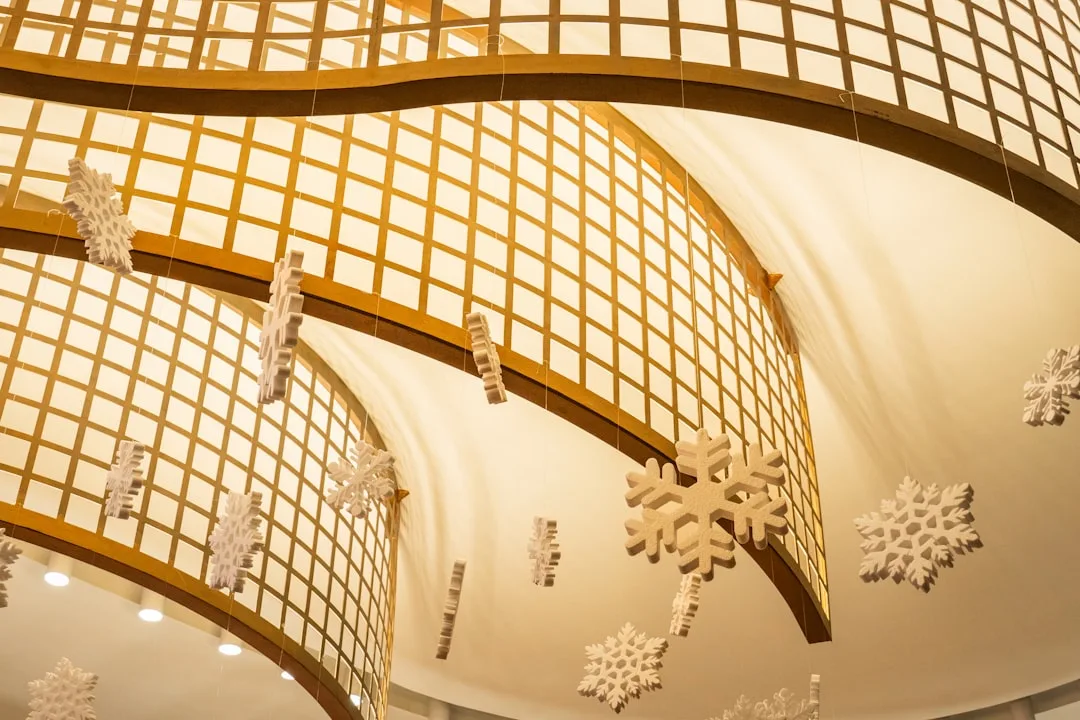
- Stark white paper ornaments or snowflakes — the material and the color have both run their course
- Anything that requires cool LED overhead light to look good, because it will look flat and institutional under the warm ambient lighting that actually characterizes a Christmas evening at home
The through-line across all the directions that are gaining traction is the same: materials and colors that look better under warm, low, imperfect light than they do under bright overhead light. That’s the test worth running on every material before it goes up.
Actionable takeaway: Hold your material samples under a warm lamp at arm’s length before purchasing. If it looks significantly worse under warm light than it does under the bright light of a store or a phone camera, it will underperform in actual use.
FAQ: Ceiling Decoration for Christmas
Q: What’s the safest way to hang ceiling decorations without damaging the ceiling?
The safest approach is to work from existing structural hardware wherever possible — existing light fixture canopies, joist-anchored cup hooks, and ceiling medallions that are already secured to framing. When you need a new attachment point, a cup hook screwed directly into a ceiling joist is the most reliable option for loads up to 10–15 pounds. To locate joists, use a magnetic stud finder rather than an electronic one in plaster ceilings; magnetic finders locate the nails that attach drywall or plaster lath to the joist, which is more reliable in older construction. Adhesive hooks are appropriate only for lightweight paper or fabric decorations under 1 pound, and only on smooth, painted drywall — not plaster, textured surfaces, or any surface that has been recently painted.
Q: How do I make ceiling decorations look intentional rather than thrown together?
Three things separate intentional from thrown together, in order of importance: a single focal point rather than distributed coverage, asymmetric drop lengths rather than uniform ones, and material consistency rather than mixed material categories. If every hanging element in your installation is made of the same two or three materials — say, fresh cedar, velvet ribbon, and aged brass — the result reads as curated regardless of how simple the arrangement is. The moment you introduce a fourth material that doesn’t share texture, finish, or color family with the others, the eye reads it as accidental.
Q: Can ceiling decoration for Christmas work in a small apartment with low ceilings?
Yes, but the approach changes significantly. In rooms under 8’6″, dropped installations that hang down into the living space feel crowding rather than dramatic. The techniques that work best in low-ceiling spaces are: garlands or botanical arrangements installed flush or near-flush to the ceiling surface, wrapped beams or ceiling perimeter treatments that draw the eye around the room rather than down into it, and chandelier wrapping that integrates seasonal material with an existing fixture without adding any downward visual weight. The goal in a low-ceiling room is to make the ceiling feel higher, not to fill the space between ceiling and floor.
Q: How far in advance can I install fresh greenery on the ceiling?
For fresh cedar and eucalyptus, install no more than 10 days before your primary event or gathering — 7 days is safer if your home runs warm or dry. Fresh pine and fir have a shorter window of 5–7 days. To extend longevity, lightly mist fresh greenery installations every 2–3 days with water (not on any electrical fixtures or hardware), keep the room temperature below 70°F if possible, and position installations away from direct heat sources including fireplaces, heating vents, and south-facing windows that receive strong afternoon sun. Dried botanical installations have no such time constraint and can go up as early as 4–6 weeks before the holiday without degradation.
Q: What’s the minimum investment to make a real impact with ceiling decoration for Christmas?
Meaningful ceiling decoration for Christmas does not require significant spending. The highest-return low-cost approaches, in order:
- A single 3-foot fresh cedar or eucalyptus garland draped across a beam or along a doorway threshold, secured with linen twine — materials cost under $25 at most garden centers or florists
- Five yards of 4-inch velvet ribbon in a deep seasonal color, hung in three asymmetric drops from a joist-anchored cup hook above a dining table — under $20 in materials
- A chandelier wrap using a single fresh or dried botanical garland threaded through existing fixture arms — cost varies from $15 to $40 depending on greenery choice, and the installation integrates with architecture rather than adding to it
- Dried orange slice clusters on monofilament, hung at asymmetric lengths from a single hook — materials cost under $15 if you dry the oranges at home (3 hours at 200°F on a wire rack), slightly more if purchased pre-dried
The common thread across all of them: one strong focal installation outperforms a full ceiling covered in inexpensive decorations, every time.
Q: What’s the safest way to hang ceiling decorations without damaging the ceiling?
The safest approach is to work from existing structural hardware wherever possible — existing light fixture canopies, joist-anchored cup hooks, and ceiling medallions that are already secured to framing. When you need a new attachment point, a cup hook screwed directly into a ceiling joist is the most reliable option for loads up to 10–15 pounds. To locate joists, use a magnetic stud finder rather than an electronic one in plaster ceilings; magnetic finders locate the nails that attach drywall or plaster lath to the joist, which is more reliable in older construction. Adhesive hooks are appropriate only for lightweight paper or fabric decorations under 1 pound, and only on smooth, painted drywall — not plaster, textured surfaces, or any surface that has been recently painted.
Q: How do I make ceiling decorations look intentional rather than thrown together?
Three things separate intentional from thrown together, in order of importance: a single focal point rather than distributed coverage, asymmetric drop lengths rather than uniform ones, and material consistency rather than mixed material categories. If every hanging element in your installation is made of the same two or three materials — say, fresh cedar, velvet ribbon, and aged brass — the result reads as curated regardless of how simple the arrangement is. The moment you introduce a fourth material that doesn’t share texture, finish, or color family with the others, the eye reads it as accidental.
Q: Can ceiling decoration for Christmas work in a small apartment with low ceilings?
Yes, but the approach changes significantly. In rooms under 8’6″, dropped installations that hang down into the living space feel crowding rather than dramatic. The techniques that work best in low-ceiling spaces are: garlands or botanical arrangements installed flush or near-flush to the ceiling surface, wrapped beams or ceiling perimeter treatments that draw the eye around the room rather than down into it, and chandelier wrapping that integrates seasonal material with an existing fixture without adding any downward visual weight. The goal in a low-ceiling room is to make the ceiling feel higher, not to fill the space between ceiling and floor.
Q: How far in advance can I install fresh greenery on the ceiling?
For fresh cedar and eucalyptus, install no more than 10 days before your primary event or gathering — 7 days is safer if your home runs warm or dry. Fresh pine and fir have a shorter window of 5–7 days. To extend longevity, lightly mist fresh greenery installations every 2–3 days with water (not on any electrical fixtures or hardware), keep the room temperature below 70°F if possible, and position installations away from direct heat sources including fireplaces, heating vents, and south-facing windows that receive strong afternoon sun. Dried botanical installations have no such time constraint and can go up as early as 4–6 weeks before the holiday without degradation.
Q: What’s the minimum investment to make a real impact with ceiling decoration for Christmas?
Meaningful ceiling decoration for Christmas does not require significant spending. The highest-return low-cost approaches, in order: