
The coat closet door closes — but only if you lean into it — and somewhere behind it is a dog leash, a broken umbrella, three scarves you forgot you owned, and at least one item that has no business being there at all. If you’ve been searching for coat closet organization ideas small spaces can actually support, you’re already ahead of most people, because at least you’re asking the right question.
Quick Answer
The coat closet door closes — but only if you lean into it — and somewhere behind it is a dog leash, a broken umbrella, three scarves you forgot you owned, and at least one item that has no business being there at all.
Most coat closet content will tell you to declutter first, then buy some pretty bins, then feel proud of yourself. That advice lasts about three weeks before the leaning-into-the-door problem comes back. What nobody is telling you is that the closet didn’t fail because of clutter. It failed because nobody ever designed a system for how that particular household actually uses that particular space — and without a system, every available surface becomes a dumping ground by default.
This is a guide built on eleven years of making small spaces functional for real people. Not aspirational. Functional.
Why Most Coat Closets Fail Before You Even Hang a Hook
In This Article

Here’s the uncomfortable truth: most coat closets are not storage failures. They’re systems failures. The distinction matters because buying more organizers — which is almost everyone’s first instinct — doesn’t fix a system problem. It just gives the chaos better containers.
I had a client in Logan Square whose coat closet was borderline unusable. She’d already bought two sets of organizers from a major home goods retailer. Both sets were still in the bags, shoved into the back corner of the closet, because she hadn’t done the harder work of understanding why the space kept reverting to disorder. The real issue was that her closet had five users — herself, two kids, and two roommates — with zero designated zones for any of them. Everything went in, nothing came out with any intention.
The pattern I kept seeing in apartment after apartment was this: people plan coat closets horizontally. They think about what goes on the floor and what goes on the rod, and they stop there. Vertical space — and the average entryway closet runs 72 inches tall on a 24 to 36-inch-wide footprint — gets almost entirely ignored. Most people use less than 40% of that vertical real estate, which means they’re working with less than half a closet and wondering why it feels stuffed.
Before you touch anything, identify which items actually belong in this closet:
- Daily outerwear — coats, jackets, vests you reach for at least weekly
- Seasonal items — ski gear, parkas, rain layers for weather you see twice a year
- Accessories — scarves, hats, gloves, dog leashes, umbrellas
- Escaped clutter — the stuff that migrated in from elsewhere and has no legitimate reason to be there
That last category is typically 20 to 30 percent of what’s in there. Remove it first, not because of some Marie Kondo principle, but because those items are actively stealing space from things that genuinely need to live near your front door.
Takeaway: Write down every category of item that currently lives in your coat closet before moving a single thing. Identification precedes organization — always.
How to Organize a Small Coat Closet When You Have More Than It Can Hold
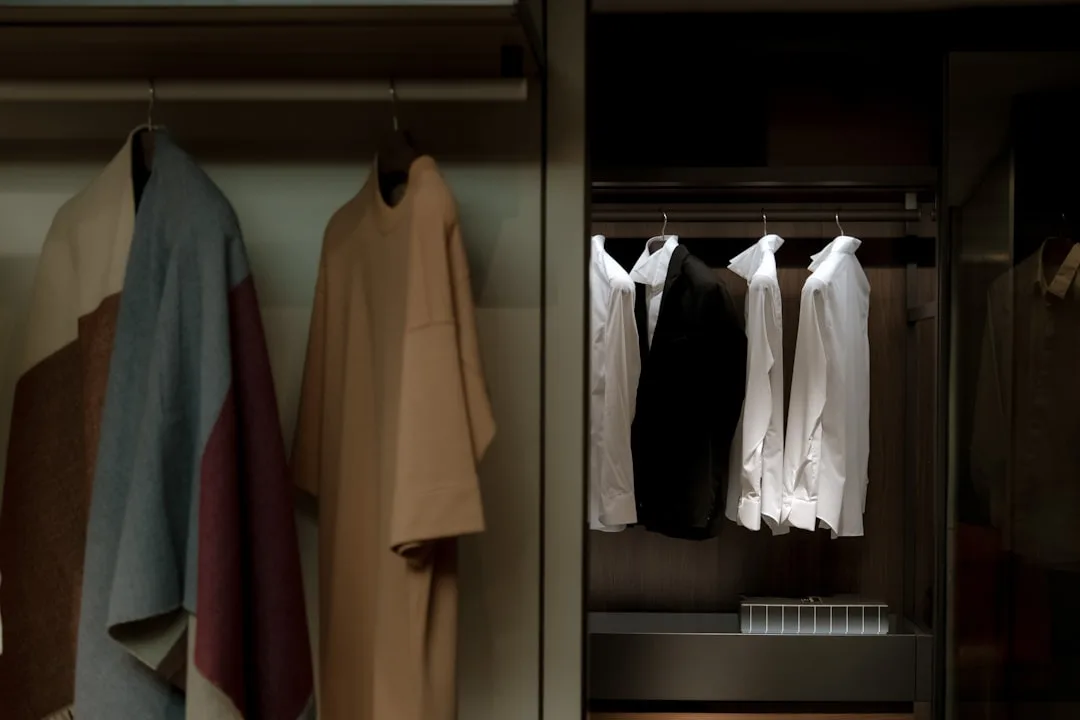
When a coat closet is overwhelmed, the instinct is to try to fit everything in simultaneously. Wrong direction entirely. Treat the closet like a curated display, not a warehouse, and rotate contents seasonally rather than cramming every coat you own into a 30-inch rod.
The framework that actually works — the one I started using with clients around year four of my practice — breaks the closet into three zones:
- Active zone — Eye level and below. Daily-use items only: the coats you reach for five times a week, the leash, the umbrella you actually like. Nothing that requires you to think about whether you need it.
- Seasonal zone — Upper shelf, vacuum-sealed or binned. The parka that comes out in January. The rain jacket that only sees April. These items earn prime closet real estate for maybe eight weeks per year; the other forty-four weeks, they live on the shelf in a labeled bin.
- Guest or overflow zone — Door back, or a hook panel near the entry. Items that visitors use, plus the overflow accessories that don’t fit in the active zone. Over-door organizers are genuinely useful here — I’ve stopped being snobbish about them.
Now, a practical note on rod capacity that most people don’t know. Slim velvet hangers measure roughly 0.2 inches thick. Standard plastic hangers run about 0.75 inches. On a 36-inch rod, that translates to approximately 45 velvet hangers versus 18 plastic ones — a 2.5x increase in capacity with zero installation required. I’ve recommended this swap to probably sixty clients over the years, and exactly none of them regretted it. It’s the single highest-ROI move in coat closet organization.
One caveat on double rods: they only work if your shortest coat clears 36 inches when hung. Measure your longest and shortest coat before installing anything. I watched a client spend an afternoon installing a double rod in a hallway closet only to discover that her wool trench — the coat she wore every single day — dragged on the lower rod every time she tried to hang it.
Takeaway: Swap to slim velvet hangers this week. No tools, no planning, immediate results. Then decide on zoning.
The Small Coat Closet Audit: What to Do Before Buying a Single Organizer
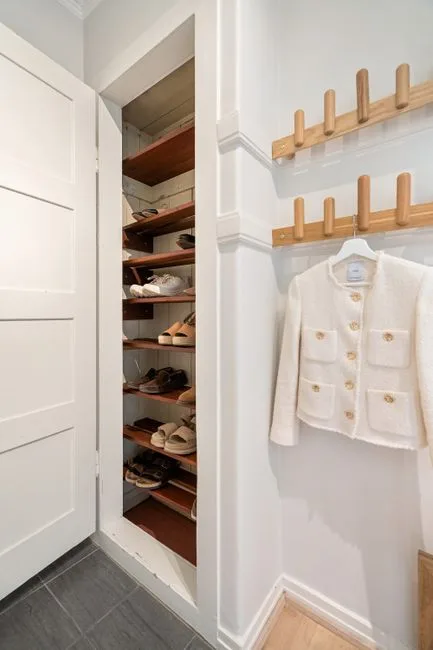
Buying organizers before auditing the space is how you end up with three sets of containers that don’t fit and a receipts-and-regret situation at the returns desk. I made this mistake myself — not with a client’s closet but with my own first apartment in Wicker Park, where I bought a wire shelving system that was three inches too wide for the closet and didn’t discover this until I was mid-installation. Measure everything. Then measure it again.
Specifically:
- Depth — Standard closet depth is 24 inches, but older buildings vary. Anything under 22 inches limits what you can hang without coats pressing against the door.
- Width — Measure at shoulder height, not just at floor level. Walls aren’t always perfectly plumb, especially in pre-war buildings.
- Height — Floor to ceiling, and note any obstructions: light fixtures, baseboard heaters, and in older apartments, strange pipe chases that eat into corner space.
- Door clearance — If it’s a swing door, map the arc. You cannot use that floor space for anything tall.
Standard closet rods are typically installed 66 to 68 inches from the floor. That’s fine for adults of average height — but it’s essentially useless for households with children, or shorter adults who end up doing this half-reach, half-jump maneuver every morning. Dropping the primary rod to 54 to 60 inches and adding a second upper rod above it transforms accessibility without reducing capacity. I did this for a family in Evanston where the two kids, ages seven and ten, had been piling their coats on the floor because they couldn’t reach the rod. Lowering it by twelve inches took forty-five minutes and completely solved a problem that had been frustrating that household for two years.
The audit phase is also when you decide what kind of door hardware makes sense. Swing doors that open into a narrow hallway are the single most common source of wasted floor space in entryway closets — the arc of the door can claim 8 to 12 inches of depth that you can never use for anything freestanding. If the closet is shallow enough that this matters, replacing the swing door with a bifold or a sliding barn-style panel is worth pricing out. It’s a bigger project, but it can recover enough floor space for a full shoe rack or a narrow rolling cart, which changes the math on what fits considerably.
When you’re working with genuine coat closet organization ideas for small spaces, the audit also needs to account for lighting. A closet with a single incandescent bulb at the back — or worse, no light at all — functions as a black hole regardless of how well it’s organized. Battery-powered LED tap lights or a plug-in strip light installed under the upper shelf cost under twenty dollars and make the entire space feel twice as large, because you can actually see what’s in it.
Takeaway: Complete your measurements before purchasing anything. Include door swing arc, wall plumb variance, and lighting conditions in your assessment — not just height, width, and depth.
Specific Coat Closet Organization Ideas for Small Spaces That Actually Hold Up

The internet has no shortage of coat closet organization ideas for small spaces that look extraordinary in a photograph and fall apart within a month of real use. The difference between the ones that last and the ones that don’t comes down to one thing: friction. The lower the friction to put something back correctly, the more likely people are to actually do it.
Here are the specific solutions I’ve seen hold up over time:
Labeled bins on the upper shelf, not baskets. Baskets look nice. Bins with clear labels on the front face — not the top — get used correctly. When someone is standing at normal height and looking up at a shelf, they can read a label on the front of a bin. They cannot read a label on the top. This is obvious in retrospect and yet the majority of organizing content shows you bins labeled on the lid.
A dedicated hook per person, not a shared hook panel. Shared hook panels create a first-in, last-out problem — the person who arrives home last hangs their coat on top of everyone else’s, and by the time the first person needs their coat, it’s buried under three layers. One hook per household member, labeled or color-coded, eliminates this entirely. For a family of four with a 24-inch-wide closet door, four hooks across the back of the door handles everyone without overlap.
Shoe storage that’s actually sized for the shoes you own. A shallow entryway closet in a family household can swallow floor space in shoe chaos faster than almost anything else. A two-tier angled shoe rack holds eight to ten pairs in the same footprint as four pairs thrown flat. More importantly, angled racks are easier to return shoes to correctly — you’re placing a shoe on a surface, not threading it into a specific slot.
A small catch-all tray, not a drawer. Drawers in entryway closets almost always become mystery zones within three weeks. A single open tray — the kind sold for drawer organization — placed on the shelf at eye level for the primary adult user, designated exclusively for keys, transit cards, and small items that need to leave with you, stays manageable because it’s visible. The moment something is hidden, it accumulates.
Takeaway: Every system you install should be easier to use correctly than incorrectly. If putting something back right requires more steps than tossing it on the floor, the floor wins every time.
FAQ
How do I organize a coat closet that’s less than 24 inches deep?
Shallow closets — anything under 22 inches — can’t accommodate standard coat hangers perpendicular to the wall without the coats pressing against the door. Your options are: install the rod at an angle (some narrow closets actually fit a diagonal rod that adds a few inches of clearance), switch to slimmer hangers that create a bit more door clearance, or convert the space entirely to open shelving and hooks rather than a hanging rod. The last option works well when your household uses more casual outerwear like fleece pullovers and parkas than structured coats that need to hang.
What’s the right way to handle seasonal coat storage in a small closet?
The rotation model works best: only the current season’s outerwear lives on the rod. Off-season coats go into vacuum-seal bags on the upper shelf, or into a secondary storage location entirely — a bedroom closet shelf, a bin under a bed, a chest at the foot of a bed. The mistake most people make is treating the coat closet as permanent storage for every coat they own, which means it’s operating at 100% capacity year-round with zero room to absorb the normal variation of a busy household.
Is it worth installing a custom closet system in a rental?
Depends on the system. Anything that requires drilling into walls — a proper double rod, bracket-mounted shelving — needs landlord sign-off and may not be worth the negotiation for a short-term lease. However, freestanding systems, tension rod setups, over-door organizers, and adhesive hooks designed for removal all work without permanent modification and can significantly improve a rental coat closet. The velvet hanger swap costs nothing to reverse and is always worth doing regardless of tenancy situation.
How do I get other people in my household to maintain the system?
Make the correct behavior the path of least resistance. This means: one hook per person rather than a shared panel, bins with visible labels rather than unlabeled containers, and a consistent place for shoes that’s easier to use than the floor. Beyond physical setup, the single most effective thing I’ve seen is a brief household conversation — not a lecture — that explains why each zone exists. People maintain systems they understand the logic of far better than systems that were simply imposed on them.
How many coats should actually live in a coat closet?
A reasonable working number for a 36-inch rod with slim hangers is one to two coats per household member for the current season, plus one or two guest coats. That’s roughly eight to ten coats for a household of four, which leaves breathing room on the rod and makes retrieval easy. Anything beyond that either belongs in seasonal storage or represents a larger wardrobe edit that the coat closet problem is just a symptom of.
How do I organize a coat closet that’s less than 24 inches deep?
Shallow closets — anything under 22 inches — can’t accommodate standard coat hangers perpendicular to the wall without the coats pressing against the door. Your options are: install the rod at an angle (some narrow closets actually fit a diagonal rod that adds a few inches of clearance), switch to slimmer hangers that create a bit more door clearance, or convert the space entirely to open shelving and hooks rather than a hanging rod. The last option works well when your household uses more casual outerwear like fleece pullovers and parkas than structured coats that need to hang.
What’s the right way to handle seasonal coat storage in a small closet?
The rotation model works best: only the current season’s outerwear lives on the rod. Off-season coats go into vacuum-seal bags on the upper shelf, or into a secondary storage location entirely — a bedroom closet shelf, a bin under a bed, a chest at the foot of a bed. The mistake most people make is treating the coat closet as permanent storage for every coat they own, which means it’s operating at 100% capacity year-round with zero room to absorb the normal variation of a busy household.
Is it worth installing a custom closet system in a rental?
Depends on the system. Anything that requires drilling into walls — a proper double rod, bracket-mounted shelving — needs landlord sign-off and may not be worth the negotiation for a short-term lease. However, freestanding systems, tension rod setups, over-door organizers, and adhesive hooks designed for removal all work without permanent modification and can significantly improve a rental coat closet. The velvet hanger swap costs nothing to reverse and is always worth doing regardless of tenancy situation.
How do I get other people in my household to maintain the system?
Make the correct behavior the path of least resistance. This means: one hook per person rather than a shared panel, bins with visible labels rather than unlabeled containers, and a consistent place for shoes that’s easier to use than the floor. Beyond physical setup, the single most effective thing I’ve seen is a brief household conversation — not a lecture — that explains why each zone exists. People maintain systems they understand the logic of far better than systems that were simply imposed on them.
How many coats should actually live in a coat closet?
A reasonable working number for a 36-inch rod with slim hangers is one to two coats per household member for the current season, plus one or two guest coats. That’s roughly eight to ten coats for a household of four, which leaves breathing room on the rod and makes retrieval easy. Anything beyond that either belongs in seasonal storage or represents a larger wardrobe edit that the coat closet problem is just a symptom of.