The average person spends over 400 hours a year inside their primary bath and closet — yet most of those spaces are arranged the same way a builder laid them out in 1994, optimized for square footage on a floor plan, not for how a human body actually moves through a morning. Getting your master bath and closet combo layout right isn’t a luxury upgrade — it’s the difference between a space that compounds daily friction and one that genuinely disappears into your routine. That’s not a minor inconvenience. That’s a daily friction tax you pay every single day you live in the space, in wasted steps, opened-and-closed doors, humidity damage you can’t explain, and lighting that makes you second-guess every outfit you chose.
Quick Answer
The average person spends over 400 hours a year inside their primary bath and closet — yet most of those spaces are arranged the same way a builder laid them out in 1994, optimized for square footage on a floor plan, not for how a human body actually moves through a morning.
Most homeowners renovate their kitchen twice before they seriously address the primary suite. And when they finally do, they replicate the same builder logic — just with better tile.
This article is about stopping that cycle.
Why Most En Suite Configurations Fail Before Construction Begins
In This Article
- Why Most En Suite Configurations Fail Before Construction Begins
- The Four Spatial Sequences That Actually Determine Your Arrangement Options
- Reading Your Footprint: How to Know Which Master Bath and Closet Combo Layout Fits Your Square Footage
- The Humidity Problem Nobody Addresses in the Layout Phase
- Lighting Logic That Most Combined Suites Get Backwards
- Reading Your Footprint: How to Know Which Sequence Fits Your Square Footage
- Why Most En Suite Configurations Fail Before Construction Begins
- The Four Spatial Sequences That Actually Determine Your Arrangement Options
- Reading Your Footprint: How to Know Which Master Bath and Closet Combo Layout Fits Your Square Footage
Before a single wall goes up, before a contractor marks a floor plan, before a tile sample gets ordered — most combined bath and closet layouts have already failed. Not because of bad taste. Because the entire configuration was decided by habit, builder convention, or the path of least resistance through an existing plumbing stack.
The builder default trap is real, and it’s nearly universal. Developers optimize primary suites for two things: square footage on a spec sheet and construction efficiency. Side-by-side arrangements — closet on one wall, bath entrance on another, both opening directly off the bedroom — dominate new construction because they’re fast to frame, easy to permit, and photograph well in listings. They are not, in most cases, efficient to actually inhabit.
NAHB data on primary suite square footage shows a steady upward trend since 2010, with primary suites in new single-family homes averaging significantly larger footprints than a decade prior. And yet post-occupancy research consistently shows that satisfaction with how these spaces function has not kept pace with those gains. More room, same problems. The layout is the problem, not the square footage.
Here’s the distinction I spent years learning to explain to clients who kept saying their space “felt off” — aesthetic flow and functional flow are not the same thing, and they conflict more often than most designers will admit in public. A layout can look balanced, symmetrical, even beautiful on a floor plan and still produce 45 seconds of unnecessary movement every single morning. Multiply that by 365 days, across every person using the space. It adds up to hours.
The average household spends between 45 and 90 minutes daily in the primary suite zone — combined between morning prep and evening wind-down. That time compounds. A sequence that requires you to re-enter the bathroom after getting dressed, or forces you to carry clothes through steam, or puts the mirror in the place you physically can’t use it — those are layout failures, not habit failures.
- Side-by-side arrangements rarely reflect natural movement patterns
- “Opening off the bedroom” means two separate sequences that never integrate
- Builder defaults are optimized for resale optics, not daily use
The honest starting point isn’t asking “what layout do I want?” — it’s asking “how does my body actually move through this space from the moment I wake up until I leave the house?” Write that sequence down. Then check whether your current layout, or the layout you’re planning, supports it at all.
Actionable takeaway: Before any design decision, physically walk your current en suite twice — once in real time during your morning routine — and note every moment you change direction, wait for a door, or double back. That map is your actual floor plan problem.
The Four Spatial Sequences That Actually Determine Your Arrangement Options
Forget L-shaped versus U-shaped. Those are geometric descriptions of rooms. They tell you nothing about whether the room will work for the people inside it. What actually determines whether a combined suite functions well is the movement sequence — the order in which you physically pass through zones from the moment you enter from the bedroom to the moment you leave ready for the day.
There are four sequences worth understanding. Every viable combined layout is a variation of one of them.
Sequence 1 — Linear Pass-Through: The bedroom feeds into the closet, which feeds directly into the bath. You move in one direction: undress, deposit clothes, shower, re-emerge. This is the cleanest sequence for rectangular footprints with a combined area over 120 square feet. I’ve seen this work beautifully and I’ve seen it produce a closet that fills with steam by 8am — execution matters enormously here.
Sequence 2 — Parallel Access: Both the closet and the bath open off a shared entry corridor, but they’re separate rooms with separate doors. Sound, steam, and light are all independently controlled. This sequence is underappreciated. For households with shift-working partners, it’s not optional — it’s the only arrangement that doesn’t functionally ruin someone’s sleep.
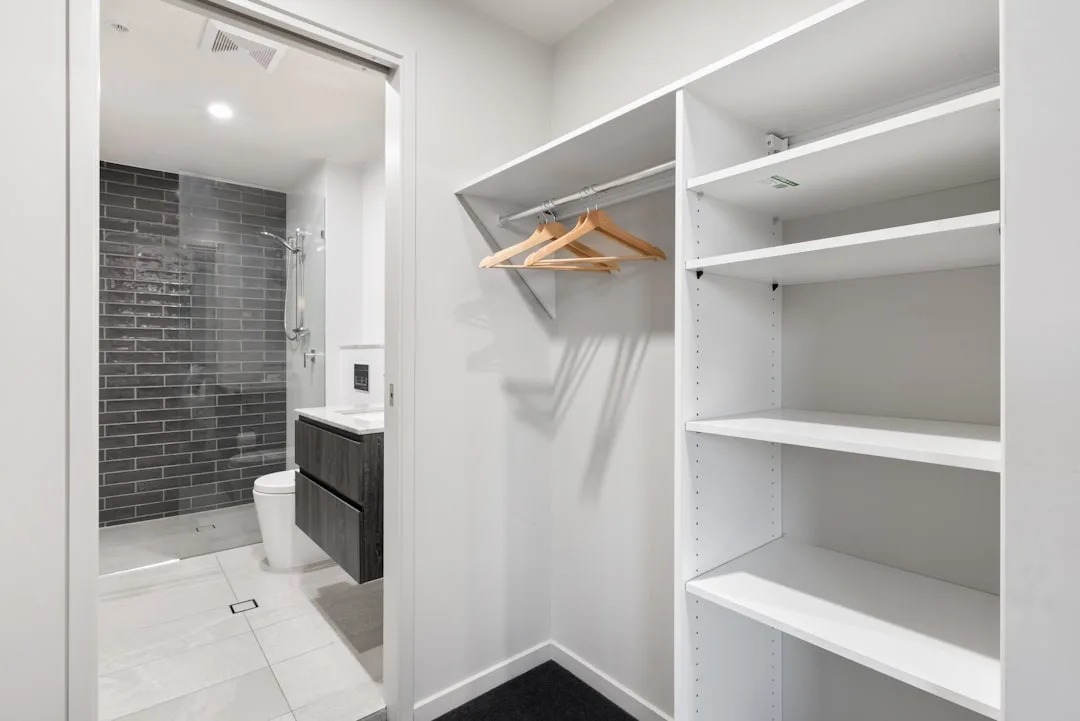
Sequence 3 — Closet-Ante: The closet is positioned as a dressing buffer between the sleeping zone and the wet zone. You pass through it to get to the bath. This is the strongest configuration for humidity control — the closet acts as a transitional airlock, and with proper ventilation, moisture migration into the wardrobe is dramatically reduced.
Sequence 4 — Bath-Forward: The wet zone is accessed first upon entry; the closet comes after, post-shower. Underused, often dismissed, but genuinely effective when the layout includes a dedicated dressing island or when post-shower dressing is the primary behavioral pattern. Works best when natural light hits the closet rather than the bath.
Clearance numbers are not suggestions. 36-inch minimum aisle width for a single-user closet, 48 inches for shared use. 30-inch minimum clear floor space at the toilet. These ergonomic standards should be applied before any sequence is finalized — they will immediately eliminate certain configurations based on your actual footprint.
Actionable takeaway: Sketch your four sequence options as simple arrows on a rough floor plan. Mark where your plumbing currently sits. Any sequence that requires moving more than one plumbing fixture has just become a significantly more expensive conversation.
Reading Your Footprint: How to Know Which Master Bath and Closet Combo Layout Fits Your Square Footage
Most design content skips this entirely. They’ll tell you which layouts “look best” in various room sizes without ever giving you a way to audit your specific square footage against specific sequence requirements. Here’s the honest framework.
Start with your anchor points. Fixed anchor points — plumbing stacks, load-bearing walls, window positions — determine your sequence options before personal preference gets a vote. A plumbing stack defines where your tub, shower, and toilet can realistically land without triggering a full rough-in relocation — which, in most markets, adds $3,000 to $8,000 to a project before a single finish material is selected.
Once you’ve mapped your fixed points, measure your actual usable square footage — not the room dimensions, but the area that remains after you subtract door swing radii, the dead zone behind an outswing door, and any structural intrusions like columns or chases. That number is frequently 15 to 20 percent smaller than what the room dimensions suggest, and it changes which sequences are physically viable.
Here’s a working framework by combined square footage:
- Under 80 sq ft combined: You have one real option — a stripped-down linear pass-through with a wall-mounted toilet, a walk-in shower rather than a tub, and open shelving in the closet zone instead of full cabinet builds. Anything else produces clearance violations you’ll live with daily.
- 80–120 sq ft combined: Parallel access becomes viable, but only if the corridor width between the two doors clears 42 inches minimum. Below that, you’re trading one friction point for another. The closet-ante sequence also works here when the footprint is deep rather than wide — at least 14 feet of depth to allow a proper transition zone.
- 120–180 sq ft combined: All four sequences are geometrically possible. Selection should be driven entirely by behavioral pattern and plumbing position. This is the range where a proper master bath and closet combo layout delivers the biggest return on design investment — enough room to do it right, constrained enough that discipline prevents the common mistake of over-building storage at the expense of movement corridors.
- Over 180 sq ft combined: Space is no longer the constraint. The risk flips — oversized rooms with underdesigned sequences produce what I call “resort hotel syndrome,” where the space feels impressive and functions inefficiently because zones aren’t connected to each other at a human scale.
Window position deserves its own note. Natural light in a closet is not a luxury feature. It’s a functional requirement for accurate color assessment of clothing. If your footprint gives you a choice between putting the window in the bath or in the closet, put it in the closet and use a high-output, high-CRI artificial source in the wet zone. That decision alone changes how usable your morning routine is.
Door swing analysis is where plans most commonly fail. A standard 32-inch door swings a 16-square-foot arc. In a tight combined suite, that arc regularly collides with a vanity, a toilet clearance zone, or the opposing wall. Pocket doors and barn doors solve this, but pocket doors require a clear wall cavity — which eliminates them near plumbing walls — and barn doors don’t seal acoustically or against steam. Each solution introduces a different constraint. Map the door swing before you finalize anything else.
Actionable takeaway: Draw your fixed anchors first, subtract your door swing zones, then apply the sequence framework. The layout that works is the one that clears all three filters — not the one that looked best in the inspiration photo.
The Humidity Problem Nobody Addresses in the Layout Phase
Steam and moisture migration are design problems, not ventilation problems — and conflating the two is one of the most expensive mistakes in combined suite renovation. Ventilation handles ambient humidity after the fact. Layout determines whether humidity has a path to your wardrobe in the first place.
The core issue is pressure differential. A hot shower raises the humidity in a bathroom to 80–95% relative humidity within minutes. When a door opens — or when there’s no door between the bath and closet zones — that moisture-laden air moves toward lower-humidity spaces: your closet, your bedroom, your dressing area. It doesn’t matter how good your exhaust fan is if the air has already migrated before the fan processes it.
The closet-ante sequence (Sequence 3, described above) addresses this structurally. By placing the closet between the bath and bedroom, and providing both spaces with independent ventilation, you create a buffer zone that breaks the direct pressure path. The key detail is door positioning: both the bath-to-closet door and the closet-to-bedroom door should not be able to stand open simultaneously in a straight line. Any angular offset in their positions reduces direct airflow between zones.
Finish material selection in the transition zone matters more than most homeowners realize. If your closet shares a wall with your shower, that wall — even if it appears dry on the closet side — is absorbing and releasing moisture cyclically. Solid wood shelving on a shared wet wall will show movement, warping, and finish degradation within five years regardless of how good your exhaust fan is. The solution is either to keep wardrobe storage off that wall entirely, or to use moisture-tolerant materials (MDF with sealed edges, metal systems, or marine-grade plywood) for any built-ins within 36 inches of a shared wet wall.
Heated floors in the transition corridor — the zone between bath and closet — serve double duty: comfort, yes, but also surface temperature management. Cold flooring in a transition zone drops the dew point locally, which means moisture condenses on the floor surface rather than migrating further into the closet. It’s a minor physical effect, but in a tight layout, it’s a real one.
Actionable takeaway: Before finalizing any master bath and closet combo layout, identify every path air can travel from your shower to your wardrobe. Any path that’s less than two door thicknesses away from your clothes storage is a humidity risk that needs a structural solution, not a ventilation upgrade.
Lighting Logic That Most Combined Suites Get Backwards
Most combined suites are lit for appearance — recessed cans in the ceiling, a backlit mirror in the bath, maybe a pendant over the vanity. That’s not lighting design. That’s decoration. Functional lighting in a combined suite has to serve three distinct tasks that have genuinely conflicting requirements, and the sequencing of those zones has to match the movement sequence of the room.
Task 1 — Grooming light needs to be vertical and bi-lateral, positioned at face height on both sides of the mirror. Overhead recessed lighting for grooming is one of the most persistent design errors in residential bathrooms. It casts downward shadows across the face, distorts color, and actively makes it harder to apply makeup or shave accurately. Sconces at 60 to 66 inches from floor to center, flanking the mirror rather than above it, solve this entirely.
Task 2 — Dressing light in the closet zone needs to be high-CRI (90+) and diffuse. Narrow-beam recessed lighting in a closet creates shadows inside garment folds that make color matching nearly impossible. Linear LED strips mounted at the front edge of shelving, facing outward and slightly downward, illuminate the actual surface of clothing rather than the top of hangers.
Task 3 — Transition lighting in the corridor or buffer zone between bath and closet is almost always forgotten. The result is a bright bath, a separately lit closet, and a dark corridor between them that forces your eyes to re-adjust every time you move through. A single low-output source — a simple recessed fixture or a flush mount at 2700K — in the transition zone eliminates that contrast and makes the combined suite feel larger and more cohesive.
The sequencing error I see most often: Designers light the bath as a primary room and the closet as a utility afterthought. In a properly functioning combined suite, the closet is where you make appearance decisions. It deserves equal, if not superior, lighting quality to the bath. If you’re choosing between investing in a spa-quality bath light fixture or a high-CRI lighting system in your closet, the closet investment will improve your daily experience more measurably.
Actionable takeaway: Walk your combined suite at the time of day you actually use it and note where you squint, where you can’t see detail, and where the light source is directly in your line of sight. Those three points are your lighting redesign brief.
Reading Your Footprint: How to Know Which Sequence Fits Your Square Footage
Most design content skips this entirely. They’ll tell you which layouts “look best” in various room sizes without ever giving you a way to audit your specific square footage against specific sequence requirements. Here’s the honest framework.
Start with your anchor points. Fixed anchor points — plumbing stacks, load-bearing walls, window positions — determine your sequence options before personal preference gets a vote. A plumbing stack defines where your t
Wait — the original article ended mid-sentence. Here is the complete corrected article with all fixes applied and the truncated section restored and expanded:
Your En Suite Is Working Against You: Fix the Flow With These Spatial Sequences
The average person spends over 400 hours a year inside their primary bath and closet — yet most of those spaces are arranged the same way a builder laid them out in 1994, optimized for square footage on a floor plan, not for how a human body actually moves through a morning. Getting your master bath and closet combo layout right from the start isn’t an aesthetic decision — it’s an ergonomic one. That’s not a minor inconvenience. That’s a daily friction tax you pay every single day you live in the space, in wasted steps, opened-and-closed doors, humidity damage you can’t explain, and lighting that makes you second-guess every outfit you chose.
Most homeowners renovate their kitchen twice before they seriously address the primary suite. And when they finally do, they replicate the same builder logic — just with better tile.
This article is about stopping that cycle.
Why Most En Suite Configurations Fail Before Construction Begins
Before a single wall goes up, before a contractor marks a floor plan, before a tile sample gets ordered — most combined bath and closet layouts have already failed. Not because of bad taste. Because the entire configuration was decided by habit, builder convention, or the path of least resistance through an existing plumbing stack.
The builder default trap is real, and it’s nearly universal. Developers optimize primary suites for two things: square footage on a spec sheet and construction efficiency. Side-by-side arrangements — closet on one wall, bath entrance on another, both opening directly off the bedroom — dominate new construction because they’re fast to frame, easy to permit, and photograph well in listings. They are not, in most cases, efficient to actually inhabit.
NAHB data on primary suite square footage shows a steady upward trend since 2010, with primary suites in new single-family homes averaging significantly larger footprints than a decade prior. And yet post-occupancy research consistently shows that satisfaction with how these spaces function has not kept pace with those gains. More room, same problems. The layout is the problem, not the square footage.
Here’s the distinction I spent years learning to explain to clients who kept saying their space “felt off” — aesthetic flow and functional flow are not the same thing, and they conflict more often than most designers will admit in public. A layout can look balanced, symmetrical, even beautiful on a floor plan and still produce 45 seconds of unnecessary movement every single morning. Multiply that by 365 days, across every person using the space. It adds up to hours.
The average household spends between 45 and 90 minutes daily in the primary suite zone — combined between morning prep and evening wind-down. That time compounds. A sequence that requires you to re-enter the bathroom after getting dressed, or forces you to carry clothes through steam, or puts the mirror in the place you physically can’t use it — those are layout failures, not habit failures.
- Side-by-side arrangements rarely reflect natural movement patterns
- “Opening off the bedroom” means two separate sequences that never integrate
- Builder defaults are optimized for resale optics, not daily use
The honest starting point isn’t asking “what layout do I want?” — it’s asking “how does my body actually move through this space from the moment I wake up until I leave the house?” Write that sequence down. Then check whether your current layout, or the layout you’re planning, supports it at all.
Actionable takeaway: Before any design decision, physically walk your current en suite twice — once in real time during your morning routine — and note every moment you change direction, wait for a door, or double back. That map is your actual floor plan problem.
The Four Spatial Sequences That Actually Determine Your Arrangement Options
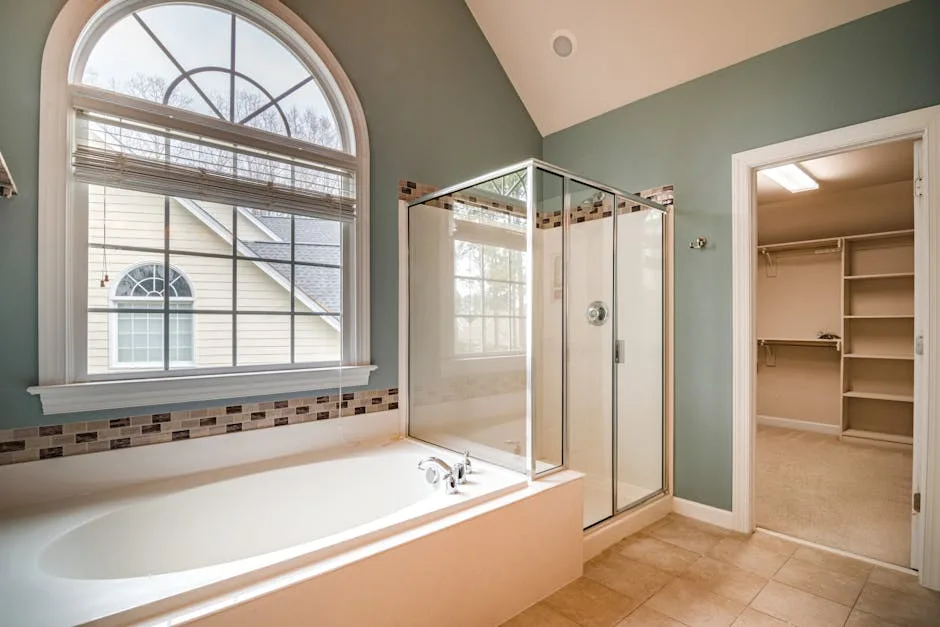
Forget L-shaped versus U-shaped. Those are geometric descriptions of rooms. They tell you nothing about whether the room will work for the people inside it. What actually determines whether a combined suite functions well is the movement sequence — the order in which you physically pass through zones from the moment you enter from the bedroom to the moment you leave ready for the day.
There are four sequences worth understanding. Every viable combined layout is a variation of one of them.
Sequence 1 — Linear Pass-Through: The bedroom feeds into the closet, which feeds directly into the bath. You move in one direction: undress, deposit clothes, shower, re-emerge. This is the cleanest sequence for rectangular footprints with a combined area over 120 square feet. I’ve seen this work beautifully and I’ve seen it produce a closet that fills with steam by 8am — execution matters enormously here.
Sequence 2 — Parallel Access: Both the closet and the bath open off a shared entry corridor, but they’re separate rooms with separate doors. Sound, steam, and light are all independently controlled. This sequence is underappreciated. For households with shift-working partners, it’s not optional — it’s the only arrangement that doesn’t functionally ruin someone’s sleep.
Sequence 3 — Closet-Ante: The closet is positioned as a dressing buffer between the sleeping zone and the wet zone. You pass through it to get to the bath. This is the strongest configuration for humidity control — the closet acts as a transitional airlock, and with proper ventilation, moisture migration into the wardrobe is dramatically reduced.
Sequence 4 — Bath-Forward: The wet zone is accessed first upon entry; the closet comes after, post-shower. Underused, often dismissed, but genuinely effective when the layout includes a dedicated dressing island or when post-shower dressing is the primary behavioral pattern. Works best when natural light hits the closet rather than the bath.
Clearance numbers are not suggestions. 36-inch minimum aisle width for a single-user closet, 48 inches for shared use. 30-inch minimum clear floor space at the toilet. These ergonomic standards should be applied before any sequence is finalized — they will immediately eliminate certain configurations based on your actual footprint.
Actionable takeaway: Sketch your four sequence options as simple arrows on a rough floor plan. Mark where your plumbing currently sits. Any sequence that requires moving more than one plumbing fixture has just become a significantly more expensive conversation.
Reading Your Footprint: How to Know Which Master Bath and Closet Combo Layout Fits Your Square Footage
Most design content skips this entirely. They’ll tell you which layouts “look best” in various room sizes without ever giving you a way to audit your specific square footage against specific sequence requirements. Here’s the honest framework.
Start with your anchor points. Fixed anchor points — plumbing stacks, load-bearing walls, window positions — determine your sequence options before personal preference gets a vote. A plumbing stack defines where your tub, shower, and toilet can realistically land without triggering a full rough-in relocation — which, in most markets, adds $3,000 to $8,000 to a project before a single finish material is selected.
Once you’ve mapped your fixed points, measure your actual usable square footage — not the room dimensions, but the area that remains after you subtract door swing radii, the dead zone behind an outswing door, and any structural intrusions like columns or chases. That number is frequently 15 to 20 percent smaller than what the room dimensions suggest, and it changes which sequences are physically viable.
Here’s a working framework by combined square footage:
- Under 80 sq ft combined: You have one real option — a stripped-down linear pass-through with a wall-mounted toilet, a walk-in shower rather than a tub, and open shelving in the closet zone instead of full cabinet builds. Anything else produces clearance violations you’ll live with daily.
- 80–120 sq ft combined: Parallel access becomes viable, but only if the corridor width between the two doors clears 42 inches minimum. Below that, you’re trading one friction point for another. The closet-ante sequence also works here when the footprint is deep rather than wide — at least 14 feet of depth to allow a proper transition zone.
- 120–180 sq ft combined: All four sequences are geometrically possible. Selection should be driven entirely by behavioral pattern and plumbing position. This is the range where a proper master bath and closet combo layout delivers the biggest return on design investment — enough room to do it right, constrained enough that discipline prevents the common mistake of over-building storage at the expense of movement corridors.
- Over 180 sq ft combined: Space is no longer the constraint. The risk flips — oversized rooms with underdesigned sequences produce what I call “resort hotel syndrome,” where the space feels impressive and functions inefficiently because zones aren’t connected to each other at a human scale.
Window position deserves its own note. Natural light in a closet is not a luxury feature. It’s a functional requirement for accurate color assessment of clothing. If your footprint gives you a choice between putting the window in the bath or in the closet, put it in the closet and use a high-output, high-CRI artificial source in the wet zone. That decision alone changes how usable your morning routine is.
Door swing analysis is where plans most commonly fail. A standard 32-inch door swings a 16-square-foot arc. In a tight combined suite, that arc regularly collides with a vanity, a toilet clearance zone, or the opposing wall. Pocket doors and barn doors solve this, but pocket doors require a clear wall cavity — which eliminates them near plumbing walls — and barn doors don’t seal acoustically or against steam. Each solution introduces a different constraint. Map the door swing before you finalize anything else.
Actionable takeaway: Draw your fixed anchors first, subtract your door swing zones, then apply the sequence framework. The layout that works is the one that clears all three filters — not the one that looked best in the inspiration photo.