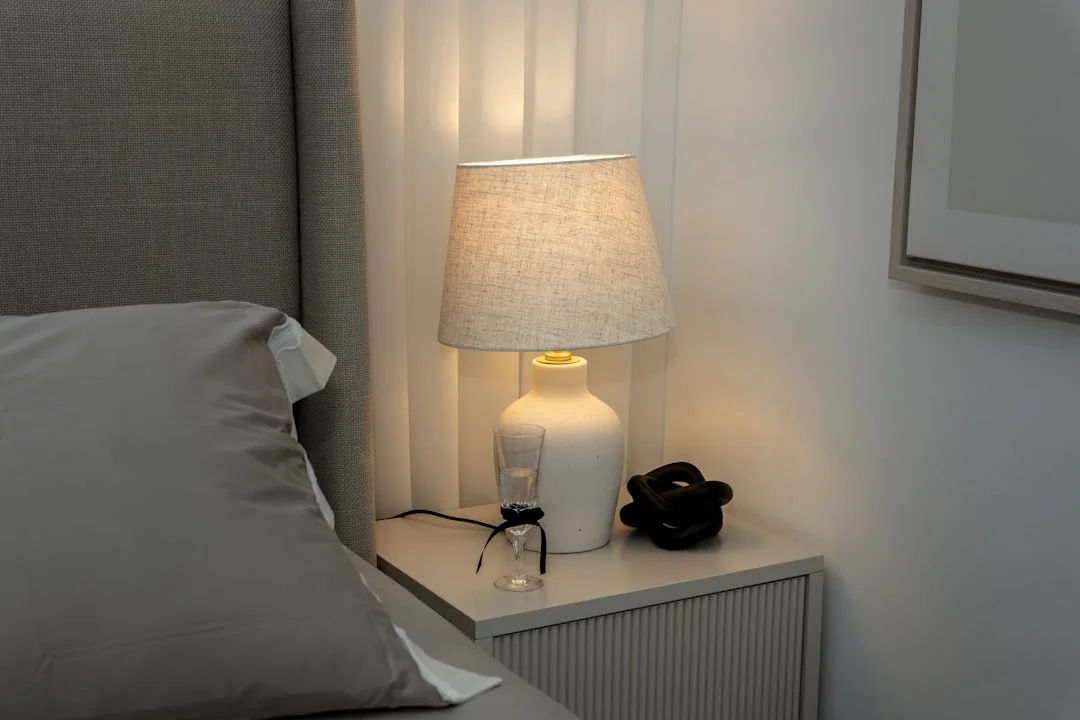
Most people redesigning their bedrooms spend thousands on the wrong things. They buy a new mattress, swap out the duvet, maybe repaint — and the room still looks like a mid-range hotel room in Cincinnati. That’s because high end bedroom design details aren’t about price tags. They’re about precision. The difference between a room that reads as expensive and one that merely costs a lot comes down to five specific decisions most guides never even mention.
I’ve walked through penthouse renovations in Manhattan, sat in on design presentations for $4M spec homes in Marin County, and interviewed enough interior designers to know what separates rooms that make your jaw drop from rooms that just make your credit card cry. Here’s what they’re actually doing — and why it works.
The Ceiling Is the Fifth Wall, and You’re Ignoring It
Every designer you admire treats the ceiling as a design surface. Every guide you’ve read ignores it entirely. That gap is exactly where mediocre bedrooms live.
The most consistently impactful high end bedroom design detail I’ve seen repeated across luxury projects — from a Nob Hill Victorian to a minimalist Palm Springs box — is ceiling articulation. Not necessarily a coffered ceiling or a hand-painted mural, though both work spectacularly. The baseline version is a simple cove detail: a recessed perimeter ledge, typically 6 to 8 inches deep, housing indirect LED strip lighting. The light washes upward, the ceiling appears to float, and the room gains an immediate sense of architectural permanence that no amount of throw pillows can replicate. Total material cost for a standard primary bedroom? Around $400 to $900 in materials, depending on your ceiling height and the LED system you choose. Labor adds more, obviously. But the visual return is disproportionate.
Beyond the cove, consider ceiling height manipulation through design rather than construction. A painted ceiling medallion — even in a contemporary space — draws the eye upward and gives pendant lighting an intentional anchor point rather than a wire emerging from drywall. In rooms with 9-foot ceilings, painting the ceiling the same color as the walls (or one shade deeper) creates an enveloping quality that reads as deliberately curated rather than accidentally cozy. Designers call this “wrapping” the room. It works because it eliminates the hard visual stop at the wall-ceiling junction, making the space feel considered from every angle.
The dark horse version of this move: a wood slat ceiling panel installed as a partial drop above the bed, roughly the footprint of the headboard and a foot on either side. It creates an architectural canopy effect without the permanence or cost of a full tray ceiling, and it photographs as though you hired someone very expensive. Which, frankly, you can.
What Everyone Gets Wrong About Luxury Bedding Layers
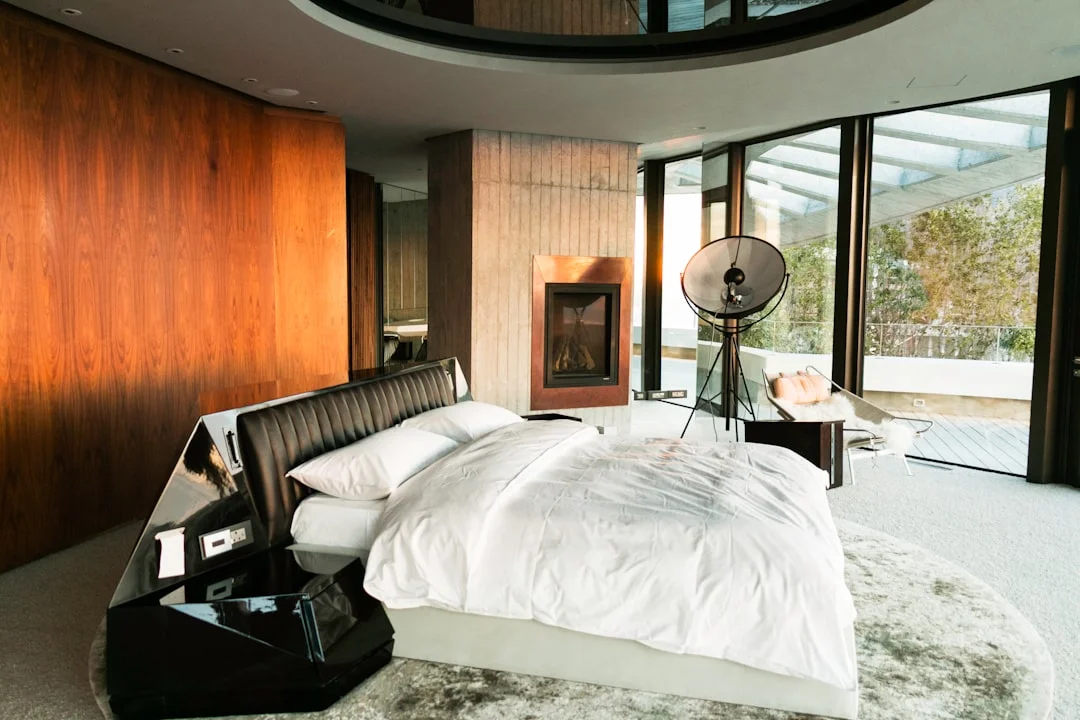
Luxury bedroom with white bedding layers on platform bed with fireplace and wood walls — Photo by Mueen Agherdien on Unsplash
Here’s what most guides get wrong about this: they tell you to buy better thread count. That’s almost irrelevant. Thread count above 400 in percale cotton is largely a marketing fiction — the fabric structure and fiber length matter far more than the number. A 600-thread-count sheet made from short-staple cotton will pill within six months. A 300-thread-count sheet made from 45mm long-staple Egyptian cotton will still feel extraordinary three years from now.
The actual secret to luxury bedding isn’t material alone — it’s layering logic. Designers who work on high-end residential projects almost universally follow a specific architecture: a fitted sheet in a tone that’s two shades lighter than the wall color, a flat sheet in matching or complementary white, a medium-weight duvet with a cover in a textured solid (waffle weave, matelassé, or subtle jacquard), and then a second lighter throw folded at the foot in a contrasting texture — linen over cotton, for instance, or a cashmere-blend over linen. The visual weight pulls toward the foot of the bed. This is why hotel beds look intentionally staged: the geometry is deliberate.
Pillows are where most people collapse into chaos. The formula that works: two king Euro shams standing upright against the headboard, two sleeping pillows in cases that match the flat sheet, and either one or two decorative accent pillows in front — never more than that if your bed is a queen. The accent pillows should have visible construction detail: a flanged edge, a hand-stitched border, a button closure on the back. Why does the back matter? Because when you toss them into the chair at night, they’re still beautiful objects. That’s the detail that separates a designed room from a staged one.
One more thing: iron your pillowcases. Not the sheets — just the cases. The creases at the pillow edges catch light and create a tailored, intentional finish that no one consciously notices but everyone unconsciously feels.
Hardware Is the Jewelry of a Room, and Most People Buy Costume
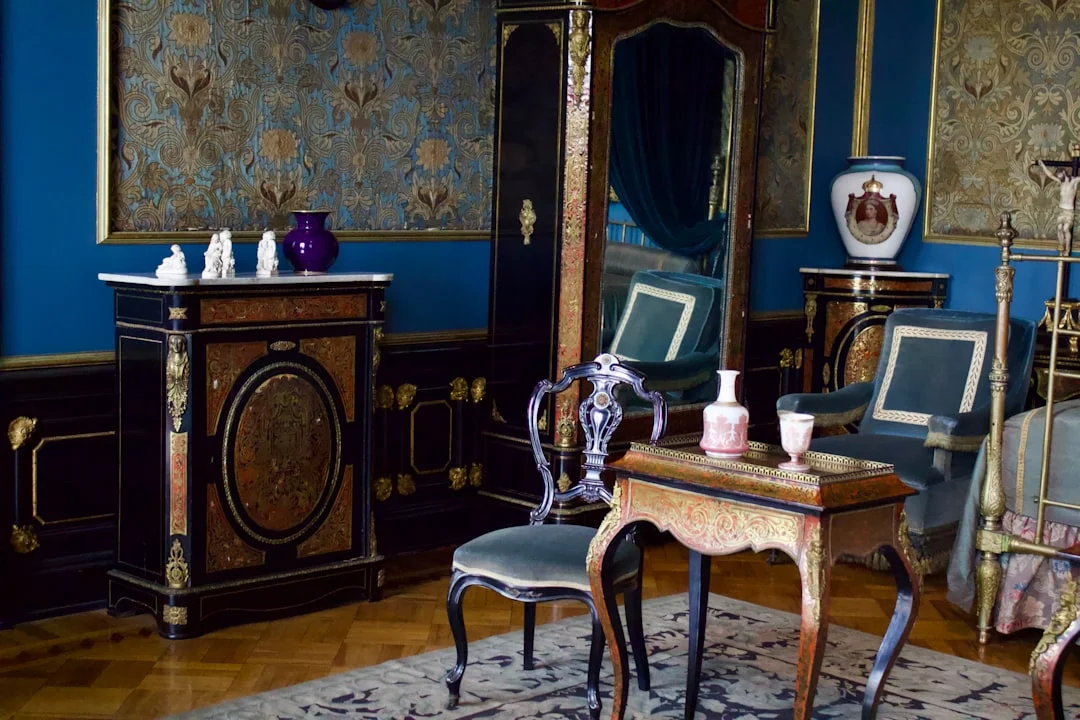
Antique French furniture with ornate gilded ormolu bronze hardware mounts and decorative drawer pull — Photo by Alan David Figueroa on Unsplash
Drawer pulls, door handles, cabinet knobs, switch plates, outlet covers. These are the details that design-literate visitors clock within thirty seconds of entering a room, even if they can’t articulate why. And they’re the single most underspent category in bedroom renovation.
Replacing a standard brushed-nickel outlet cover with a brushed unlacquered brass plate costs roughly $18. Doing this for every outlet and switch in your bedroom takes maybe $90 and forty-five minutes. The visual consistency it creates — that warm, slightly aged metallic note repeated at a dozen low-frequency points around the room — reads as the kind of attention that expensive interior designers are hired to enforce. Because it is exactly what expensive interior designers enforce. Minimalist bedroom design relies almost entirely on this kind of material consistency: when the design is stripped back, every hardware choice becomes proportionally louder.
For case goods — nightstands, dressers — the hardware upgrade math is ruthless in its effectiveness. A $400 six-drawer dresser from a big-box retailer with its original plastic pulls looks like a $400 dresser. The same dresser with solid brass bar pulls at 128mm center-to-center from an architectural hardware supplier looks like a $1,200 piece. I’m not guessing at this. I’ve seen the same dresser styled both ways in a photo shoot and watched editors argue about which was the “investment piece.” They were the same dresser. The pulls cost $12 each.
The non-obvious edge case here: finish consistency has more impact than finish quality. Mixing brushed brass, polished chrome, and oil-rubbed bronze in a single room — even with expensive versions of each — reads as incoherent. Pick one metal family and hold it across every hardware point in the room: light switch plates, cabinet hardware, lamp bases, curtain rod brackets, even the small hooks on the back of the bathroom door if it opens into the bedroom. The repetition is what makes it luxury. Repetition of intention is the definition of design.
The Lighting Layering Formula That Changes Everything
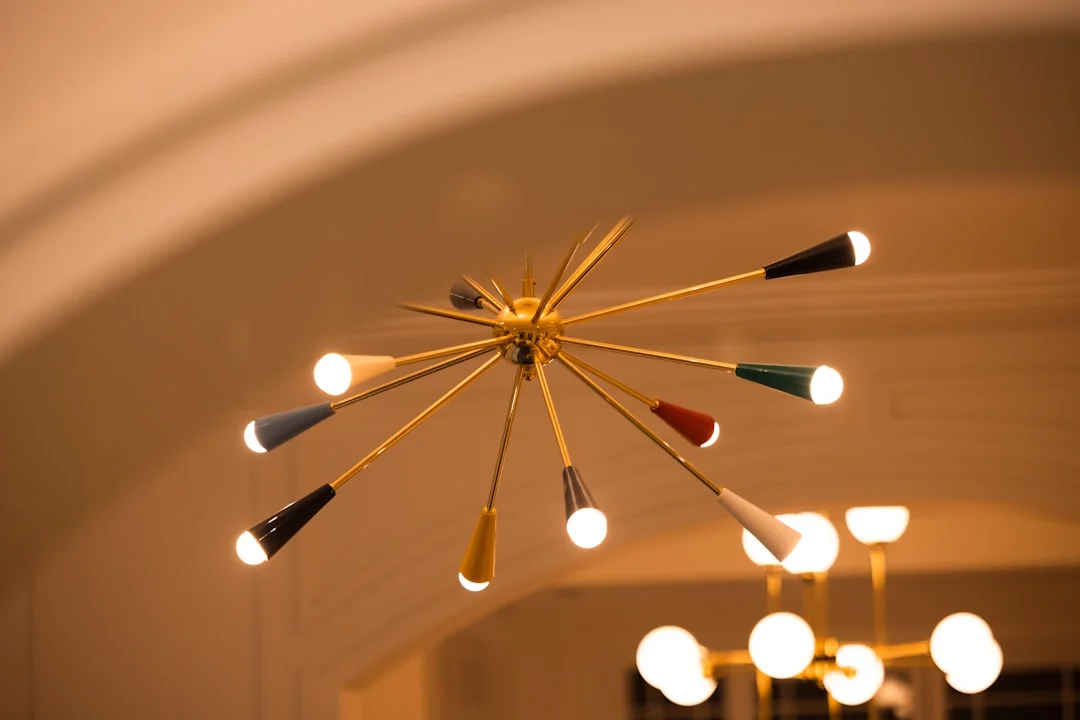
Mid-century modern Sputnik chandelier with colorful cone shades for layered bedroom lighting — Photo by Xiangkun ZHU on Unsplash
Single-source overhead lighting is the fastest way to make a bedroom look like a college dorm. Even an expensive single-source overhead light. This is non-negotiable: high end bedroom design details always include at minimum three light sources operating at different heights and controlled independently. Always.
Here’s the framework designers use. The ambient layer sits highest — recessed cans on a dimmer, a flush or semi-flush ceiling fixture, or the cove lighting discussed above. It provides the baseline functional light for dressing and moving through the space. The task layer sits at bedside height: wall-mounted swing-arm sconces are the gold standard here because they free the nightstand surface completely and position light exactly where you need it for reading — roughly 18 inches above mattress height when centered. The accent layer is the one most people skip entirely, and it’s the one that makes rooms look like magazine photographs. This is the lamp tucked into a corner on a console table, the under-shelf LED in a built-in, the small table lamp on the dresser that you never use for reading but that creates depth, warmth, and spatial dimension when everything overhead is dimmed to 15%.
The specific control system matters more than most people realize. Smart dimmer switches — not smart bulbs, smart dimmers controlling standard warm-white bulbs — give you the most flexibility and the most longevity. A 2700K color temperature across all sources in the bedroom is not negotiable for warmth. 3000K reads clinical. 2200K reads orange in ways that flatter candlelight but not faces. 2700K is the sweet spot that makes skin tones look extraordinary and materials look rich.
The moment of genuine surprise in this formula: the light source you absolutely need and almost certainly don’t have is one that illuminates the space below the bed. A simple strip of warm LED tucked underneath the bed frame’s perimeter creates a floating effect that is genuinely disorienting in the best possible way. It’s used in virtually every luxury hotel bedroom built in the last decade, it costs under $60 in materials, and it turns any bed into an architectural statement at night. Interior lighting design at the residential level almost never discusses this technique, which is exactly why it works so well when you use it.
The Architectural Bones Most Guides Never Mention
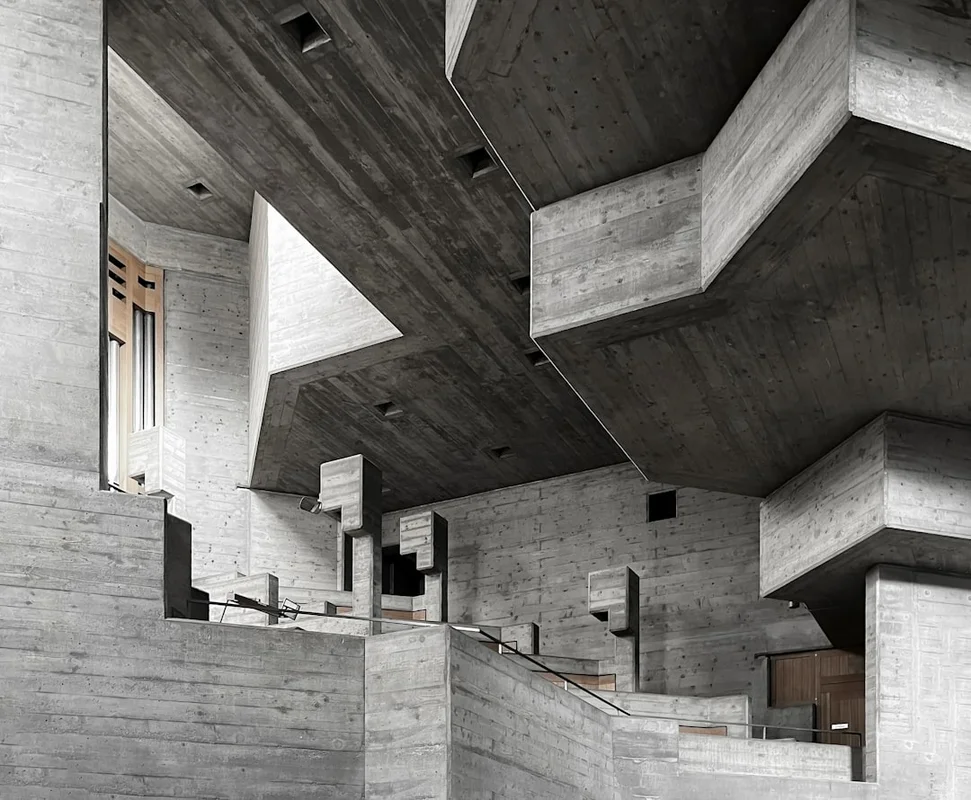
Brutalist concrete interior exposing raw architectural structural bones and framework — Photo by Ricardo Gomez Angel on Unsplash
Paint and soft furnishings are the surface of a room. Architectural millwork is the skeleton. And the skeleton is what determines whether a room has presence or just decoration.
The most accessible form of this is board and batten wall treatment behind the bed. Run vertical boards at 16-inch intervals from baseboard to a horizontal rail at 60 to 72 inches — roughly two-thirds of your ceiling height — paint everything the same color as the wall (or a shade deeper), and you’ve created the kind of architectural wainscoting that adds $30,000 to a home’s perceived value for approximately $800 in materials and a weekend of work. Designers charge significantly more to specify and oversee this. The principle is straightforward: the vertical lines elongate the room, the horizontal rail creates a datum that grounds furniture against the wall, and the play of light across the raised panels adds dimension that flat paint simply cannot deliver.
Beyond the accent wall, consider what’s happening at the ceiling-to-wall transition. A 3.5-inch to 4-inch crown molding, painted the same color as the ceiling rather than the wall, is the move that separates rooms that look finished from rooms that look designed. The trick of matching crown to ceiling color rather than using bright white is one of those details that every serious designer knows and almost no one writing quick-tip blog posts has ever mentioned. It makes the crown read as a ceiling extension rather than an applied decoration. The room gains architectural coherence. The ceiling reads taller.
Floor materials are the final layer of this architectural conversation, and they’re the one that’s hardest to retrofit but most worth doing if you’re doing a full renovation. Wide-plank hardwood at 5 inches or wider, in a matte or satin finish, is the baseline of every genuinely high-end bedroom I’ve ever photographed or written about. Not engineered, if you can avoid it. The sound difference — the hollow knock of engineered versus the solid resonance of 3/4-inch solid hardwood — is something you feel in your body before your brain processes it as quality. If solid hardwood isn’t in the budget, the next best move is large-format stone or stone-look porcelain in a 48×48 format with minimal grout joints. The scale of the material makes the room feel larger and more considered in ways that 12×12 tile, however expensive, simply cannot.
What Beginners Actually Need to Know Before Spending a Dollar
If you’re starting from a standard bedroom with builder-grade everything, the sequence matters as much as the selections. Most beginners make the mistake of buying the headboard first. Don’t. The headboard is the most visible piece, so it feels urgent — but if you haven’t resolved your ceiling, your lighting, and your wall treatment first, the headboard will always be fighting against an unresolved background. Do the background first.
The sequence that produces the best results for the investment: start with paint and hardware (the cheapest and most impactful per dollar), then add architectural millwork if the budget allows, then address lighting with a focus on dimmers and layering, then invest in window treatments (which most people radically underspend on — a well-made drapery panel pooling slightly on the floor transforms a room’s formality register more than nearly anything else), and finally, invest in the bed and bedding.
Bedroom color schemes are often where beginners start, and that’s not wrong — color is foundational — but the mistake is choosing color in isolation from material. A deeply saturated navy wall behind cheap bed linens looks dramatic. Behind 500-thread-count long-staple cotton in ivory, it looks expensive. The same color. The same wall. The material context changes everything.
Budget allocation that reflects how designers actually prioritize: spend 35% of your bedroom renovation budget on lighting (fixtures, dimmers, and professional installation if needed), 25% on window treatments, 20% on bedding and pillows, 15% on hardware and architectural details, and 10% on decorative accessories. Most people invert this, spending heavily on the statement furniture and almost nothing on lighting and hardware. That’s why most bedrooms — even expensive ones — feel unresolved.
Questions We Get Every Day
What’s the single most impactful change for a bedroom that looks “almost there” but not quite?
Add a dimmer switch to every light in the room, today. Not next week. The inability to control light intensity is what makes bedrooms feel residential rather than designed, and it costs $25 per switch. Once you can dim the room to 20% and experience the transformation, every other design decision becomes clearer.
How important is symmetry in a high-end bedroom?
Symmetry around the bed is essential; symmetry across the entire room is a trap. The bed and its flanking elements — nightstands, lamps, sconces — should be symmetrical because the bed is the dominant architectural element and asymmetry there reads as an error rather than a choice. But deliberate asymmetry elsewhere — an armchair in one corner, an asymmetric light fixture over a reading nook — signals confident design rather than compensating balance.
What does “quiet luxury” actually mean in a bedroom context?
No logos. No loud patterns. Restraint in color (typically a palette of three tones at most). Maximum investment in material quality and construction finish. It’s the opposite of maximalism, but it’s not minimalism either — it’s the presence of richness without the performance of it. Think unlacquered brass, natural linen, solid plaster walls, and furniture with visible joinery rather than concealed construction.
Can a renter achieve genuinely high-end bedroom design without renovating?
Yes, but the priorities shift entirely. Focus on: lighting (all portable, all dimmable), bedding quality, hardware that you can swap out and reinstall when you leave, and curtains hung from a tension rod system or ceiling-mounted hooks that don’t require wall damage. The architectural details are off the table, but the soft details — bedding architecture, light layering, hardware — deliver roughly 60% of the total perceived luxury.
How do you know when a bedroom is actually finished?
When you can’t find anything to remove. Not anything to add — anything to remove. A finished high-end bedroom has nothing in it that doesn’t earn its place: no decorative objects added from habit, no extra pillows added from insecurity, no extra furniture added to fill awkward corners. Luxury is edited. The room is done when the editing is done.
Is matching furniture sets a mistake?
Yes. Matching bedroom sets signal that the room was decorated in a single shopping trip rather than curated over time. The high-end look requires at least the appearance of curation: a nightstand that doesn’t match the dresser, a bench at the foot of the bed from a different period than the headboard. It doesn’t have to be literal antiques — just visual diversity that suggests taste rather than convenience.
What’s the most common mistake in high-end bedroom design?
Scale. Specifically, furniture that’s too small for the room. A queen bed in a 14×16 room with petite nightstands and a small dresser tucked in the corner looks timid. The same room with a king bed, substantial nightstands, and a full-width dresser looks intentional. Luxury does not shrink from the edges. It fills the room with authority.
The Room Is Never Just a Room
Here’s the truth that ties all of this together: the rooms that stop people mid-scroll, that get saved and shared and returned to, aren’t designed around any single wow-factor element. They’re designed around the relationship between elements. The way the cove light warms the ceiling and the ceiling color wraps into the walls and the walls articulate behind the bed with board and batten and the bed itself sits on a rug that’s genuinely too big — 11×14 in a 13×16 room — so the nightstands sit fully on it rather than perching awkwardly at its edge.
High end bedroom design details are a system. Not a checklist.
Get the bones right — ceiling treatment, wall articulation, floor material — and everything placed into that room will read as more expensive than it is. Get the bones wrong and no amount of Italian bedding or hand-forged hardware will fix the feeling that something is slightly off. Because that feeling is structural. It lives in the room, not the objects.
The designers who charge $400 an hour aren’t selling taste. They’re selling sequence, proportion, and the discipline to finish.
You now have the sequence.