The decision around limewash paint vs regular paint is one that comes up constantly in renovation planning — and most people approach it backwards. The finish on your walls can outlast your furniture, your flooring, and possibly your mortgage — so the choice between limewash and regular paint is less about trend-chasing and more about understanding what you’re actually buying. Most people treat this as a style question. It isn’t. It’s a materials question that happens to have aesthetic consequences, and getting it wrong can mean a wall that looks beautiful for eight months and then starts doing something you didn’t plan for.
Quick Answer
The finish on your walls can outlast your furniture, your flooring, and possibly your mortgage — so the decision between limewash and regular paint is less about trend-chasing and more about understanding what you’re actually buying.
I’ve watched clients make this choice based on an Instagram photo and a mood board. I’ve also watched them make it based on a knowledgeable conversation at a specialty retailer, armed with the right questions. The outcomes were not the same.
What Limewash Actually Is (And Why It’s Not Just a Trendy Finish)
In This Article
Before any comparison makes sense, you need to understand what limewash is at a material level — because calling it “paint” is technically wrong, and that wrongness matters.
Limewash is made from crushed limestone that has been burned in a kiln, then “slaked” — combined with water — into a putty, which is then diluted further into a thin, water-like wash. There is no binder in the traditional sense. No acrylic polymer. No vinyl resin. What holds it to the wall is chemistry: the lime reacts with carbon dioxide in the air and hardens back into calcium carbonate, essentially becoming stone again. It doesn’t form a film on top of your wall. It becomes part of the wall surface.
Regular latex paint works entirely differently. It carries pigment suspended in an acrylic polymer emulsion, which dries to form a flexible film over whatever surface it’s applied to. That film is what gives it washability, durability, and consistent sheen. The wall underneath is irrelevant to how the paint behaves — the film is doing all the work.
This distinction — mineral carbonation versus polymer film — explains every single difference in behavior, maintenance, and suitability that follows in this article.
True limewash has been documented on structures for over 4,000 years. The Pantheon in Rome and medieval European buildings still carry original limewash layers preserved beneath later coatings. That longevity isn’t incidental — it’s the direct result of how the material bonds at a molecular level rather than adhering as a surface coating.
Here’s where things get complicated for modern buyers. Most products sold as “limewash paint” at retailers are acrylic-limewash hybrids: they contain some lime pigment or calcium carbonate for aesthetics, but their binder system is acrylic. They behave like paint. They dry like paint. They clean up like paint. That’s not inherently bad — but treating them as equivalent to true limewash leads to incorrect expectations about performance, breathability, and longevity.
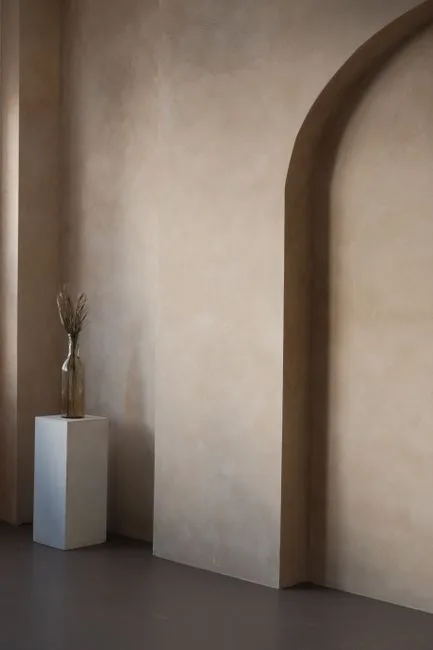
The mottled, layered, dimensional quality that makes limewash visually distinctive comes from the application technique and the lime’s natural movement as it carbonates — not from a tinted base coat. You cannot achieve the same result by buying a product that looks similar in the can.
Actionable takeaway: Before you evaluate any limewash product, read the ingredient list. “Slaked lime” or “calcium hydroxide” signals a true mineral product. “Acrylic” or “latex binder” signals a limewash-effect paint — evaluate it accordingly.
How They Look Side by Side — and Why One Is Harder to Predict

Regular latex paint is, above almost everything else, reliable. The color chip at the store is the color on your wall. Mix a second batch six months later and it matches. Apply it in July, apply the same product in January, and it looks the same. For most people in most situations, that predictability is worth a great deal.
Limewash operates on different terms entirely. Two walls in the same room, painted on the same afternoon with product from the same bucket, can dry to subtly different finishes — because the amount of natural light hitting them, their position relative to a window, and minor differences in how much moisture each section of wall held at application time all influence the final carbonation. Interior designers note consistently that limewash applied during humid summer months dries darker and more mottled than the same product applied in dry winter air. This isn’t a defect. It’s the material behaving as designed. But it means you cannot fully predict the outcome, and that unpredictability is either a feature or a problem depending on what you need.
The dimensional quality — the way limewash seems to absorb and reflect light differently depending on the angle you view it from — comes from the crystalline calcium carbonate surface. Under good natural light, it reads as warm, deep, almost architectural. Under cool-temperature artificial lighting, the same wall can look flat and chalky. This isn’t consistent across rooms or times of day, which is either magic or aggravating, and I’ve seen clients feel both emotions about the same wall.
If you need color consistency across a large home, matching adjacent rooms, or a rental property where repainting by a future tenant or contractor is probable — limewash raises the complexity significantly. Matching an existing limewash wall later is not like opening a saved paint color on an app.
Regular latex is also predictably affected by sheen level:
- Flat/matte: hides wall imperfections, no glare, marks easily
- Eggshell: gentle sheen, moderate washability, most common for living spaces
- Satin: durable, slight glow, good for hallways and bedrooms
- Semi-gloss/gloss: highly washable, reads every imperfection, typically kitchens and trim
Limewash has no equivalent sheen selection. The finish is always matte — the variation comes from depth and texture, not reflectivity.
Actionable takeaway: If you’re considering limewash, look at it in your actual room at different times of day before committing. Order a sample pot, apply it to a 2×2 foot section of wall, and evaluate it under your lighting conditions — morning sun, afternoon shade, and with your artificial lights on at night.
What Are the Disadvantages of Limewash Paint?
Most content on this topic buries the drawbacks at the end of an otherwise enthusiastic sales pitch. I’d rather put them up front, because these are the things that determine whether limewash paint vs regular paint is the right call for your situation — not the aesthetic appeal.
True limewash is not washable in the traditional sense. Running a damp cloth along a latex-painted wall removes scuffs. Running the same cloth along a true limewash wall, especially in the first months before full carbonation, can lift or smear the surface layer. Acrylic-limewash hybrids are more resistant to this, but still softer than standard latex. If you have children, dogs, or cooking grease anywhere near the wall in question, this matters enormously.
Surface compatibility is another real constraint. True limewash performs best on porous mineral surfaces — plaster, masonry, unpainted drywall with a specific primer. Applied over existing latex paint, it may not bond reliably because the porous surface it needs to carbonate into simply isn’t there. This is one of the most common application failures, and it’s rarely mentioned prominently in product marketing. If your walls have been painted with latex before, you either need to strip them back or accept that you’re using a hybrid product, not true limewash.
The skill gap is significant. A competent DIYer can roll latex paint on a room in an afternoon and achieve a perfectly acceptable result. Limewash application — the brushwork, the layering, the deliberate variation in pressure and direction — is a learned technique. Bad application produces a wall that looks streaky and uneven in the wrong way, rather than textured and intentional in the right way. Many contractors who offer limewash services have taken specific training. That labor cost difference is real and often catches buyers off guard after they’ve already committed to the material.
Color range is limited compared to latex. True limewash relies on natural mineral pigments, which means the available palette skews toward earthy neutrals — whites, warm grays, ochres, terracottas. You will not find a saturated navy or a deep forest green in a true limewash product. Acrylic hybrids have broader color options, but again, they’re not the same material.
Durability in high-moisture environments is complicated. Limewash is breathable, which is genuinely useful in older homes with moisture movement through walls. But in wet zones — showers, areas with direct water splash — true limewash without a sealer will deteriorate. Some manufacturers offer sealers compatible with limewash, but sealing reduces the breathability that is often cited as a core benefit.
Actionable takeaway: Before committing to limewash in a specific room, ask yourself three questions: Is this surface bare plaster or drywall, or has it been painted before? Will anyone be touching, wiping, or splashing this wall regularly? Do I have the budget for professional application or the patience to practice the technique properly? If the answers complicate the picture, they’re meant to.
Where Each Material Makes Sense — and Where It Doesn’t
The limewash paint vs regular paint question doesn’t have a universal answer. It has a situational one.
Limewash is a strong choice when:
- The wall is plaster, masonry, or properly primed bare drywall
- The room has good natural light that will animate the dimensional finish
- The space is low-traffic — a primary bedroom, a formal dining room, a study
- You’re working in an older home where breathability actually matters for moisture management
- The aesthetic goal is organic, layered texture that reads differently throughout the day
- You’re prepared to touch up in the same technique rather than rolling over imperfections
Regular latex is the stronger choice when:
- Consistent color matching across multiple rooms or paint sessions is required
- The wall will see contact, cleaning, or splashing on a regular basis
- The application is being done by someone without limewash technique experience
- The surface has existing latex paint and stripping back isn’t feasible
- The project is a rental unit or a space that will need to be repainted by others in the future
- Budget for labor is limited and the DIY route needs to be straightforward
There’s also a middle path worth acknowledging: acrylic-limewash hybrid products. They offer the visual effect of limewash — the mottled, layered, dimensional look — with the application behavior and durability of latex. They’re easier to apply correctly, more tolerant of imperfect surfaces, and more washable. What they don’t offer is the breathability, the true mineral depth, or the multi-century track record of the real thing. For most residential buyers who want the look without the constraints, hybrids are a legitimate choice — as long as you go in knowing what you’re buying.
Actionable takeaway: Match the material to the surface, the use, and the applicator — not just the mood board. The most beautiful limewash wall in the wrong room will disappoint faster than a well-executed latex finish in the right one.
Cost Comparison: What You’re Actually Paying For
Material cost alone tells an incomplete story here.
True limewash products from quality suppliers run roughly $60–$120 per gallon, depending on source and pigment. Standard latex paint ranges from $25 for builder-grade products to $90+ for premium lines like Farrow & Ball or Fine Paints of Europe. On material cost alone, the gap is narrower than people assume.
The real cost difference appears in labor. A professional limewash application in a standard bedroom — roughly 400 square feet of wall — typically runs $800–$1,500 depending on region and the number of coats and technique layers involved. The same room painted in latex by the same contractor might be $300–$600. That gap exists because limewash technique is slower, requires more setup, and demands a higher skill level to execute well.
DIY limewash is achievable, but the learning curve means your first wall will not look like the reference images that sold you on the material. Plan for a practice surface — a closet wall, a small bathroom, or a piece of drywall in the garage — before committing the technique to a feature wall.
Longevity affects the cost equation differently for each material. Well-applied true limewash on a suitable surface can last 15–25 years before needing significant attention. Standard latex in a living space typically looks its best for 5–10 years before repainting becomes worthwhile. If you’re calculating lifetime cost of ownership, limewash on the right surface with the right application can be the more economical choice over a 20-year horizon — but only if those conditions are met.
FAQ
Can you paint over limewash with regular latex paint?
Yes, but with conditions. True limewash that has fully carbonated can be painted over with latex if the surface is primed correctly first — a bonding primer or a diluted PVA solution is typically recommended to give the latex film something to grip. Painting directly over limewash without priming risks poor adhesion and peeling. Acrylic-limewash hybrids are generally easier to paint over since their surface behaves more like standard paint.
Is limewash paint safe for interiors?
True limewash is one of the most non-toxic interior finishes available. It contains no VOCs, no synthetic binders, and no off-gassing compounds. The high pH of fresh lime means it’s caustic during application — gloves and eye protection matter — but once carbonated, the surface is inert. For households with sensitivities to conventional paint chemicals, true limewash is often a preferred alternative.
How do you touch up limewash without it being obvious?
This is one of the practical challenges that rarely gets discussed. Because limewash finish depends heavily on the specific application technique, moisture level, and layering used in the original application, spot repairs often read as patches. The most reliable approach is to feather the repair outward in a wide area, blending wet edges rather than stopping at the damaged spot. Some designers recommend touching up an entire wall panel or corner-to-corner section rather than attempting spot repairs, especially on walls with significant patina development.
Does limewash work on already-painted walls?
True limewash requires a porous mineral surface to carbonate properly. Applied over existing latex paint, it cannot complete the carbonation process and typically peels or flakes within months. You can either strip the latex back to bare plaster or drywall, apply a specific mineral primer that restores porosity, or accept that you need an acrylic-limewash hybrid rather than a true mineral product. Hybrid products are formulated to adhere to painted surfaces the way any latex paint does.
What’s the actual difference between limewash and whitewash?
The terms are often used interchangeably, which causes real confusion. Traditional whitewash is lime-based but more diluted and less refined than limewash, historically used on exterior structures and farm buildings for its antimicrobial properties. Limewash is a more developed product — typically tinted with mineral pigments, applied in multiple thin layers, and intended for interior or finished exterior surfaces. Modern “whitewash” products sold at paint retailers are usually acrylic washes with no lime content at all. When evaluating either product, the ingredient list matters more than the label name.