The average person’s eye settles on a room’s dominant feature within 1.5 seconds of entering — and in most living rooms, that feature was chosen by accident. If you’ve been searching for living room focal point ideas because something feels off but you can’t name it, that instinct is correct — and the fix is more structural than decorative.
Quick Answer
The average person’s eye settles on a room’s dominant feature within 1.5 seconds of entering — and in most living rooms, that feature was chosen by accident.
It’s usually the TV. Sometimes a window facing the wrong direction. Occasionally a blank white wall that your eye lands on purely because nothing else competed for the job. The room isn’t ugly. The furniture isn’t bad. But something feels off, and you’ve probably repainted twice trying to fix it without knowing what you were actually solving for.
What you’re solving for is a focal point. Not in the vague sense that design blogs deploy the term, but in the structural, psychological, practical sense — the thing your room is organized around. The anchor. Miss it, and every subsequent design decision you make will feel slightly wrong, like you’re building a sentence without a subject.
I spent 11 years as an interior designer — first in Chicago, then Manhattan — and the complaint I heard more than any other wasn’t “I hate my sofa” or “the color is wrong.” It was some version of “I don’t know why, but this room just doesn’t feel right.” Nine times out of ten, I’d walk in, look around, and see immediately that nothing was in charge. No anchor. Every wall competing weakly against every other wall. The room was visually leaderless. That’s fixable. Here’s how.
What Should Be the Focal Point in a Living Room?
In This Article
A focal point is the first thing the eye lands on when entering a room — and its job is not decorative. Its job is structural. It creates visual hierarchy: one dominant element that tells the eye where to start, supported by secondary features that keep the eye moving, and tertiary elements that fill out the composition without demanding attention. Without that hierarchy, every element in the room competes equally, and the result isn’t abundance. It’s visual noise.
Every room already has a default focal point whether you chose one or not. The brain will find the area of highest contrast, largest scale, or most visual complexity and land there first. The question is whether that landing spot is doing anything useful for your room, or whether it’s just the place where your ex left a bookshelf that you’ve been meaning to replace since 2021.
The psychological piece matters more than most design writing admits. A room with a clear focal point feels settled — even if the furniture is budget IKEA. A room without one feels restless, incomplete, like something is missing even when every individual piece is fine. Interior designers consistently report that rooms lacking a deliberate focal point are the most common source of “something feels off” complaints from homeowners — even when furniture and color choices are individually strong. That pattern held up repeatedly in my own practice. The $800 sectional I once helped a client choose looked beautiful in the showroom and made her living room unlivable because we’d placed it facing a wall that had nothing on it. We’d built the whole room around an absence.
The focal point should be visible from the room’s primary entry angle — not tucked into a corner you can only appreciate once you’re already inside. Stand in your doorway right now. Where does your eye go? That’s your current focal point. The rest of this article is about whether you want to keep it.
Common living room focal point ideas by room type:
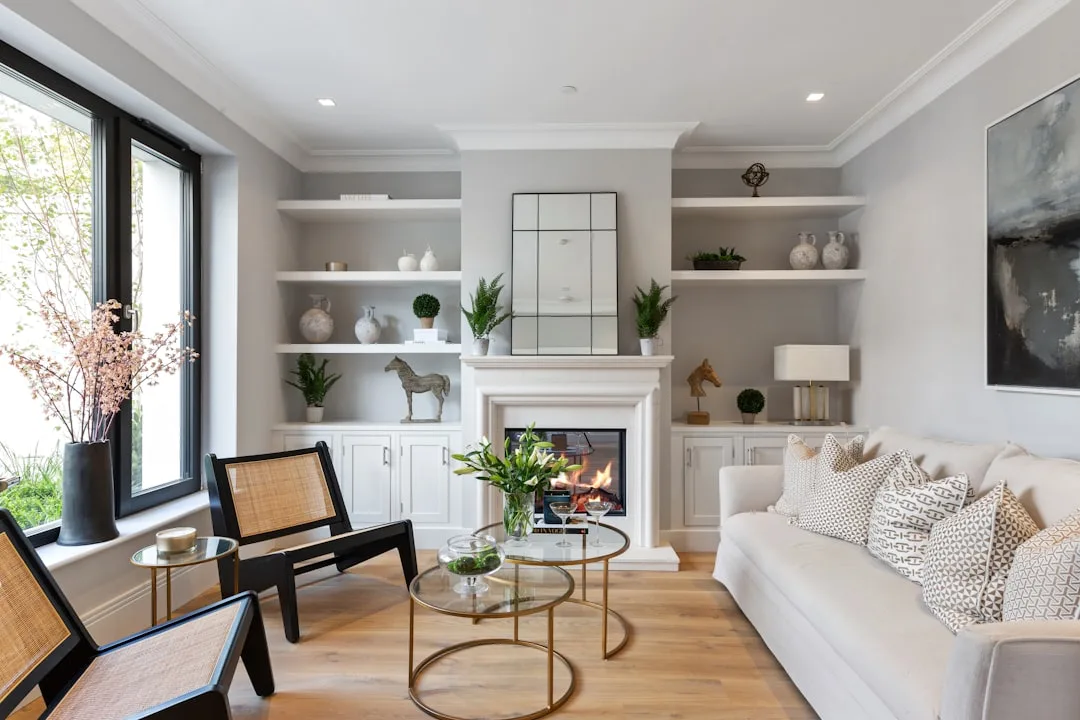
- Rooms with a fireplace: Almost always use it. It’s an architectural gift. The mistake is ignoring it and mounting the TV on a different wall.
- Rooms with large windows: A window with a meaningful view or strong light can anchor a room, but only if you orient furniture toward it rather than perpendicular to it.
- Rooms with no architecture: You’re building from scratch — oversized art, a dramatic paint treatment, or a statement piece of furniture are your primary tools.
- Rental apartments: Removable wallpaper panels, large-format leaning mirrors, and gallery walls all create focal points without permanent changes.
- Long, narrow rooms: The short wall at the far end is typically your focal point — it’s what draws the eye down the length of the space.
Actionable takeaway: Stand in your living room doorway and note exactly where your eye lands first within two seconds. Write it down. That location — not where you’d like the focal point to be — is your baseline.
The 3-5-7 Rule in Decorating (And Why It Matters for Focal Points)
Most people have heard of this rule in passing and filed it under “interior design trivia.” That’s a mistake. The 3-5-7 rule — grouping objects in odd numbers — is the single most useful compositional tool for building a focal point that actually reads as intentional.
Here’s why it works: the brain processes asymmetrical groupings as more dynamic and visually engaging than symmetrical pairs, which read as static or resolved. This is rooted in gestalt psychology — our perceptual system interprets even-numbered pairs as “finished” and stops looking. An odd-numbered grouping creates a slight visual tension the eye keeps trying to resolve, which means it keeps engaging. That’s exactly what you want your focal zone to do.
Applied to your living room, the rule operates on two levels:
- The count level: Three candles on a mantel. Five frames in a gallery cluster. Seven objects on an open shelving unit. Count before you arrange.
- The scale level: Within any grouping, vary heights across roughly three distinct tiers — tall, medium, short. Not evenly staggered. Three tiers, with the dominant object clearly tallest.
The mistake I see constantly — including in my own early work — is treating the focal point as a single object. A mirror. A piece of art. A TV. A single object, no matter how beautiful, sits in space without a composition. It’s a period with no sentence around it. The focal point should be a vignette of three, five, or seven elements arranged with deliberate scale variation, so the eye enters the grouping, moves through it, and settles — rather than glancing and moving on.
A mantel styled with one large vase reads as incomplete. That same mantel with a large vase, two candlesticks of different heights, and a small framed print creates a three-tier composition of five objects — and now the eye has somewhere to travel.
The 3-5-7 rule governs the focal zone, not the whole room. Secondary groupings elsewhere in the space can and should use it too, but the focal point is where it matters most, because that’s where the eye spends the most time.
How to apply the 3-5-7 rule in practice — common compositions that work:
- Mantel, three objects: One large lantern or vase (tall), one framed print leaned against the wall (medium), one small decorative object or stack of books (short)
- Mantel, five objects: Add two candlesticks of slightly different heights to the above grouping — place them asymmetrically, not flanking symmetrically
- Shelving unit, seven objects: One large sculptural piece, two medium vessels, two small framed prints, two trailing plants at varying heights
- Gallery wall, five frames: One large anchor frame (at least 24×30), two medium frames, two small frames — cluster them tightly with 2–3 inch gaps rather than spreading across the wall
- Console or credenza, three objects: One tall lamp, one medium-height decorative object, one low tray or stack — stagger them front-to-back as well as left-to-right
Actionable takeaway: Count the objects currently on or around your intended focal point. If you have two, four, or six, add or remove one. Then check whether those objects span three distinct height tiers.
How to Make a Focal Point in a Living Room Without a Fireplace
This is the question most design content buries under three sections about fireplaces before getting to it. Let me lead with it directly: you don’t need a fireplace. You don’t need any existing architecture. You need scale, intention, and orientation — and all three are achievable in a rental apartment with a $200 budget.
These are the most effective living room focal point ideas for rooms starting from scratch:
1. Oversized art
The fastest high-impact swap available. The threshold I consistently recommend is 60 inches wide — smaller than that and most walls swallow it. Hung at seated eye-level (center of the piece at 57–60 inches from the floor), a large piece of art on an otherwise plain wall creates an immediate anchor. The scale does the work. The mistake I see almost every time: the art is beautiful but 24 inches wide, hung too high, and floating in the middle of eight feet of empty wall. It reads as an afterthought.
- Minimum size for a standard 10-foot wall: 48 inches wide
- Minimum size for a wall 12 feet or wider: 60–72 inches wide
- Hung height: center of piece at 57–60 inches from floor, regardless of ceiling height
- Budget option: print shops can produce large-format prints on paper or canvas for $40–$120
2. A bold accent wall
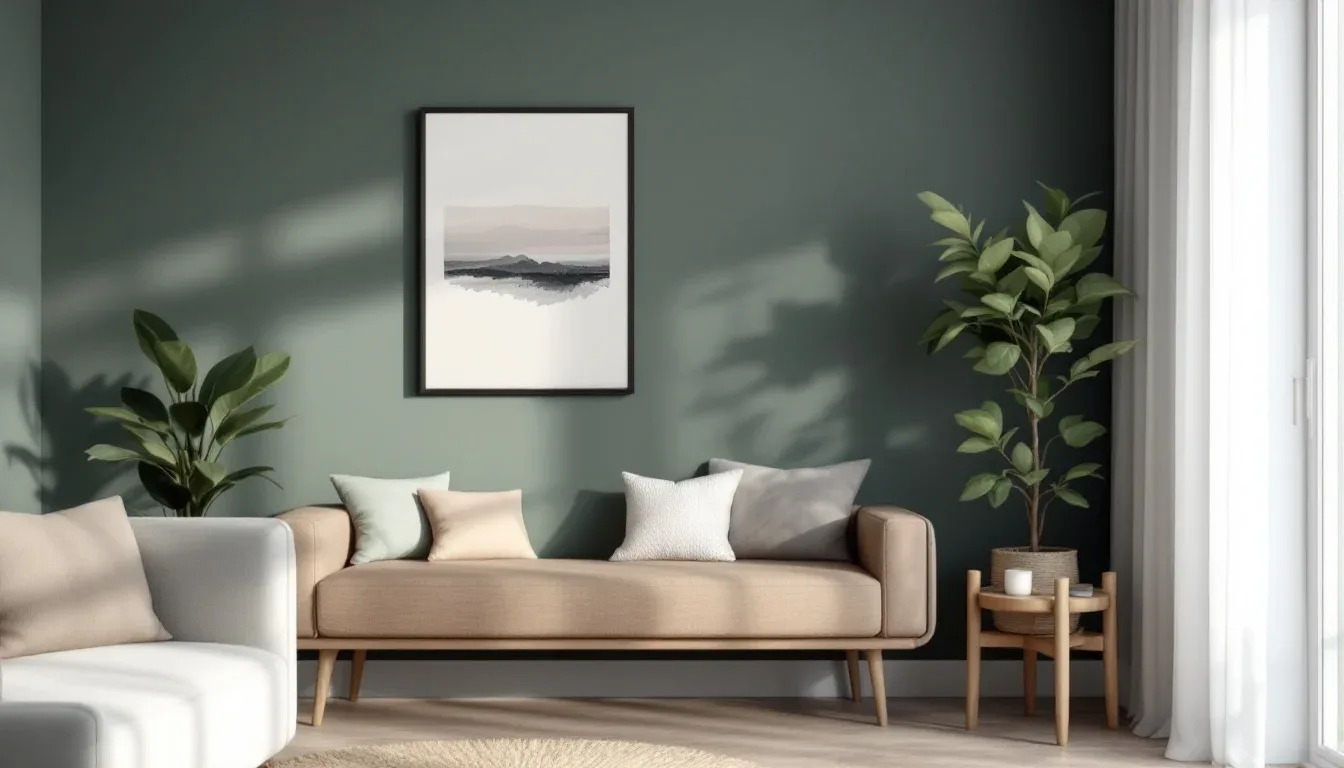
A bold paint treatment on one wall is even faster than hanging art and requires nothing to mount. The wall behind the primary seating is almost always the right choice — it frames the furniture grouping and gives the eye a reason to stop. Deep colors work harder than light ones: navy, forest green, terracotta, and charcoal all create the contrast needed to read as a true anchor rather than a backdrop.
- Identify the wall your seating faces, not the wall behind the sofa
- Take the color all the way to the ceiling and into the corners — stopping short makes it look unfinished
- If painting isn’t an option, peel-and-stick wallpaper panels in a single pattern can cover one wall in an afternoon
3. A statement furniture piece
Not every focal point lives on the walls. A dramatically scaled or visually distinct piece of furniture — a curved velvet sofa in a color that contrasts the room, a lacquered sideboard, an architectural bookcase — can anchor a space entirely on its own. The requirement is that it must be genuinely large and genuinely different from everything around it. A slightly interesting sofa in a slightly different color reads as furniture, not focal point.
- Scale matters more than style: the piece needs to occupy at least one-third of the wall it sits against
- Color contrast is the accelerator: a green sofa against a white wall creates immediate visual hierarchy
- A floor-to-ceiling bookcase on a full wall is one of the strongest focal points available without any architectural work
4. A leaning mirror
A mirror 72 inches or taller, leaned against the primary wall, creates scale, reflects light, and reads as intentional in a way that a smaller hung mirror never does. It works particularly well in narrow rooms or rooms with poor natural light. The leaned position — rather than hung — signals that it’s a design choice rather than a functional afterthought.
5. A gallery wall (done with discipline)
Gallery walls fail when they’re too spread out, too small in individual scale, or too random in spacing. A gallery wall that works as a focal point:
- Clusters tightly — 2 to 3 inches between frames, not 6 to 8
- Anchors around one large piece (minimum 18×24) that the other frames orbit
- Stays within a defined boundary: sketch the outer edges before you hang anything
- Uses consistent framing — same frame color or same mat color — even if art styles vary
Actionable takeaway: If your living room currently has no clear focal point, pick one of the five options above and commit to it before adding anything else. Trying to create two focal points simultaneously is what produces the “competing walls” problem in the first place.
Frequently Asked Questions
Can a TV be a focal point in a living room?
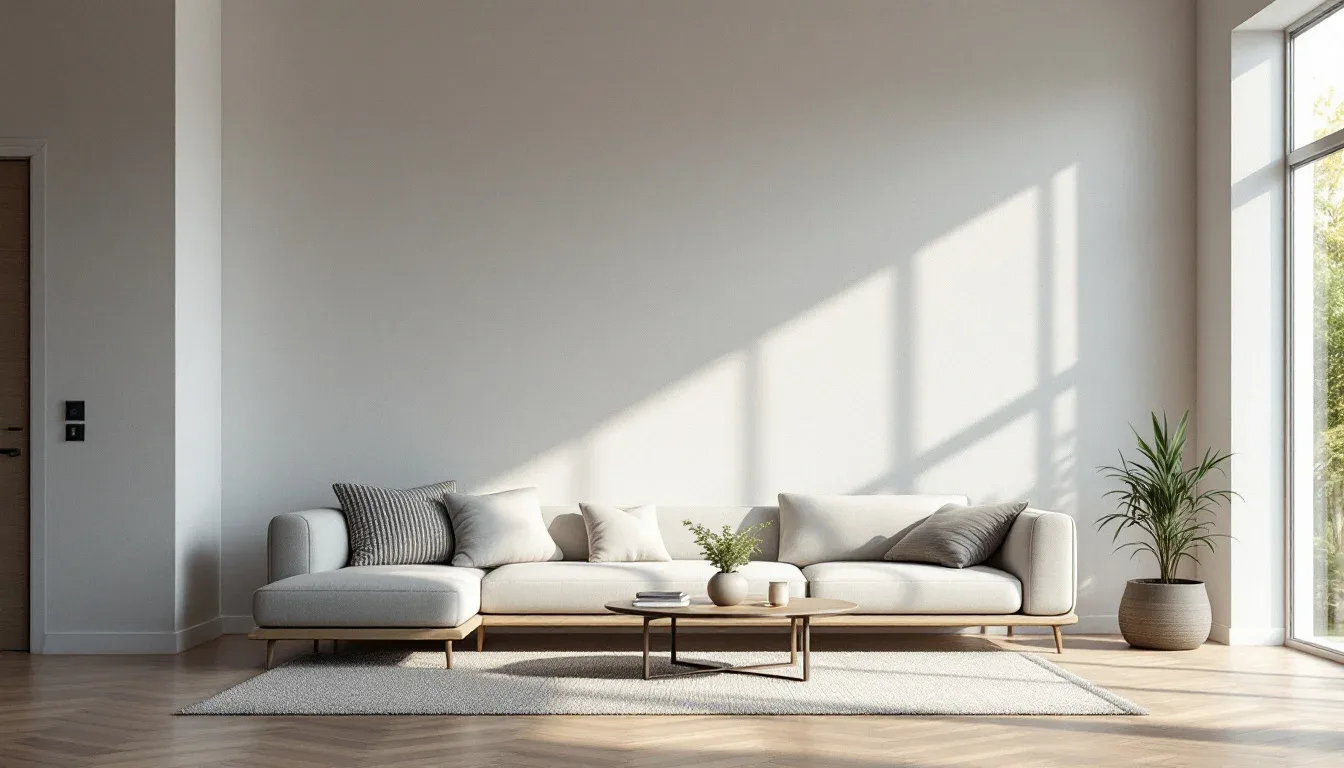
Yes, and in most living rooms it already is — which is fine if you make it intentional. The problem isn’t the TV; it’s the bare black rectangle surrounded by empty wall. Frame the TV with a gallery arrangement, mount it above a console styled with the 3-5-7 rule, or install it on a wall treated with a contrasting paint color so it reads as part of a composition rather than a default landing spot. A TV mounted on a plain white wall with nothing around it is a focal point only in the sense that nothing competed — that’s a different thing from being a deliberate anchor.
What if my living room has two focal points competing?
This is the most common cause of rooms that feel restless despite having good furniture and good light. The fix is hierarchy, not removal. Identify which of the two existing focal points is stronger or more permanent — usually the architectural one — and visually subordinate the other. If you have a fireplace on one wall and a large TV on another, reduce the TV wall by removing everything around it and letting the fireplace wall hold the anchor position. Orient your seating toward the fireplace. The TV becomes a functional element rather than a competing visual statement.
How do you create a focal point in a small living room?
Scale still matters in small rooms — arguably more, because the proportional impact of one large element is greater. The most effective living room focal point ideas for small spaces are:
- A large-format piece of art that takes up most of one wall (small art in small rooms makes the room feel smaller, not more proportionate)
- A floor-to-ceiling mirror on the shortest wall, which creates depth as well as visual anchor
- A single deeply colored accent wall — in small rooms, this reads as dramatic rather than oppressive, especially with light furniture in front of it
- Removing competing visual noise from the other three walls so the focal wall has nothing to fight against
Should the focal point face the main seating or be behind it?
It should face the main seating. The focal point is what your sofa and chairs are oriented toward — it’s the thing the room is gathered around. If your focal point is behind your sofa (behind where people sit), it’s technically the first thing you see on entering the room, but it’s also the last thing you see when seated. That creates a room that reads well from the doorway and feels backwards from inside. The exception is when the entry angle and the seated angle are the same — in open-plan spaces where the living area is viewed from a kitchen or hallway, the focal point sometimes needs to work for both orientations simultaneously.
How much should I spend to create a focal point?
The range is genuinely wide. The most impactful living room focal point ideas by budget:
- Under $50: A gallon of paint for one accent wall, applied with discipline to the right surface
- $50–$200: Large-format art print from a print shop, or a set of frames for a disciplined gallery wall
- $200–$600: An oversized mirror, a piece of secondhand statement furniture, or a quality canvas print at 60+ inches
- $600–$2,000: A custom piece of art, a built-in bookcase using stock IKEA units with added trim, or a proper antique or vintage statement piece
- $2,000+: Architectural interventions — adding a fireplace surround, installing paneling or board-and-batten on one wall, commissioning original art at scale
The most expensive option is rarely the most effective one. A $40 large-format print hung at the correct height with correct scale will outperform a $500 piece of art hung too small and too high, every time.