
If you’ve been searching for murphy bed small bedroom ideas that actually work in real apartments and houses — not staged showrooms — you’re in the right place. The average American bedroom is 132 square feet, and a standard queen bed frame eats 42 of them before you’ve placed a single other piece of furniture. That’s nearly a third of your floor plan committed to something you use for eight hours and then stare at all day. What’s left gets carved up by a dresser, maybe a nightstand, possibly a desk if you’re optimistic, and the slow creep of stuff that has nowhere else to go. Murphy beds exist to solve exactly this — not as a novelty, not as a guest room trick, but as a legitimate way to reclaim the floor space your bedroom has been quietly stealing from you.
Quick Answer
The average American bedroom is 132 square feet — and a standard queen bed frame eats 42 of them before you’ve placed a single other piece of furniture.
Are Murphy Beds Actually Good for Small Rooms — or Just a Trend?
In This Article
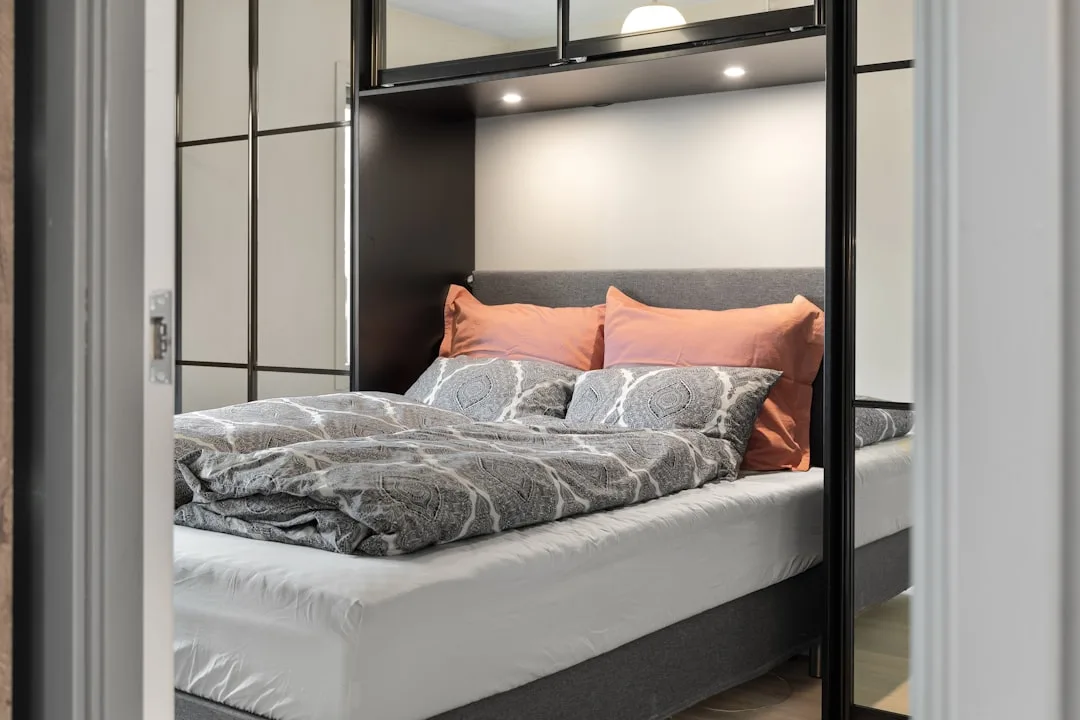
Most people asking this question are already suspicious, and honestly? That suspicion is reasonable. For years, Murphy beds were sold as a clever solution for the once-a-year guest — the kind of thing you show off at a dinner party rather than actually sleep in. That framing is outdated and worth discarding immediately.
Wall beds reclaim 40 to 60 square feet of usable floor space when folded — more than any other single furniture swap you can make in a small room. Not a new sofa, not a loft bed, not clever storage ottomans. Nothing else comes close to that number. What that means in practice: a 10×10 room with a Murphy bed installed can function as a home office, a yoga space, or a real living area during the day, and then convert to a bedroom in under thirty seconds at night.
The mechanism question comes up constantly. People worry about daily use — whether the hardware will fail, whether opening and closing a wall bed every day is asking too much of the system. Modern wall bed mechanisms are rated for 30,000+ open-close cycles by most major manufacturers. At one cycle per day, that’s over 80 years of use. Daily operation isn’t a problem. It’s what these things are built for.
What the market data shows is telling. According to the Space-Efficient Furniture Market Report, demand for wall beds grew 38% between 2020 and 2024, driven primarily by urban renters and studio apartment dwellers — not by people furnishing guest rooms. The buyer profile has shifted. These are primary beds, not backup sleeping arrangements, and the industry has followed with better hardware, cleaner cabinetry systems, and mechanisms designed for daily use.
Where Murphy beds fail — and I’ve seen this happen more than once — is when they’re dropped into a room without a layout plan. A wall bed isn’t a plug-and-play fix. It’s a spatial commitment, and the rest of the room has to be thought through in relation to it. Buy the bed first, figure out the rest later, and you’ll end up with a beautiful wall bed that faces three pieces of furniture it can’t clear.
The murphy bed small bedroom ideas that actually get used share a few traits:
- They treat the Murphy unit as the room’s anchor, not an afterthought
- They pair the bed with integrated storage — shelving, wardrobes, or desk panels — so the surrounding wall does double duty
- They plan furniture clearance before ordering anything, not after
- They account for the bed’s full swing arc as a permanent feature of the floor plan
- They choose a mattress depth that the mechanism is rated for, rather than swapping in a thicker mattress later and hoping the spring tension holds
Takeaway: Murphy beds work exceptionally well for small rooms, but only when treated as the anchor of a full room layout — not a standalone purchase.
The Layout Decisions That Make or Break a Murphy Bed Setup

Here’s a mistake I watched happen in a client’s studio in Wicker Park: she ordered a vertical-mount queen Murphy bed for a room with 7’8″ ceilings. The unit arrived, the installer showed up, and we spent an afternoon figuring out that the cabinet was four inches taller than her ceiling would accommodate. The unit went back. The installation fee didn’t.
Ceiling height is the first number you write down. Vertical-mount Murphy beds in queen size require a minimum 8-foot ceiling clearance — this is non-negotiable, and it’s the spec most buyers check last rather than first. If your ceilings are lower than that, a horizontal-mount model is your only real option. Horizontal units open sideways rather than folding down from the top, which means the ceiling height requirement drops dramatically. The trade-off: you need at least 60 inches of unobstructed wall width, and the room needs to be wide enough that the extended mattress doesn’t push perpendicular into the middle of the floor.
Door placement matters more than most Murphy bed content acknowledges. The bed should open away from the door — this sounds obvious until you realize how often it gets reversed during the planning phase when someone falls in love with which wall “looks right” for the unit. A Murphy bed that swings toward the entry door blocks egress, creates a hazard, and forces you to enter the room before the bed fully drops. Map the swing arc first.
Clearance on the lowered mattress matters for the same reason your bedroom aisle matters in a traditional layout. The National Kitchen and Bath Association recommends a minimum 36-inch clearance pathway in sleeping areas — a standard almost no Murphy bed listicle actually references, because those articles are about aesthetics rather than how the space functions at 6 a.m. Get that 36 inches on at least one side of the lowered mattress, even if it means pushing the desk panel closer to the opposite wall.
For a 10×10 room, the most efficient configuration I’ve seen consistently is corner placement with a flanking wardrobe or desk panel integrated into the cabinet surround. The Murphy unit occupies one wall, the panels extend to frame it and provide storage, and the corner position means you’re not sacrificing the center of the room to the bed’s footprint.
Before installation, lay out the clearance zone with painter’s tape on the floor. The bed’s full drop arc — where the mattress swings as it opens — is permanent. Furniture inside that arc gets hit every single time.
Pre-installation checklist for murphy bed small bedroom ideas that actually fit:
- Ceiling height: Measure at the exact wall where the unit will mount, not in the center of the room — ceilings slope near walls more often than you’d expect
- Wall width: Confirm you have unobstructed stud runs across the full cabinet width; Murphy beds mount into studs, not just drywall
- Swing arc: Tape out the full arc on the floor before ordering anything
- Door clearance: The lowered mattress should not intersect the door swing on either side
- Outlet and switch locations: Units can be built around them, but it’s far easier to plan around them from the start than to relocate electrical after the cabinet is mounted
- Baseboard depth: Some baseboard profiles prevent cabinet flush-mounting; you may need to scribe the base panel or remove a section of trim
Takeaway: Measure ceiling height and map the swing arc before you look at a single product page. Everything else is secondary.
Build It or Buy It: What the Real Cost Breakdown Looks Like
No one in this space gives you a straight answer on cost, probably because the range is wide enough to make people feel misled. So here’s what the numbers actually look like at each tier.
A DIY flat-pack Murphy bed kit — mechanism only, no lumber — runs $300 to $700 from suppliers like Murphy Bed Depot, Rockler, or Hafele. Add the lumber, hardware, and finish materials, and your total material cost lands between $600 and $1,200. That’s the honest floor. It does not include the cost of your time, any tools you need to buy or rent, or what it costs to redo a panel you cut wrong. DIY is genuinely cheaper, but it requires intermediate woodworking skill and serious patience with a level. A misaligned mechanism doesn’t just look bad — it can cause the bed to drop unsafely or refuse to stay closed, and neither of those is a minor inconvenience.
Pre-built units from mid-range retailers — IKEA hacks using PAX wardrobes with a kit mechanism, Wayfair systems, Container Store configurations — run $1,200 to $3,500 with installation. HomeAdvisor data shows the average Murphy bed installation cost in the US is $2,183, with a range of $1,300 to $3,200 for professional supply-and-install. That’s a useful anchor number.
Cost comparison by tier — what you actually get at each price point:
- $600–$1,200 (DIY kit + materials): Mechanism only, no integrated cabinetry, requires woodworking skill; best for people who already own tools and have built furniture before
- $1,200–$2,500 (mid-range pre-built): Complete unit with basic side panels, minimal integrated storage, typically flat-pack assembly with professional install available as an add-on
- $2,500–$4,500 (full unit with integrated desk or wardrobe panels): Murphy bed plus flanking cabinetry designed as a system; this tier is where most of the murphy bed small bedroom ideas you see on design sites actually live
- $4,500–$8,000+ (custom built-in): Cabinetry milled to your specific wall dimensions, finished to match existing trim, often includes integrated lighting and outlet access; the closest thing to a permanent architectural feature
- Renter consideration: If you’re renting, confirm with your landlord before any wall-mount installation — some buildings require a patch-and-repaint deposit, others prohibit structural wall modifications entirely
The variable that blows budgets most often isn’t the unit itself — it’s the wall preparation. If your walls are plaster rather than drywall, if the studs aren’t where the spec sheet assumes they’ll be, or if there’s electrical running through the mounting wall that needs to be rerouted, expect to add $300 to $800 to whatever number you’ve budgeted for installation alone.
Takeaway: Budget for the unit, the installation, and a 20% buffer for wall prep. The buffer gets used more often than not.
Murphy Bed Combinations That Make a Small Room Actually Function
The bed itself isn’t the product. The system around it is. Standalone Murphy beds — a mechanism, a mattress, and two side panels that don’t connect to anything — are common at the lower price tiers, and they work fine mechanically. But they don’t solve the room’s larger problem, which is that a small bedroom needs to do more than sleep. The murphy bed small bedroom ideas worth stealing from designers all share one thing: the wall bed is part of a larger storage and function system, not an isolated unit dropped into a corner.
Combinations that consistently work in rooms under 150 square feet:
- Murphy bed + integrated desk panel: The desk folds flat against the cabinet face when the bed is down, and swings out to a usable work surface when the bed is up. The desk surface should be at least 24 inches deep to be genuinely useful — anything shallower starts to feel like a shelf with pretensions
- Murphy bed + flanking wardrobes: Full-height wardrobe towers on either side of the Murphy cabinet replace a separate dresser and closet system entirely. This works especially well in rooms that lack adequate built-in closet space
- Murphy bed + floating shelving above the closed unit: When the bed is closed, the face of the cabinet becomes a display or storage wall. Shelving mounted above the unit — to the ceiling if possible — adds vertical storage without consuming any floor space
- Murphy bed + sofa: Some Murphy systems are designed to integrate with a sofa that remains in place when the bed is lowered — the sofa slides forward on tracks as the mattress descends. These systems are more expensive ($3,500–$6,000+) but genuinely convert a room from a studio living space to a bedroom without moving any furniture
- Murphy bed + pegboard or slat wall panel: On the face of the closed unit, a pegboard or slat wall system provides flexible storage for a home office or craft space that reconfigures easily as your needs change
The combination to avoid: Murphy bed plus a separate queen-size sofa that doesn’t integrate with the unit. In a room under 150 square feet, a standalone sofa and a Murphy bed compete for the same floor space and you end up with neither function working well.
FAQ
Can a Murphy bed be your only bed — or is it just for occasional use?
It can absolutely be your primary bed, and increasingly that’s exactly how people use them. The relevant question is mattress quality, not the mechanism. Murphy beds accommodate standard mattresses up to a manufacturer-specified depth — typically 10 to 12 inches depending on the system. A quality foam or hybrid mattress within that depth range will sleep identically to the same mattress on a platform frame. The mechanism doesn’t affect comfort; the mattress does.
Do Murphy beds work in rental apartments?
They can, with caveats. Wall-mount Murphy beds require lag screws into studs, which constitutes a structural modification to the wall. Some landlords approve this; others don’t. Always get written permission before installation. If your landlord won’t approve wall mounting, there are freestanding Murphy bed systems that don’t require wall attachment — they’re stabilized by their own weight and ballast — though the selection is narrower and the stability is slightly reduced.
What size Murphy bed makes sense for a small room?
For rooms under 120 square feet, a full (double) size is often more practical than a queen, even if you normally sleep in a queen. The difference in mattress width is 6 inches, but in a small room that 6 inches can mean the difference between a 36-inch clearance aisle and a 30-inch one — which is the difference between comfortable and cramped at 6 a.m. Twin XL is worth considering for single occupants in rooms under 100 square feet.
How long does a Murphy bed take to open and close?
Properly balanced mechanisms take 20 to 30 seconds from closed to sleeping-ready. The process: release the latch or handle, lower the bed using the integrated assist (either spring tension or piston, depending on the system), and the mattress and bedding come down together. Linens stay on the mattress — you tuck the duvet and pillows against the mattress face before closing. The closed position holds everything in place. If a system takes longer than a minute or requires significant physical effort, the mechanism is either undersized for the mattress weight or needs adjustment.
What’s the most common mistake people make with murphy bed small bedroom ideas they find online?
Copying a layout without accounting for their own room’s specific dimensions and door placement. Most murphy bed small bedroom ideas you find in design content are photographed in staged rooms built to ideal proportions. Your room probably has a window in an inconvenient location, a closet door that swings the wrong way, or baseboard heating along the wall you wanted to use. The ideas are useful as starting points for understanding what’s possible — they stop being useful the moment you treat them as templates to replicate exactly.