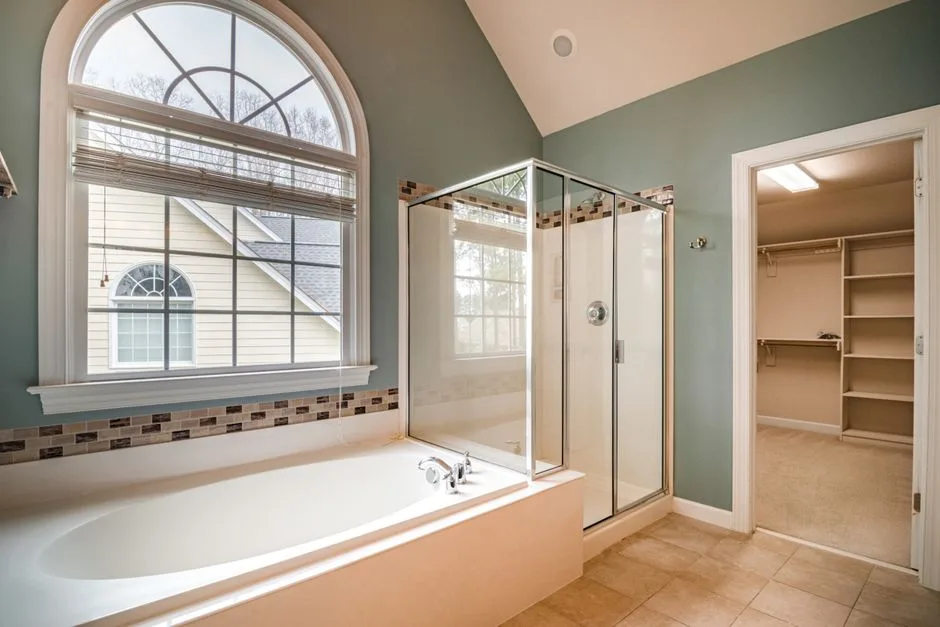
The floor plan looked perfect on paper — and then the steam from a morning shower started warping the closet shelves six months after move-in. I watched it happen to a client in Lincoln Park. Beautiful custom millwork, walnut-finished shelves, an Elfa system she’d spent weeks configuring. Ruined. Not because of a structural flaw or a bad contractor, but because nobody — not the architect, not the builder, not the showroom rep who sold her the shelving — ever asked which direction she got dressed in the morning. If you’re rethinking your master bath layout with closet, that single question is exactly where the planning should start — before you look at a single floor plan option, before you call a contractor, before you pin one more image to your renovation board.
Quick Answer
The floor plan looked perfect on paper — and then the steam from a morning shower started warping the closet shelves six months after move-in.
That question sounds minor. It determines whether your primary suite functions like a well-run backstage operation or like a daily obstacle course you’ve simply learned to tolerate.
Most primary bath layouts with a closet are designed around square footage optics — what photographs well, what makes the listing description sing, what fits inside a standard framing package without blowing the builder’s per-unit budget. The sequence of how a human body actually moves through those spaces is almost never the starting point. It should be.
Why the Order You Enter Spaces Changes Everything
In This Article
- Why the Order You Enter Spaces Changes Everything
- The Four Spatial Relationships Between Bath and Wardrobe — Mapped Out
- Humidity Is the Silent Closet Killer — And Most Plans Ignore It
- The Vanity Zone: Where Most Master Bath Layout with Closet Plans Actually Break Down
- Flooring and Threshold Transitions: The Detail Most Renovations Get Wrong
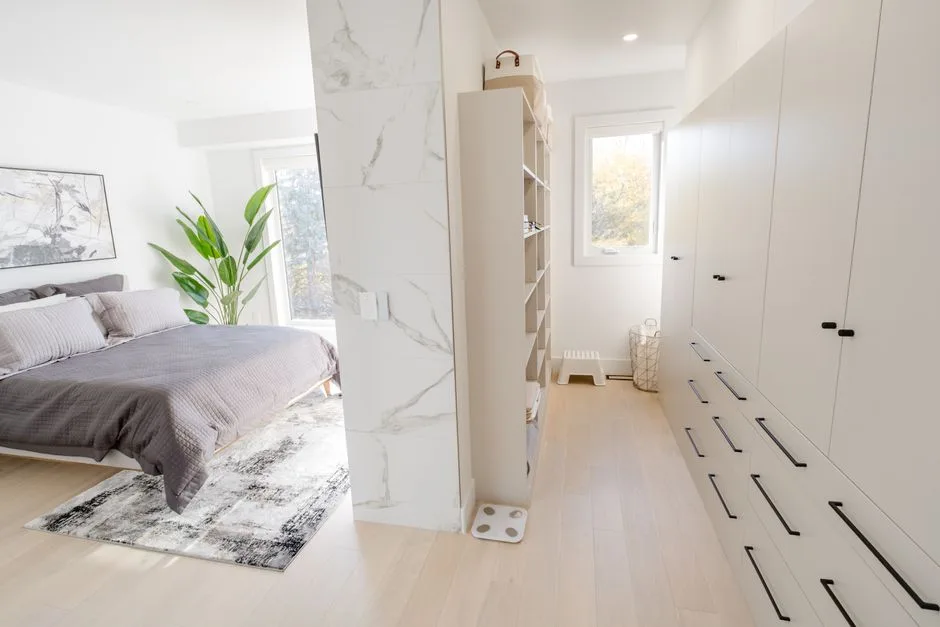
There are two fundamentally different ways people use a primary suite in the morning, and they demand opposite spatial configurations.
The first is the dressing sequence: you wake up, go to your closet, pull your outfit, then move into the bath to shower, groom, and finish getting ready while already knowing what you’re wearing. This is the pattern of people who plan ahead — and it means the closet needs to function independently from the bath, without requiring you to cross through steam or navigate around a partner who’s still in the vanity zone.
The second is the grooming sequence: you go straight to the bath, shower, use the vanity, and then move into the closet to dress. This is more common than most floor plan designers assume — and it means the closet is the last stop before you leave, which makes its placement relative to the bedroom door or hallway exit matter enormously.
Confusing these two sequences — or worse, designing a layout that accommodates neither cleanly — is what creates the friction most people blame on “not having enough space” when the real problem is sequencing. I had a client in a 180-square-foot primary bath who felt cramped every morning, not because the room was small but because her closet was positioned so that accessing it required walking through her husband’s shower steam cloud. The room wasn’t the problem. The order was.
Traffic patterns matter beyond personal inconvenience, too. When one partner keeps an earlier schedule, a poorly sequenced layout means light intrusion into the sleeping area, noise carrying from the vanity zone into the bedroom, and the kind of low-grade morning tension that’s hard to articulate but completely avoidable with smarter planning.
The NKBA recommends a minimum 36-inch clear pathway between fixtures and walls — and most prefab floor plans deliver exactly that. The absolute minimum. In a single-user scenario, 36 inches is workable. In a shared-use morning rush, it creates a bottleneck where two people physically cannot operate simultaneously without choreographing their movements. That’s not a luxury upgrade issue. That’s a layout failure.
A few other sequencing failures worth mapping before you start planning:
- The lighting mismatch: Closets placed at the end of a walk-through bath typically rely on light borrowed from the bath space. That works when the bath lights are on. It fails completely at 5:30 a.m. when your partner is still sleeping and you’re navigating a dark closet by memory.
- The return trip problem: If your morning sequence ends at the closet but you realize you forgot something — a razor, a hair product — returning to the bath means crossing back through an active grooming zone. In a couple’s household, that return trip is where most morning friction actually lives.
- The sightline issue: An open connection between bath and closet creates a sightline from the vanity mirror into the closet. Some people find this convenient. Others find it visually chaotic to see hanging clothes reflected in a mirror they’re using to apply makeup or shave.
Actionable takeaway: Before you evaluate any floor plan option, write down your actual morning sequence — closet first or bath first — and verify that the layout supports that order without requiring you to backtrack or cross paths with a partner in the middle of their routine.
The Four Spatial Relationships Between Bath and Wardrobe — Mapped Out

Most layout articles will hand you a list of configuration names — L-shaped, U-shaped, walk-through — and leave you to figure out which one you need. That’s not useful. What matters is the use case each configuration actually serves, and whether it matches your household. Every master bath layout with closet falls into one of these four categories, regardless of what the builder’s brochure calls it.
Adjacent (side-by-side, shared wall) is the right call for compact footprints under 150 combined square feet and single-user households. The plumbing consolidation benefit is real — keeping wet zones on shared walls reduces both rough-in labor and future maintenance access complexity. What nobody tells you is that this configuration also makes future closet expansion nearly impossible without encroaching on the bath footprint.
Walk-through — where the closet is accessed through the bath, or vice versa — is genuinely useful for couples with different schedules, but only if the door placement is handled correctly. The single most common failure I saw in walk-through layouts was a door positioned directly in the steam path from the shower. Warm, humid air moves toward cooler, drier zones. A walk-through connection is essentially an invitation for that migration. Correct door placement means the closet entry is on the opposite wall from the shower, with a solid-core door between them.
Separated — closet off the bedroom, bath accessed independently — is the configuration most renovation magazines dismiss as dated or inefficient. It is, functionally, often the smartest option for households with children or for couples with dramatically different schedules. No shared steam. No shared noise. No “I needed that hanger and you were in the way” conflicts. I’ve seen clients spend $40,000 reconfiguring a suite to a walk-through layout they saw in a magazine, then spend another $8,000 two years later installing a door because they couldn’t tolerate the humidity.
Integrated — an open dressing area within the bath envelope, no separation — is trending in high-end builds and makes for extraordinary photography. It also has real trade-offs that the aspirational coverage systematically ignores, which I’ll address in the humidity section.
Here’s a quick reference for matching configuration to household type:
- Single user, compact footprint → Adjacent configuration, shared plumbing wall
- Couple, same schedule → Walk-through with solid-core door, closet entry opposite shower wall
- Couple, different schedules → Separated configuration, or walk-through with full door and independent ventilation in closet
- Household with children → Separated configuration; keeps primary suite circulation private
- Single user, large footprint → Integrated can work, provided ventilation is engineered correctly (see next section)
Actionable takeaway: Map your household type first — single user, couple with same schedule, couple with different schedules, household with children — and use that as the filter for configuration, not the other way around.
Humidity Is the Silent Closet Killer — And Most Plans Ignore It
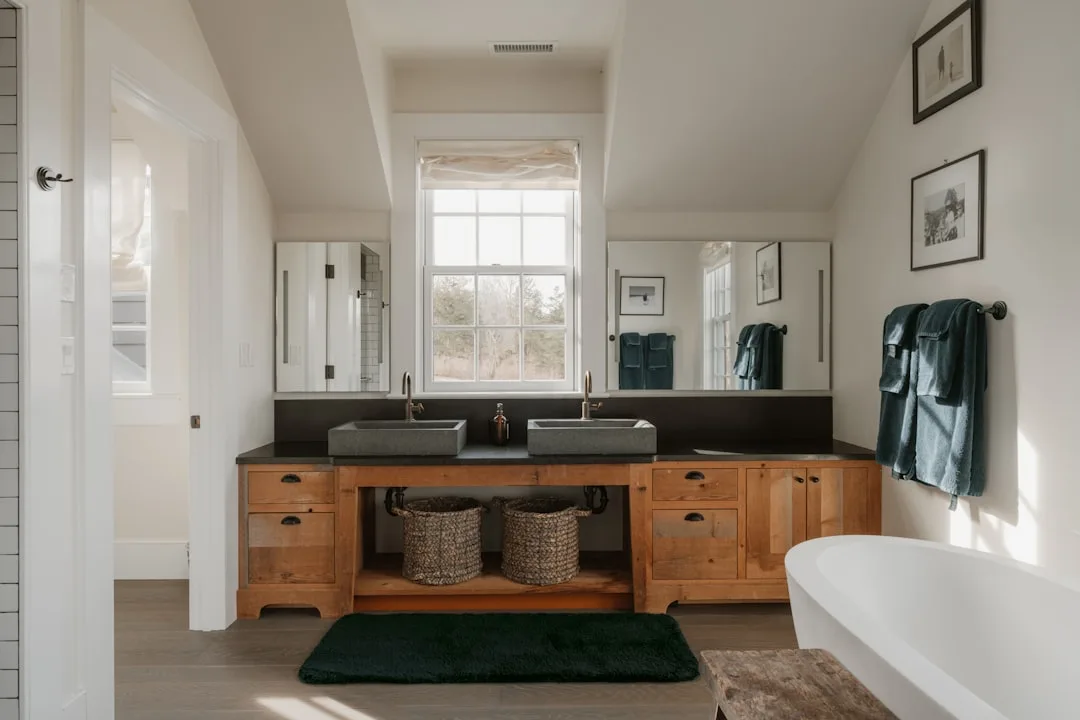
Six months into that Lincoln Park project, the warping started at the back of the shelves — the ones closest to the pass-through door. The finish lifted first.
Humidity damage in closets connected to primary baths is the most consistently underestimated problem in residential suite design. It doesn’t show up in renderings. It doesn’t appear in the contractor’s punch list. It arrives quietly, usually between month four and month eight after move-in, when the seasonal temperature differential between the bath and the closet creates the pressure gradient that pulls moist air toward the drier zone.
The standard exhaust fan spec for a primary bath is sized for the bath’s square footage — not for the combined volume of bath plus closet. If your layout connects those two spaces without a solid door, the effective volume the fan needs to manage increases by 30 to 60 percent depending on closet size. Most fans are not doing that job. The result is elevated relative humidity in the closet, which affects:
- Wood-based shelving and millwork: Warping, finish lifting, and joint failure typically begin at the back wall — the surface with the least air circulation.
- Fabric and leather goods: Mold spores require sustained relative humidity above 60 percent to activate. A walk-through closet connected to an active shower can hit that threshold within minutes of shower use and stay there for hours if ventilation is undersized.
- Metal hardware: Drawer pulls, rod brackets, and hinge hardware in high-humidity closets show accelerated oxidation — particularly in coastal climates or homes with well water.
- Painted drywall surfaces: Closet walls that share thermal boundary with a bath are particularly vulnerable to paint bubbling and substrate softening near floor level, where cooler air pools and condensation is most likely.
The fix is not complicated, but it requires being specified during design, not corrected after the damage appears. A few specific interventions that actually work:
- Independent exhaust in the closet: A small, quiet exhaust fan — Panasonic’s WhisperGreen Select series works well — installed on a humidistat rather than a manual switch. It runs when humidity rises, not when you remember to flip a switch.
- Solid-core door with a threshold: A hollow-core door between bath and closet provides almost no meaningful barrier to humidity migration. Solid-core with a door sweep reduces infiltration significantly.
- Tempered or sealed shelving material: Standard melamine on particleboard substrate fails in high-humidity conditions. Plywood-based systems with sealed edges, or metal shelving systems, are dramatically more resistant.
- Strategic placement of sensitive storage: Shoes, leather bags, and fine knitwear should be stored on the wall farthest from the bath connection, with the highest air circulation in the space.
Actionable takeaway: Specify your exhaust fan for the combined cubic footage of bath plus closet if there is any open or pass-through connection between them. Then add a humidistat so the ventilation responds to actual conditions rather than habitual behavior.
The Vanity Zone: Where Most Master Bath Layout with Closet Plans Actually Break Down
The vanity is where the majority of primary bath time is spent — more than the shower in most households, by a significant margin. The NKBA’s use data consistently shows that grooming at the vanity accounts for 60 to 70 percent of active time in the bath. Yet vanity placement in most master bath layout with closet configurations is treated as residual — whatever wall space is left after the shower and tub claim their square footage.
That’s the wrong approach, and it produces layouts where the vanity is:
- Too far from natural light: The vanity is where detail work happens — makeup application, grooming, skincare. These tasks require accurate color rendering. Artificial light, regardless of CRI rating, does not replicate what natural daylight does for color accuracy. A vanity positioned on an interior wall, away from windows, is a functional problem that no lighting specification fully solves.
- Positioned to create traffic conflict: When the vanity sits between the bath entry and the shower or toilet, anyone using the vanity creates a full blockage. In a shared-use morning scenario, this means one person cannot move through the bath without interrupting the other.
- Inadequately deep: Standard vanity depth is 21 inches. For households where the vanity is a primary grooming station rather than a quick-use surface, 24 inches creates meaningfully more functional workspace — particularly for anyone who uses a lighted mirror, a hairdryer, or multiple products simultaneously.
For a two-person household, the most functional vanity configuration is a double vanity with a minimum 60-inch total length — not because symmetry is aesthetically satisfying, but because it creates enough linear separation that two people can operate simultaneously without physical interference. The key dimension is center-to-center sink spacing: 36 inches minimum, 42 inches preferred.
The relationship between the vanity and the closet entry is worth specific attention. In a walk-through master bath layout with closet, the closet door positioned directly behind someone using the vanity creates a collision point every time the closet is accessed while the vanity is in use. This is the layout failure most commonly described by couples as “the bathroom feels cramped” — when what they’re actually describing is a door swing that conflicts with standing vanity use. A 24-inch clear zone between any door swing arc and an occupied vanity position eliminates most of this friction.
Actionable takeaway: Place the vanity on the wall with the best access to natural light first, then position the shower and tub around it. Confirm that no door swing — including the closet entry — conflicts with standing vanity use.
Flooring and Threshold Transitions: The Detail Most Renovations Get Wrong
The floor plan conversation almost never includes the transition between bath flooring and closet flooring — and that omission creates problems that are expensive to fix retroactively.
In most primary baths, the wet-zone flooring is tile. In most closets, it’s hardwood, carpet, or a softer surface. The transition between these materials is a functional boundary, not just an aesthetic one. Handled correctly, it reinforces the humidity barrier and provides a tactile signal that you’ve moved from wet zone to dry zone — which matters at 5 a.m. when nobody is fully awake.
Common threshold failures include:
- Flush transitions with no height differential: Water from a wet floor can migrate under a flush threshold into the closet, particularly in walk-through configurations where someone exits the shower and walks directly toward the closet.
- Carpet in the closet extending to the bath doorway: Carpet absorbs and retains humidity from the bath connection. Even a 12-inch band of hard flooring inside the closet entry — a “landing zone” of the same tile used in the bath — significantly reduces moisture transfer into carpet.
- No transition strip between dissimilar materials: Beyond the aesthetic issue, an unsealed joint between tile and hardwood is a direct path for moisture infiltration into the hardwood substrate. This is where edge-glued hardwood begins to cup and separate, typically within the first two years.
Actionable takeaway: Specify a minimum 12-inch hard-surface landing zone inside the closet entry, using the same tile or sealed stone as the bath floor. Seal the transition joint, don’t just cover it.
FAQ
Does a master bath layout with closet actually require more square footage than a standard primary bath?
Not necessarily. The configuration matters more than the total square footage. A well-sequenced master bath layout with closet in 160 combined square feet functions better than a poorly sequenced one in 220 square feet. What you’re optimizing for is unobstructed circulation paths and a door placement that doesn’t create conflict between simultaneous users — both of which are design decisions, not area decisions.
What’s the minimum closet size that works in a walk-through configuration?
The functional minimum for a walk-through closet — one where two people can realistically dress simultaneously without physical conflict — is approximately 6 by 8 feet of clear floor space, with storage on three walls. Below that, the walk-through becomes a pass-through, and you lose the functional independence that makes the configuration worth building. If your footprint doesn’t support 6 by 8 feet of clear space, a separated closet off the bedroom will serve you better.
Should the closet or the bath be closer to the bedroom door?
This depends entirely on your morning sequence. If you follow the grooming sequence — bath first, then dress — the closet should be the last space before you exit toward the bedroom or hallway. If you follow the dressing sequence — pull your outfit first, then shower — the closet needs direct, independent access from the bedroom without requiring you to enter the bath zone first. Neither answer is universal. The mistake is accepting a layout that requires you to adapt your sequence to the architecture rather than the other way around.
How do I spec ventilation for a connected bath-closet layout?
Calculate the combined cubic footage of both spaces (length × width × height for each room, added together). Divide by 60 to get the minimum CFM rating for your exhaust fan if you’re targeting eight air changes per hour — the standard recommendation for a humid bathroom. If your combined space is 500 cubic feet, you need a minimum 83 CFM fan. Most builder-grade fans are spec’d at 50 to 80 CFM for the bath alone, which is insufficient for a connected configuration. Install the fan on a humidistat, not a manual switch, so it responds to actual humidity rather than habitual use patterns.
Is an integrated open dressing area within the bath ever a practical choice, or is it purely aesthetic?
It can be practical for a single-user household with a correctly engineered ventilation system and storage materials specified for humidity resistance. The integrated configuration fails reliably when it’s installed in a couple’s suite without independent exhaust, when standard wood-based shelving is used, or when the open dressing area includes carpet or fabric-lined drawers. The photography that popularizes integrated layouts almost never shows the ventilation infrastructure — typically a ceiling-mounted exhaust system with multiple registers — that makes the configuration viable. If your contractor or designer isn’t specifying that infrastructure, the integrated layout is aesthetic, not practical.
Does a master bath layout with closet actually require more square footage than a standard primary bath?
Not necessarily. The configuration matters more than the total square footage. A well-sequenced master bath layout with closet in 160 combined square feet functions better than a poorly sequenced one in 220 square feet. What you’re optimizing for is unobstructed circulation paths and a door placement that doesn’t create conflict between simultaneous users — both of which are design decisions, not area decisions.
What’s the minimum closet size that works in a walk-through configuration?
The functional minimum for a walk-through closet — one where two people can realistically dress simultaneously without physical conflict — is approximately 6 by 8 feet of clear floor space, with storage on three walls. Below that, the walk-through becomes a pass-through, and you lose the functional independence that makes the configuration worth building. If your footprint doesn’t support 6 by 8 feet of clear space, a separated closet off the bedroom will serve you better.
Should the closet or the bath be closer to the bedroom door?
This depends entirely on your morning sequence. If you follow the grooming sequence — bath first, then dress — the closet should be the last space before you exit toward the bedroom or hallway. If you follow the dressing sequence — pull your outfit first, then shower — the closet needs direct, independent access from the bedroom without requiring you to enter the bath zone first. Neither answer is universal. The mistake is accepting a layout that requires you to adapt your sequence to the architecture rather than the other way around.
How do I spec ventilation for a connected bath-closet layout?
Calculate the combined cubic footage of both spaces (length × width × height for each room, added together). Divide by 60 to get the minimum CFM rating for your exhaust fan if you’re targeting eight air changes per hour — the standard recommendation for a humid bathroom. If your combined space is 500 cubic feet, you need a minimum 83 CFM fan. Most builder-grade fans are spec’d at 50 to 80 CFM for the bath alone, which is insufficient for a connected configuration. Install the fan on a humidistat, not a manual switch, so it responds to actual humidity rather than habitual use patterns.
Is an integrated open dressing area within the bath ever a practical choice, or is it purely aesthetic?
It can be practical for a single-user household with a correctly engineered ventilation system and storage materials specified for humidity resistance. The integrated configuration fails reliably when it’s installed in a couple’s suite without independent exhaust, when standard wood-based shelving is used, or when the open dressing area includes carpet or fabric-lined drawers. The photography that popularizes integrated layouts almost never shows the ventilation infrastructure — typically a ceiling-mounted exhaust system with multiple registers — that makes the configuration viable. If your contractor or designer isn’t specifying that infrastructure, the integrated layout is aesthetic, not practical.