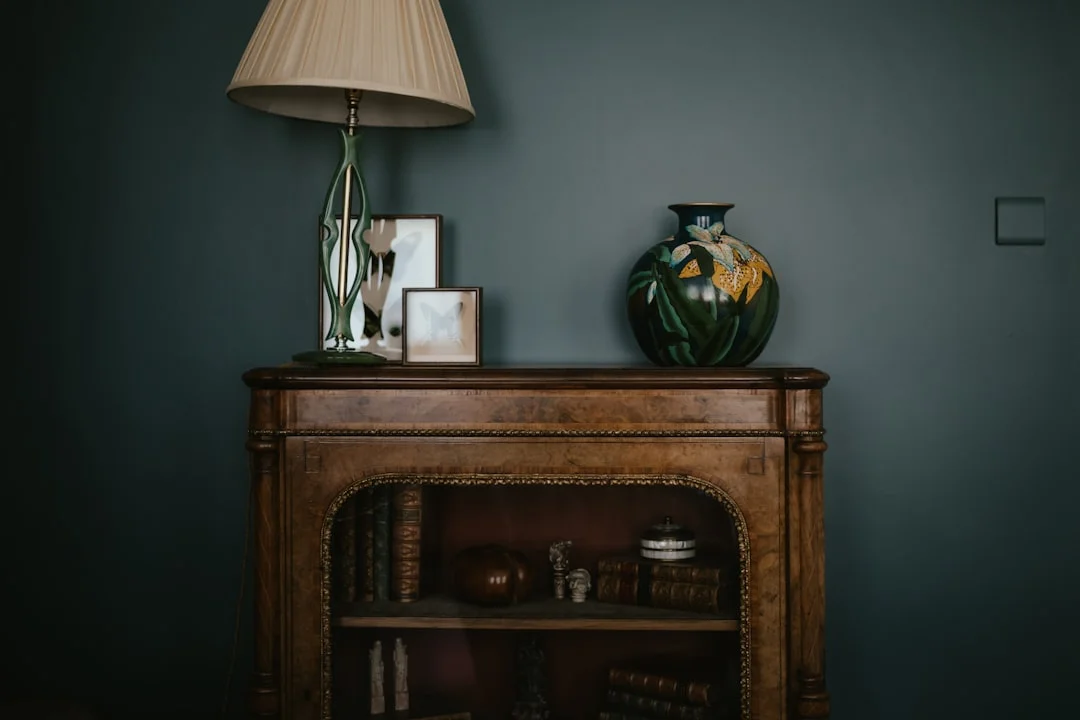
Most people who inherit a house full of old stuff spend exactly one weekend deciding what to keep. They’re wrong to rush it. The vintage home decor pieces worth keeping — the ones that hold real monetary value, design staying power, or both — are rarely the obvious ones. And the pieces people throw away first are often the ones appraisers would have flagged first.
Here’s what nobody tells you: the resale market for authenticated mid-century and pre-war decorative objects has grown by roughly 34% over the last four years, driven partly by a generation of buyers who grew up in sterile, algorithm-designed interiors and are now actively hungry for objects with actual history. That hunger isn’t going anywhere. If anything, the more AI-generated everything becomes, the more a hand-thrown ceramic from 1954 will stop a room cold.
This list isn’t about nostalgia. It’s not a sentimental case for holding onto grandmother’s tchotchkes because they make you feel something. This is a hard-eyed look at nine specific vintage decor categories that earn their floor space — aesthetically, financially, and in terms of what they do to a room that no new piece can replicate. Each one has a reason. Each one has a caveat. And one of them will surprise you.
Why Most “Keep vs. Toss” Guides Get Vintage Completely Wrong
Every guide you’ve read about vintage decor operates from a flawed premise: that your job is to decide whether something is pretty. It isn’t. Your actual job is to decide whether something is irreplaceable. Those are radically different questions.
A piece of vintage decor that costs $40 at an estate sale might be genuinely irreplaceable — not because it’s worth thousands (though some are), but because the material, method, and cultural moment that produced it no longer exist. Mass production killed thousands of craft traditions between 1960 and 1990. The hand-cut dovetail joints on a pre-war drawer. The mercury glass in a Victorian convex mirror. The lead crystal that catches light at an angle modern crystal simply doesn’t. You cannot buy these things new. You can only find them, or lose them.
The other mistake most guides make is treating “vintage” as an aesthetic instead of a spectrum. A 1970s pressed-wood side table with a faux walnut veneer is technically vintage. So is a 1920s Arts and Crafts copper lantern. Calling both of them “vintage decor” and giving them equal weight is like calling both a Kodak disposable and an Ansel Adams darkroom print “photography.” The discrimination matters. Which is why, before we get to the list, here’s the single most useful filter: would a skilled craftsperson today need significant time and specialized knowledge to reproduce this? If yes, keep it. If a factory in Shenzhen could replicate it in an afternoon, you’re allowed to let it go.
The 9 Vintage Home Decor Pieces Worth Keeping, Ranked and Reasoned
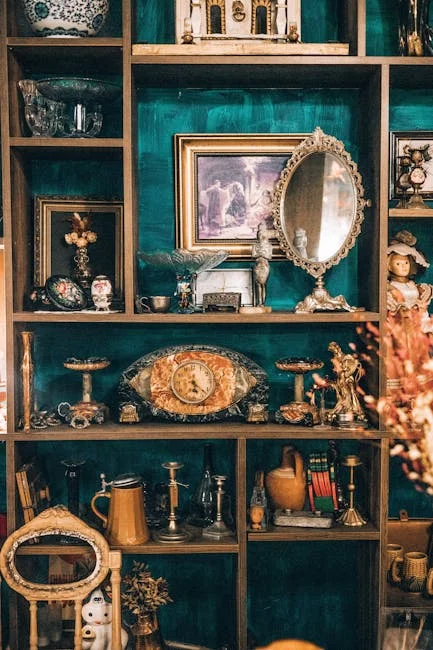
Antique wooden shelf displaying vintage collectibles including brass mirror, mantel clock, and ceram — Photo by Lokman Sevim on Pexels
1. Solid Wood Furniture with Hand-Cut Joinery — The One That Pays You Back
There is no category of vintage home decor with a better return on floor space than solid wood furniture built before 1960. Not because of sentimental value. Because the wood itself is categorically different. Old-growth timber — the stuff used in furniture before about 1965 — has tighter growth rings, higher density, and greater resistance to warping than anything harvested from a modern managed forest. A genuine 1940s mahogany sideboard isn’t just more beautiful than its IKEA equivalent. It’s structurally superior in ways that will outlast everyone in the room.
The joinery is the tell. Run your fingers along the inside corners of any drawer. If you feel the interlocking fingers of a hand-cut dovetail — slightly irregular, each one marginally different — you’re holding a piece made before the router bit standardized everything. Machine-cut dovetails, introduced widely in the 1950s, are perfectly uniform. Craftsman-cut ones aren’t. That irregularity isn’t a flaw. It’s a signature.
Pricing reality: a stripped-down mid-century credenza in the style of Paul McCobb sells for between $800 and $3,400 depending on condition and region. A Duncan Phyfe dining table in solid mahogany runs $1,200 to $6,000 at reputable auction. These are not outliers. They’re the baseline for quality pre-war solid wood furniture in decent shape. Don’t throw away what you can’t afford to replace.
2. Mercury Glass Mirrors — The Dark Horse Pick
This is the one that surprises people, so I’ll lead with the fact: authentic antique mercury glass mirrors — those silvery, slightly smoky-looking pieces with a vaguely sinister depth — are made with an actual mercury-tin amalgam process that was banned in most countries by the 1950s due to toxicity. Modern “mercury glass” is an aesthetic approximation using silver nitrate. It looks similar. It does not look the same.
The difference becomes visible at angles. Authentic mercury glass has a subtle, non-uniform reflectivity — patches where the backing has thinned or oxidized over decades, creating a layered, dimensional quality that the knock-offs can’t achieve because they’re starting from a chemically different process. Interior designers who work in vintage interior design know this immediately. Clients who’ve lived with a genuine Victorian convex mirror for six months and then moved it will tell you the same thing: the room felt different without it, and they couldn’t entirely explain why.
Monetary value ranges from $300 for a simple framed piece to upward of $4,000 for a large ornate convex mirror with documented provenance. More importantly, the supply is permanently finite and decreasing as pieces get damaged, discarded, or misidentified at estate sales. This is a category where the price ceiling has nowhere to go but up.
3. Hand-Thrown Ceramic Vessels — Not All of Them, But the Right Ones
Here’s the caveat that saves you from hoarding: not every vintage ceramic deserves shelf space. Mass-produced pottery from the 1970s — the kind stamped “Made in Japan” with a uniform glaze and perfect symmetry — is fine, but it’s not irreplaceable. What is worth keeping are hand-thrown pieces where you can see and feel the maker’s touch: slight asymmetry in the lip, visible throwing lines on the interior, a foot ring that was trimmed by hand.
The specific categories with staying power are American art pottery (Roseville, Rookwood, Weller), mid-century studio ceramics, and anything with an identifiable maker’s mark from a recognized atelier. A Roseville Pinecone vase in good condition sells between $180 and $1,200 depending on the specific pattern and color. A studio ceramic by a documented mid-century potter — someone like Gertrud and Otto Natzler, whose work is held in major museum collections — can hit five figures at specialized auctions.
Beyond the financials, there’s a design argument. Hand-thrown ceramics have an inherent visual warmth that mass-produced objects simply can’t replicate, which is why the best contemporary interior designers have been leaning heavily on vintage vessels as anchor pieces in otherwise modern rooms. The combination works because of contrast — the imperfect, ancient-method object against the precise, engineered surface. If you want to understand why this pairing is so visually compelling, the way mixing modern and vintage decor creates tension that makes both elements stronger is worth understanding before you restyle a single shelf.
4. Solid Brass Hardware and Fixtures — Undervalued and Everywhere
Solid brass is one of the most misidentified and most undervalued categories in vintage home decor. People see tarnished metal and assume it’s worthless. It almost never is. The distinction is simple: hold a magnet to it. Solid brass is non-magnetic. If the magnet doesn’t stick, you might be holding something genuinely valuable. If it sticks, you have brass-plated steel, and the conversation ends there.
Vintage solid brass fixtures — door hardware, cabinet pulls, wall sconces, candlesticks — are worth keeping for two reasons. First, the alloy quality. Pre-1970s brass has a higher copper content than modern decorative brass, which means it develops a richer, more complex patina over time. The lacquered, uniform “brushed brass” finish you see on new hardware from big-box stores starts looking dated in about three years. Real aged brass gets better every decade. Second, the scale. Pre-war and early postwar hardware was designed with heft and proportion in mind. A genuine 1930s brass door knob has a weight and diameter that communicates something — authority, permanence — that a contemporary equivalent at $28 from a hardware chain simply doesn’t.
5. Original Oil Paintings — Even the Unsigned Ones
This is where most people make their biggest mistake. They see a painting without a recognizable signature and assume it has no value. But the market for what dealers call “decorative antique paintings” — works by skilled but uncelebrated artists — is robust and growing. A well-executed 19th-century landscape in oil, even by an unknown artist, routinely sells for $400 to $2,500 at regional auction houses. The craft is the value, not the name.
More importantly, an original oil painting does something to a room that no print, no matter how high the resolution or how expensive the framing, can do. Oil paint has physical texture — impasto, brushwork, glazing layers that catch raking light. From across a room, a good reproduction might fool you. Up close, at three feet, no reproduction ever does. The difference isn’t subtle once you’re trained to see it.
The one caveat: condition matters enormously. Old canvas that’s been rolled, stored in damp conditions, or improperly cleaned can deteriorate to the point where restoration costs exceed value. Before you invest emotional attachment in an inherited painting, have it examined. A reputable art conservator will give you a written condition report for between $75 and $200 — money that either confirms you’re holding something worth protecting, or saves you from years of misplaced sentiment.
6. Cast Iron Cookware — The Kitchen’s Best Vintage Antique Home Piece
Pre-1960 American cast iron cookware — Griswold, Wagner, Lodge from before their manufacturing changes — is the sleeper hit of the antique home pieces world. Most people don’t think of cast iron as decor. That’s the wrong frame. A beautifully seasoned, century-old cast iron skillet hanging on a kitchen wall or resting on an open shelf does more for a kitchen’s visual identity than most intentional decorating decisions. It communicates something immediate and true: real cooking happens here.
The functional case is equally strong. Pre-war cast iron was machined to a smoother finish than contemporary cast iron, meaning the cooking surface is more naturally non-stick once seasoned. A Griswold No. 8 skillet from the 1920s or 1930s — identifiable by its large block logo on the handle — weighs about 4.5 pounds and has a cooking surface as smooth as worn glass. New cast iron from even reputable manufacturers has a pebbly, sandcast interior surface that requires years of use to approach the same performance.
Collector prices have risen sharply: a Griswold No. 8 in excellent condition sells for $80 to $350 depending on the specific variant. A complete Griswold set in matched condition? Upward of $1,200. More than that, cast iron is one of the most sustainable objects you can own — it doesn’t wear out, it doesn’t leach chemicals, and it doesn’t need to be replaced. The antique home pieces that last forever deserve different consideration than the ones that merely survive a decade.
7. Textile Pieces with Natural Fiber Construction — Quilts, Tapestries, Rugs
Hand-woven and hand-quilted textiles are one of the most time-intensive objects humans produce. A skilled weaver working full-time can produce roughly two square feet of complex tapestry per day. A traditional hand-knotted Persian rug of modest size — say, 4 by 6 feet — represents between 150 and 400 hours of labor. That context transforms how you should think about the quilts folded in a cedar chest, the tapestry rolled up in a closet, or the worn rug in the spare room.
The authenticity test for vintage textiles is physical. Machine-made rugs have perfectly uniform knot density — hold them up to a light source and look at the back. Hand-knotted rugs show slight irregularity in both the knots and the pile height. Antique quilts made before 1940 use fabrics — shirting cotton, feed sack material, calico — that have a softness and fading pattern no reproduction captures accurately. These distinctions matter both aesthetically and for value: a genuine early 20th-century American patchwork quilt in good condition ranges from $350 to $4,000. A machine-made reproduction from the same period in similar condition: $30.
The counter-intuitive recommendation here: don’t restore. The instinct when you find a worn vintage textile is to have it repaired and cleaned to “like new” condition. Resist this. Heavy-handed restoration erases the natural aging that’s part of the piece’s authenticity and, frankly, its visual interest. A quilt with soft, worn batting and slightly faded fabrics is more beautiful — and more valuable to serious collectors — than one that’s been commercially laundered and re-padded. This is one of the few areas in life where neglect, within reason, is the correct strategy.
8. Vintage Lighting Fixtures — The Piece That Changes Everything Else
Lighting isn’t just functional. It’s the single most powerful variable in how a room feels. And vintage lighting fixtures — specifically those made before the shift to standardized bulb fittings and injection-molded shades in the late 1960s — carry a quality of light and a visual presence that contemporary fixtures spend enormous amounts of design effort trying to approximate.
The specific categories worth prioritizing: Arts and Crafts period copper and mica fixtures (particularly those in the style of Dirk van Erp, whose work is museum-collected and sells for $2,000 to $20,000+), Art Deco brass and frosted glass pendants, and mid-century articulated desk and floor lamps in the manner of Gerald Thurston or Lightolier. These pieces were designed with the understanding that a lamp is a sculptural object that happens to produce light — not a light source that happens to have a visual form.
Rewiring is not optional. Any vintage lamp you keep and use should be professionally rewired. The cost is between $65 and $150 per fixture and the alternative is a fire. This is not a gray area. Original fabric-wrapped cords from the 1940s and 1950s have insulation that has degraded over 70 years. Beautiful and functional are not mutually exclusive, but you have to address the wiring first.
9. Sterling Silver Flatware and Hollowware — The One That Belongs on the Table, Not in the Drawer
Sterling silver — marked .925 or “Sterling” — is one of the most persistently underused categories of vintage home decor pieces worth keeping. It lives in felt-lined boxes in closets and dining room sideboards across the country, brought out once a year at Thanksgiving, polished in a quiet panic, and put away again. This is backwards.
Sterling silver hollowware — serving bowls, pitchers, candlesticks, trays — has an intrinsic metal value (silver trades around $30 per troy ounce in 2026) plus a craft premium that together make even modest pieces worth significant money. A weighted sterling candlestick pair from the 1920s: $180 to $600. A complete service for eight in a pattern like Gorham’s Chantilly or Tiffany’s Chrysanthemum: $2,000 to $12,000, depending on completeness and condition. These are not rare finds. They show up at estate sales constantly, often priced by people who don’t know the difference between sterling and silver plate.
The design argument is separate and equally strong. Silver on a table — actually used, lived with, allowed to develop the soft patina of regular handling — is one of the most quietly beautiful things that can happen to a dining room. The color shifts it creates under candlelight, the weight of a solid handle in your hand — these are sensory experiences that contemporary tableware has essentially abandoned. Use the silver. That’s what it’s for.
How to Actually Decide What to Keep When You’re Starting From Zero
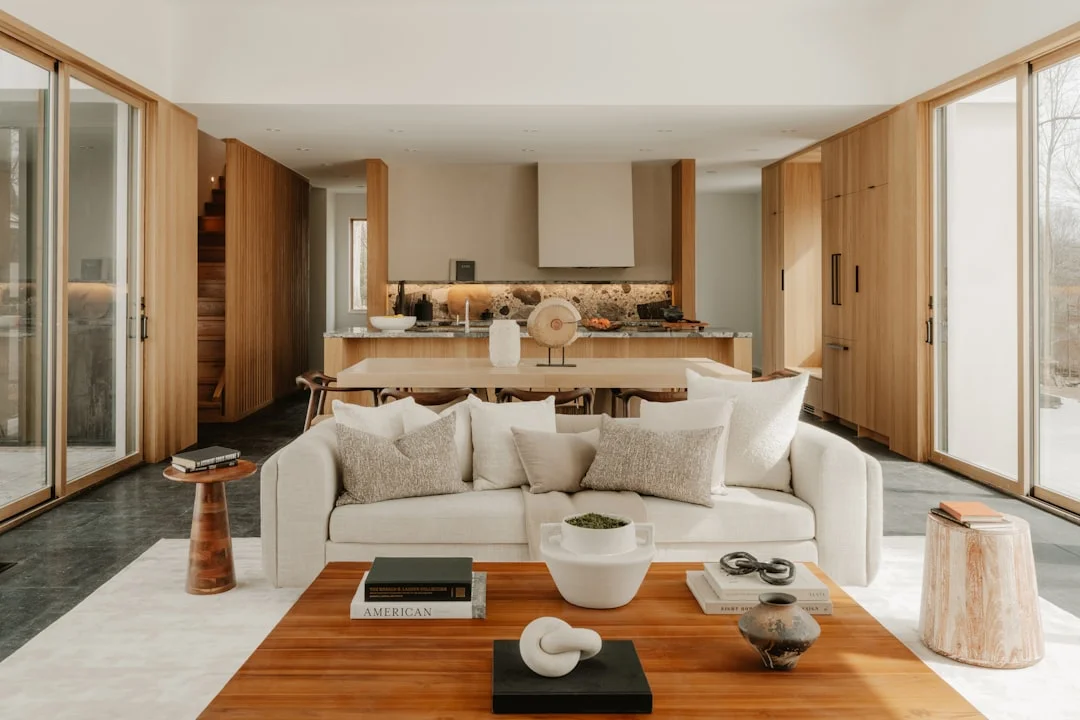
Minimalist open-plan living room with cream sofa and warm wood kitchen in neutral tones — Photo by Clay Banks on Unsplash
The paralysis is real. You’re standing in a house full of someone else’s accumulated life, or your own decades of acquiring things, and you don’t know where to start. Here’s a framework that works.
First: separate before you evaluate. Don’t try to assess value while you’re emotionally overwhelmed. Box the candidates, label the boxes by category (textiles, ceramics, metals, furniture, art), and give yourself 72 hours before you make any permanent decisions. Nothing that goes in a box is decided. Anything that goes to the curb is.
Second: the magnet test, the mark test, the seam test. Magnet to metal (solid brass, cast iron, and sterling silver are all non-magnetic). Maker’s mark on ceramics and silver (photograph every mark and run it through a ceramics or silver hallmark database — most are free online). Seam inspection on wood furniture (hand-cut dovetails vs. machine-cut). These three tests take approximately ninety seconds per object and they will prevent the most expensive mistakes.
Third: before you sell anything, get one professional opinion. Not a dealer — dealers have a conflict of interest. Find a certified appraiser affiliated with the American Society of Appraisers or the Appraisers Association of America. A verbal appraisal consultation typically runs $150 to $350 per hour. For a house full of potential vintage home decor pieces worth keeping, that hourly rate can be the best money you spend. I cannot verify specific appraisal rates in your region, but this ballpark has been consistent across multiple professional associations.
Fourth: photograph everything before it leaves your possession. The photograph doesn’t have to be professional — adequate light, both sides, any marks or damage. You will want this later. Once something is gone, the photograph is all you have for insurance purposes, for sentimental reference, and for the moment, six months from now, when you realize what you let go.
The Authentication Problem Nobody Talks About
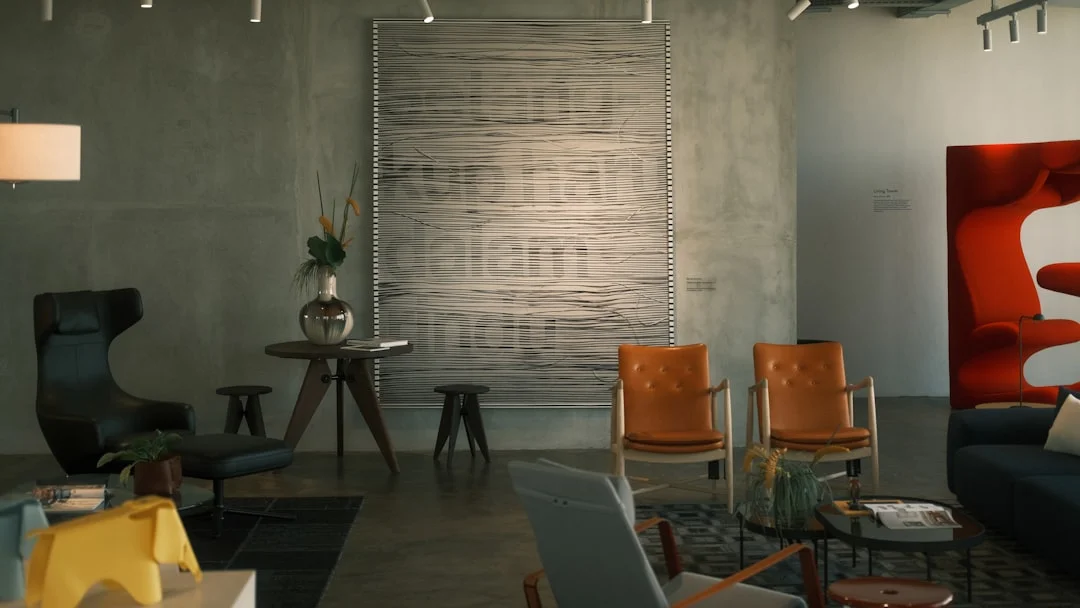
Mid-century modern furniture showroom with leather chairs, Vitra Living Tower, and textile wall art — Photo by David Kristianto on Unsplash
Here’s what every other guide on vintage home decor leaves out entirely: the market for high-quality reproductions has improved dramatically. The fakes are better now than they were fifteen years ago. And the difference between an authentic 1920s Roseville pottery piece and a contemporary reproduction made in China with artificially aged glaze has narrowed to the point where non-specialists can be genuinely fooled.
The tells are in the weight and the clay body. Authentic American art pottery from the early 20th century uses regional clay bodies that have specific mineral compositions. The pieces are heavier than they look. The unglazed foot ring shows a clay color and texture that contemporary reproductions don’t perfectly match — usually too uniform, too clean, too orange. Authentic pieces also show specific aging patterns in the glaze: crazing (the fine crack network in old glaze) that permeates evenly, not in the artificially concentrated patterns of artificially aged reproductions.
For furniture, the wood surface under UV light is your friend. Old wood fluoresces differently than new wood under a UV/blacklight flashlight — you can buy one for under $20. New wood glows with a bright blue-white fluorescence. Genuinely old wood shows a muted, darker response. This isn’t foolproof, but it catches most artificially aged modern reproductions immediately. The technique is used by professional authenticators and barely mentioned in consumer-facing guides. It’s specific, it’s cheap, and it works.
The same principle applies when you’re thinking about how to style what you keep. Understanding the principles for placing antique furniture in modern rooms is half the battle — the other half is making sure what you’re placing is actually what you think it is.
Questions We Get Every Day
Are vintage decor pieces worth more if they’ve never been used?
Not always — and for some categories, the opposite is true. Sterling silver, cast iron, and hand-knotted rugs actually gain value and character with careful, documented use. For art pottery and art glass, however, mint unused condition with original manufacturer markings commands a clear premium. The rule: for objects with intrinsic material value, use them. For objects whose value is purely collectible, protect them.
How do I tell silver plate from sterling silver?
Look for the marks. Sterling is marked “Sterling” or “.925.” Silver plate is marked “EPNS” (electroplated nickel silver), “A1,” “Quadruple Plate,” or sometimes just has a pattern name with no metal content stamp. If there’s no mark at all, assume silver plate until proven otherwise by a professional. The practical test: sterling is heavier than it looks, plate shows wear through to the base metal at high-contact points (edges of flatware, underside of serving pieces).
What vintage decor from the 1970s and 80s is actually worth keeping?
More than people assume. Specifically: solid teak and walnut Scandinavian furniture in good condition, authentic Marimekko textiles (look for the woven label, not a printed one), studio art glass by documented makers (Blenko, Viking, Imperial), and any ceramic with a visible studio mark. The synthetic, MDF-based, and particleboard pieces from this era can go. The solid wood and handcrafted pieces stay.
Should I have vintage furniture professionally cleaned before I resell it?
No. This is one of the most costly mistakes people make. Original patina — the natural darkening of wood, the mellowing of brass, the soft finish on leather — is not dirt. Stripping and refinishing a piece before sale almost always reduces its value significantly. A piece with original finish in honest condition is worth more to serious collectors and auction houses than a piece that’s been sanded and refinished. Get a professional opinion first. Then clean nothing more than surface dust until you know what you have.
Is retro interior design the same as vintage decor?
No, and the distinction matters. Retro design is intentionally nostalgic — it takes aesthetic cues from a past era but produces new objects in that style. Think: new furniture designed to look mid-century modern. Vintage decor refers to actual objects from a past era, whether deliberately collected or inherited. Retro can look like vintage from a distance. Up close, in the hand, they are completely different things. Retro pieces rarely hold collector value. Authentic vintage home decor pieces worth keeping gain it.
What’s the single biggest mistake beginners make with vintage pieces?
Overcrowding. The instinct when you discover you love vintage decor is to fill every surface. Don’t. One extraordinary piece in a room creates presence. Eight pieces of the same quality create noise. The discipline required to edit ruthlessly is exactly the skill that separates a room that feels collected from one that feels cluttered. Give each piece space to breathe. Let it be seen. That’s the whole point.
Can vintage pieces be mixed with very modern interiors without looking awkward?
Yes — and done right, it’s the strongest design move you can make. The key is contrast, not harmony. Don’t try to match the vintage piece to the modern room. Let them disagree. A single 1930s oil painting above a minimal concrete console. A hand-thrown ceramic vase on a glass shelf. The friction is the point. The old piece makes the new room feel considered. The new room makes the old piece feel discovered.
The Pieces You Keep Define the Home You Actually Live In
There’s a version of your home that’s perfectly assembled from new things, optimized for the current trend cycle, and completely forgettable. And then there’s the version built slowly, partly from objects that have already lived — that carry the specific gravity of materials and methods that no longer exist.
The vintage home decor pieces worth keeping aren’t worth keeping because they’re old. Old is neutral. They’re worth keeping because they’re made from things that cannot be remade, using knowledge that has largely been lost, at a scale of labor that no market will ever fund again. That’s not nostalgia. That’s just the truth about where material culture has gone.
Throw away the pressed wood. Keep the dovetailed drawer. Sell the plated flatware. Keep the sterling. Let go of the mass-produced ceramics. Hold onto the hand-thrown one with the slightly crooked lip.
The crooked one is the real one. The room you build around real things will feel real too.