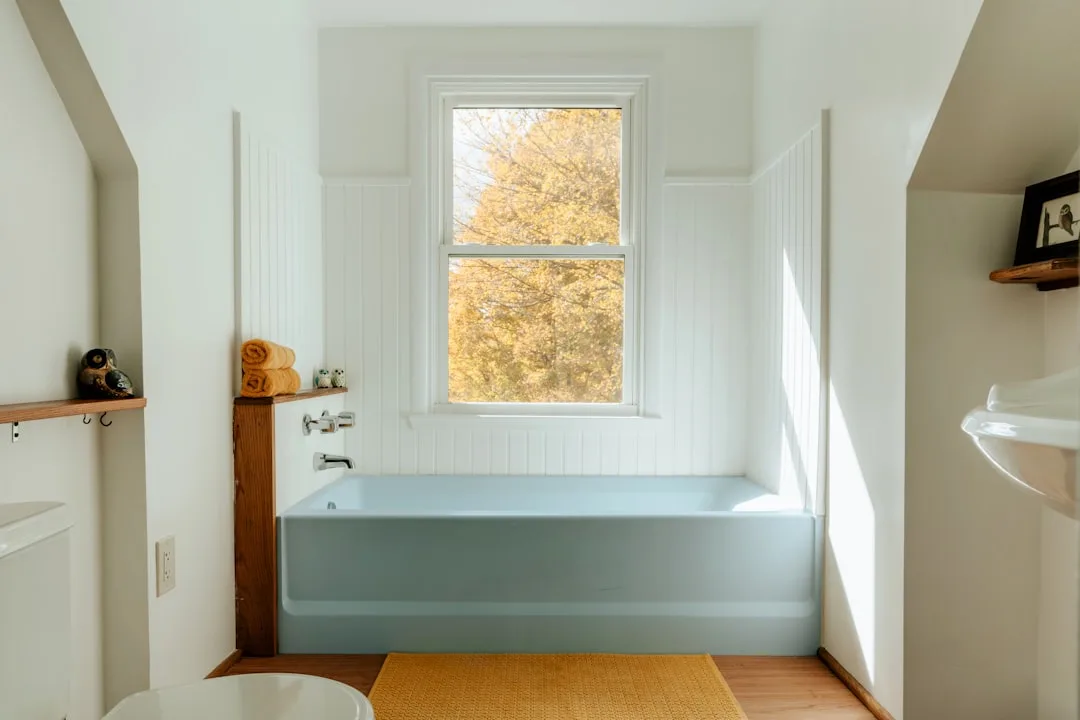
Most bathrooms fail their paint job not because the homeowner chose the wrong sheen — but because they chose a finish for how it looked on a colour card rather than how it would survive 90% humidity every single morning. If you’re trying to find the best paint finish for bathroom walls, the answer starts before you even open a tin — it starts with understanding what your specific bathroom actually does to paint over time. I watched this happen in apartment after apartment during my years doing residential work in Chicago. Someone would pick a gorgeous warm eggshell, apply it beautifully, and six months later call me asking why the paint near the shower was bubbling. The answer was never the colour. It was never even really the sheen. It was that nobody had asked the right questions before picking anything at all.
Quick Answer
Most bathrooms fail their paint job not because the homeowner chose the wrong sheen — but because they chose a finish for how it looked on a colour card rather than how it would survive 90% humidity every single morning.
This article is about asking those questions first.
What Paint Finish Do You Actually Use on Bathroom Walls?
In This Article
Here’s the thing that most sheen guides skip entirely: the finish decision is not one decision — it’s three decisions stacked on top of each other, and most people only make one of them.
The three decisions are: what sheen level, what formula, and what your bathroom’s actual humidity load demands. Get all three right and almost any mid-range paint will hold up. Get only the first one right and you’re repainting in two years wondering what went wrong.
Satin and semi-gloss are the baseline recommendations you’ll see everywhere, and they’re not wrong exactly — they’re just incomplete without context. A bathroom with a properly sized extractor fan running on a humidity sensor and a window above the bath is a fundamentally different environment than a windowless bathroom shared by three people, and treating them identically is where the advice falls apart.
Bathrooms generate the highest indoor humidity of any room in a home. A single 10-minute shower can push relative humidity above 90%. That matters because surface porosity — how readily a dried paint film absorbs moisture vapor — is as important as sheen level when choosing a finish. A matte paint with low porosity in ideal conditions can still fail in a steam-heavy bathroom because moisture finds its way into micro-imperfections that a higher-sheen film would seal over.
What most guides also won’t tell you: the formula inside the tin often matters more than the sheen number on the label. A specialist bathroom paint in eggshell finish, with built-in mold inhibitors and a washability rating of 2000+ scrub cycles, will outperform a standard satin from the general decorating range in virtually every high-humidity scenario. The sheen level sets the ceiling on moisture resistance. The formula determines whether you actually reach it.
There’s also the question of binder chemistry. Most consumer bathroom paints today use acrylic latex formulas, which are flexible enough to expand and contract with temperature shifts without cracking. Oil-based alkyds were the traditional answer for bathroom walls and they still offer superior hardness and moisture resistance — but they yellow over time, require mineral spirits cleanup, and off-gas significantly during application. For most homeowners, a high-quality acrylic latex with bathroom-specific additives is the practical choice. Where alkyd still earns its place is in heavily used wet zones or on woodwork around windows where condensation pools repeatedly and nothing else holds.
- Poor ventilation bathroom: formula and sheen both need to be working hard — semi-gloss minimum, specialist bathroom formula required
- Average ventilation bathroom: satin with a bathroom-specific formula is the reliable middle ground
- Well-ventilated bathroom: the formula still matters, but you have more freedom to drop toward eggshell for aesthetics
One more variable that rarely appears in paint guides: wall substrate. Drywall behind tile or in wet zones is categorically different from the plaster walls in an older home. Standard drywall is highly absorbent and needs a moisture-resistant primer before any topcoat — skipping this step means even the best paint formula is bonding to a substrate that’s already compromised. Greenboard or cement backer in wet zones gives any topcoat a far more stable foundation. If you’re repainting over drywall in a shower-adjacent wall and the previous paint is already showing staining or soft spots, the problem is almost certainly substrate, not sheen level.
Takeaway: Before you pick a finish name, describe your bathroom’s ventilation situation out loud. That description should drive your choice more than any colour-card comparison.
Is Satin or Eggshell Better for Bathroom Walls?
I have specified both in bathrooms. I have also watched both fail in bathrooms. The “satin always wins” answer is lazy, and the real story involves your bathroom’s square footage, its lighting, and the condition of its walls.
Satin sits in roughly the 26–40 gloss unit range and repels moisture more effectively than eggshell because its denser binder system leaves fewer microscopic pathways for vapor penetration. That makes satin the correct default for family bathrooms with heavy use, wet zones, and anyone who takes long showers with the door closed. It cleans easily, handles repeated wiping, and doesn’t absorb soap residue the way softer finishes do.
Eggshell reflects 10–25% of light compared to satin’s 26–40%. That gap is subtle on a paint chart and genuinely visible on a wall — particularly in small spaces with direct overhead lighting, where satin can feel uncomfortably clinical and reflective, bouncing light in ways that flatten the space rather than expand it. In a larger en-suite with a window and a decent extractor, eggshell is not a compromise. It’s the better-looking choice that performs adequately.
The practical advantage of eggshell that almost nobody talks about: touch-ups are significantly easier. Satin’s higher sheen means lap marks from touching up a small section are obvious, especially under artificial light. Eggshell’s softer finish blends repairs more forgivingly — which matters enormously in older homes with textured plasterwork that never holds paint perfectly evenly.
The mistake I kept seeing was someone choosing eggshell in a small, poorly ventilated bathroom because it “looked softer” on the sample card. That specific mistake is where mold starts. Small bathrooms with inadequate ventilation are not the place for eggshell — the reduced moisture resistance combined with trapped humidity creates exactly the surface conditions that mold needs.
It’s also worth separating the ceiling from the walls here. The ceiling takes the worst of the steam rising from a shower or bath, and even in bathrooms where eggshell is acceptable on the walls, the ceiling almost always warrants a step up in sheen or a dedicated ceiling formula with stronger mold inhibitor content. I’ve seen people apply the same paint uniformly across ceiling and walls to save cost, and the ceiling consistently fails first. A flat or matte ceiling paint in a bathroom is a short-term mistake regardless of how good the ventilation is.
- Choose satin when: family bathroom, heavy daily use, small square footage, weak ventilation, shower-adjacent walls
- Choose eggshell when: larger en-suite, good natural light and extraction, one or two users, older walls with imperfections, or where touch-up frequency is a genuine concern
Takeaway: If your bathroom is under 50 square feet and has no window, don’t touch eggshell. If it’s a spacious en-suite with a proper fan, eggshell is worth serious consideration — especially if the walls aren’t perfect.
What Is the Best Paint Finish for a Steamy Bathroom?
Semi-gloss. Not “maybe semi-gloss.” Not “semi-gloss if you prefer it.” For a genuinely steamy bathroom — no window, weak or absent extractor, multiple users daily — semi-gloss is the professionally defensible answer, and the reason it fell out of fashion in residential design has more to do with aesthetics than performance.
Social housing contractors and rental property managers have used semi-gloss on bathroom walls for decades, and not because they have great taste. Because it works. Semi-gloss creates a near-impermeable film surface that steam cannot easily penetrate, condensation wipes off cleanly, and mold has no microscopic ledges to grip. It’s not glamorous. It’s correct.
The legitimate objection to semi-gloss is that it shows everything. Every brush mark, every roller stipple, every small crack or surface irregularity gets amplified by that higher sheen. This is not an argument against semi-gloss — it’s an argument for proper wall preparation before applying semi-gloss. Skim, sand, prime. In a steamy bathroom where performance is the priority, that preparation is not optional.
If the idea of semi-gloss from floor to ceiling genuinely bothers you aesthetically, there is a workable middle path: use semi-gloss on the lower half of the walls — the sections closest to the shower, bath, or basin where steam and splash are concentrated — and step down to satin on the upper walls and ceiling area away from direct moisture. This zoned approach is more work to cut in neatly but it solves the visual problem without sacrificing protection where the walls actually need it. The transition line at dado height or just above the towel rail height reads as intentional rather than accidental, especially if you reinforce it with a tile or a physical trim piece.
One thing that surprises people: colour depth interacts with sheen in steam-heavy spaces. Dark colours in semi-gloss show water marks and condensation streaks much more visibly than pale colours in the same finish. This isn’t a reason to avoid dark walls — dark bathrooms are having a well-deserved moment — but it is a reason to choose a formula with better water-mark resistance and to wipe walls down after showers more consistently. A very deep charcoal or navy in semi-gloss on a poorly ventilated bathroom wall will show every drop. Factor that into maintenance expectations before you commit.
The other thing nobody mentions about steamy bathrooms: reapplication cycle. Even the best semi-gloss in the best formula in a genuinely steamy bathroom without adequate ventilation will need refreshing every four to six years. That’s not a failure of the paint — it’s a realistic maintenance expectation. Budgeting for it, and keeping a small quantity of the original paint for touch-ups, is more practical than hoping a single application lasts indefinitely.
Takeaway: Steamy bathroom with no window? Semi-gloss and proper prep. No exceptions. If the sheen bothers you, zone it rather than downgrade it.
How to Choose the Right Finish Based on Your Specific Bathroom
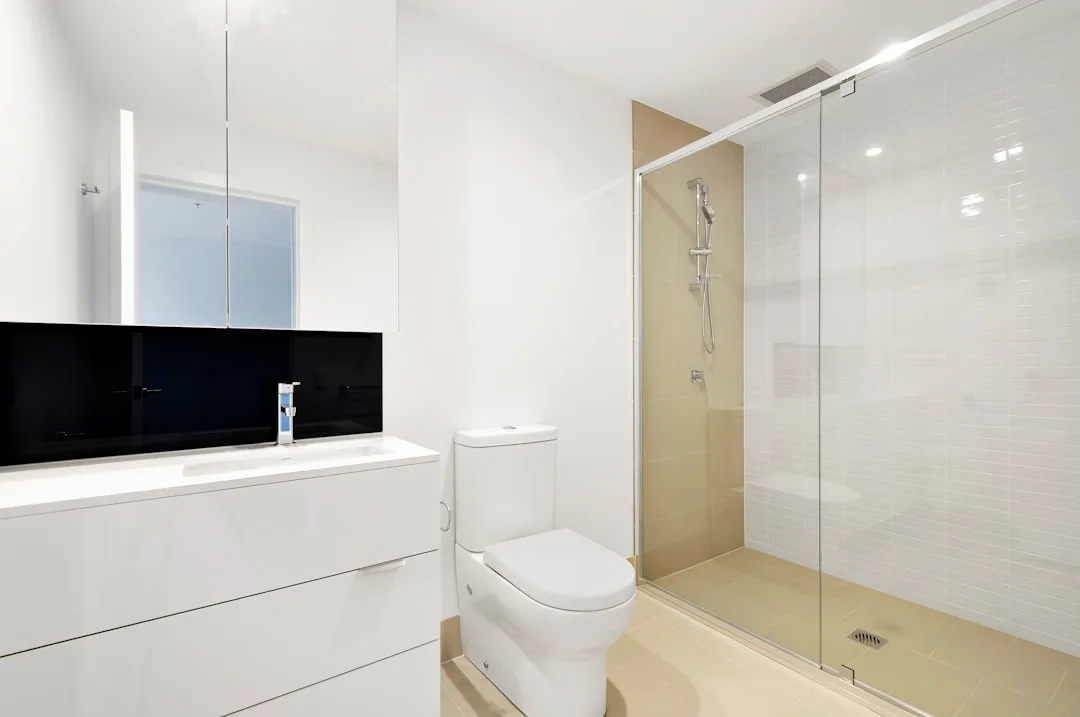
Most people read a general recommendation and apply it without accounting for the variables that make their bathroom different from the example. Here is a more direct decision framework.
Bathroom type and corresponding finish:
A windowless bathroom under 50 square feet with one extractor fan is the highest-risk environment. Semi-gloss with a dedicated bathroom formula is the only sensible answer. If there is no extractor fan at all, no paint finish will compensate for the underlying ventilation failure — fix the ventilation first, then apply semi-gloss.
A family bathroom with a window and basic extractor falls into the middle tier. Satin with a bathroom-specific formula performs reliably here. Standard satin from a general range is borderline — worth spending the extra amount to get a formula with mold inhibitor included rather than hoping the sheen alone is enough.
A master en-suite with good natural ventilation, a proper extractor on a humidity sensor, and two daily users gives you real flexibility. Satin remains the safe choice. Eggshell from a specialist bathroom range is genuinely viable if the walls are in good condition and you’re after a softer look. The sheen decision here becomes an aesthetic one rather than a purely functional one.
A guest bathroom used infrequently is often over-engineered in the other direction — people put semi-gloss in a room that’s used twice a week and end up with a finish that’s harder to touch up and harsher visually than the usage actually demands. Satin or even a quality eggshell bathroom formula works fine in a low-traffic bathroom where steam is genuinely infrequent.
Don’t forget the trim. Skirting boards, door frames, and window surrounds in bathrooms should always go one step higher in sheen than the walls — semi-gloss trim in a satin-walled bathroom, gloss trim in a semi-gloss-walled bathroom. Trim takes direct splash, cleaning contact, and condensation pooling at window reveals. Under-specifying the trim finish while getting the walls right is a common oversight that shows up fast.
Frequently Asked Questions
Can I use regular wall paint in a bathroom if it’s the right sheen?
Technically yes, but practically it’s a gamble. Standard wall paints in satin or semi-gloss will hold up in low-humidity bathrooms with excellent ventilation, but they lack the mold inhibitors and washability ratings built into dedicated bathroom formulas. In any bathroom with average or below-average ventilation, the mold inhibitor in a specialist formula does real work that sheen alone cannot replicate. The price difference between a standard satin and a bathroom-specific satin is rarely significant enough to justify skipping it.
How many coats does bathroom paint need?
Two finish coats over a proper primer is the baseline. In high-humidity bathrooms, a third finish coat adds meaningful film thickness that improves both moisture resistance and longevity. Thin coats are always better than thick ones — two thin coats over primer outperform one heavy coat every time, both in adhesion and in how cleanly the surface dries. If you’re applying semi-gloss, the third coat pays for itself in how much more uniformly the sheen reads.
Does primer matter as much as the topcoat in bathrooms?
Yes, and often more. A moisture-resistant primer creates the foundation that keeps topcoats bonded to the substrate when humidity cycles up and down. Skipping primer or using a standard interior primer in a wet bathroom is one of the most common causes of paint peeling from the wall rather than failing at the surface. In previously painted bathrooms showing any staining, a stain-blocking primer before the topcoat prevents discolouration bleeding through the new finish regardless of how many topcoats you apply over it.
What’s the best paint finish for bathroom walls that are already showing mold?
The mold needs to be treated before any paint goes on. Painting over mold — even with a mold-inhibiting formula — does not kill the underlying growth. Clean the surface with a diluted bleach solution, allow it to dry completely, and if the mold is recurring in the same spot, address the ventilation or condensation source causing it before repainting. A mold-resistant primer followed by a semi-gloss bathroom formula is the correct sequence after treatment, not a substitute for it.
Is satin finish good for bathroom ceilings specifically?
Satin is acceptable on bathroom ceilings in well-ventilated spaces, but a dedicated bathroom ceiling paint — typically formulated as a flat or low-sheen finish with strong mold inhibitor — often performs better because it’s designed to handle the specific problem of condensation forming on a horizontal surface above a shower. The ceiling is where moisture rises and sits longest before the extractor clears it. If your bathroom has any history of ceiling mold, use a specialist ceiling formula rather than extending your wall paint upward.
Can I use regular wall paint in a bathroom if it’s the right sheen?
Technically yes, but practically it’s a gamble. Standard wall paints in satin or semi-gloss will hold up in low-humidity bathrooms with excellent ventilation, but they lack the mold inhibitors and washability ratings built into dedicated bathroom formulas. In any bathroom with average or below-average ventilation, the mold inhibitor in a specialist formula does real work that sheen alone cannot replicate. The price difference between a standard satin and a bathroom-specific satin is rarely significant enough to justify skipping it.
How many coats does bathroom paint need?
Two finish coats over a proper primer is the baseline. In high-humidity bathrooms, a third finish coat adds meaningful film thickness that improves both moisture resistance and longevity. Thin coats are always better than thick ones — two thin coats over primer outperform one heavy coat every time, both in adhesion and in how cleanly the surface dries. If you’re applying semi-gloss, the third coat pays for itself in how much more uniformly the sheen reads.
Does primer matter as much as the topcoat in bathrooms?
Yes, and often more. A moisture-resistant primer creates the foundation that keeps topcoats bonded to the substrate when humidity cycles up and down. Skipping primer or using a standard interior primer in a wet bathroom is one of the most common causes of paint peeling from the wall rather than failing at the surface. In previously painted bathrooms showing any staining, a stain-blocking primer before the topcoat prevents discolouration bleeding through the new finish regardless of how many topcoats you apply over it.
What’s the best paint finish for bathroom walls that are already showing mold?
The mold needs to be treated before any paint goes on. Painting over mold — even with a mold-inhibiting formula — does not kill the underlying growth. Clean the surface with a diluted bleach solution, allow it to dry completely, and if the mold is recurring in the same spot, address the ventilation or condensation source causing it before repainting. A mold-resistant primer followed by a semi-gloss bathroom formula is the correct sequence after treatment, not a substitute for it.
Is satin finish good for bathroom ceilings specifically?
Satin is acceptable on bathroom ceilings in well-ventilated spaces, but a dedicated bathroom ceiling paint — typically formulated as a flat or low-sheen finish with strong mold inhibitor — often performs better because it’s designed to handle the specific problem of condensation forming on a horizontal surface above a shower. The ceiling is where moisture rises and sits longest before the extractor clears it. If your bathroom has any history of ceiling mold, use a specialist ceiling formula rather than extending your wall paint upward.