
The floor beneath your bed is almost certainly the largest single storage zone in your home — and it is probably either empty or full of things you cannot name without lifting the duvet to check. If you’ve been searching for under bed storage ideas for a small bedroom, you’ve already identified the right problem. The solution isn’t buying more furniture — it’s treating the space you’re already sleeping on top of as the functional storage zone it can be.
Quick Answer
The floor beneath your bed is almost certainly the largest single storage zone in your home — and it is probably either empty or full of things you cannot name without lifting the duvet to check.
That tension — between obvious potential and consistent underuse — is the thing I kept running into during eleven years of client work. People would hire me to solve a storage crisis, and I would walk into their bedroom, clock the gap beneath a queen frame, and think: there it is. The second closet they didn’t know they had. Getting them to treat it like one, rather than a convenient place to kick things out of sight, was almost always the harder job.
What follows is not a gallery of pretty bins. It is a framework — the same one I used with real clients in real apartments — for turning that dead floor space into storage you can actually find things in.
Why Most Small Bedrooms Waste Their Single Biggest Storage Zone
In This Article
- Why Most Small Bedrooms Waste Their Single Biggest Storage Zone
- Measure Before You Buy: The Clearance Numbers That Actually Determine Your Options
- The Six Zoning Categories Designers Assign to Under-Bed Space
- Container Types, Materials, and What the Price Difference Actually Buys You
- Bed Risers: When and How to Use Them Without Compromising Stability
- Maintaining the System: Why Most Under-Bed Storage Fails After Month Three

Here is the number that usually stops people cold: a standard queen-size bed covers approximately 33.3 square feet of floor area. A twin covers 18.75 square feet. For reference, a small walk-in closet runs between 25 and 40 square feet. So most people are sleeping on top of an empty walk-in closet and paying for external storage, fighting over shared wardrobes, or piling clothes on a chair they stopped sitting in years ago.
The culprit is almost never laziness. It is bed height. Standard frames sit 7–9 inches off the ground — low enough that most full-depth bins simply don’t fit, and just high enough that you have to crouch uncomfortably to see what’s back there. That combination creates a zone that feels too awkward to use properly and too inconvenient to maintain. So it becomes a dumping ground, which makes it feel even more unusable, which confirms the original neglect. A predictable spiral.
The other problem — the one that takes longer to name — is the difference between reactive storage and intentional zoning. Reactive storage is what happens when a box of winter sweaters ends up under the bed because there was nowhere else. Intentional zoning is deciding, in advance, that the under-bed area is your seasonal wardrobe overflow, and building the container system, labelling, and rotation schedule around that single purpose. One of those approaches creates a functional space. The other creates the shoebox graveyard I spent the better part of a decade helping clients excavate.
I once helped a client in a 650-square-foot Chicago apartment realise she had been paying for a storage unit — $85 a month — to house items that would have fit, properly containerised, beneath her queen bed with room to spare. She cancelled the unit within two weeks of the project. That number tends to land differently than any aesthetic argument I could make.
The reason under bed storage ideas for small bedrooms keep circulating in design conversations is that the math is genuinely compelling. You are not adding square footage. You are not knocking down walls. You are extracting value from space that already exists inside your apartment’s footprint, which is the only kind of gain that doesn’t cost you floor area somewhere else.
There is also a psychological dimension that rarely gets discussed. A bedroom with visible clutter — the chair pile, the dresser overflow, the basket of things with no designated home — reads as smaller than it actually is. When you redirect that overflow into a properly organised under-bed system, the room doesn’t just function better. It looks larger, which matters enormously in a small bedroom where every visual inch counts.
Takeaway: Before you buy a single bin, reframe the under-bed zone as a designated room annex — not extra space, but the only storage square footage you’re not currently using.
Measure Before You Buy: The Clearance Numbers That Actually Determine Your Options
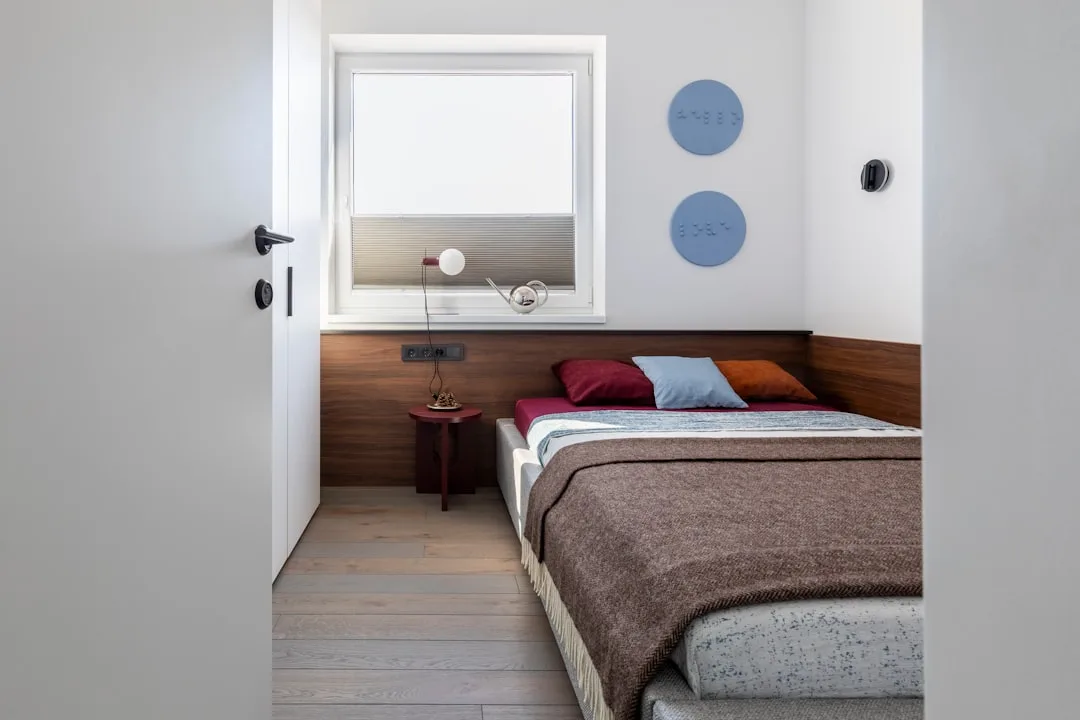
Every mismatched purchase I’ve ever seen in a client’s under-bed zone came from the same mistake: buying first and measuring second, or not measuring at all. A 7-inch rolling bin doesn’t fit a 6-inch clearance. That sounds obvious until you’ve watched someone try to force it.
Measuring true usable clearance means measuring floor to the lowest structural point of the frame — not the mattress edge, not the bottom of the slats, but the absolute lowest point of whatever is fixed. On many frames that is a centre support beam or a cross-brace running diagonally, both of which can be 2–3 inches lower than the visible frame rail. Measure in three places: each side and the centre. Use the smallest number. That is your actual clearance.
Here is how that number changes your options:
- Under 6 inches: Flat sliding trays only — think shallow wooden boards with a handle, or purpose-built slide-out platforms. Rigid containers don’t fit. Flexibility is minimal.
- 6–10 inches: Standard rolling bins and vacuum compression bags in a flat configuration. IKEA’s HEMNES bed frame offers 9.5 inches, which puts it at the upper edge of this tier. Rolling containers in this range typically run 6–7 inches tall, leaving a half-inch of clearance — workable on hardwood, tight on carpet.
- 10–14 inches: Full drawer units, deeper lidded boxes, and file storage. Platform beds with integrated storage drawers typically fall in the 11–13 inch range, which is why the drawers on those frames feel genuinely useful rather than token.
- 14 inches and above: Maximum flexibility. Hanging canvas organisers on risers, full-depth file boxes, even small wicker baskets that would normally live on a shelf. This is riser territory.
Hidden obstructions deserve their own mention because they destroy otherwise workable plans. Centre support legs — the vertical posts that drop from the centre beam to the floor — are common on queen and king frames and divide the under-bed zone into two separate cavities, each with its own depth limit. Diagonal cross-braces on metal frames do the same and can be impossible to work around with rigid containers. Measure depth from the frame edge inward to the first obstruction. That is the maximum bin depth you can use, regardless of height clearance.
One thing most people miss: electrical outlets near the headboard wall. If you run bins all the way to the head of the bed, you may be blocking access to a socket — which matters if a lamp, phone charger, or CPAP machine lives there.
Takeaway: Spend ten minutes measuring all three dimensions — height at three points, depth to the first obstruction, and width between any centre legs — before opening a single product listing.
The Six Zoning Categories Designers Assign to Under-Bed Space
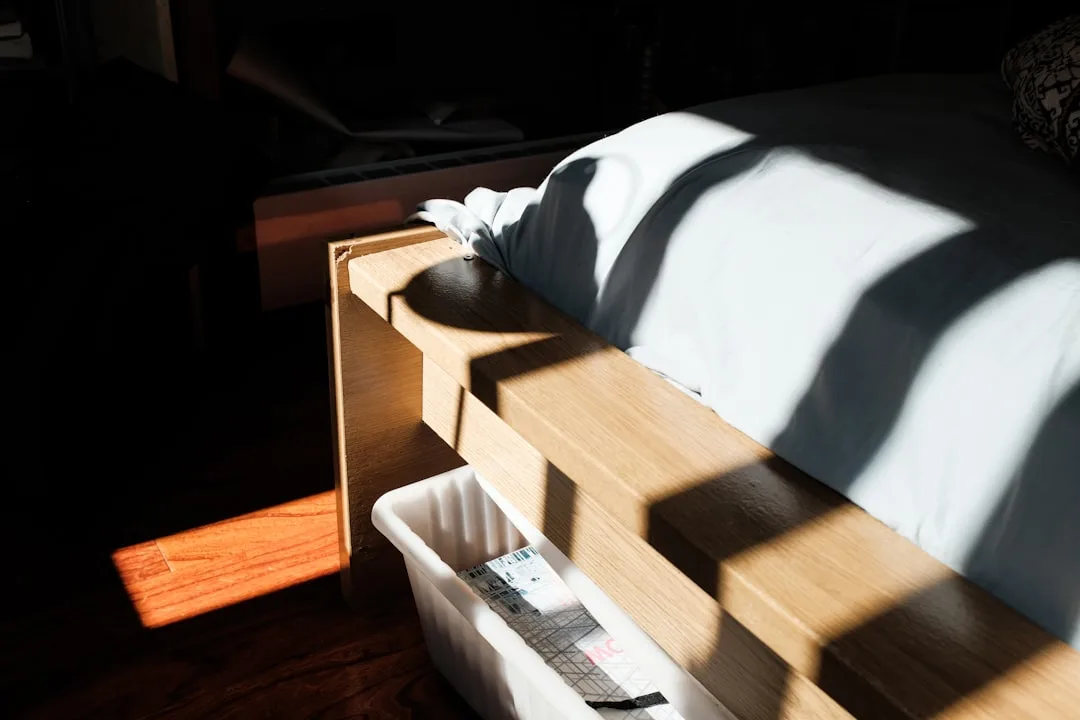
Generic advice says “use under-bed storage for seasonal items.” That is true and also almost completely useless, because it doesn’t tell you which seasonal items, where within the under-bed zone to put them, or what to do with the other four categories of things that also belong there. Here is the framework I actually used with clients.
Zone 1 — Seasonal Wardrobe Overflow
Off-season clothes are the highest-value use of under-bed space, for a simple reason: they are bulky, infrequently accessed, and currently occupying prime real estate inside your main wardrobe. Moving winter coats and summer linen trousers into flat vacuum bags under the bed frees an extraordinary amount of hanging rail space without requiring you to purge anything. The rotation schedule — swap at the equinox, or whenever your heating clicks on or off for the season — is simple enough that it actually happens.
What to use: flat zip-close vacuum compression bags for soft goods, lidded canvas bins with handles for folded knitwear that you don’t want compressed. Label the outside with the season and the contents, not just “winter clothes,” which tells you nothing useful at 6am when you need the specific navy roll-neck.
Zone 2 — Extra Bedding and Towels
A second set of sheets, spare duvet, extra pillows, and guest towels belong here rather than on the shelf of the linen closet that you have to excavate every time you strip the bed. The key is keeping this zone as close to the foot of the bed as possible so it remains accessible without moving other containers. Flat zip bags are excellent for duvets. Folded sheets store well in a slim lidded box.
Zone 3 — Archived Papers and Documents
Filing boxes fit under a bed with 10–14 inches of clearance and serve an important function: they get paper out of desks, kitchen drawers, and that one cardboard box that has lived in the corner since the last move. Tax returns, property documents, and insurance records are accessed rarely enough that being under the bed imposes no real inconvenience — but they need to be in a rigid, labelled, waterproof container, not a cardboard Amazon box.
Zone 4 — Shoes and Accessories
Shoes are the storage item clients were most surprised to see me recommend for the under-bed zone, but the geometry is nearly perfect: most shoes sit roughly 4–5 inches tall, most heels under 5 inches, which means they slide easily into a 6-inch clearance zone that would defeat almost any other container. Clear-front shoe boxes or a low-profile rolling shoe rack lets you see and retrieve specific pairs without unpacking everything. Limit this zone to the shoes you are actually wearing in the current season — not the archive, which belongs in Zone 1.
Zone 5 — Hobby and Craft Overflow
Books you are actively reading, craft projects in progress, gym equipment too small for a dedicated area — this is a zone that varies enormously by person, which is exactly why it needs to be pre-assigned rather than improvised. Without a designated container and a size limit, hobby overflow expands to fill whatever space is available and becomes the new shoebox graveyard. Give it one bin, one label, one access point, and a rule: when it’s full, something leaves before something new enters.
Zone 6 — Gift and Wrap Supplies
Wrapping paper, tissue paper, ribbon, gift bags, and unwrapped gifts waiting for their occasion are items that benefit enormously from being out of sight and in one place. A long, narrow bin — 36 inches or longer — slides along the side of the bed and handles full-length rolls without requiring you to fold or crush them. This is the zone most clients had never considered, and the one that most consistently produced an immediate, visible improvement in the rest of the apartment, because wrap supplies tend to migrate everywhere when they have no home.
Container Types, Materials, and What the Price Difference Actually Buys You
Not all under-bed containers are equal, and the difference between a $12 canvas bin and a $45 polypropylene drawer unit is not purely aesthetic. Here is what the materials actually determine.
Fabric and canvas bins are the most common and the most frequently regretted purchase. They are inexpensive, lightweight, and easy to slide on smooth floors — but they collapse when not full, which means half-empty seasonal storage looks chaotic and is harder to maintain. The good versions have a rigid board insert in the base. If the listing doesn’t mention one, assume it’s absent. Fabric bins also accumulate dust on the exterior and offer no moisture resistance, which matters if your bedroom is below grade or in a humid climate.
Polypropylene (hard plastic) bins with lids are the workhorses. The lid keeps dust out, the rigidity means they hold their shape regardless of contents, and a smooth base slides consistently on hardwood. The downside is weight — a full polypropylene bin with a lid can run 15–20 pounds depending on contents, which is manageable on casters but awkward to lift and move. Look for bins with integrated handles on the short ends, not rope handles attached after the fact, which tend to pull out at the worst moment.
Rolling drawer units are the premium option when clearance allows it (typically 11 inches minimum for a useful drawer depth). The casters change the experience entirely — access becomes effortless, which means you actually maintain the system rather than avoiding it because retrieval is annoying. The best versions have a stop mechanism on the caster so the drawer doesn’t roll when you pull the handle. Without that stop, the entire unit slides toward you when you try to open a drawer.
Vacuum compression bags deserve a separate mention because they are the only container type that actively reduces the volume of what you’re storing. A queen-size duvet that normally takes 18 inches of shelf space compresses to roughly 4 inches in a flat vacuum bag. The tradeoff: compression creases fabric, which matters for some materials and not at all for others. Knitwear and duvets tolerate compression well. Structured blazers and linen shirts do not.
What the price difference buys:
- Under $15: Fabric bins, usually without a rigid insert. Workable for lightweight, infrequently accessed items.
- $15–$35: Polypropylene bins with lids and handles. The reliable middle tier. This is where most clients landed.
- $35–$80: Rolling units with quality casters, or purpose-built under-bed drawer systems in wood or MDF. Worth the premium for items you access frequently.
- $80 and above: Integrated bed frame storage, custom-built drawer platforms, or high-end modular systems. Appropriate when the under-bed zone is serving as a primary wardrobe.
Bed Risers: When and How to Use Them Without Compromising Stability
Bed risers are the fastest way to dramatically expand under-bed storage capacity — a set of 6-inch risers transforms a 7-inch clearance into a 13-inch one, effectively unlocking an entirely different tier of container options. But they are also the most frequently misused product in the small-bedroom toolkit, and the misuse tends to produce results ranging from wobbly and uncomfortable to genuinely unsafe.
The stability question comes down to contact area. A riser that accepts only the foot of the bed leg — a small cup-style riser — concentrates the entire load of the frame, mattress, and sleepers onto an area roughly the size of a coaster. On carpet, that creates a tip risk. On hardwood, it creates a sliding risk. The better risers have a wide, flat base that distributes load across a larger floor area, and a deep socket that captures the leg fully rather than letting it rest in a shallow depression.
Weight capacity matters more than most people check. A queen mattress runs 60–100 pounds. Add a box spring (another 60–80 pounds) and two adults (combined 300+ pounds in many households), and you are asking the risers to support 400–500 pounds total, distributed across four contact points. Each riser therefore needs to handle 100–125 pounds minimum under a realistic load. Many inexpensive risers are rated at exactly that threshold, which means they are operating at maximum capacity with no margin. Look for risers rated at 1,500–2,000 pounds total system load, which translates to 375–500 pounds per leg — a meaningful safety margin.
Height options and what they change:
- 2-inch risers: Modest clearance gain. Useful if you are just below the threshold for a specific container size. Minimal impact on mattress height.
- 4-inch risers: Noticeable increase — a bed at standard height becomes genuinely easy to slide full bins beneath. Mattress height increases to around 30 inches from floor, which most adults find comfortable and which makes sitting on the edge of the bed more chair-like.
- 6-inch risers: Significant transformation. Most under-bed storage options become available. Mattress height approaches 33–35 inches, which some people find too high and which can create a step-up requirement for shorter individuals or older adults with mobility considerations.
- 8-inch risers: Maximum common height. Full rolling drawer units, file boxes, and larger containers fit. Mattress height becomes genuinely unusual — around 37 inches — which tends to suit only those who already prefer a very high sleep position.
One riser configuration that works particularly well for the full range of under bed storage ideas for a small bedroom: use 4-inch risers at the foot of the bed, where access and clearance matter most, and keep the head of the bed at standard height by using a taller headboard or none at all. This creates a slight incline — imperceptible in practice — while maximising the usable zone at the foot end where most people naturally pull bins in and out.
Maintaining the System: Why Most Under-Bed Storage Fails After Month Three
The most common failure mode I saw across eleven years of client projects was not a bad initial setup. It was a system that worked well for six to eight weeks and then degraded into a new version of the original chaos. The bins were there. The labels were there. But by month three, things were being shoved in without reference to zones, labels no longer matched contents, and the area had reverted to a no-man’s land.
The reason is almost always the same: the system was designed for an idealised version of the user’s behaviour rather than the actual version.
Maintenance rules that hold up in real life:
- One-in, one-out for Zone 5 (hobby overflow). Without a hard limit, this zone expands indefinitely. The bin is the limit. When it’s full, something leaves.
- Label the front face and the short end of every container. You approach the bed from the side to pull bins out. If the label is only on the front, you cannot read it from the access angle. Both sides get a label.
- Schedule two rotation sessions per year, not on demand. Seasonal rotation that happens “when I get around to it” reliably happens never. Tie it to a fixed calendar event — the first weekend after the clocks change, or the equinox — and treat it as a standing appointment.
- Keep the foot-of-bed zone for frequent-access items only. The deepest point — near the headboard — should hold the things you access least. If you put the spare sheets near the headboard and the seasonal tax records near the foot, you will be pulling out and replacing bins every time you change the bed, and the system will feel like more work than it saves.
- Run a quarterly audit. Fifteen minutes, once every three months. Pull everything out, verify that contents match labels, return items to their correct zone. This sounds onerous and in practice takes less time than finding the thing you need when the system has drifted.
The under-bed zone, like any storage system, reflects the clarity of the decisions made at the start. Vague initial zoning produces vague long-term results. Specific zones, specific containers, specific rules for what triggers a rotation — those produce a system that still works in year two.
Frequently Asked Questions
Q: What is the minimum bed height needed for under bed storage to be practical in a small bedroom?
Six inches is the functional minimum for any meaningful storage — below that, you are limited to flat sliding boards and little else. At 6–7 inches you can fit slim rolling bins and flat vacuum bags, which covers the most valuable use cases (seasonal clothing, spare bedding). If your current frame sits at 5 inches or below, risers are almost certainly worth considering before investing in containers, since the container options at that clearance are so limited that the system will feel frustrating to maintain. The sweet spot most designers aim for is 10–12 inches, which opens up the full range of rolling drawers and lidded boxes without requiring extreme risers.
Q: Can under bed storage work on carpet, or does it only work on hard floors?
It works on carpet, but requires a different container strategy. Standard plastic bins with flat bases develop significant friction on carpet pile, which makes pulling them out — especially when full — genuinely difficult. The solutions are: casters (which roll on carpet, though less smoothly than on hard floors), a thin plywood or hardboard panel placed under the bins to create a hard sliding surface, or purpose-built under-bed frames on wheels designed for carpet use. Avoid canvas bins on carpet — they bunch and drag rather than slide.
Q: How do I stop dust from accumulating in under-bed storage?
Dust accumulation is real and unavoidable, but manageable. The most effective approach is lidded hard-sided containers for anything that would be damaged or visibly affected by dust — clothes, bedding, documents. Fabric bins without lids will accumulate dust on the contents, which means seasonal clothes need washing before wearing even when they were clean going in. A second practical step: run a vacuum along the perimeter of the under-bed zone every time you vacuum the room. It takes thirty seconds and prevents the buildup that makes the whole area feel unwieldy to maintain.
Q: I rent and cannot change my bed frame. What are my best under bed storage ideas for a small bedroom without modifying anything permanent?
Risers are renter-friendly — they require no modification to the frame and leave no trace when removed. Beyond risers, the most versatile renter-friendly options are: vacuum compression bags (no container required beyond the bag itself), rolling polypropylene bins that slide in and out freely, and canvas bins with a rigid base insert for lighter items. The one permanent-seeming modification that is actually reversible: adhesive label holders applied to bins, which peel off cleanly and keep the system organised without any structural changes.
Q: How do I decide what actually belongs under the bed versus in other storage areas?
The under-bed zone is best used for items that share two characteristics: they are used seasonally or infrequently (not daily), and they are either flat, compressible, or short enough to fit within your clearance. Items that need to be accessed more than once a month tend to work better in a wardrobe, dresser, or open shelf — the friction of sliding bins in and out daily adds up and erodes the habit. The one exception is shoes in the current season’s rotation, which can be stored under the bed in a rolling rack if your wardrobe floor space is genuinely exhausted. Think of the under-bed area as your second-tier storage: not the archive, not the daily grab zone, but the place for things you need regularly enough to keep at home and infrequently enough to tolerate a small amount of access effort.