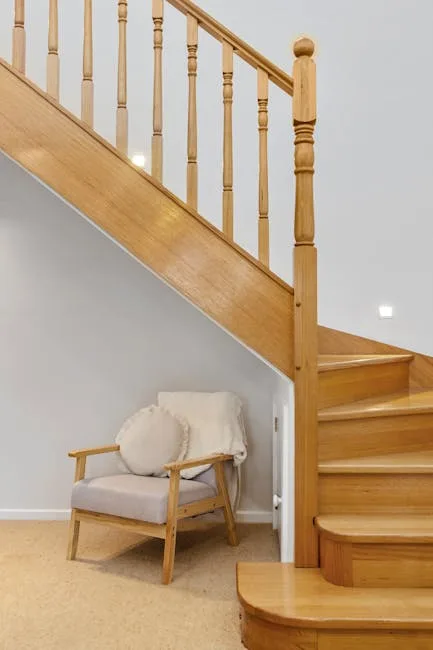
The average under-stair cavity in a two-story home contains between 30 and 70 square feet of floor space — and most homeowners fill it with a vacuum cleaner and a forgotten box of holiday decorations. That’s the equivalent of a walk-in closet being used as a junk drawer. If you’ve been searching for home office under stairs ideas, you’re already ahead of most homeowners, who never think to search at all. I’ve walked through hundreds of homes across Chicago and New York, and I can tell you the under-stair cavity is consistently the most expensive mistake people make by doing nothing — not the bad sofa choice, not the wrong paint color, but the deliberate, daily decision to ignore square footage that’s already paid for.
Quick Answer
The average under-stair cavity in a two-story home contains between 30 and 70 square feet of floor space — and most homeowners fill it with a vacuum cleaner and a forgotten box of holiday decorations.
Why the Space Under Your Stairs Is One of the Most Overlooked Work Zones in Any Home
In This Article
- Why the Space Under Your Stairs Is One of the Most Overlooked Work Zones in Any Home
- What to Do With the Space Under My Stairs — and What Actually Fits There
- The Lighting Problem Every Competitor Mentions — and the Layered Fix They Never Explain
- Ventilation, Acoustics, and the Two Details Everyone Gets Wrong
- Storage Integration That Doesn’t Eat Your Workspace
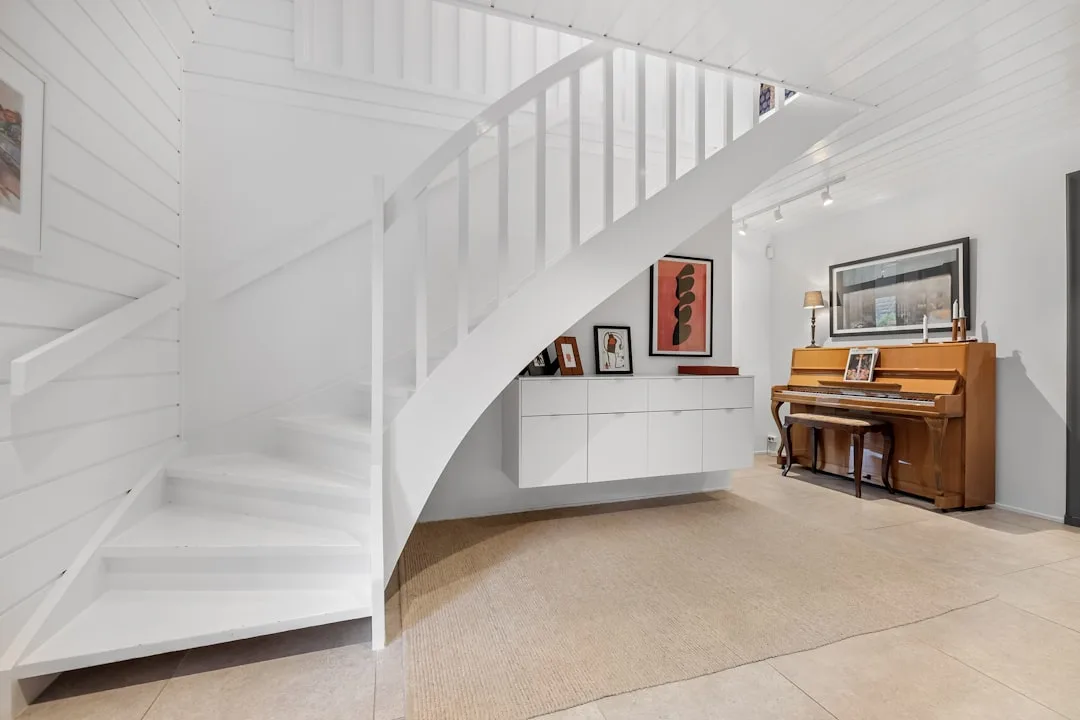
Most people look at the angled ceiling and the irregular footprint and immediately categorize the under-stair cavity as unusable. It’s a mental shortcut that costs real money. That 30-to-70-square-foot pocket is structurally comparable to a dedicated walk-in closet — the kind that adds a documented premium to resale price when it appears on a listing.
The opportunity cost of treating this space as a dumping ground is now higher than it’s ever been. Remote and hybrid work arrangements didn’t just change how people work; they changed which rooms in a house carry weight. A spare bedroom that functions as a home office is worth more than one that doesn’t. But spare bedrooms are a finite resource, and converting one to an office comes with real costs — both financial and practical, since it reduces bedroom count in the eyes of every future buyer.
Under-stair buildouts occupy a different category entirely. They require no change in bedroom count, rarely trigger permit requirements in most U.S. jurisdictions, and can be executed for a fraction of what a room addition costs. The American Institute of Architects’ Home Design Trends Survey has consistently placed dedicated home office space among the top three most-requested features in residential remodels since 2020 — and the under-stair cavity is the most logical answer for homes that don’t have a spare room to sacrifice.
What I kept seeing in client homes was this: the nook had been visually dismissed because nobody had framed it as a room. Once you frame it as a room — once you treat its angled ceiling as an architectural feature instead of an obstacle — the decisions become clearer. The best home office under stairs ideas all share one trait: they start by respecting the geometry rather than fighting it.
Your first action: Measure your cavity today. Write down three numbers — floor footprint, height at the tallest point, height at the shallowest point. Everything else follows from those three measurements.
What to Do With the Space Under My Stairs — and What Actually Fits There
Before you start pulling inspo images, you need to know what your staircase geometry actually permits. Not every under-stair cavity is a candidate for the same configuration — and this is where most design content fails people, because it shows beautiful finished photos without disclosing which stair types made them possible.
Straight-run staircases are the most forgiving. They typically yield 48 to 60 inches of usable desk run with a consistent linear depth. The ceiling slopes gradually from front to back, which means you can plan shelving at the open end where clearance is greatest and closed storage at the back where it tapers. L-shaped and winding staircases create irregular ceiling heights that almost always require custom solutions — but they also tend to produce two distinct alcoves that can be assigned separate functions.
The functional threshold — the point below which a cavity stops being a useful work zone and starts being an elaborate closet — sits at roughly 24 inches of clear floor depth and 60 inches of ceiling height at the tallest point. Below that, you’re in storage territory. Above it, you have options.
A standard under-stair cavity in a home with nine-foot ceilings typically yields 72 to 84 inches of clearance at the open end, tapering to 18 to 24 inches at the back. That dimensional profile is more than enough for a seated workstation with overhead shelving at the tall end. Here’s how that translates into real configurations — and these are among the most practical home office under stairs ideas you’ll find anywhere because they account for geometry first:
- Full built-in desk workstation — best for straight-run stairs with 48+ inches of depth
- Phone booth or video call nook — ideal for shallower cavities where you only need to fit a person, a chair, and a light source
- Reading alcove — works in any geometry; needs only a narrow bench, a light, and clear sightlines
- Podcast or recording corner — the irregular walls and enclosed shape actually provide natural sound dampening, which is an acoustic benefit most people overlook
- Standing-desk nook — requires only 24 inches of depth and 78+ inches of clearance at the front; suited for very shallow, tall-fronted cavities
- Dual-monitor editing station — works in cavities with 54+ inches of depth; the side walls give you natural monitor-arm anchor points without requiring a wall mount
- Compact filing and call station hybrid — a shallow depth paired with a fold-down desk surface; particularly useful when the cavity sits adjacent to a main living area and needs to disappear at the end of the workday
What doesn’t fit: anything that requires you to recline, turn around frequently, or use a rolling chair with full swivel range. The geometry won’t forgive it.
Your first action: Identify which stair type you have — straight-run, L-shaped, quarter-turn, or winding — and eliminate the configurations that require geometries you don’t have before you spend a single dollar on furniture research.
The Lighting Problem Every Competitor Mentions — and the Layered Fix They Never Explain
Every article about under-stair offices says the same thing: “add lighting.” That’s technically accurate the way “eat better” is technically accurate dietary advice. The under-stair cavity has a specific lighting problem — not just darkness, but directional darkness, where light enters only from one open face and leaves everything behind it in shadow. A single desk lamp doesn’t solve that. It creates one lit circle and leaves the rest of the space looking like a crime scene.
The fix I’ve used in real buildouts is a three-layer system, and each layer does a specific job that the others can’t.
Layer one — ambient base. Recessed LED puck lights or a shallow flush-mount fixture positioned at the peak of the cavity address the cave problem without consuming any of the vertical clearance that makes the space functional. This is non-negotiable. If you skip it and rely on task lighting alone, every video call you take will look like you’re broadcasting from a bunker.
Layer two — task lighting. An articulated monitor arm light — the BenQ ScreenBar is the most practical option I’ve found at around $109 — mounts directly to the top of your monitor and throws light downward onto your work surface without taking up any desk footprint. It also eliminates screen glare that standard desk lamps create when positioned at eye level inside an enclosed space.
Layer three — perimeter fill. Warm LED strip lighting tucked along the sloped ceiling edge or the back wall edge eliminates the hard shadow line that makes under-stair offices feel cramped on camera. This isn’t decorative; it’s functional. The strip should sit behind a diffuser channel — the aluminum extrusion kind, not bare tape — so the output reads as a soft wash instead of a string of visible dots. Budget around $40 to $80 for a quality channel kit covering a six-foot run.
Together, these three layers cost less than $300 total and solve a problem that a $1,500 pendant fixture positioned at the wrong angle cannot.
Bulb temperature matters more here than in any other room. In an open room, you can mix 2700K and 4000K sources and the eye compensates. In a cavity this enclosed, inconsistent color temperatures read as visual noise. Set everything to 3000K — warm enough to feel residential, cool enough to keep you alert during a three-hour focus block.
Ventilation, Acoustics, and the Two Details Everyone Gets Wrong
Most home office under stairs ideas stop at the desk and the lighting. The buildouts that fail — the ones that get abandoned after six weeks — almost always fail because of two overlooked physical problems: heat accumulation and echo.
Heat accumulation is a direct function of enclosure. Every piece of electronics running inside a cavity generates heat that has nowhere to go. A single laptop running for four hours in an unventilated under-stair space can raise ambient temperature by 8 to 12 degrees Fahrenheit above the room outside it. That’s uncomfortable at best and damaging to equipment at worst.
The fix is straightforward but must be planned before the buildout is finished:
- Install a small USB-powered or 12V inline fan at the back high corner of the cavity, exhausting into the adjacent wall cavity or a vented soffit — not back into the room
- Leave a minimum one-inch gap at the base of any enclosure panels or doors to allow passive air intake from the room
- Never place your router or NAS drive inside the cavity without a dedicated ventilation path; both generate sustained heat that degrades hardware lifespan
Echo and acoustic harshness are the second failure point. The under-stair cavity is essentially a resonant box — parallel hard surfaces on the sides, a hard floor, and a sloped ceiling above. Human voice frequencies bounce between those surfaces in ways that make recorded audio and video calls sound noticeably worse than they would in an open room.
The most effective acoustic interventions for this specific geometry, ranked by cost-to-impact ratio:
- A fabric panel on the back wall — a stretched canvas or acoustic foam panel covering 40% of the back surface breaks up the primary reflection path; cost around $30 to $80
- An area rug with a pad underneath — eliminates floor reflection; budget $50 to $150 for a rug sized to the footprint
- Open bookshelves with irregular objects — books, plants, and objects of varying depth scatter sound rather than reflecting it cleanly; cost is effectively zero if you already own the objects
- Curtain or fabric panel at the open face — closing off the front with a heavy curtain during calls can reduce room bleed-in from the rest of the house by a measurable amount; particularly useful in open-plan homes where kitchen noise travels freely
None of these require professional acoustic treatment. The goal isn’t a recording studio — it’s a call environment that doesn’t make you sound like you’re inside a cardboard box.
Storage Integration That Doesn’t Eat Your Workspace
The instinct when finishing a home office under stairs is to maximize storage. That instinct is mostly right — but the execution is where most buildouts go wrong. Overhead shelving placed too low destroys the headroom that made the space viable. Cabinets placed too deep block the knee clearance that makes the desk comfortable for more than 20 minutes.
The proportions that work consistently across different cavity sizes:
- Desk surface height: 28 to 30 inches from floor — standard, but critical to verify against your chair height before cutting anything
- First overhead shelf: minimum 18 inches above desk surface; 24 inches is better if clearance allows
- Shelf depth at the open end: 12 inches maximum — deeper shelves at the front create a visual ceiling that triggers claustrophobia faster than the actual sloped ceiling does
- Cabinet depth at the taper: match it to whatever clearance remains; a 6-inch-deep cabinet at the back of a tapered cavity is more useful than a 12-inch cabinet that forces you to crouch every time you retrieve something
Pull-out drawers built into the desk base outperform wall cabinets in this geometry every time. They keep the sightlines open, they don’t require you to stand or turn to access them, and they add structural rigidity to a floating desk surface that might otherwise flex under monitor weight.
If you need a printer in the space, put it on a pull-out shelf, not on the desk surface. A standard inkjet occupies roughly 18 by 14 inches — that’s one-third of a modest desk run gone before you’ve set down a notebook.
FAQ
How much does it cost to convert an under-stair space into a home office?
The range is wide because the variables are wide. A basic conversion using flat-pack furniture, peel-and-stick lighting, and a few shelves can come in under $500. A fully custom built-in with integrated lighting, closed cabinetry, and electrical work typically runs $3,000 to $8,000 depending on your market and the complexity of the stair geometry. The most common mid-range buildout — custom desk surface, two overhead shelves, recessed lighting, and a single electrical outlet added — lands between $1,200 and $2,500 when done by a finish carpenter.
Do I need a permit to build a home office under my stairs?
In most U.S. jurisdictions, cosmetic buildouts — adding shelving, a desk surface, and lighting — don’t require permits. The trigger points are typically structural changes (removing stair framing), new electrical circuits (rather than extending an existing one), and HVAC modifications. If your buildout involves any of those three elements, pull the permit. It protects you at resale and ensures the work is inspected.
What’s the minimum space needed to make an under-stair home office work?
The practical minimum is 24 inches of clear floor depth and 60 inches of ceiling height at the tallest point. Below those thresholds, you’re looking at storage rather than a functional workspace. The sweet spot that allows a comfortable seated workstation with meaningful storage is 36 inches of depth and 72 inches of clearance at the open end — dimensions that most straight-run staircases in homes with standard nine-foot ceilings will meet.
How do I handle the lack of natural light in an under-stair office?
You don’t replicate natural light — you compensate for its absence with layered artificial lighting and deliberate color choices. Paint the interior walls and ceiling in a warm white with an LRV (light reflectance value) above 80; this bounces light further into the space than any mid-tone or dark color will. Then apply the three-layer lighting approach described above: ambient base at the ceiling peak, task lighting at monitor level, and perimeter fill along the sloped edge. Mirrors used strategically on the side walls can amplify the perceived brightness without adding any electrical load.
Can I add an under-stair home office without doing a full built-in?
Yes, and for many households a non-permanent solution is actually smarter. A floating desk surface on heavy-duty wall-mounted brackets, a set of open shelves on adjustable standards, and plug-in LED puck lights can replicate 80% of the functional result of a full built-in at 20% of the cost. The tradeoff is storage density and finished appearance. If you’re renting, if your household needs are likely to change in the next two years, or if you want to test the configuration before committing to a permanent buildout, the modular approach is the more practical starting point among all home office under stairs ideas.