
The single measurement most homeowners get wrong is not which curtain to buy — it is where to put the rod, and getting it even four inches too low can make an entire living room feel smaller than it is. Understanding living room curtain height rules is the difference between a space that looks finished and one that quietly underperforms no matter what else you do right. That gap between “looks fine” and “looks right” is almost always a vertical one. Not color. Not fabric. Not even the furniture underneath it. The rod height.
Quick Answer
The single measurement most homeowners get wrong is not which curtain to buy — it is where to put the rod, and getting it even four inches too low can make an entire living room feel smaller than it is.
I spent eleven years doing this professionally, and the curtain conversation happened in nearly every client home I walked into — not because people had bad taste, but because nothing in mainstream retail prepares you for the actual math involved. You buy panels, you buy a rod, you put them up near the window, and then something feels off and you can’t name it. This article names it.
The Real Reason Curtain Height Matters More Than Style
In This Article

Most design mistakes are recoverable. You buy the wrong throw pillow, you swap it out. You pick a rug that’s too small, you sell it and try again. Curtain height is different — because fixing it means taking everything down, patching or repainting the wall where the old bracket holes were, and starting over. I’ve had clients live with bad curtain placement for three years because the fix felt too disruptive. That’s how sticky this mistake is.
The deeper problem is that wrong height doesn’t just look off on its own. It undermines every other decision in the room. A beautiful sofa looks squat when the curtains behind it are hanging at window-frame level. Art that’s properly scaled to the wall suddenly looks cramped. Even decent lighting suffers — low curtains chop the room horizontally, and your eye reads the space as a box rather than a volume.
Research in environmental psychology has documented that vertical lines increase a room’s perceived ceiling height. Curtains hung close to the ceiling are doing real perceptual work — they’re not decorative in any superficial sense, they’re architectural. When they terminate at the window frame instead, you lose that vertical line entirely. What you get instead is a fabric rectangle floating in the middle of a wall, which reads as furniture, not as architecture.
The interaction between rod placement and everything else is also something beginner guides consistently underweight. Fabric weight changes how the vertical line reads — a heavy velvet panel hung four inches too low looks even more compressed than a linen one would, because the eye registers its mass before it registers its movement. Rod placement also interacts with window trim in ways that matter: if your window has deep exterior casing, a rod mounted flush to the trim rather than near the ceiling will visually merge with the window unit and disappear rather than frame the space.
One client — an apartment in Wicker Park, nine-foot ceilings — had curtains hanging two inches above the window frame. The room was 14 by 18 feet. It felt like a hallway. We moved the rods to within three inches of the ceiling, kept every other element identical, and the room read as genuinely large for the first time.
Here is what curtain height affects in concrete terms — this list is longer than most guides acknowledge:
- Perceived ceiling height: The vertical line of a full-length panel signals “tall room” to the eye before any conscious measurement happens.
- Sofa scale: A low rod visually compresses the wall behind a sofa, making the sofa look wider and heavier than it is.
- Window size: Rods mounted well above the frame and extended past the frame on both sides make windows appear dramatically wider and taller — a detail that matters enormously in older homes with small original windows.
- Natural light: Wider rod extensions mean panels stack away from the glass when open, letting more daylight into the room without the fabric eating into the window opening.
- Art placement: Rooms with low curtains tend to have walls that feel choppy — the fabric interrupts the wall plane in a way that makes hanging art at the right height harder to calibrate.
- Overall room proportion: A room where verticals are emphasized reads as better proportioned even when the actual square footage hasn’t changed.
Takeaway: Before you buy a single panel or rod, resolve where the bracket is going. Everything else follows from that decision, not the other way around.
What Height Should Curtains Be in a Living Room? (The Actual Answer, Not the Vague One)

Here’s the problem with the standard advice. The “hang 4 to 6 inches below the ceiling” rule was calibrated for nine-foot ceilings, which are common in homes built since the 1990s. Apply that rule to an eight-foot ceiling and you’ve just burned two to four feet of your visible panel on blank wall above the window. Your curtain panels end up looking stunted — shorter than they should be, heavier than they feel, disconnected from the floor.
The ceiling height changes the formula, and the formula changes per room. Applying living room curtain height rules correctly means adjusting for your specific ceiling height rather than borrowing a one-size guideline from a context that doesn’t match your space. Here’s how I’d think about it:
- 8-foot ceilings: Mount the rod 1–3 inches below the ceiling or crown molding. No more. You cannot afford wasted wall space here, and a smaller gap reads as intentional rather than timid.
- 9- to 10-foot ceilings: The standard 6–8 inch drop below the ceiling works. This is the scenario the rule was designed for. Follow it.
- Vaulted or 11-foot-plus ceilings: Stop chasing the ceiling. In very tall rooms, mounting a rod eight or ten feet up creates a floating, isolated effect — the curtains look tacked to a cliff. Align your rod with the top of the window trim, or no more than 8–10 inches above it, and let the room’s height speak for itself.
Floor clearance is equally non-negotiable:
- ½-inch float: The clean, practical option. Panels hover just above the floor. Easy to clean underneath. Looks intentional in casual, family-use rooms.
- 1-inch break: Slightly more tailored. The fabric just grazes and breaks slightly at the hem. Most common in living rooms that aren’t formal but aren’t purely functional either.
- 3–6 inch puddle: Formal spaces with anchored furniture arrangements where nobody’s regularly moving the panels. Not for renters. Not for households with dogs.
The critical calculation that most people skip: standard retail panel lengths run at 63, 84, 95, 108, and 120 inches. Knowing your floor-to-rod distance before you order prevents the most common length mistake, which is buying a panel that almost reaches the floor — that “almost” looks worse than either a full break or a deliberate float.
How to measure before you order — step by step:
- Decide where the rod will sit (ceiling-adjacent, or above window trim based on the ceiling height guidance above).
- Measure from that rod location down to the finished floor — not the subfloor, not a threshold, the finished surface.
- Subtract the clearance you want (½ inch, 1 inch, or 3–6 inches for a puddle).
- That final number is your required panel length.
- Match it to the nearest standard size, always rounding up rather than down if you’re between sizes — you can hem a panel, you cannot add fabric.
- If no standard size fits within a reasonable margin, order custom or plan to hem.
Takeaway: Measure from the floor up to your intended rod location before you open a single product page. That number — not the window frame, not the ceiling — is your starting point for every other decision.
Rod Width: The Height Mistake Nobody Talks About
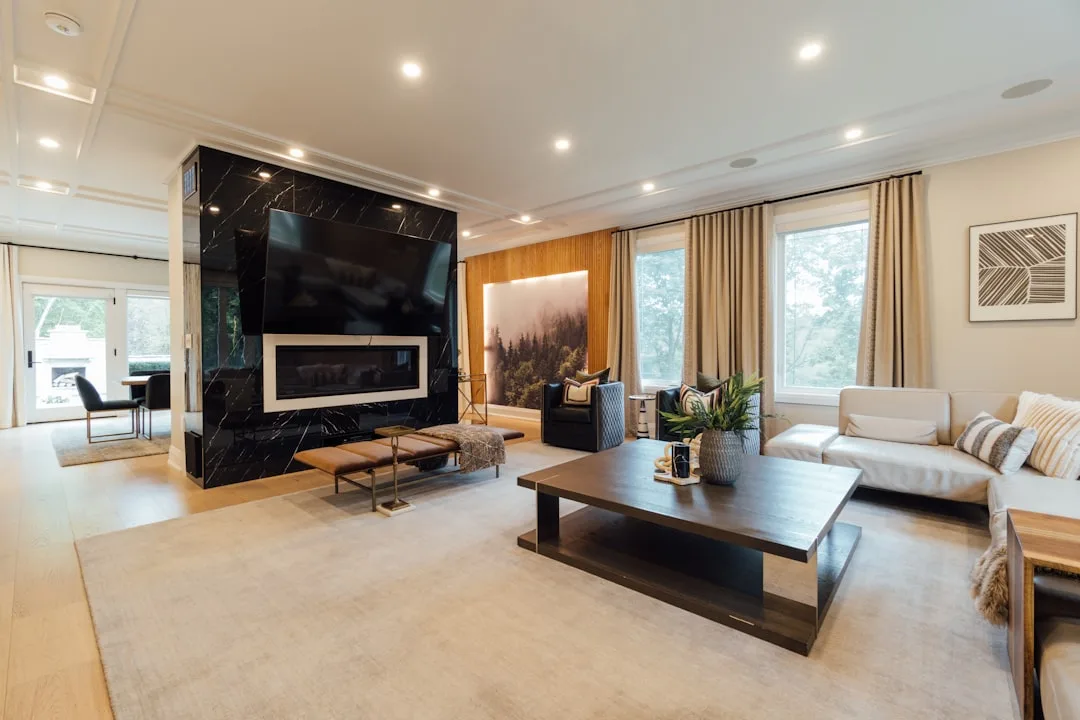
Most guides treat rod width as an afterthought — something you figure out after the height question. That’s backwards. Rod width and rod height work together, and getting the width wrong can undo a perfectly placed height decision.
The standard recommendation is to extend the rod 6–12 inches past the window frame on each side. That’s a reasonable baseline, but here’s the logic behind it: when panels are pushed open, they need somewhere to stack that isn’t blocking the glass. If the rod only extends to the edge of the trim, the stacked fabric will always eat into the window opening. Natural light suffers. The window looks smaller than it is.
In a living room context, where window light is usually doing real work in the space, this matters more than people expect. Consider these guidelines:
- Narrow windows (under 36 inches wide): Extend 10–14 inches past the frame on each side. This also visually widens the window, which benefits rooms that feel closed-in.
- Standard windows (36–60 inches wide): 8–12 inches past the frame on each side. Standard advice applies here.
- Wide windows or picture windows (60 inches and up): 6–8 inches is sufficient — the window is already reading as large, and extending too far will make the rod feel disconnected from what it’s meant to frame.
- Window walls and sliding doors: Use a ceiling-mounted track system rather than a traditional rod. Extensions don’t apply in the same way — the track runs the full width of the wall.
The rod extension decision also affects how much fabric you need. Wider rods require either more panels or wider panels to achieve proper fullness across the full span. A rod that extends 12 inches past the frame on each side has 24 inches more horizontal distance to cover than one mounted at the trim — a detail that shows up in underfilled, flat-hanging curtains when people skip the math.
A quick check before you order panels: Total rod width minus stacked panel width on each side equals usable open window width. If that number is less than your actual glass width, your panels will always partially block the window even when “open.”
How High to Hang Curtains in 2026 — What Has Actually Changed
Some curtain rules are timeless. Others belong to a specific moment. Knowing which is which matters, especially if you’re making a purchase that’s going to stay on the wall for five-plus years.
Ceiling-mount rods have gone mainstream. This was an editorial and hotel-design trick for years — a track or rod mounted directly into the ceiling, panels falling straight from above. Drapery hardware brands have been releasing ceiling-track systems at accessible price points since about 2022, and searches for “ceiling mount curtain rod” grew significantly from that year through 2025. In 2026, this is no longer a renovation-budget-only move. It’s showing up in apartments and modest living rooms. The effect is genuine — it’s the maximum possible vertical line, and in rooms with eight- or nine-foot ceilings, it can transform the spatial reading of the entire wall.
Other shifts worth noting for 2026:
- Linen and textured weaves have overtaken smooth polyester as the dominant living room panel choice, and they behave differently on the rod. Linen hangs loosely at first and needs time to relax into proper vertical drape — if you’re judging placement too soon after installation, give it a week before making adjustments.
- Quiet, neutral hardware is the current default. Matte black rods dominated 2019–2022. Brushed brass had its moment through 2024. In 2026, the preference has shifted toward hardware that disappears — ceiling tracks, tension systems, and slim oval rods in warm silver or off-white that don’t compete with the fabric.
- Double rods for layering sheers and panels remain popular but have a specific living room curtain height rule implication: the sheer rod and the panel rod create two separate horizontal lines when both are visible. Mounting them too low doubles the chopping effect. Both rods should sit close to the ceiling, not just the outer one.
- Thermal and blackout linings have improved enough that you no longer have to choose between light control and a panel that hangs well. Earlier blackout linings were stiff and made panels bunch awkwardly — current options are softer and don’t fight the fabric the way older versions did. This matters for height because a panel that doesngs’t hang cleanly won’t make the most of a properly placed rod.
What hasn’t changed, and shouldn’t:
- Panels that don’t reach the floor still look unfinished. That rule is permanent.
- The visual compression caused by low rod placement is not a style preference — it’s a spatial fact. No trend overrides it.
- Living room curtain height rules calibrated to your specific ceiling height will always outperform any generic guideline you read on a product listing.
Common Mistakes and How to Avoid Them
Even with good intentions and a measuring tape, certain errors come up repeatedly. Here are the most common ones, and the specific fix for each:
Hanging the rod at window-frame height
- Why it happens: Most curtain rods come packaged with instructions that reference the window frame as the mounting point. Hardware packaging is not design advice.
- The fix: Ignore the frame as a reference. Your mounting point is determined by ceiling height, not window location.
Buying panels without measuring first
- Why it happens: Retail panels come in standard lengths that look approximately right in the store or online. The floor-to-rod measurement gets skipped.
- The fix: Measure first, always. The floor-to-rod distance is the only number that matters when selecting panel length.
Choosing panels that are exactly floor length
- Why it happens: The math seems clean. 96-inch ceiling, 96-inch panel.
- The fix: Account for the rod and ring height. If your rings add 1.5 inches, your 96-inch panel now hangs at 97.5 inches from the ring — which may be just enough to puddle awkwardly on a floor where you wanted a float.
Installing the rod too close to the window on vaulted ceilings
- Why it happens: The “hang near the ceiling” rule gets applied without adjustment for ceiling type.
- The fix: On vaulted or very high ceilings, use the top of the window trim — not the ceiling peak — as your reference. Add no more than 8–10 inches above trim height.
Using too few panels for the rod width
- Why it happens: Panel count is calculated based on window width, not rod width.
- The fix: Calculate fullness based on total rod width. For gathered or pleated panels, you want 2–2.5 times the rod width in total fabric. For flat panels, 1.5 times is the minimum.
Mismatched left and right panel lengths
- Why it happens: Floors aren’t always level, and bracket heights can vary slightly between installation points.
- The fix: After installation, hang a level across the rod and measure from the rod to the floor at multiple points. Adjust bracket height if needed before hemming anything.
FAQ: Living Room Curtain Height Rules
Q: What is the standard curtain height for a living room?
There is no single standard — the right height depends on your ceiling. The most widely applicable living room curtain height rule is to mount the rod within 4–8 inches of the ceiling for 9- to 10-foot ceilings, and within 1–3 inches for 8-foot ceilings. The consistent rule across all ceiling heights is that panels should reach the floor. Any option shorter than floor-length reads as unfinished in a living room context.
Q: Is it better to hang curtains high or at window level?
High, consistently. Hanging curtains close to the ceiling rather than at window level increases perceived ceiling height, makes the room feel larger, and gives the panels the vertical run they need to read as architectural rather than decorative. There is no living room scenario where window-level placement is preferable to ceiling-adjacent placement, unless you have an unusually tall ceiling (11 feet or more) where the ceiling mount would create an isolated, disconnected effect.
Q: How far past the window frame should the rod extend?
For most living room windows, 8–12 inches past the frame on each side is the right range. The purpose is twofold: it lets panels stack clear of the glass when open, maximizing natural light, and it makes the window appear wider than it is. For narrow windows in smaller rooms, extending 12–14 inches past the frame can substantially improve the window’s visual presence. For very wide windows or picture windows, 6–8 inches is sufficient.
Q: Can curtains be too long for a living room?
Yes, in practice if not in principle. Puddle-length curtains — panels with 3–6 inches of extra length pooling on the floor — work in formal living rooms with anchored furniture arrangements, but they’re impractical in high-traffic spaces, rooms with pets or children, or any room where the panels are opened and closed frequently. The most forgiving option for most living rooms is a ½-inch float or a 1-inch break, both of which look deliberate without creating a tripping hazard or a dust collector.
Q: Do living room curtain height rules change for apartment renters?
The height principles don’t change, but the implementation does. Most renters can’t patch and repaint walls freely, which makes bracket placement a higher-stakes decision. The practical workarounds are tension rods (which work for lightweight sheers but not heavy panels), adhesive-mount brackets rated for the panel weight you’re using, or — increasingly common — ceiling-track systems that use minimal ceiling attachment points and cause less damage than wall-mounted brackets. Check your lease before any ceiling installation; some landlords prohibit it. For renters committed to proper living room curtain height rules without wall damage, the adhesive bracket category has improved significantly since 2022 and can now support panels up to roughly 30 pounds per bracket pair.
Getting curtain height right is one of those interventions that costs almost nothing extra — the hardware price is the same whether the bracket goes in at the right place or the wrong one — but it affects how the entire room reads, every day, for as long as the panels stay up. The living room curtain height rules outlined here aren’t arbitrary. They’re calibrated to how human perception actually processes vertical space. Measure once, place the bracket correctly, and every other decision in the room gets easier.