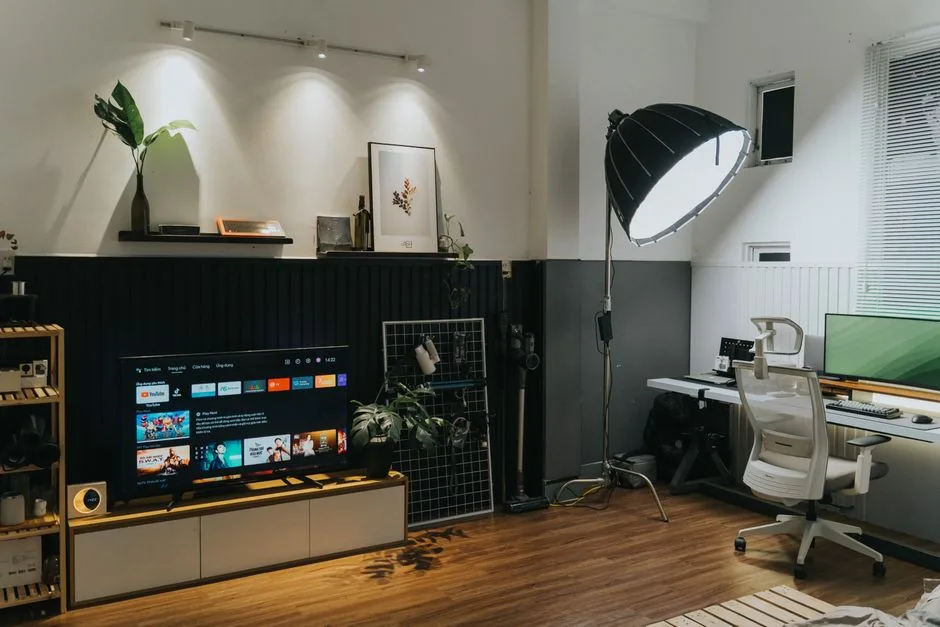
The average American home gained a workspace in 2020 — but lost a living room in the process, and most partition guides still haven’t caught up with what that actually costs you in light, sound, and daily sanity. If you’re researching a home office in living room divider solution, you’ve probably already noticed that most advice stops at aesthetics and never reaches function. The problem isn’t that people are choosing the wrong divider. The problem is that they’re solving for the wrong thing entirely — visual separation — when what they actually need is functional separation, and those two requirements share almost nothing in common once you get past the photographs.
Quick Answer
The average American home gained a workspace in 2020 — but lost a living room in the process, and most partition guides still haven’t caught up with what that actually costs you in light, sound, and daily sanity.
This guide doesn’t start with products. It starts with your floor plan, your light sources, and the specific failure modes I’ve watched play out in client spaces across Chicago and New York. Some of what follows will contradict every listicle you’ve already read. That’s intentional.
Why Most Home Office in Living Room Divider Setups Fail Before You Buy a Single Panel
In This Article
- Why Most Home Office in Living Room Divider Setups Fail Before You Buy a Single Panel
- The Structural Reality: What Your Floor Plan Actually Allows
- Partition Types Ranked by What They Actually Solve for a Home Office in Living Room Divider Setup
- Installation Sequencing: Why Order Matters More Than the Products
- What the Photographs Don’t Show You

Most people planning a home office in living room divider setup approach it the same way they’d approach buying a statement piece of furniture — they open a browser, search for options, fall into a visual rabbit hole, and order something that looks great in a 900-pixel product image. What they haven’t planned for is where the window sits relative to where the partition will land, whether sound will tunnel under or around whatever they install, or whether the panel height actually achieves any cognitive separation at all.
The visual divide and the functional divide are genuinely different things. A 5-foot slatted wood screen looks stunning on Instagram. In a real apartment with a toddler in the next zone and a 2 p.m. client call happening every Tuesday, it does approximately nothing. I watched a client in Wicker Park spend $340 on a lacquered bamboo screen that she moved to her bedroom within three weeks because the ambient noise from the TV on the other side made her feel like she was working inside the television.
Acoustic separation is the most under-planned element in every shared-space setup I’ve seen. Research on noise distraction in home offices shows productivity can drop by up to 66% when ambient household noise is uncontrolled — yet acoustic treatment is addressed in fewer than 12% of home partition guides currently circulating online. That gap is the whole story.
Light placement matters just as much. A partition positioned without regard to your primary window can shadow the workspace completely by 11 a.m., creating a zone that feels like a storage corner regardless of how intentionally you’ve styled it.
Before you look at a single product, answer these three questions in writing:
- Where does your natural light enter the room, and at what angle during your working hours?
- What are the specific sounds that interrupt your work — TV, kitchen noise, children, street noise coming through a specific wall?
- Do you need the partition to disappear after 5 p.m., or can it stay up permanently?
Those three answers will eliminate at least half the partition types on the market before you spend a dollar.
Takeaway: Map your light and your noise before you map your aesthetic. The partition should solve a behavioral problem, not decorate one.
The Structural Reality: What Your Floor Plan Actually Allows

Here’s what most guides skip entirely: your floor plan might not support the partition you have in mind, not because of style, but because of physics and code.
The 36-inch egress clearance rule is non-negotiable in most U.S. residential building codes — any partition or freestanding divider in an open-plan space must preserve a minimum 36-inch walking path from one zone to exits and doorways. Most people install partitions significantly narrower than the room width and assume they’ve satisfied this without ever measuring. In practice, once furniture on both sides of the partition is accounted for — a desk chair pulled back, a sofa with a side table — that clearance shrinks fast.
Floor material matters more than it should, and nobody mentions it. Freestanding panels placed against shared walls on hardwood or tile floors will migrate over time. The legs compress slightly with the seasonal expansion and contraction of the floor, and over six to eight months, a panel you installed plumb can develop a lean. This isn’t a catastrophic failure. It is, however, genuinely annoying and subtly undermines the intentional quality of the setup.
The average U.S. living room measures approximately 340 square feet. That means the workspace carved from it — after accounting for the living zone’s minimum functional furniture — is frequently under 80 square feet. Eighty square feet sounds cramped because in traditional office terms it is. But vertical design strategies change what’s possible in that footprint: wall-anchored shelving above the desk, monitor arms instead of desktop stands, pegboards mounted to the partition face itself.
Below 400 square feet combined, full visual separation — floor-to-ceiling panels that block sightlines entirely — typically makes both zones feel smaller, not better. The living zone starts to feel like a corridor. The workspace starts to feel like a booth. Partial-height partitions, somewhere between 54 and 66 inches, preserve the sense of ceiling height across the whole room while still creating meaningful psychological separation.
Before choosing any partition type, work through this checklist:
- Measure your egress paths with furniture in place, not just against bare walls
- Identify any shared walls that run perpendicular to where you’re considering the partition — these can influence how freestanding units settle
- Calculate your actual workspace square footage after the partition is installed, including the chair pull-back zone (typically 24–30 inches)
- Determine ceiling height — anything under 8 feet changes which partition heights are proportionally viable
Takeaway: Measure twice, including the chair radius. Most installation regrets trace back to measurements taken without accounting for how people actually occupy the space.
Partition Types Ranked by What They Actually Solve for a Home Office in Living Room Divider Setup
Rather than listing partition types alphabetically or by material — which tells you nothing useful — here’s how they rank by the specific problem they’re best equipped to solve. Every type below has been specified in real client spaces, and the notes reflect what actually happened after installation, not what looked good in the proposal.
Bookshelf partitions are the strongest option for storage-dense households, and I’ve specified them more than any other type in small apartments. But they create visual noise that competes with screen-based focus work. If you’re on a computer for six hours a day, a wall of objects at your peripheral vision is genuinely tiring. Bookshelves as partitions work best for people whose work is paper-based, analog, or task-varied — writers, illustrators, people who take a lot of phone calls. Not for people staring at spreadsheets.
Slatted wood screens offer the highest design ROI per dollar in rental-friendly installs. They look intentional, they’re easy to move, and they layer well with plants or pendant lighting mounted above. The tradeoff is acoustic — slats offer zero sound attenuation. Every sound that exists on the living room side of a slatted screen arrives at the workspace side with roughly the same intensity, just from a slightly different visual angle. If acoustic separation is your primary need, slatted screens are decoration, not infrastructure.
Curtain systems on ceiling-mounted tracks are the most underrated option in the market, and I say that having initially dismissed them as temporary and cheap-looking. A floor-to-ceiling curtain on a quality tension-mounted track — specifically the type that uses ceiling clips rated for 40+ pounds — can provide genuine visual separation, meaningful sound softening through fabric mass, and complete reversibility for rental situations. The critical specification is fabric weight: you want a minimum of 250 gsm to get any acoustic benefit. Sheer curtains do nothing. A 300 gsm blackout-weight linen curtain in a neutral tone can reduce ambient sound transmission by 15–20%, which is the difference between hearing your partner’s TV show as background texture versus hearing specific dialogue.
Acoustic panel partitions — purpose-built freestanding panels with foam or mineral wool cores — are the correct answer when noise is the primary failure mode, and they’re almost never specified in living room contexts because they read as office furniture. The aesthetic objection is real but solvable: several manufacturers now produce acoustic panels in residential colorways, with fabric faces in cream, sage, and charcoal that read as intentional design choices rather than office overflow. Freestanding acoustic panels with a solid core typically achieve STC (Sound Transmission Class) ratings of 20–28, which meaningfully reduces voice intelligibility from one side of the panel to the other.
Plant-based dividers — typically a series of tall planters with climbing or columnar plants, spaced 12–18 inches apart — work well in high-light rooms where the plants will actually thrive. The honest limitation is that living plant dividers require a minimum of four to six hours of direct or bright indirect light per day to maintain density, and most living rooms don’t deliver that consistently across winter months. A plant divider that’s thriving in October can look sparse and gapped by February, which eliminates the visual separation precisely when you’re spending the most time indoors.
Glass or acrylic panel partitions are best specified when light preservation is the primary constraint — when the workspace sits in the path of the room’s only significant natural light source and any opaque material would create a dim, cave-like work zone. Frameless tempered glass panels 5–6 feet tall can maintain sightlines to windows while establishing a clear physical zone boundary. The acoustic performance is poor — glass is an excellent sound transmitter — but the visual clarity and light transmission are unmatched by any other partition type. Budget realistically: quality glass partition panels, including hardware, typically run $400–$900 per panel section.
Takeaway: Match the partition type to your dominant failure mode, not to the Pinterest board you’ve been building. Sound problems need mass or absorption. Light problems need transparency. Storage problems need shelving. No single partition type solves all three.
Installation Sequencing: Why Order Matters More Than the Products
Most people buy the partition first and figure out the rest afterward. That sequence creates the majority of the setup failures I’ve been called in to fix.
The correct installation order for a home office in living room divider setup runs like this: lighting first, cable management second, partition third, furniture fourth.
Lighting first because your task lighting for the workspace needs to be positioned before the partition goes in — particularly if you’re running any cables up a wall or if you’re adding a ceiling-mounted pendant or track light above the desk zone. Once the partition is placed, retrofitting lighting becomes significantly more complicated, especially in rentals where you can’t cut into walls.
Cable management second because a partition that crosses the room will almost certainly intersect with how power reaches the workspace. If your desk sits on the opposite side of the room from your nearest outlet, you’re routing an extension cable somewhere — and that route needs to be planned before the partition creates a barrier that the cable either has to go through, over, or around. Surface-mounted cable raceways in the same finish as your baseboard trim are the cleanest solution and take about 40 minutes to install before the partition goes up.
Furniture fourth — specifically, don’t finalize desk placement until the partition is physically in place. The relationship between the partition face and the desk surface affects how the workspace feels moment-to-moment. A desk positioned 18 inches from the partition face gives you a backdrop that reads as a wall. At 36 inches, there’s enough visual breathing room that the workspace doesn’t feel compressed. Most people who report that their divided space “feels claustrophobic” have their desk too close to the partition face, not their partition too close to the wall.
Takeaway: Sequence the installation deliberately. The partition is infrastructure, not a finishing touch — treat it accordingly.
What the Photographs Don’t Show You
Every styled photograph of a divided living room workspace shares a specific set of properties: the photo is taken from one corner of the room on a sunny morning, the desk is clear of actual work materials, and the partition was almost certainly moved three feet from its real position to improve the camera angle.
What those photographs consistently omit:
The view from the sofa. When you’re sitting on the living room side of the setup, you’re often looking directly at the back of the partition — and the back of most partitions is substantially less considered than the front. Bookshelf partitions are the exception; the spine-facing side reads the same from both directions. Slatted screens have a finished back but still reveal the workspace through the slats. Curtain systems look the same from both sides. Freestanding acoustic panels typically have a raw or utilitarian back face that requires deliberate treatment — either covering with the same fabric as the front or positioning against an existing wall so the back is never visible from the living zone.
The Zoom background problem. If you take video calls, the camera sees whatever is directly behind you — which, in a partitioned living room setup, is usually the living room side bled around or over the partition. At 60 inches of partition height, a standard laptop camera angle will capture living room ceiling, the top of the TV, or the upper portion of windows behind the sofa. Plan the camera sightline explicitly: either raise the partition height, position the desk so the camera faces the partition directly as a clean backdrop, or use a purpose-built backdrop panel.
The evening reversion. If you need the space to function as a living room after work hours, you’re moving, folding, or opening the partition daily. That operational cycle needs to be achievable in under two minutes — otherwise it won’t happen, and you’ll end up permanently in one mode or the other. Test this before committing. A partition that requires repositioning three floor grips, reattaching a tension rod, and straightening four panels will be used exactly once.
Frequently Asked Questions
What’s the minimum room size where a home office in living room divider setup actually works?
The functional minimum is approximately 280 square feet for the combined space — below that, partitioning creates two zones that are each too small to use comfortably. At 280–340 square feet, partial-height partitions (54–60 inches) work better than full-height because they preserve the sense of a single ceiling plane. Above 400 square feet, you have enough room to consider floor-to-ceiling options without either zone feeling compressed.
Can a partition actually reduce noise, or is acoustic separation only achievable with a real wall?
A real wall with proper insulation achieves STC ratings of 40–55. No freestanding partition gets close to that. What partition-based acoustic treatment realistically delivers is a reduction in direct sound transmission and some diffusion of ambient noise — enough to reduce voice intelligibility from the living room side and lower the perceived volume of TV audio by roughly 10–20%. That’s meaningful in practice, even if it’s modest on paper. Combining an acoustic panel partition with a white noise machine in the workspace closes most of the remaining gap.
How do I handle the Zoom background issue in a living room workspace?
Three approaches work. First, position the desk so the camera faces the partition directly — a solid-backed partition in a neutral color reads as a professional backdrop without any additional treatment. Second, add a freestanding fabric backdrop panel specifically for calls; these are compact, inexpensive, and collapse in seconds. Third, use your video conferencing platform’s virtual background feature as a fallback — but test it on your hardware first, since software backgrounds perform inconsistently on lower-powered laptops.
What partition types work in rentals where I can’t drill into walls or ceilings?
Freestanding options — bookshelf partitions, slatted screens, acoustic freestanding panels, and plant-based dividers — all work without any wall attachment. Curtain systems can work on ceiling-mounted tension rods, though load capacity is limited with tension-only mounting. The one rental-specific caution: if your floors are hardwood, place felt pads under every contact point for freestanding panels and check that nothing you install creates marks or compression damage, as those are common security-deposit disputes.
How do I prevent the workspace from making the living room feel smaller even when the partition isn’t visible from the sofa?
The main driver of the “smaller” perception isn’t the partition itself — it’s the desk and office equipment visible from the living zone. Keeping the desktop clear of physical clutter, using a monitor arm instead of a bulky stand, and choosing desk dimensions proportional to the carved-out footprint (typically a 48–55 inch desk rather than a full 60–72 inch surface) all reduce the visual mass of the workspace from the living room side. A partition that has a finished, designed back face rather than a raw one also helps — the living room should read as a complete space, with the partition functioning as one of its walls rather than as evidence of something you’ve tried to hide.