Getting sconce placement bedroom either side of the bed right is the difference between a reading setup that works every night and two holes in your wall you’ll be patching by spring. The 60-inch rule you keep reading about was designed for a bed that probably isn’t yours — here’s how to figure out the right height for the one you actually sleep in.
Quick Answer
The 60-inch rule you keep reading about was designed for a bed that probably isn’t yours — here’s how to figure out the right height for the one you actually sleep in.
Why Most People Get Bedside Wall Light Positioning Wrong From the Start
In This Article
- Why Most People Get Bedside Wall Light Positioning Wrong From the Start
- Where to Place Sconces on Either Side of the Bed: The Personalized Method
- How to Position Wall Sconces in a Bedroom So They Actually Light What You Need
- Getting Sconce Placement Right on Non-Standard Beds and Room Configurations
- The Wiring Decision Nobody Wants to Make Until It’s Too Late
Standard mattress heights range from 18 to 36 inches from floor to top surface depending on your bed frame, mattress thickness, and whether you’re running a box spring underneath. That’s a 16-inch swing. And yet every third article on the internet hands you a single floor-to-center measurement and tells you to mark your wall with a pencil like the work is done.
It isn’t.
The real problem isn’t that people use the wrong number — it’s that they’re measuring from the wrong surface entirely. Sconce height is relative to your mattress top, not an absolute floor measurement. A floor measurement made sense when beds were more standardized. They aren’t now. Platform beds sit low; beds with box springs and pillow-top mattresses can push the sleeping surface up past 30 inches before you’ve even stacked a pillow.
I watched this go wrong in a Wicker Park apartment I worked in years ago. My client had a storage platform bed — solid wood, no box spring, low-profile memory foam — and she’d used the 60-inch floor rule because that’s what she found online. Both sconces landed so high above her mattress that they lit the ceiling more than her book. We had to patch two sets of holes. Expensive afternoon.
What actually matters during the planning phase:
- Mattress surface height — measure floor to top of your mattress, including any mattress topper
- Your normal seated reading position — the sconce must work for how you actually sit in bed, not how a diagram says you should
- The headboard height — if it’s upholstered and tall, the 60-inch rule may put your sconce directly behind the headboard, which helps nobody
- Pillow stack height — if you sleep propped on two or three pillows, your effective seated eye level is higher than someone who reads flat; account for this before you drill
- Whether you share the bed — a solo sleeper optimizes for one position; a shared bed requires a compromise height that works for two different bodies at two different seated heights
- Swing-arm versus fixed sconce — a fixed sconce commits you to one position permanently; a swing-arm gives you 6 to 10 inches of adjustability after installation, which can rescue a measurement that landed slightly off
Most installation errors are locked in before a single hole is drilled. Someone picks a number from the internet, grabs a tape measure, and skips the ten minutes of sitting in bed and actually thinking about sight lines and arm reach. That planning gap is where regret lives.
Actionable takeaway: Before you touch a drill, sit against your headboard in your normal reading position and have someone hold a book or phone at comfortable reading height. That light source position — relative to your eyes and your arm — is where your sconce needs to live.
Where to Place Sconces on Either Side of the Bed: The Personalized Method
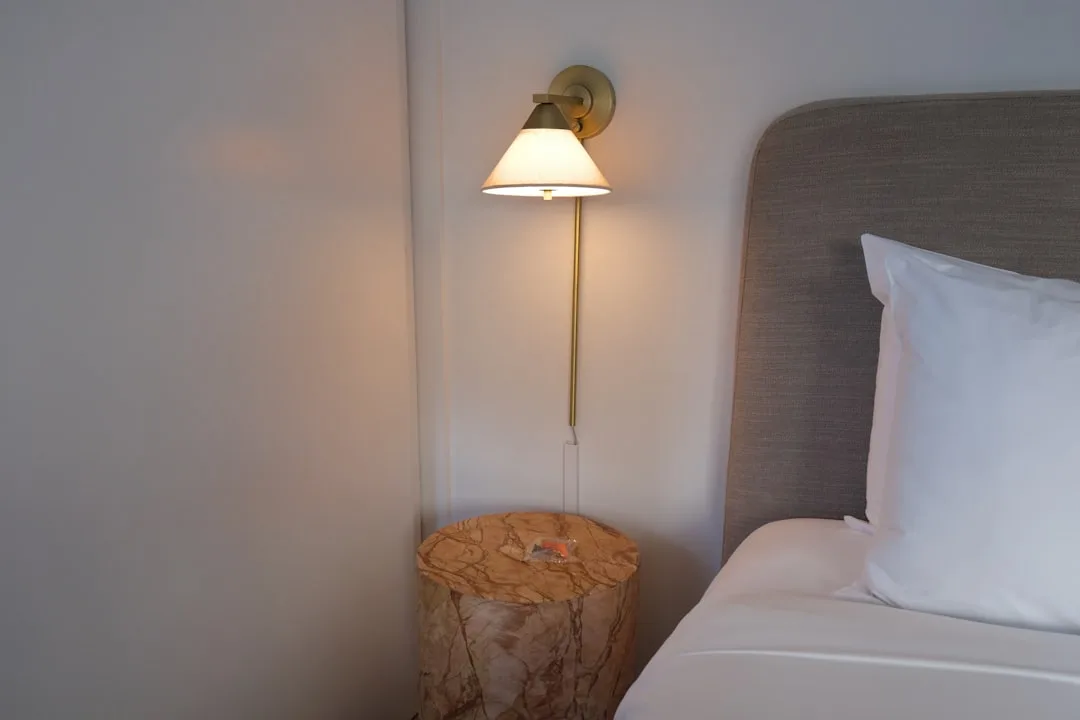
Correct sconce placement bedroom either side requires working from your specific mattress height rather than a universal floor measurement — and the sequence below is how you get there without guessing. Start from your mattress surface — not the floor — and measure up 28 to 36 inches to find the center of your sconce. That range exists because beds vary, and you need to move within it based on your specific setup rather than splitting the difference and hoping.
The seated eye-level test is the single most important check you’ll do. Sit against your headboard exactly the way you read — propped on pillows, maybe a slight slouch, however your body actually goes. The bottom of the shade or the visible light source should clear your eye line by 2 to 4 inches. If it sits at eye level or below, you’ll be staring directly into the bulb every time you look up from your book. That’s not a minor annoyance. It causes eye strain that accumulates over weeks and eventually makes you stop using the lights entirely.
The average American adult has a seated eye level of approximately 44 to 48 inches from the floor — which means on a low platform bed, your 28-inch-above-mattress measurement might put the sconce center at only 46 to 50 inches from the floor. A completely different result than 60 inches, and completely correct for that setup.
Taller beds push the sweet spot closer to 28 inches above the mattress surface because the bed itself has already eaten up the vertical distance. Lower beds — platform frames, futon-style setups, beds without box springs — may need the full 36 inches above the mattress to keep the light usable.
Then do the arm-reach check:
- Sit in bed in your normal position
- Reach toward where the switch or pull chain would be
- You should be able to operate it without leaning out of a comfortable position — if you’re lunging sideways, adjust the horizontal placement before you finalize the vertical measurement
- If the switch is completely unreachable, you’ve placed the sconce for the wall, not for yourself
- On swing-arm models, confirm the arm extends far enough inward to bring the switch within reach before you buy — not all swing-arms have the same extension range
- On hardwired fixed sconces, consider a smart bulb or in-wall dimmer so you’re not reaching for a physical switch at all
A 2023 Sleep Foundation survey found that 68% of adults who read before bed do so in a propped-up, near-vertical seated position — not reclined at a shallow angle. This matters because a lot of sconce placement logic assumes a more reclined posture, which changes the geometry of where light should fall relative to your face and your page.
Horizontal placement matters just as much as height. For sconce placement bedroom either side of a shared bed, center each fixture over its respective sleeping half — typically 6 to 8 inches outward from the edge of each pillow. This keeps the light source close enough to be useful for reading without the beam crossing the centerline and disturbing a sleeping partner. On a standard queen, that puts each sconce roughly 16 to 20 inches from the bed’s center point. On a king, you have more room to work with and can afford to push each fixture slightly further out, which actually improves the reading angle.
Actionable takeaway: Measure your mattress height from the floor right now. Add 28 to 36 inches. That’s your installation range — narrow it down using the seated eye-level test before you commit.
How to Position Wall Sconces in a Bedroom So They Actually Light What You Need

Direction matters more than height. I say this because I’ve seen beautifully positioned sconces — perfect height, correct distance, lovely finish — that were completely useless for reading because the shade sent light straight up into the room and left the book in shadow. Height gets you in the right zone. Light direction determines whether the sconce actually does its job.
Downward-facing sconces create a focused reading cone, which sounds ideal until your partner is trying to sleep six inches away. The beam is concentrated enough that it crosses the centerline of most beds and lands directly on the other person’s face. Fixed downward sconces work well for solo sleepers or for beds positioned against a wall where there’s only one active reading side.
Upward-facing sconces are genuinely beautiful and genuinely useless for reading in bed — not my opinion, just physics. The light bounces off the ceiling and diffuses into the room, which creates lovely ambient mood lighting and approximately zero reading utility. If your goal is atmosphere over function, upward-facing fixtures do that well. If you actually read in bed, they will frustrate you within a week.
Adjustable or swing-arm sconces solve almost every direction problem because you can redirect the light after installation. They’re not always the most architecturally refined option, but they’re the most forgiving — particularly in rooms where two people have different reading habits or where the bed position might shift. The best swing-arm models allow both vertical pivot and horizontal rotation, giving you a full cone of adjustability rather than just one axis of movement.
Here’s how to think about light direction by use case:
- Solo reader, fixed sconce: A directional downward-angled shade aimed at a 45-degree angle toward the book works well; position the sconce slightly toward the center of the bed rather than flush above the pillow edge
- Shared bed, both partners read: Two independently switched swing-arm sconces, each centered over its respective sleeping half, is the only configuration that fully solves the problem
- Shared bed, one reader: A fixed downward sconce on the reading side paired with a soft ambient upward sconce on the non-reading side gives each person what they need without compromise
- Decorative use only: Upward-facing or fully diffused globe sconces work here; just accept that you’ll need a separate task light if you ever want to read
Bulb choice compounds the direction problem in ways most people don’t anticipate. A 2700K warm-white LED in a downward-angled sconce creates a genuinely pleasant reading environment. The same fixture fitted with a 4000K cool-white bulb will feel clinical and harsh regardless of placement. Dimmer compatibility matters here too — a sconce you can dial down to 30% before sleep is a different object than one stuck at full brightness. Not all LED bulbs dim cleanly; check the manufacturer’s dimmer compatibility list before buying, not after.
Getting Sconce Placement Right on Non-Standard Beds and Room Configurations
Most placement guides assume a bed centered on a wall with clearance on both sides. A significant number of real bedrooms don’t look like that, and the standard rules break down in ways that aren’t always obvious until you’re standing there with a drill.
Wall-adjacent beds — where one side sits against or very close to a wall — create an asymmetry problem. The person on the wall side either has no sconce at all, or a sconce mounted so close to the headboard corner that the fixture becomes decorative by default. In these rooms, consider:
- A single centered sconce above the headboard that serves both sides at lower intensity, supplemented by a clip-on task light for the active reader
- A ceiling-mounted reading light on an adjustable arm positioned above the sleeping side that reads
- Accepting the asymmetry and mounting only one bedside sconce on the open side, with a small table lamp solution for the wall side
Low-ceiling rooms compress your vertical options significantly. In a room with 8-foot ceilings, a standard bed, and a tall upholstered headboard, you may find that the correct sconce height — 28 to 36 inches above the mattress — puts the top of the fixture uncomfortably close to the ceiling line, especially if the shade has any upward projection. In these rooms:
- Choose sconces with a low-profile vertical footprint — fixtures under 10 inches tall
- Avoid shades that flare upward; they’ll eat ceiling clearance and create a cramped visual
- Consider a fully horizontal plug-in sconce that mounts flat against the wall with minimal vertical projection
Asymmetric headboards and upholstered walls require extra planning. If your headboard is taller on one side, or if you have a fabric-paneled wall treatment that extends unevenly, the visual relationship between the sconce and the headboard matters as much as the functional height. The sconce should appear to float above the headboard, not disappear into it. A general rule: maintain at least 6 inches of clear wall between the top of the headboard and the bottom of the sconce shade. Less than that starts to look accidental rather than intentional.
Key measurements to document before purchasing any fixture:
- Floor to top of mattress (including topper)
- Floor to seated eye level (measure while actually seated in your reading position)
- Top of headboard to ceiling
- Width of your sleeping half (pillow edge to bed center)
- Distance from the wall to the nearest obstruction on the nightstand side
- Ceiling height at the wall where the sconce will mount
Having these six numbers before you walk into a lighting store — or start scrolling product pages — eliminates most of the guesswork that leads to returns and re-installation.
The Wiring Decision Nobody Wants to Make Until It’s Too Late
Hardwired versus plug-in is a question most people treat as a purely aesthetic one. It isn’t. It’s a commitment question, and making it at the wrong point in the process causes real problems.
Hardwired sconces are permanent. Once the electrician runs wire inside your wall and you patch the drywall, moving the fixture means opening the wall again. This means your placement needs to be correct — not approximately correct, not close enough — before you call the electrician. The seated eye-level test and arm-reach check described above aren’t optional for hardwired installations. They’re mandatory.
Plug-in sconces give you a testing window. Mount them temporarily, live with the placement for two weeks, adjust if needed, then commit. The trade-off is cord management — a visible cord running down the wall to an outlet is a compromise that varies in acceptability depending on your wall finish, outlet placement, and tolerance for visual noise. Cord covers exist and work adequately in most cases, but they’re visible on close inspection and add a small DIY quality to an otherwise considered room.
The practical recommendation for anyone uncertain about placement:
- Start with a plug-in version of the fixture you want, or the closest equivalent
- Use it for at least one week of actual nightly reading
- Note whether you find yourself reaching uncomfortably for the switch, whether the light falls on your book or behind it, whether it disturbs your partner
- Only then finalize the measurement and call the electrician
This process costs you a few extra weeks but eliminates the scenario where you’re patching drywall because a number from the internet didn’t account for your particular body, bed, and reading habit.
FAQ: Sconce Placement Bedroom Either Side
Q: What is the standard height for bedroom wall sconces on either side of the bed?
There is no single correct number, which is why the “standard” keeps causing problems. The functional range is 28 to 36 inches above your mattress surface — not above the floor. On a low platform bed where the mattress top sits at 18 inches, that puts the sconce center at 46 to 54 inches from the floor. On a tall bed with a box spring and thick mattress at 32 inches, the same relative measurement puts you at 60 to 68 inches from the floor. The seated eye-level test narrows this range to the right number for your specific setup.
Q: How far apart should sconces be when placed on either side of the bed?
Center each sconce over its respective sleeping half — typically 6 to 8 inches outward from the outer edge of the pillow on that side. On a standard queen bed (60 inches wide), this puts each sconce approximately 36 to 38 inches from the bed’s centerline. On a king (76 inches wide), each sconce sits roughly 44 to 46 inches from center. The goal is that the light source is close enough to illuminate the page without the beam crossing to the other side of the bed.
Q: Can I put a sconce above a tall upholstered headboard?
Yes, but the relationship between the top of the headboard and the bottom of the sconce matters. Maintain at least 6 inches of visible wall between the headboard top and the bottom of the sconce shade. Less than that and the fixture looks like it’s emerging from the headboard rather than mounted above it. If your headboard is very tall — 60 inches or more — verify that you still have room to achieve your functional placement height without the sconce crowding the ceiling line.
Q: Do both sconces on either side of the bed need to be at exactly the same height?
They should be at the same floor-to-center measurement for visual symmetry, even if the two people sleeping on each side have different heights or reading habits. Visual asymmetry in paired fixtures is distracting in a room where the bed is the focal point. If the two users genuinely need different functional heights — which happens when partners have a significant height difference — swing-arm sconces that adjust after installation are the practical solution. You get symmetrical mounting with individualized positioning.
Q: How do I handle sconce placement if my bed isn’t centered on the wall?
Place each sconce in its correct position relative to the bed, not relative to the wall. The sconces should be symmetrical to the bed, not to the room. If the bed sits closer to one wall than the other, the sconces will appear asymmetrical relative to the wall — that’s correct. Centering the sconces on the wall instead of the bed would put them in the wrong position relative to the actual sleeping surface, which is where the functional problem lives. Trust the bed geometry, not the wall geometry.
Q: What is the standard height for bedroom wall sconces on either side of the bed?
There is no single correct number, which is why the “standard” keeps causing problems. The functional range is 28 to 36 inches above your mattress surface — not above the floor. On a low platform bed where the mattress top sits at 18 inches, that puts the sconce center at 46 to 54 inches from the floor. On a tall bed with a box spring and thick mattress at 32 inches, the same relative measurement puts you at 60 to 68 inches from the floor. The seated eye-level test narrows this range to the right number for your specific setup.
Q: How far apart should sconces be when placed on either side of the bed?
Center each sconce over its respective sleeping half — typically 6 to 8 inches outward from the outer edge of the pillow on that side. On a standard queen bed (60 inches wide), this puts each sconce approximately 36 to 38 inches from the bed’s centerline. On a king (76 inches wide), each sconce sits roughly 44 to 46 inches from center. The goal is that the light source is close enough to illuminate the page without the beam crossing to the other side of the bed.
Q: Can I put a sconce above a tall upholstered headboard?
Yes, but the relationship between the top of the headboard and the bottom of the sconce matters. Maintain at least 6 inches of visible wall between the headboard top and the bottom of the sconce shade. Less than that and the fixture looks like it’s emerging from the headboard rather than mounted above it. If your headboard is very tall — 60 inches or more — verify that you still have room to achieve your functional placement height without the sconce crowding the ceiling line.
Q: Do both sconces on either side of the bed need to be at exactly the same height?
They should be at the same floor-to-center measurement for visual symmetry, even if the two people sleeping on each side have different heights or reading habits. Visual asymmetry in paired fixtures is distracting in a room where the bed is the focal point. If the two users genuinely need different functional heights — which happens when partners have a significant height difference — swing-arm sconces that adjust after installation are the practical solution. You get symmetrical mounting with individualized positioning.
Q: How do I handle sconce placement if my bed isn’t centered on the wall?
Place each sconce in its correct position relative to the bed, not relative to the wall. The sconces should be symmetrical to the bed, not to the room. If the bed sits closer to one wall than the other, the sconces will appear asymmetrical relative to the wall — that’s correct. Centering the sconces on the wall instead of the bed would put them in the wrong position relative to the actual sleeping surface, which is where the functional problem lives. Trust the bed geometry, not the wall geometry.