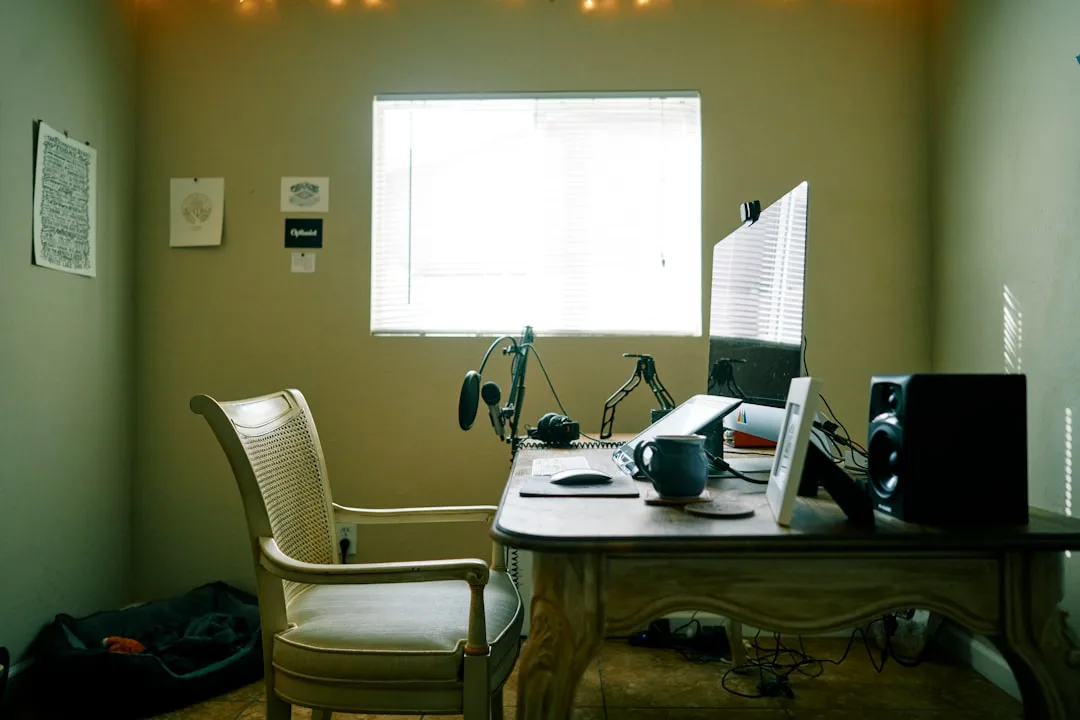
The $40 door sweep does more for a noisy home office than $300 worth of acoustic foam — but almost nobody starts there. If you’re serious about soundproofing a home office cheaply, the first thing to understand is that cheap doesn’t mean ineffective — it means strategic. People buy foam tiles, arrange them in a grid on the wall, and then wonder why they can still hear every word of their neighbor’s phone call. The foam looks like soundproofing. It isn’t. What it does is reduce echo inside your room — which is genuinely useful — but it does almost nothing to stop sound from traveling through surfaces. That distinction is the most important thing you’ll read today, and every dollar you spend before understanding it is probably wasted.
Quick Answer
The $40 door sweep does more for a noisy home office than $300 worth of acoustic foam — but almost nobody starts there.
I spent eleven years doing interiors and the last several of those involved carving out functional home offices from apartments that were never designed for serious work. Studios in Wicker Park with paper-thin walls. Pre-war flats in Brooklyn where you could hear the upstairs neighbor’s Netflix choices. The pattern I kept seeing was this: people had spent money on the wrong things first, felt defeated, and assumed good soundproofing required a gut renovation. It doesn’t. But it does require knowing what’s actually letting sound in before you buy a single product.
Diagnose Your Noise Problem Before Spending a Dollar
In This Article

Most soundproofing advice skips this step entirely. That’s why it fails.
Sound travels in three distinct ways, and each one needs a different fix. Airborne noise — voices, street traffic, your partner’s television — travels through air and passes through surfaces that aren’t dense enough to stop it. Impact noise — footsteps overhead, a dropped weight, bass frequencies from a subwoofer two floors down — travels as vibration through the building structure itself. Flanking noise is the sneaky one: it doesn’t come directly through the wall facing you, it travels around it — through the floor, up through a shared ceiling, around a doorframe, through an electrical outlet on a shared wall. You can treat every square inch of one wall and still hear everything, because the sound is finding the path of least resistance somewhere else.
Here’s a simple test before you spend anything. Stand in your office, close every door and window, and clap loudly once. If you hear a sharp, prolonged ring, you have an echo problem — absorption will help. If you’re primarily bothered by noise coming in, clapping tells you nothing useful. Instead, put your hand flat against different surfaces while the noise is happening. Walls carry vibration you can feel even when they look solid. A door that rattles slightly in its frame is leaking sound from every edge simultaneously.
The data point that should permanently change how you think about this: gaps and cracks in a room can account for up to 90% of sound leakage according to acoustic engineering standards. A door with a gap representing just 1% of its surface area loses roughly half its soundproofing value. Half. Not a small percentage — half. That gap under your hollow-core door isn’t a minor inefficiency; it’s a hole. Every dollar you spend on foam panels before sealing it is a dollar spent on aesthetics, not acoustics.
Common mistakes I’ve watched people make, ranked by how much money they wasted:
- Buying foam panel packs ($80–$150) for a room with no weatherstripping on the door
- Hanging acoustic curtains while leaving an uncovered air gap at the window frame
- Treating the wall across from the noise source instead of the shared wall closest to it
- Addressing the wall while completely ignoring the floor — impact noise doesn’t care about your foam tiles
Start with your ears, not Amazon. Identify whether your noise is airborne or impact, then identify where it enters the room. Only after that should you look at a product.
Takeaway: Do the tap test and clap test before buying anything. Ten minutes of diagnosis will save you hundreds in misdirected purchases.
How to Soundproof an Office Cheaply — Starting With the Door

Your door is the weakest link. Not because doors are inherently bad at blocking sound — though many of them are — but because a door is the only surface in the room that was specifically designed to have gaps in it. Gaps at the bottom, gaps at the sides, gaps at the top. That’s the point. It’s a door. The problem is that sound doesn’t know or care that the gap is there for ventilation.
Hollow-core interior doors are the default in almost every apartment and most residential construction built after 1960. They have an STC (Sound Transmission Class) rating of roughly 20–25. For context, STC 25 means a loud speech is clearly audible and fairly intelligible through the door. STC 35 means loud speech is audible but not intelligible — you hear someone talking but can’t make out words. That difference is enormous when you’re on a client call. Solid-core doors achieve STC 35–45. Replacing a hollow-core door costs $150–$400 plus installation, which is often not possible for renters — but understanding why the hollow door is bad helps you understand why sealing the frame matters so much more than covering the surface.
Here’s what actually works, in order of impact per dollar:
- Door sweep ($10–$25): Seals the gap at the bottom of the door — the largest single gap in most rooms. Automatic door sweeps rise when the door opens and drop when it closes, which makes them easier to live with. This is your first purchase, always.
- Weatherstripping foam tape ($8–$15): Applied to the door frame perimeter, it seals the three remaining sides. Compressible foam tape works for most gaps; if you have an uneven frame, self-adhesive EPDM rubber is more durable.
- Door-frame acoustic seal kit ($25–$50): A step up from basic foam tape — these use compression gaskets rather than foam and hold up significantly better with daily use.
- Heavy curtain over the door ($30–$80): This adds mass to a hollow-core door and is completely reversible. A floor-to-ceiling curtain hung from a tension rod in the doorframe — rather than in front of the door — creates an air gap that adds additional absorption.
Adding a door sweep and weatherstripping to a hollow-core door can realistically add 5–8 STC points without touching the door itself. That’s not nothing. That’s the difference between hearing every word of a conversation and hearing a muffled voice you can ignore.
A client of mine — a freelance attorney working from a one-bedroom in Lincoln Park — insisted her problem was the wall shared with her neighbor’s unit. We spent an afternoon rearranging furniture and adding bookshelves before I noticed the half-inch gap under her office door, which opened directly into the living room where her husband worked from the couch. One door sweep, ten dollars, problem mostly solved.
Takeaway: Buy the door sweep before anything else. If you do nothing else from this article, do that.
What Is the Least Expensive Way to Soundproof a Room?
Soundproofing a home office cheaply is genuinely possible — but only if you work in the right order. The least expensive approach isn’t about finding the cheapest products. It’s about sequencing your fixes so that every dollar does real acoustic work before you move to the next thing.
Here’s the order I give every client who’s working with a tight budget:
1. Seal every gap first (total cost: $20–$65)
Door sweep, weatherstripping, acoustic caulk around baseboards and window frames. Acoustic caulk — also sold as sealant or acoustic sealant — stays flexible after curing, which matters because rigid caulk eventually cracks and opens new gaps. A $7 tube applied around a window frame can do more than a $60 curtain panel hung in front of it.
Check electrical outlets on shared walls while you’re at it. Most people skip this. An outlet box on a shared wall is essentially a hole punched through the drywall with a thin plastic cover. Foam outlet gaskets cost about $5 for a pack of ten and take four minutes to install. They’re not transformative on their own, but they’re part of treating the wall as a system rather than a surface.
2. Add mass to surfaces (total cost: $0–$150 depending on what you own)
Mass blocks sound. More mass, less sound transmission. This is the principle behind mass-loaded vinyl (MLV), which is one of the more effective soundproofing materials available outside of construction — but it costs $1–$2 per square foot and requires installation. Before you buy MLV, look at what you already own. A large bookshelf filled with books placed against a shared wall adds meaningful mass and costs nothing if you already own the books. Floor-to-ceiling bookshelves are the most practical and visually appealing mass-addition strategy for a home office, and a good used bookshelf from a Facebook Marketplace search costs less than a single sheet of MLV.
A large rug with a thick pad underneath addresses impact noise transmission to rooms below you — which matters if you have neighbors downstairs or if you’re sensitive to the sound of your own footsteps during calls. A rug pad specifically designed for sound absorption (not just furniture protection) runs $25–$60 and is one of the better investments per dollar in this category.
3. Treat the windows (total cost: $30–$200)
Windows are the second-largest gap problem after doors. Even a closed single-pane window has an STC of roughly 26–28. The gap between the sash and the frame, and between the frame and the wall, is where the real leakage happens. Rope caulk — a temporary, removable product — can be pressed into window frame gaps and peeled out at the end of a lease. It costs about $5 and is one of the more genuinely underrated products in affordable soundproofing.
Heavy thermal curtains add some mass and absorption, but their real value is blocking the convective air movement that carries sound through imperfectly sealed windows. Look for curtains with a dense woven backing rather than a thin liner — the backing is what does the acoustic work. A curtain rod positioned several inches outside the window frame, with the curtains extending to the floor and well past the window edges on both sides, creates a significantly better seal than a curtain hung exactly at the window edge.
Acoustic window inserts — secondary glazing panels that sit in the window reveal inside the existing window — are the most effective window treatment short of replacement. They run $200–$400 for a single window, which puts them outside the cheap category, but they’re worth knowing about as a ceiling for this approach.
4. Absorb what gets through (total cost: $0–$100)
This is where acoustic foam panels, moving blankets, and soft furnishings actually belong — at step four, not step one. Once you’ve sealed gaps and added mass, absorption helps with what remains: the echo and reverb that make voices on calls sound unclear, and the residual mid-to-high frequency sound that passes through surfaces.
Moving blankets hung on walls are the honest person’s acoustic panel. They’re not attractive, but they work and they’re cheap. A four-pack runs $30–$50 and covers significant wall area. For a client who works entirely on video calls and didn’t want to invest in anything permanent, moving blankets behind the camera line solved the echo problem entirely — which is often more noticeable to the person on the other end of the call than to you.
Acoustic foam panels do have a place — specifically in a room that has been otherwise treated and still has a flutter echo problem. The right foam for home offices is 2-inch wedge or pyramid foam, not the thin decorative tiles often sold in small packs. Thinner foam absorbs high frequencies only; 2-inch foam starts to address mid frequencies where speech intelligibility problems typically live.
Takeaway: The cheapest path to a quieter office is sealing, then massing, then treating — in that order. Skipping to step four first is how people waste money.
The Surfaces Most People Ignore
After doors and windows, these are the surfaces that account for the most unexplained sound leakage in home offices:
HVAC vents and ductwork. A forced-air system creates a direct air channel between rooms — which is acoustically a direct sound channel. If your office shares a duct run with an adjacent room, sound travels freely through the metal duct regardless of what you’ve done to the walls. Acoustic duct liner (installed inside ductwork) is the professional fix, but for renters, the simpler approach is to partially cover the vent with a fabric cover or acoustic vent deflector. You’ll lose some airflow, so this is a tradeoff — but if your primary noise source is an adjacent room with shared HVAC, it’s worth testing.
The ceiling. If you’re on a lower floor, impact noise from above is almost always transmitted through the ceiling, not the wall. Adding mass to a ceiling as a renter is difficult — you generally can’t add drywall layers or resilient channels without landlord permission. What you can do is identify which area of the ceiling corresponds to the noise path and address it with acoustic tiles on a tension system or temporary cloud panels. These are commercially available, require no permanent installation, and run $100–$300 for a ceiling treatment that can be entirely removed.
The floor. For people below you, your footsteps are impact noise. For you, if you’re above a room where music or bass-heavy audio plays, the floor is transmitting low-frequency vibration that foam panels cannot touch. A rug with a proper acoustic pad is the renter’s fix. If you can persuade a landlord, a floating subfloor with acoustic mat underneath is the permanent solution — but that’s well outside the cheap category.
Electrical outlets and switch plates. Already mentioned above, but worth repeating because they’re so frequently skipped: foam outlet gaskets, installed in about thirty seconds each, reduce a small but real path for airborne sound on shared walls.
What Won’t Work (And Why People Keep Buying It)
Egg cartons. The internet refuses to let this one die. Egg cartons have negligible mass and minimal absorption coefficient. They reduce flutter echo marginally in a very live room. They do not block sound from entering a room. The reason people believe they work is that they look vaguely like acoustic foam, and after hanging them people feel like they’ve done something. Confirmation bias does the rest.
Thin foam tiles. The 1-inch decorative foam squares sold in multicolor packs for $25–$40 absorb high frequencies only, and only modestly. They’re the acoustic equivalent of a thin towel trying to block a window draft. They’re not useless — a completely bare room with hard parallel walls will have a flutter echo that these tiles reduce — but they don’t do what most people buy them to do.
Spray foam in wall cavities (DIY). Filling a wall cavity with spray foam sounds logical — foam blocks air, air carries sound, therefore foam blocks sound. The problem is that airborne sound doesn’t primarily travel through the air in a wall cavity; it travels through the drywall itself as structure-borne vibration. Spray foam adds some mass but not enough to matter, and the installation process is invasive and usually not reversible.
Takeaway: If a product looks like it should work based on vibes rather than acoustic principles, it probably doesn’t.
Frequently Asked Questions
Does soundproofing a home office cheaply actually work, or do you need to spend thousands?
It genuinely works, within limits. A $50–$100 investment in a door sweep, weatherstripping, and a basic rug pad will produce noticeable results in most home offices — particularly for reducing airborne noise from adjacent rooms. What budget soundproofing can’t do is match the performance of a professionally treated room with added drywall mass, decoupled walls, and resilient channels. But for the specific goal of making a home office functional for calls and focused work, cheap fixes applied correctly outperform expensive fixes applied in the wrong order.
What’s the single best product for soundproofing a home office cheaply?
A door sweep, every time. It’s the highest impact-per-dollar purchase in this category and it addresses the most common source of sound leakage in residential spaces. If you buy nothing else, buy the door sweep.
Will acoustic foam panels stop my neighbor’s noise from coming through the wall?
No. Acoustic foam panels reduce echo and reverberation inside your room — they absorb sound that’s already inside the space. They do not have enough mass or density to meaningfully block sound traveling through a wall from outside. For that, you need mass (bookshelves, MLV, additional drywall) combined with decoupling or sealing. Foam panels belong in a treated room as a finishing step, not a starting point.
I’m renting — what can I do without losing my deposit?
Quite a lot. Door sweeps attached with screws leave small holes that most landlords consider normal wear; adhesive versions leave no holes at all. Weatherstripping foam tape is removable. Rope caulk in window gaps peels out cleanly. Bookshelves, rugs, and heavy curtains require no installation. Moving blankets hung with removable hooks are fully reversible. The main things renters genuinely can’t do are adding drywall mass, installing resilient channels, or modifying HVAC ductwork — but the renter-friendly options cover the majority of the acoustic problem in most apartments.
How much does it cost to properly soundproof a home office?
The answer depends entirely on what “properly” means for your situation. A functional improvement — enough to hold calls without audible interruption — can be achieved for $50–$150 in most apartments using the sequence described here. A complete acoustic treatment that would satisfy a recording engineer runs $2,000–$10,000 or more depending on room size and construction. Most home office workers need something closer to the first number than the second.