
If you’re searching for christmas decor for small apartment ideas that actually work in real square footage, you’ve probably already noticed that most holiday decorating guides weren’t written with your floor plan in mind. The average apartment is roughly half the size of the home where most of that advice was written — and yet every guide keeps telling you to buy more. More ornaments, more garland, more themed throw pillows in a room that already has four. I spent eleven years helping people make their actual spaces feel good to live in, and the holiday season was always the period when the gap between “decorating advice” and “decorating reality” became most painful to watch.
Quick Answer
The average apartment is roughly half the size of the home where most Christmas decorating advice was written — and yet every guide keeps telling you to buy more.
This article is not that kind of advice. It was written for a 650-square-foot apartment, not a four-bedroom Colonial in Connecticut.
Why Most Holiday Decorating Advice Was Written for Houses, Not Apartments
In This Article
- Why Most Holiday Decorating Advice Was Written for Houses, Not Apartments
- How to Decorate for Christmas in a Tiny Apartment Without Losing Your Floor Plan
- What Is the Best Christmas Tree for a Small Apartment? (It’s Not Always What You Think)
- The Color and Material Choices That Make Small Spaces Feel Festive, Not Crowded
- Room-by-Room christmas decor for small apartment Strategies
- The Storage Problem Nobody Wants to Think About in December
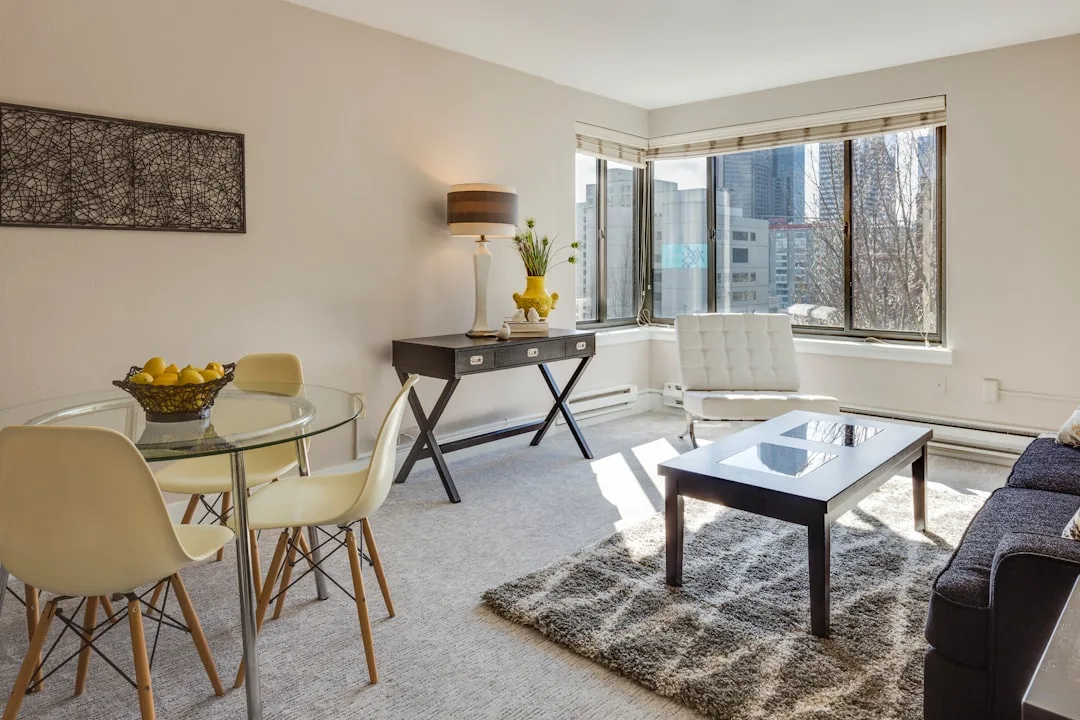
Here’s the structural problem nobody talks about: the economics of holiday content creation favor a broader audience, which means the people producing most of it are targeting the statistical median of American homeownership — not your one-bedroom with the couch six inches from the wall. According to U.S. Census data, the average new apartment unit is under 900 square feet, roughly half the size of the average single-family home. The guides most widely read and shared were almost certainly written with the latter in mind.
The “more is more” instinct in traditional holiday decorating — a wreath on every door, garland on every surface, a tree in the corner and a second one on the porch — is not inherently wrong. It just collapses under the physics of a compact apartment. What creates warmth in a 2,400-square-foot house creates visual chaos in a space a fraction of that size. The issue isn’t taste. It’s scale.
What actually works in a small space is atmosphere over inventory. I had a client in a 480-square-foot studio in Wicker Park who’d bought three tubs of holiday decorations from a big box store the year before we worked together. Her apartment didn’t feel festive — it felt like the decorations were competing with each other for somewhere to land. We cut the display down to nine pieces, total. The space felt more like Christmas after that, not less.
This is the concept of decor density — the ratio of visual impact to physical footprint. A single well-placed wreath with real texture and weight reads as a design decision. Six items on a side table reads as inventory. In compact rooms, every decorative object you place should earn its footprint by delivering outsized atmosphere relative to its size.
The goal this article is working toward isn’t to make your small apartment look like a house with lots of Christmas decorations. It’s to make it feel like the holidays in a way that suits the actual space you’re living in.
Start here: Before you buy a single decoration, define the atmosphere you actually want — warm and minimal? Bright and playful? Nordic and spare? That adjective is your filter for every purchase decision that follows.
How to Decorate for Christmas in a Tiny Apartment Without Losing Your Floor Plan

Most decorating mistakes I’ve seen happen at the hardware store, not at home. Someone buys a 6-foot inflatable snow globe because it looked manageable in the warehouse aisle — it is not manageable in a one-bedroom apartment. The antidote is a footprint audit: a ten-minute assessment of your actual space before you spend a dollar.
Walk through your apartment and categorize every surface into two groups:
- Already working hard: Coffee table, kitchen counter, entryway console, nightstand — surfaces actively used in daily life where adding decor means stacking on top of function
- Underused real estate: Top of the refrigerator, windowsills, a blank wall corner, the top shelf of a bookcase, the wall above a doorframe — surfaces that aren’t doing much and can absorb decoration without disrupting how you live
Interior designers generally hold that a room should have no more than 60% of its surfaces “dressed” at any time to avoid visual clutter — in rooms under 400 square feet, that ceiling drops even further. This isn’t an arbitrary aesthetic rule. It’s the difference between a room that reads as intentionally designed and one that reads as accumulated.
The principle I always gave clients: swap, don’t stack. Replace your everyday cream pillow covers with a deep green or burgundy version. Swap the plain white candle for a balsam-scented one in a similar vessel. Exchange the ceramic vase for one with a holiday motif. You’re not adding objects — you’re rotating them. The physical volume of your space stays constant. This alone eliminates the storage problem most people don’t think about until January.
Use the entry-to-anchor principle to define your two mandatory décor zones. The first is whatever a guest sees within the first five seconds of entering — a front door wreath, a console table vignette, a mat change. The second is the room’s natural focal point: the TV wall, a window, a fireplace if you have one. Decorate those two zones with intention and leave the rest minimal. Every apartment has these two zones. Neither requires square footage.
Scent and light function as invisible décor and are underused in almost every small apartment I’ve ever worked in. A quality candle or diffuser with a cedar, fir, or cinnamon profile does more for holiday atmosphere than most physical decorations — and it takes up the space of a small jar. String lights consume zero floor plan while transforming the quality of a room’s light after dark.
Actionable takeaway: Do the footprint audit tonight, before any shopping. Mark your two mandatory zones and your underused surfaces. Everything else is a background decision.
What Is the Best Christmas Tree for a Small Apartment? (It’s Not Always What You Think)
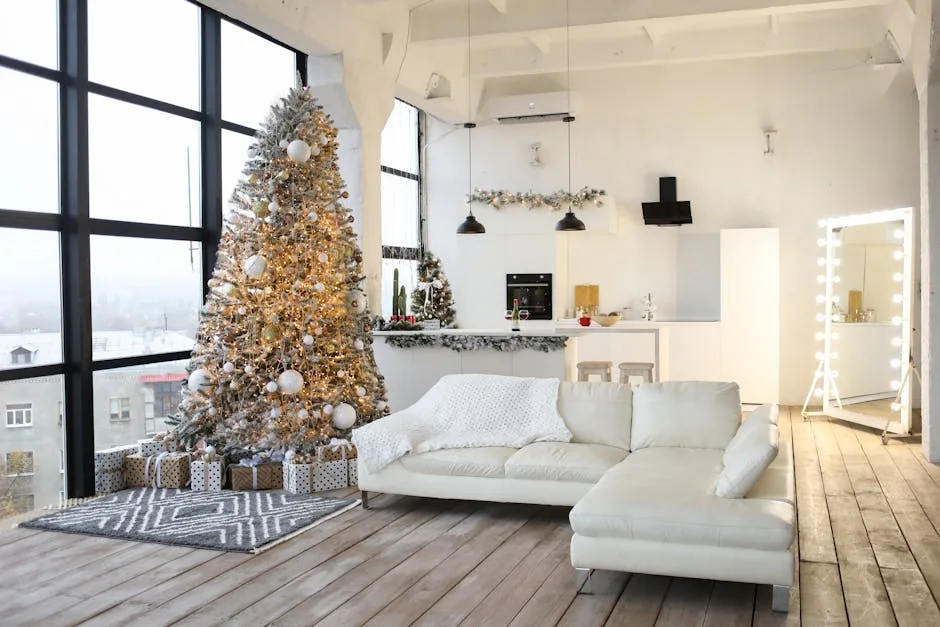
Pencil trees are not always the answer. That sentence will get me some disagreement, but here’s the honest math: a standard slim or pencil Christmas tree marketed as “space-saving” still has a base diameter of 12–18 inches and a visual spread of 24–30 inches once lit and decorated. In a room where your sofa is already 6 inches from the wall, that matters — not just physically, but visually. A 6-foot pencil tree in a 250-square-foot studio does not disappear just because it’s narrow. It commands the room.
There are four options worth actually considering for small spaces, and the right one depends on your specific square footage and layout:
- Tabletop tree (under 3 feet): Underrated and often more proportionate than anything full-height. Placed on a shelf, side table, or raised stool, a 24-inch tree at eye level reads as festive and intentional — often more so than a 6-foot tree crammed into a corner at floor level.
- Slim or pencil tree (under 18 inches wide): Appropriate for apartments in the 400–700 square foot range with a dedicated corner that isn’t serving another function. Pre-lit versions simplify the cord situation considerably.
- Wall-mounted flat tree: A silhouette cut from plywood or purchased as a flat panel, mounted to the wall and strung with lights. Takes up zero floor space. Works especially well in studios where every square foot of floor counts. This is one of the more underrated christmas decor for small apartment solutions because it delivers full visual impact without touching your layout at all.
- Branch or twig arrangement: A few pruned branches from a birch or eucalyptus spray, placed in a tall floor vase and hung with minimal ornaments, functions as a tree analog. The footprint is a single vase base. The visual reads as intentional and editorial rather than compromised.
The question to ask before choosing any tree format is: where will this live, and what is currently happening in that spot? If the answer is “nothing,” you have room. If the answer is “my only reading chair” or “the path to the kitchen,” you’re trading function for decoration — which is a bad trade in a small apartment.
One practical note on storage: a tabletop artificial tree in a 24-inch box stores under a bed or in a closet without the annual January negotiation that a 6-foot tree box requires. For christmas decor for small apartment living, storage math is part of the decorating equation, not an afterthought.
The Color and Material Choices That Make Small Spaces Feel Festive, Not Crowded
Color does a significant amount of structural work in a small room, and holiday palettes can either help or fight your existing space depending on how they’re applied.
The default holiday palette — red, green, and gold — works well in large rooms because the colors have room to separate and read individually. In a compact apartment, the same combination applied broadly can feel like a theme park rather than a home. The fix isn’t to abandon color. It’s to anchor and edit.
Anchor your palette to one existing element in the room. If your sofa is charcoal, burgundy and brass work without fighting the existing furniture. If your walls are warm white, cream and forest green read as natural extensions of the room’s existing tone rather than an overlay. The holiday decoration should feel like it grew out of the room, not landed on top of it.
Materials matter as much as color in small spaces. Shiny, reflective surfaces — mercury glass, metallic tinsel, high-gloss ornaments — multiply light in a small room, which reads as expansive and warm after dark. Matte, heavy materials — chunky knit tree skirts, velvet ribbon, thick wool stockings — add texture and warmth but absorb light, which can make a small room feel smaller if overused. A balance of both is the most reliable approach: reflective elements to open the space visually, textured elements to add the warmth that makes it feel holiday-specific.
Natural materials (real or high-quality faux) — pine, cedar, dried orange slices, cinnamon sticks, birch — tend to age better visually than their plastic equivalents and double as decor outside of Christmas when the holiday-specific elements are removed. A pinecone bowl on a coffee table works in January. A bowl of red plastic ornaments does not.
One palette rule that consistently works in small apartments: choose two colors and one metal. Burgundy and cream with brass. Forest green and white with copper. Navy and ivory with gold. The constraint forces cohesion, and cohesion is what separates “designed” from “decorated” in a tight space.
Room-by-Room christmas decor for small apartment Strategies
The footprint audit gives you a framework. This section gives you the room-specific decisions.
Entryway
In most apartments, this is a strip of floor between the door and the living room — sometimes just a mat and a hook. Work with that reality. A wreath on the front door handles the exterior-facing impression entirely. Inside, a single vignette on a console or a small basket on the floor with a candle and a few pine branches is enough. If you have hooks for coats, a sprig of eucalyptus or fir tied with ribbon to one hook takes thirty seconds and costs under five dollars at a grocery store floral section.
Living Room
This is your highest-impact zone and the room where most christmas decor for small apartment effort should concentrate. Pick your anchor: tree, fireplace mantel, or TV wall. Decorate that anchor with your best pieces. Everything else in the room should support it, not compete with it.
String lights along a window frame or bookcase perimeter do the heaviest atmospheric lifting per square inch of any decoration in this category. They’re on when you’re home, they’re off when you’re not, and they transform the quality of an evening in the room in a way that a wreath on an interior wall simply does not.
Throw pillow swaps and a holiday-adjacent throw blanket are the fastest way to shift the room’s seasonal register without adding any physical volume.
Kitchen
Holiday scent often originates here naturally — candles, stovetop simmers with cinnamon and orange peel — so the decorating work is minimal. A small potted rosemary topiary trimmed into a cone shape sits on a counter, smells like the holidays, and gets used in cooking. A linen dish towel in a seasonal pattern costs under fifteen dollars and swaps back out in January. A small arrangement of dried citrus slices and greenery in a bud vase near the sink takes up four inches of counter space.
Bedroom
The bedroom is where most people over-decorate because they apply living room logic to a room that functions differently. The bedroom should feel restful, and holiday decoration here should stay light. Swap pillow covers to a deeper winter tone — navy, forest green, deep burgundy. Add a single candle with a warm winter scent on the nightstand. If you have a window, a small string of warm white lights along the frame is enough. That’s genuinely all the bedroom needs.
The Storage Problem Nobody Wants to Think About in December
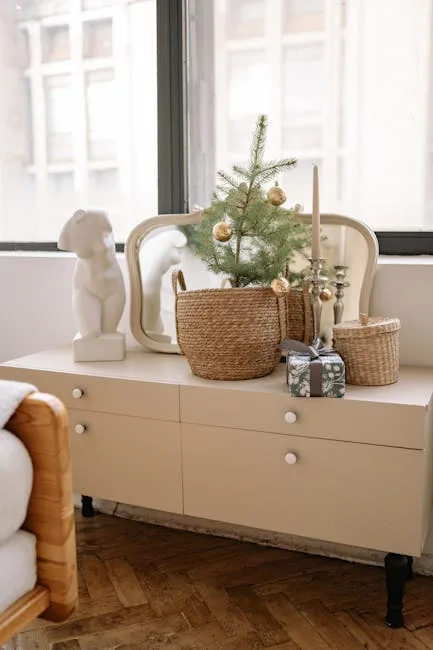
Here is the part of christmas decor for small apartment planning that gets skipped every year and creates the January problem: where does all of this go when the season ends?
A standard three-tub holiday decoration haul — which represents a fairly modest collection — takes up roughly twelve cubic feet of storage. In a one-bedroom apartment with one hall closet and the space under a bed, that is a meaningful percentage of available storage. Buying decorations in December without a clear plan for where they’ll live in January is how apartments end up with boxes of holiday items wedged behind furniture for six months.
The editing process I described earlier — nine pieces instead of thirty — isn’t only about visual density. It’s about storage logistics. Nine pieces fit in one medium box. One medium box fits under a bed. This is a solvable problem only if the number of pieces stays manageable.
Practical storage approaches that work in compact apartments:
- One dedicated box rule: Everything you own for holiday decorating must fit in one clearly labeled box that has a designated home. If a new purchase doesn’t fit in the box, something else comes out before it goes in.
- Dual-purpose pieces: Decorations that have a non-holiday life — brass candlesticks, a quality throw blanket, a ceramic bowl — don’t need to go into storage at all. They rotate back into the room’s year-round configuration.
- Vertical storage: A flat storage bag designed for wreath storage hangs on the back of a closet door and takes zero floor or shelf space.
The storage audit is worth doing before the purchase audit. Know your container before you fill it.
FAQ: Christmas Decor for Small Apartment
Q: How do I make my small apartment feel festive without it looking cluttered?
Focus on atmosphere over quantity. Two or three well-chosen pieces in your main sightlines — a wreath, a lit tree or branch arrangement, a candle grouping — will read as more festive than twenty items distributed across every surface. Scent and warm lighting do significant atmospheric work that physical decoration cannot replicate in a tight space.
Q: What kind of Christmas tree works best in a studio apartment?
A tabletop tree on a raised surface (shelf, stool, or side table) or a wall-mounted flat tree silhouette are the two options that cause the least disruption to a studio floor plan. Both can be decorated with the same care as a full-size tree and read as intentional rather than compromised. Pencil trees work in studios only if there is a corner that isn’t serving another function.
Q: Can I do christmas decor for small apartment on a tight budget?
Yes, and the constraint is actually useful. A small space rewards editing, which means a smaller number of higher-quality pieces will outperform a larger number of cheap ones. Natural materials — pine branches, dried oranges, cinnamon sticks — are inexpensive and come from grocery stores. String lights from the previous year, a swap of pillow covers, and one new candle can fully update a room’s holiday register for under thirty dollars.
Q: How do I handle Christmas decorations when I have almost no storage space?
Apply the one-box rule before you buy anything: every holiday decoration you own must fit in a single container that has a designated storage location. Buy only what fits. Prioritize dual-purpose pieces that stay in the room year-round — quality candlesticks, a wool throw in a deep winter color, a ceramic bowl that works in any season. What goes into storage should be limited to the strictly seasonal items.
Q: What’s the biggest mistake people make with christmas decor for small apartment spaces?
Applying house-scale decorating logic to apartment-scale rooms. The instinct to cover every surface, fill every corner, and match the visual volume of holiday decorating you grew up with or see in magazines is understandable — but it produces a crowded, visually loud result in a compact space. The apartment-appropriate version of that same holiday warmth comes from density and placement, not volume. Less, placed deliberately, consistently outperforms more, distributed broadly.
Q: How do I make my small apartment feel festive without it looking cluttered?
Focus on atmosphere over quantity. Two or three well-chosen pieces in your main sightlines — a wreath, a lit tree or branch arrangement, a candle grouping — will read as more festive than twenty items distributed across every surface. Scent and warm lighting do significant atmospheric work that physical decoration cannot replicate in a tight space.
Q: What kind of Christmas tree works best in a studio apartment?
A tabletop tree on a raised surface (shelf, stool, or side table) or a wall-mounted flat tree silhouette are the two options that cause the least disruption to a studio floor plan. Both can be decorated with the same care as a full-size tree and read as intentional rather than compromised. Pencil trees work in studios only if there is a corner that isn’t serving another function.
Q: Can I do christmas decor for small apartment on a tight budget?
Yes, and the constraint is actually useful. A small space rewards editing, which means a smaller number of higher-quality pieces will outperform a larger number of cheap ones. Natural materials — pine branches, dried oranges, cinnamon sticks — are inexpensive and come from grocery stores. String lights from the previous year, a swap of pillow covers, and one new candle can fully update a room’s holiday register for under thirty dollars.
Q: How do I handle Christmas decorations when I have almost no storage space?
Apply the one-box rule before you buy anything: every holiday decoration you own must fit in a single container that has a designated storage location. Buy only what fits. Prioritize dual-purpose pieces that stay in the room year-round — quality candlesticks, a wool throw in a deep winter color, a ceramic bowl that works in any season. What goes into storage should be limited to the strictly seasonal items.
Q: What’s the biggest mistake people make with christmas decor for small apartment spaces?
Applying house-scale decorating logic to apartment-scale rooms. The instinct to cover every surface, fill every corner, and match the visual volume of holiday decorating you grew up with or see in magazines is understandable — but it produces a crowded, visually loud result in a compact space. The apartment-appropriate version of that same holiday warmth comes from density and placement, not volume. Less, placed deliberately, consistently outperforms more, distributed broadly.