Christmas decorating a small apartment is one of those tasks that exposes every gap in generic holiday advice. The average American apartment measures 941 square feet — but the holiday decorating advice served to renters every December was largely written for people with attics, mantles, and dedicated storage rooms they will never have. “Get a slim tree” is the first thing every listicle offers, followed by “add some greenery” and “use Command hooks” — advice so stripped of specificity it’s nearly useless to someone staring at a 550-square-foot studio with one window and a coat closet. I spent eleven years working with apartments exactly like that, and the mistakes I watched people make were never about budget. They were about using the wrong framework entirely.
Quick Answer
The average American apartment measures 941 square feet — but the holiday decorating advice served to renters every December was largely written for people with attics, mantles, and dedicated storage rooms they will never have.
Small space holiday decorating isn’t a scaled-down version of what you’d do in a house. It’s a different discipline — one that treats constraint as creative structure rather than a problem to work around. The nine moves below come from professional staging principles, sensory design research, and a career’s worth of watching what actually makes a small apartment feel alive versus just busy.
1. Stop Thinking Vertically — Go Diagonal With Your Focal Point
In This Article
- 1. Stop Thinking Vertically — Go Diagonal With Your Focal Point
- 2. The Scent Architecture Trick That Makes a Studio Feel Like a Townhouse
- 3. Rent-Safe Lighting That Does More Work Than Any Ornament You Own
- 4. Christmas Decorating a Small Apartment Means Editing, Not Adding
- 5. The Window as Your Entire Feature Wall
- 6. Greenery as Architecture, Not Decoration
- 7. The One-Color Rule That Makes Small Spaces Look Designed, Not Decorated
- 8. Furniture That Earns Double Duty in December
- 9. The Exit Strategy: Storing It All Without Losing Your Closet
Most renters do the same thing every December: they push a pencil tree into the corner and arrange everything else around the room’s perimeter, hugging the walls. The result is a space that feels smaller and more enclosed than it did in November — which is the opposite of what holiday decor should accomplish.
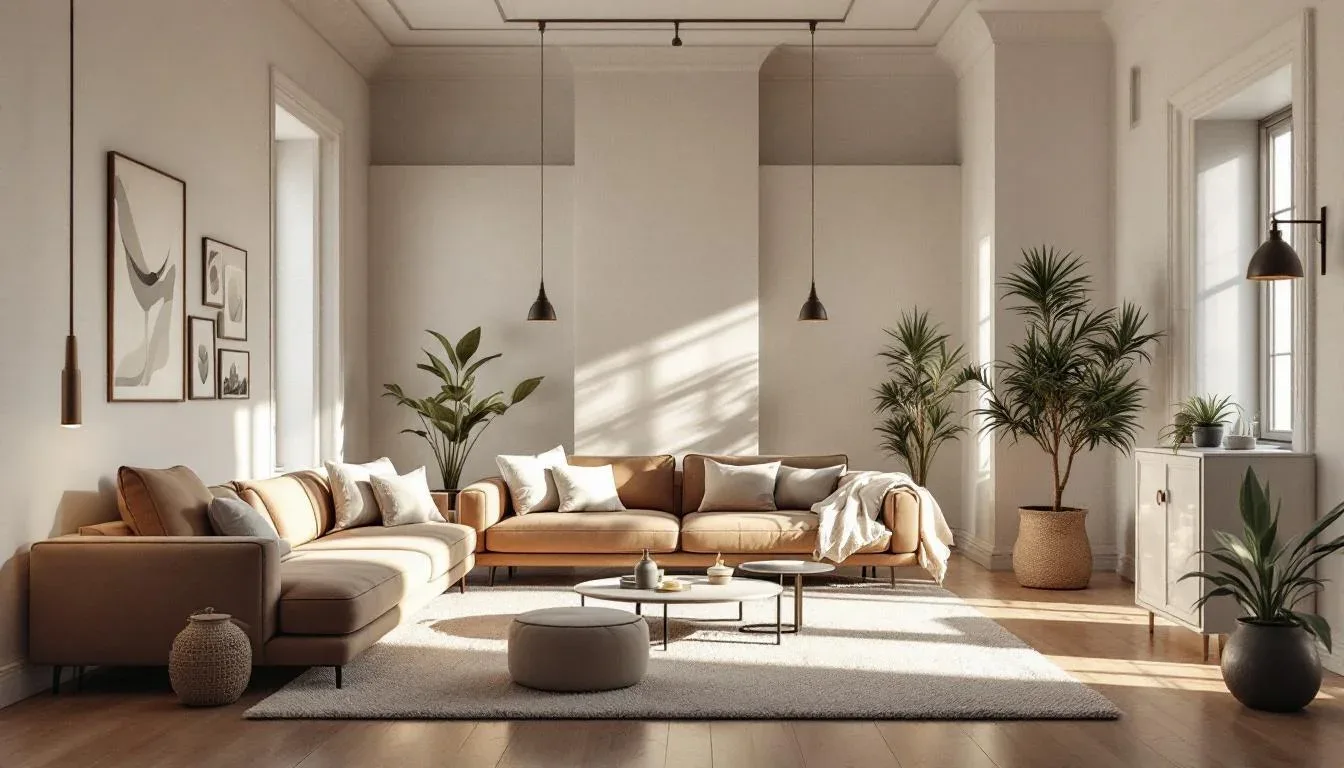
Professional stagers have used diagonal placement as a spatial-expansion technique for decades. The principle is straightforward: a single styled vignette placed at a 45-degree angle from the room’s entrance draws the eye across the full floor plan, forcing the gaze to travel through space rather than bounce along its edges. Interior designers refer to the “triangle of interest” rule — three elements placed at varying heights in a diagonal line across a room create visual movement that makes under-400-square-foot spaces read 30–40% more expansive, a finding that surfaces consistently in retail staging perception studies. The same effect works in a studio apartment.
What this looks like in practice:
- Replace the pencil tree in the corner with a low, wide arrangement — a coffee table vignette, a styled console, or a deep windowsill — positioned so it’s the first thing you see when entering
- Anchor the diagonal with a mirror placed behind or beside the display to double the perceived depth of the vignette — boutique retailers do this in window dressing specifically to manufacture spatial generosity
- Place a secondary element (a candle grouping, a greenery bundle) at a different height and 6–8 feet away from the main vignette to complete the triangle
- The three points of the triangle should never be at the same height — varying by at least 8 inches each creates the visual movement that makes the floor plan feel traversed rather than cramped
I once rearranged a client’s living room on December 22nd — nothing added, nothing bought — by simply rotating her existing console and the small tree beside it to create a diagonal axis through the room. She texted me the next day to say her apartment felt “twice as big.” Nothing had changed except where the eye was being led.
Takeaway: Before you buy a single decoration this year, stand in your doorway and trace where your eye lands. Then reposition your primary display to pull that gaze diagonally across the room.
2. The Scent Architecture Trick That Makes a Studio Feel Like a Townhouse
Here is what almost no holiday decorating content will tell you: the feeling of spaciousness in a home is not purely visual. Scent is a spatial design tool — and in a studio or one-bedroom apartment, using it strategically can manufacture the psychological experience of moving between distinct rooms even when no walls exist to separate them.
The approach is called scent zoning, and it works by assigning a different aromatic profile to each functional area of the apartment. Research from the Smell & Taste Treatment and Research Foundation indicates ambient scent can measurably alter perceived room size and comfort ratings — warm spice scents in particular correlate with higher “cozy” and “spacious” scores in enclosed spaces, which is a remarkable finding when you consider how counterintuitive that sounds. Warmth typically reads as closeness, not openness. But the emotional association overrides the geometry.
Three-zone scent architecture for a small apartment:
- Entry zone (front door, coat area, entryway shelf): Fresh fir, eucalyptus, or pine — something green and cool that signals “arrival.” A small dried botanical bundle or a reed diffuser with a forest-forward blend works here.
- Living zone (sofa, coffee table, main seating area): Warm spice or amber — cinnamon, clove, cardamom, or a dark resin candle. This is the zone that should smell the most “Christmas.”
- Sleep or reading zone (bedroom, reading chair, bedside table): Vanilla, cedarwood, or sandalwood — grounding and quieter. This tells the body it has moved somewhere different.
Avoid plug-in air fresheners for this entirely. They flatten everything into one undifferentiated cloud, which is the scent equivalent of painting every wall the same color — technically cohesive, but spatially unintelligent. Clove-studded oranges, dried orange slices, and cinnamon bundles placed at varying heights double as decor objects while contributing to the scent layer. They compress function into decoration, which is exactly what small-space design demands.
Takeaway: Assign one scent family to each functional zone, and switch them out deliberately — not randomly. The separation is what creates the psychological architecture.
3. Rent-Safe Lighting That Does More Work Than Any Ornament You Own
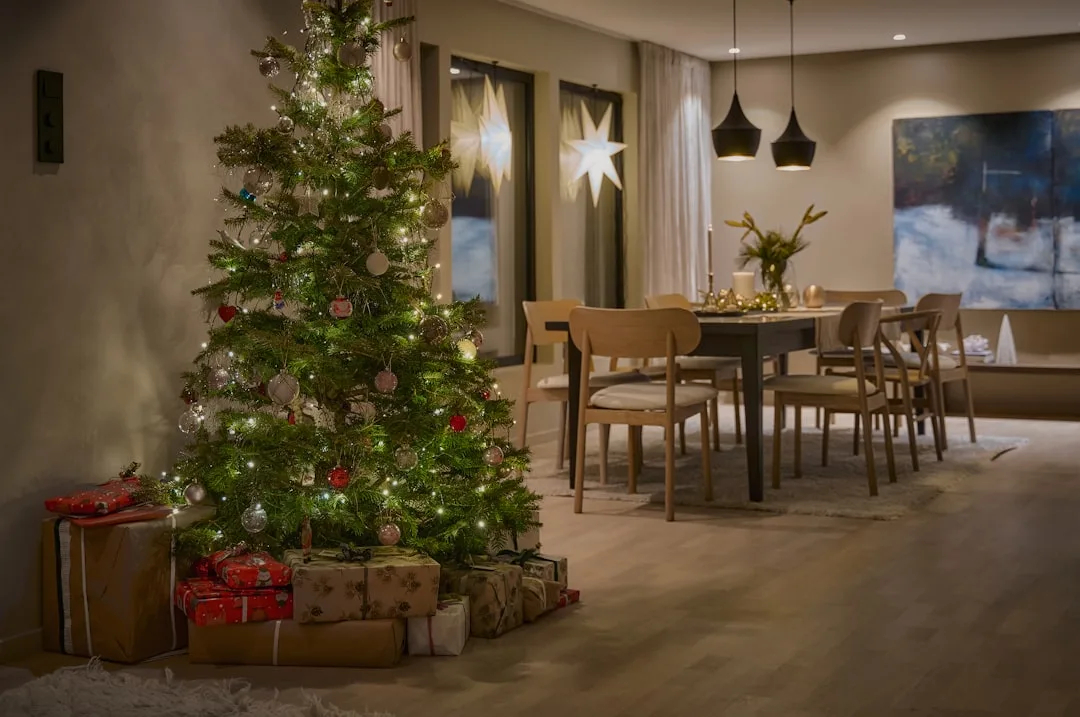
Lighting temperature is the single highest-impact design variable in a small apartment, and it costs almost nothing to change. A 2700K warm-white bulb emits light in the same spectrum as candlelight and the incandescent bulbs phased out in many markets since 2023 — and design photographers routinely re-lamp a room before shooting because lighting temperature accounts for roughly 60% of a space’s perceived warmth, both in photographs and in person. That number is not an exaggeration. I have walked into apartments that were identically decorated and watched one feel like a catalog shoot and the other feel like a break room, purely because one had daylight-balanced overhead bulbs.
For the holiday season specifically:
- Swap every overhead bulb you have access to for 2700K warm-white equivalents — budget under $15 for a four-pack, and swap them back in January if you want to
- Use string lights as structural lines, not random wrapping: run them along bookshelf edges, window frames, and the top edge of crown molding channels to define the architecture of the room rather than obscure it
- Layer three light sources at different heights — overhead, mid-level (table lamps, sconces), and floor level (pillar candles, a lit garland on a low shelf) — because depth in lighting creates depth in space perception the same way diagonal placement does
- Battery-operated LED taper candles placed inside glass hurricanes are rent-safe, fire-safe, and produce flicker effects that photograph beautifully and read as genuinely warm in person
One thing most renters miss: dimmer switches require an electrician to install properly, but plug-in dimmer modules cost under $12 at any hardware store and work with standard floor lamps and table lamps without any installation. Buying two of those transforms the mood control available in a small apartment overnight.
Takeaway: Re-lamp before you redecorate. Temperature before tinsel.
4. Christmas Decorating a Small Apartment Means Editing, Not Adding
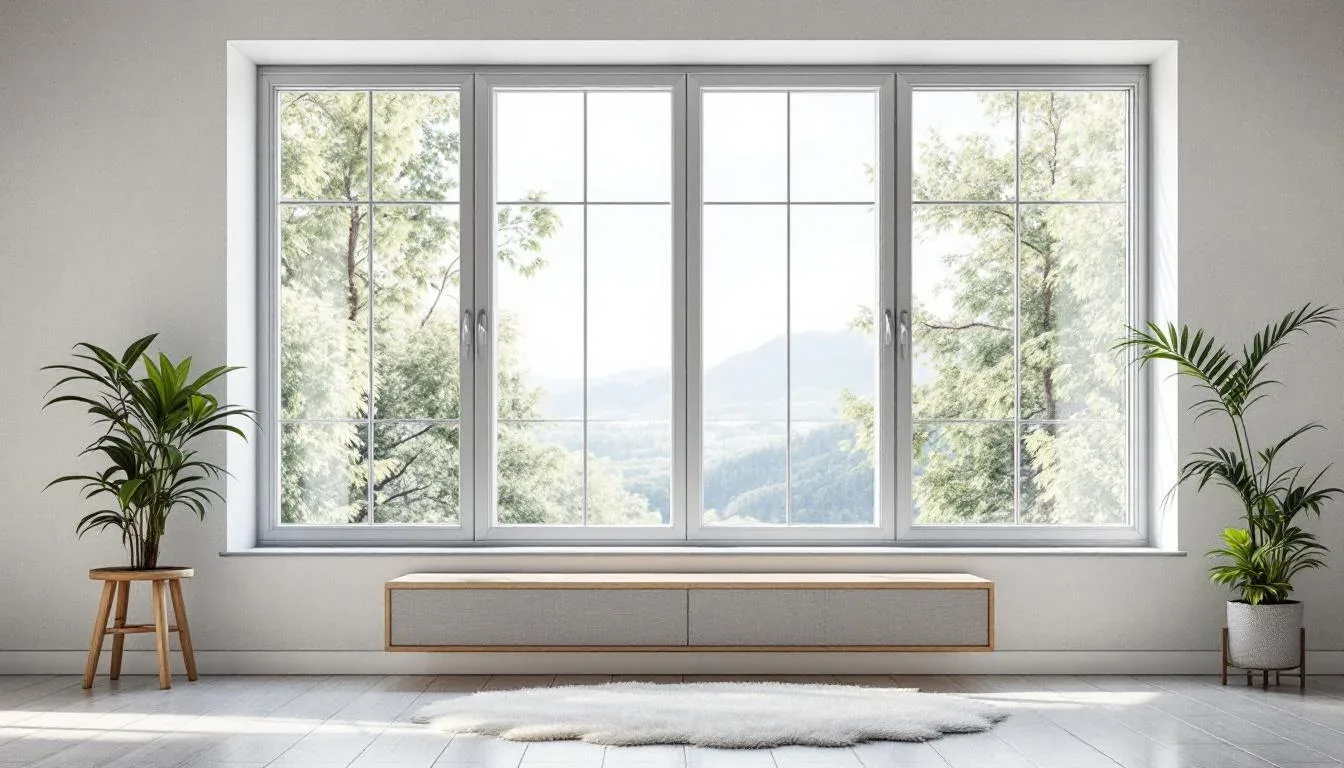
The instinct when christmas decorating a small apartment is to bring in more — more ornaments, more garland, more surfaces covered with seasonal objects. The professional instinct runs exactly opposite. Small apartments decorated well for the holidays almost always have fewer objects than the same spaces in November, not more.
The principle at work is called visual rest — the deliberate preservation of empty surface area so that the elements you do display can actually read as intentional rather than chaotic. Retail visual merchandisers use a rule of three-to-one: for every three objects placed, one nearby surface should remain cleared. In a small apartment, that ratio often needs to shift to two-to-one. The discipline required is real. It means choosing your five best pieces and putting the other fifteen back in the box, which feels wrong until you see the result.
What to keep, what to store:
- Keep anything that combines function with seasonal appearance: a plaid throw that you actually use, a candle you actually burn, a bowl of clementines that you’ll actually eat
- Store anything that is purely decorative without adding warmth, texture, or scent — small figurines, novelty pieces, and collections that require a dedicated flat surface to display without looking cluttered
- If a surface was already crowded in October, adding seasonal objects to it for December will not make it look festive — it will make it look overwhelmed
One edit I recommend every year: pull everything off your coffee table and bookshelf before you start decorating for the holidays. Start from nothing, then add back only what genuinely belongs. The decorations earn their place rather than compete for attention.
Takeaway: Your most effective holiday edit is subtraction. The pieces you keep will do more work precisely because they have room to breathe.
5. The Window as Your Entire Feature Wall

In a small apartment, windows are structural gifts that most renters dramatically underuse at the holidays. A properly dressed window operates as a full feature wall — it creates a focal point, draws in natural light, reflects it back into the room, and is visible both from inside and from the street, which doubles its decorative return on investment.
The approach that works best in tight spaces treats the window as a shadow box frame rather than a surface to be covered:
- Mount a tension rod inside the window frame and hang a sheer white or linen curtain behind a garland of eucalyptus, magnolia, or faux evergreen — the sheer diffuses daylight into a soft glow while the greenery reads crisp against it
- Place battery-operated fairy lights along the window sill and inside the garland using copper wire lights (which disappear against green stems better than silver or white wire)
- A single large object centered on the sill — a mercury glass vase, a sculptural candle, a small potted rosemary topiary trimmed into a tree shape — performs better than a collection of small objects that fragment the view
- If your window faces a street or courtyard, a paper star lantern hung in the center of the frame is visible from outside and inside simultaneously, and costs under $8
Takeaway: Dress one window completely before you touch anything else. It will do more work than any other surface in the room.
6. Greenery as Architecture, Not Decoration
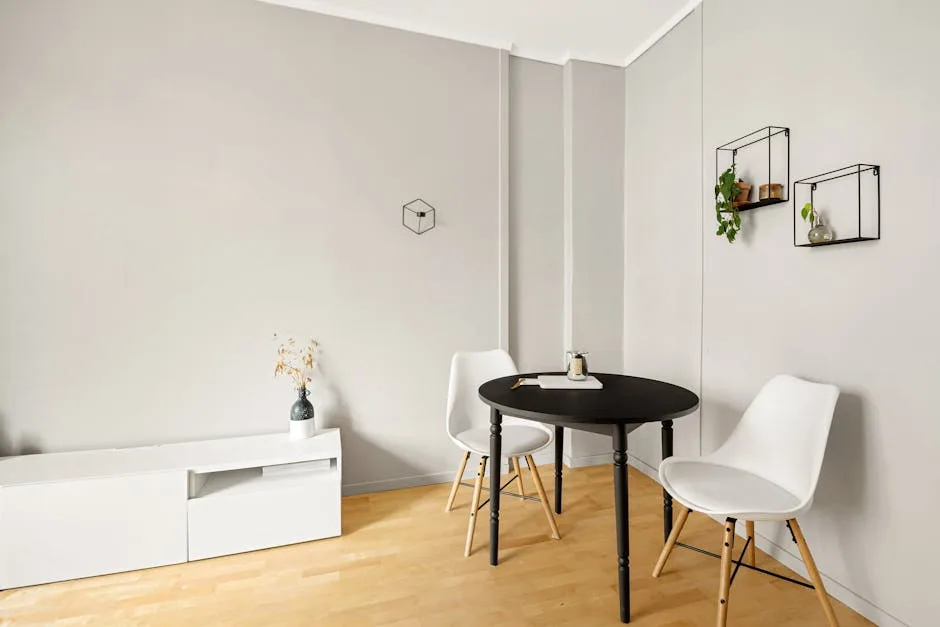
Cut or faux greenery is the most spatially intelligent decorating material available for small apartments because it occupies volume without visual weight. A bough of eucalyptus draped over a doorframe reads as lush and full but adds almost no visual mass — the eye reads through it rather than stopping at it, which means it expands the perceived boundaries of a room rather than contracting them.
The distinction between greenery used architecturally and greenery used decoratively:
- Architectural use: Placed along structural lines — doorframes, window ledges, the top edge of a bookshelf, the mantle of a faux fireplace — so it traces the bones of the apartment and makes those bones feel more substantial
- Decorative use: Placed on a flat surface in a vase or scattered across a table — which is fine, but does none of the spatial work that architectural placement accomplishes
Eucalyptus, magnolia, cedar, and juniper are the four greenery materials that hold up best when dried or preserved, which matters because fresh-cut greenery in a dry, heated apartment can look tired within ten days. Preserved eucalyptus from a craft store or online supplier costs roughly $12–18 for a bundle that will last the entire season and beyond. Dried orange slices tucked into the greenery add color, scent, and texture simultaneously — another example of design compression.
Takeaway: Place greenery along structural lines first. Flat surfaces are the last place it belongs.
7. The One-Color Rule That Makes Small Spaces Look Designed, Not Decorated
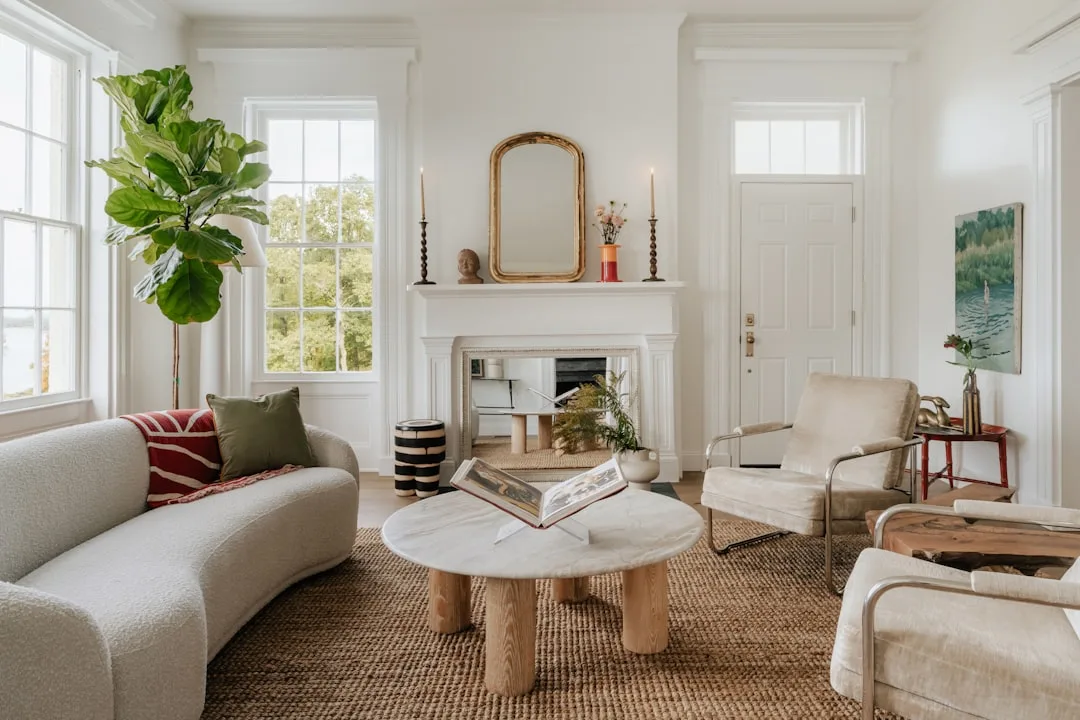
The most common small apartment holiday decorating mistake I observed over eleven years was color proliferation — red and green and gold and silver and plaid and buffalo check all appearing in the same room at the same scale, creating a visual noise that reads as “decorated” rather than “designed.” The fix is almost embarrassingly simple: choose one metallic and one natural material and repeat them everywhere.
The combinations that work consistently in small spaces:
- Brass + linen: Warm, quiet, works in apartments with wooden floors or warm-toned walls. Brass ornaments, linen ribbon, natural dried botanicals.
- Silver + white: Cooler and more graphic. Works in apartments with gray walls, white tile, or concrete floors. Glass ornaments, white candles, silver wire.
- Copper + greenery: The most organic combination. Works almost universally. Copper fairy lights, copper lanterns, dense green garland.
When you commit to one metallic and one natural material, every purchase decision for the season becomes easy — you’re filtering every option through a two-variable test. And the result in the room is a space that reads as intentional at a scale that punches well above its square footage.
Takeaway: Pick two materials. Repeat them. Resist everything else.
8. Furniture That Earns Double Duty in December
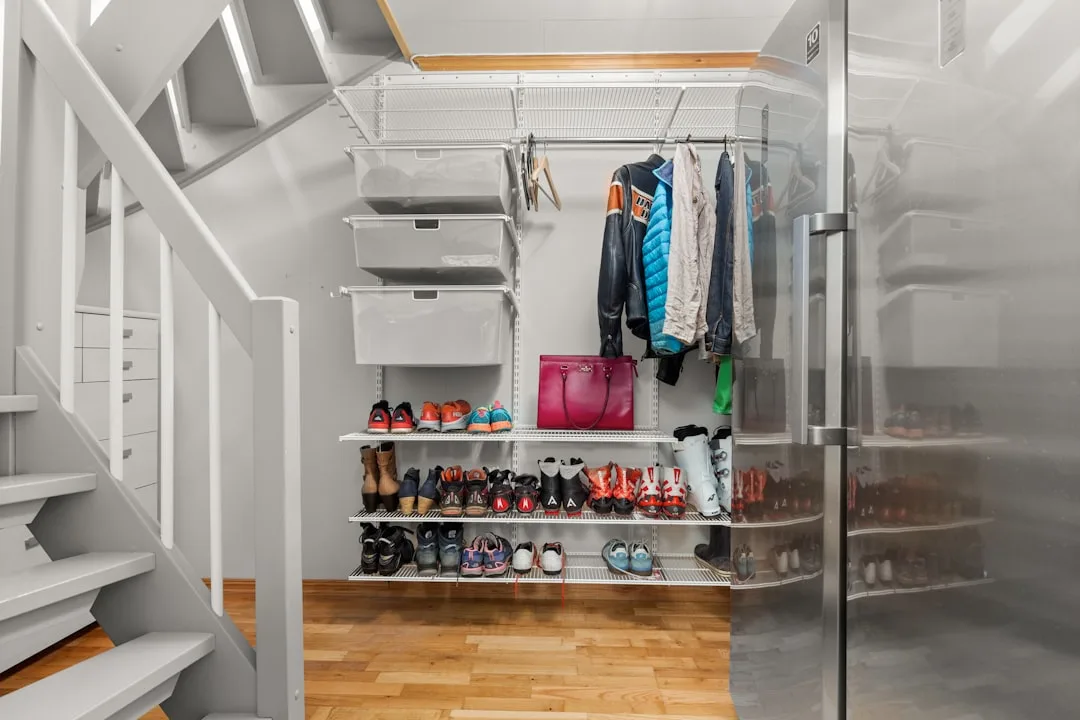
Christmas decorating a small apartment successfully often comes down to whether your furniture can carry seasonal work without being replaced or supplemented by additional pieces that eat floor space. The apartments that feel best at the holidays aren’t the ones with the most decorations — they’re the ones where the existing furniture has been reactivated for a seasonal role.
Practical furniture reassignments for December:
- A storage ottoman with a tray on top becomes a styled coffee table vignette — the tray holds candles, a small greenery bundle, and two ornaments without the ottoman losing its function
- A bar cart, if you have one, converts directly into a holiday display surface — bottles replaced with decanters, greenery draped over the top shelf, brass ornaments hung from the frame
- A ladder shelf that holds books in November holds wrapped packages and potted topiaries in December — the vertical format works with the architectural greenery principle from Move 6
- Dining chairs draped with a textured throw and a single sprig of greenery tucked into the back read as styled rather than bare, without adding any objects to the floor plan
The test for any December furniture reassignment: does the piece do its original job AND a new decorative job simultaneously? If it only does one, it’s either furniture or decor — and in a small apartment, everything needs to earn both designations.
Takeaway: Before buying anything new, ask what your existing furniture could do in December that it isn’t doing in November.
9. The Exit Strategy: Storing It All Without Losing Your Closet

The part of christmas decorating a small apartment that nobody covers is what happens on January 2nd. For renters without basements, garages, or storage units, the holiday decor has to live somewhere inside the apartment for eleven months of the year — and if you haven’t planned for that before you buy anything in December, you will spend next November excavating a closet trying to find objects you’ve half-forgotten you own.
Storage principles that make next year’s decorating faster:
- Buy clear lidded bins in one size only — uniformity means they stack without shifting, and clear sides mean you can identify contents without opening every box
- Store by category, not by room — all lighting together, all greenery together, all ornaments together — so you can pull a single category when you’re working on a specific area of the apartment
- Photograph your finished apartment this December and store the image in the same digital folder as your receipts — next year’s setup starts with a reference rather than a memory
- Before packing anything away, discard one item for every item you’re keeping. Small apartments demand small inventories, and the edit you do in January costs nothing compared to the clutter you avoid in December
One structural recommendation: a vacuum storage bag for any textile-based holiday items — throws, stockings, tree skirts, ribbon — compresses them to roughly 20% of their original volume and keeps them dry and moth-free through the year. Two large vacuum bags can replace four medium storage bins for textiles alone.
Takeaway: The best christmas decorating a small apartment strategy includes a plan for undoing it cleanly. Invest fifteen minutes in January to save two hours next December.
Frequently Asked Questions About Christmas Decorating a Small Apartment
Q: What’s the single highest-impact change I can make when christmas decorating a small apartment on a budget under $30?
Swap your light bulbs to 2700K warm-white and buy one bundle of preserved eucalyptus. The bulbs will cost under $15 for a four-pack; the eucalyptus runs $12–18 at most craft stores. Those two changes — lighting temperature and architectural greenery — will do more for your space than $100 spent on ornaments and novelty decor.
Q: How do I make a studio apartment feel festive without making it feel crowded?
Work with the edit-first principle: remove items from your existing surfaces before adding seasonal ones. A studio that feels festive but not crowded is almost always one where the ratio of empty surface to styled surface is higher than the resident expected to allow. Keep your five best seasonal pieces, store the rest, and resist the instinct to fill every available flat surface.
Q: Is a real Christmas tree worth it in a small apartment?
For apartments under 600 square feet, a real tree over five feet tall typically creates more problems than it solves — it competes with furniture for floor space and can make the room smell wonderful but feel genuinely smaller. A three-to-four foot tabletop real tree placed on a side table or console at the right diagonal (see Move 1) gives you the scent and texture of a real tree without the footprint. Alternatively, a wall-mounted tree silhouette made from branches, twine, or even painter’s tape with small ornaments pinned to it costs almost nothing and takes up zero floor space.
Q: How do I hang holiday decorations in a rental without losing my security deposit?
Command strips rated for the appropriate weight handle almost everything — garland, wreaths, mirror hangers, stocking holders. For heavier items, 3M damage-free picture hanging strips hold up to 16 pounds per pair on most painted drywall surfaces. Avoid 3M foam tape on wallpaper or fresh paint (less than 30 days old). Tension rods inside window frames and doorways require no adhesive at all and hold garland, curtain sheers, and hanging ornament arrangements without any wall contact.
Q: When is the right time to start christmas decorating a small apartment?
From a practical standpoint, the first weekend of December works well for small apartments — early enough to enjoy the result for a full month, late enough that you’re not managing decor fatigue by Christmas week. More importantly, do your edit before you decorate: clear surfaces, assess what you already own, and identify your two-material palette before you bring anything new into the space. The apartments that look best on December 25th are the ones where someone made a plan on November 30th.
Q: What’s the single highest-impact change I can make when christmas decorating a small apartment on a budget under $30?
Swap your light bulbs to 2700K warm-white and buy one bundle of preserved eucalyptus. The bulbs will cost under $15 for a four-pack; the eucalyptus runs $12–18 at most craft stores. Those two changes — lighting temperature and architectural greenery — will do more for your space than $100 spent on ornaments and novelty decor.
Q: How do I make a studio apartment feel festive without making it feel crowded?
Work with the edit-first principle: remove items from your existing surfaces before adding seasonal ones. A studio that feels festive but not crowded is almost always one where the ratio of empty surface to styled surface is higher than the resident expected to allow. Keep your five best seasonal pieces, store the rest, and resist the instinct to fill every available flat surface.
Q: Is a real Christmas tree worth it in a small apartment?
For apartments under 600 square feet, a real tree over five feet tall typically creates more problems than it solves — it competes with furniture for floor space and can make the room smell wonderful but feel genuinely smaller. A three-to-four foot tabletop real tree placed on a side table or console at the right diagonal (see Move 1) gives you the scent and texture of a real tree without the footprint. Alternatively, a wall-mounted tree silhouette made from branches, twine, or even painter’s tape with small ornaments pinned to it costs almost nothing and takes up zero floor space.
Q: How do I hang holiday decorations in a rental without losing my security deposit?
Command strips rated for the appropriate weight handle almost everything — garland, wreaths, mirror hangers, stocking holders. For heavier items, 3M damage-free picture hanging strips hold up to 16 pounds per pair on most painted drywall surfaces. Avoid 3M foam tape on wallpaper or fresh paint (less than 30 days old). Tension rods inside window frames and doorways require no adhesive at all and hold garland, curtain sheers, and hanging ornament arrangements without any wall contact.
Q: When is the right time to start christmas decorating a small apartment?
From a practical standpoint, the first weekend of December works well for small apartments — early enough to enjoy the result for a full month, late enough that you’re not managing decor fatigue by Christmas week. More importantly, do your edit before you decorate: clear surfaces, assess what you already own, and identify your two-material palette before you bring anything new into the space. The apartments that look best on December 25th are the ones where someone made a plan on November 30th.