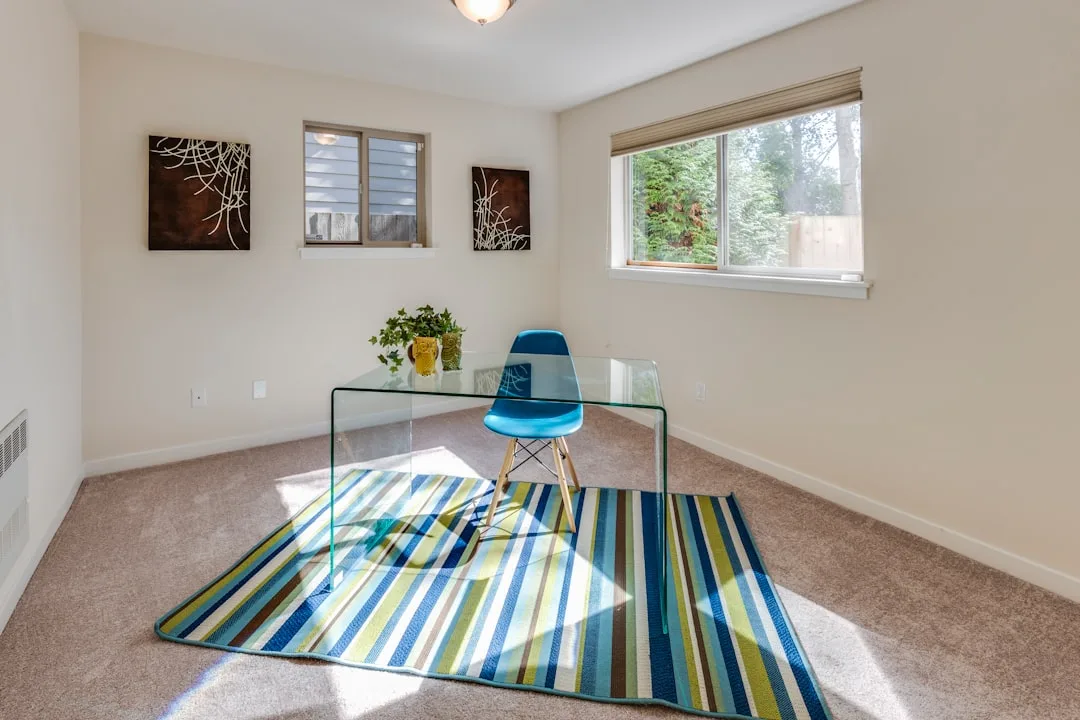
The desk-against-the-wall setup fills roughly 70% of home offices — and it is the one layout every rug placement article in existence fails to actually address. If you’ve been searching for home office rug placement ideas that actually reflect how real people work, you’ve probably noticed that most guides assume you’re working at a freestanding desk positioned heroically in the center of the room, backlit by a perfect window, with 24 inches of clearance on all sides. That room doesn’t exist for most people. What actually exists is a desk wedged against a wall, a chair that rolls into whatever space is left, and a rug that either gets swallowed under the furniture or floats awkwardly in front of it, serving no purpose that you can identify. I spent eleven years solving these exact problems in real apartments — the 90-square-foot converted bedrooms, the living rooms with a desk shoved into a corner pretending to be an office. This is the guide I wish existed when I was starting out.
Quick Answer
The desk-against-the-wall setup fills roughly 70% of home offices — and it is the one layout every rug placement article in existence fails to actually address.
Why Most Home Office Rugs End Up Looking Wrong
In This Article
- Why Most Home Office Rugs End Up Looking Wrong
- Read Your Room Before You Shop: Mapping Your Home Office Layout
- Rug Placement for a Wall-Flush Desk (The Setup Most Guides Ignore)
- The Floating Desk Situation: When You Actually Have Clearance
- Layering Rugs in a Home Office (When One Isn’t Enough)
- Rug Placement Ideas by Room Shape
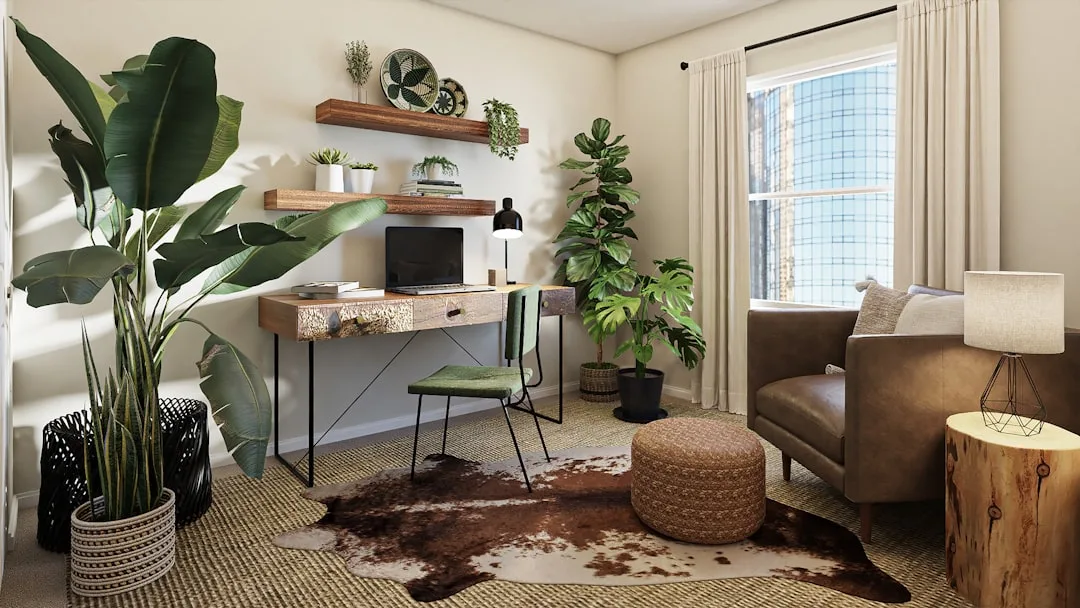
Here’s what nobody says plainly: most rug advice is built around showroom furniture arrangements, and showrooms are built around rugs they already decided to sell. The logic runs backwards from the beginning.
The “rug under the desk” rule that you’ll find repeated across every home decor site assumes a centered, freestanding desk with walkable space on multiple sides. When you apply that logic to a desk pushed against a wall, you end up with a rug that disappears under the desk, gets hidden behind the chair, and contributes exactly nothing to how the room looks or feels. I watched a client in Wicker Park spend $400 on a beautiful hand-knotted rug that became completely invisible within a week because nobody told her the rule didn’t apply to her layout.
Sizing charts are the second problem. The grid that says “small room gets a 4×6, medium room gets a 6×9” ignores room shape, natural light distribution, and the visual weight of the furniture around the rug. A 6×9 in a narrow rectangular room with a wall-flush desk can make the room feel like a hallway. The same rug in a square room with a floating desk looks anchored and intentional. Same rug. Completely different result.
The root complaint I heard most consistently — from clients, from other designers, from people messaging me on Instagram — was that the rug made the room feel smaller. Not larger, not more defined. Smaller. That happens when the rug is either too small to establish a zone or positioned to stop at the furniture instead of extending beyond it. A rug that terminates at the desk legs rather than continuing into the usable floor space creates a visual wall that cuts the room off at the furniture line.
The pattern I kept seeing was this: people chose a rug size before they mapped their furniture layout. The order of operations was wrong. Interior designers consistently note that 60–70% of rug placement mistakes trace back to this exact sequence error — shopping first, measuring second, and only discovering the problem after the rug is already unrolled. The fix is to sketch your layout before you open a single browser tab.
Actionable takeaway: Tape the proposed rug dimensions on your floor with painter’s tape before buying anything. Live with the taped outline for a day. Where does the chair roll? Does the tape disappear under the desk? If you can’t see the tape from the doorway, you won’t be able to see the rug either.
Read Your Room Before You Shop: Mapping Your Home Office Layout
Sketching a floor plan sounds like homework nobody wants to do. But I’ve learned that ten minutes with a measuring tape and a piece of graph paper prevents a hundred dollars in return shipping. Worth the homework.
There are three dominant home office configurations, and they require completely different rug strategies — and completely different home office rug placement ideas:
- Floating desk (center-room): Desk positioned away from walls with walkable clearance on multiple sides. The rug anchors the desk from below, and sizing is the primary decision.
- Wall-flush desk (against a wall): Desk pushed against one wall, chair extending outward into the room. The rug’s relationship to the chair matters more than its relationship to the desk.
- L-shaped or corner desk: Two work surfaces meeting at a corner, often with one return against a wall. The rug needs to negotiate two desk legs and a chair path that moves along an L-axis rather than a straight line.
Once you know your configuration, identify your room’s visual anchor — and this is the piece most people skip. The visual anchor is the wall you look at when you walk through the door. It is not necessarily the wall where the desk sits. In many home offices, the desk is against a side wall, which means the anchor wall is straight ahead of you when you enter. The rug should orient toward that wall, not toward the desk. If the rug runs perpendicular to the anchor wall, it will feel wrong even if everything else is correct.
Then mark your dead zones — areas where a rug would block a door swing, create a trip hazard at a threshold, or slide under built-in cabinetry where you’d never see it again. These are non-negotiable exclusion zones regardless of what any sizing chart recommends.
Rooms under 120 square feet — which describes the majority of dedicated home offices in urban apartments and older homes — benefit from rugs placed slightly off-center rather than perfectly symmetrical. This counterintuitive placement creates an implied depth that a centered rug in a small room actually destroys. Centering a rug in a small, square-ish room makes it look like a rug sample was dropped in a box.
Actionable takeaway: Before measuring for a rug, stand in your office doorway and photograph the room. The photo will show you what your eye edits out in person — including where the floor is bare, where the furniture clusters, and where a rug would actually land in your sight line.
Rug Placement for a Wall-Flush Desk (The Setup Most Guides Ignore)
Let me be direct about something: this is the section that doesn’t exist anywhere. I’ve read a lot of home office decor content. Not one article addresses the wall-flush desk configuration with any specificity. They mention it and then give you the same advice they’d give for a floating desk. That’s like recommending the same traffic route for driving and cycling — technically related, functionally useless.
When your desk is against a wall, the rug’s job is to define the seating position, not the desk footprint. The desk is furniture. It lives against a wall. It doesn’t need to be anchored — it’s literally touching a wall. What needs anchoring is the work zone, which is the space where you sit, where your body occupies the room, where the chair moves. That zone extends outward from the desk, not under it.
The correct placement for a wall-flush desk setup:
- Do not attempt to slide the rug fully under the desk. A rug that disappears under a wall-flush desk is a rug you paid for and cannot see. The front edge of the rug should sit approximately two to four inches behind the front legs of the desk — close enough to visually connect to the desk, far enough forward to be visible from the room. If your desk has no front legs (a floating wall-mounted situation), the rug front edge should align with where the desk surface ends when you’re seated beneath it.
- Size the rug to the chair travel, not the desk width. Sit in your chair and roll it back as far as you naturally would during a full stretch or a phone call. Measure from the desk to the back of the chair wheels in that extended position. Add six inches. That is your minimum rug depth. Width should extend at least six inches beyond the chair on both sides — which often means going wider than the desk itself.
- Consider a runner if your desk spans the full wall width. In rooms where the desk occupies most of one wall (common in converted closet offices and narrow alcoves), a standard rectangular rug creates awkward side margins. A runner — typically 2.5×8 or 3×10 — placed in front of the desk with its length running parallel to the wall can define the work zone cleanly without fighting the desk’s horizontal spread.
- Use the rug to create separation from the rest of the room. In home offices that share space with a bedroom or living area, the wall-flush desk creates an ergonomic problem: your back is exposed to the room. A rug placed correctly — extending far enough behind the chair to create a defined zone — acts as a psychological boundary between work space and living space. It gives the work zone its own territory even when there are no walls to enforce it.
What about the chair mat question? If you’re on hardwood or tile, a rug under the chair area can replace a plastic chair mat entirely — provided the rug pile is low enough (under 0.5 inches) to allow smooth rolling. High-pile rugs under desk chairs cause the chair to drag, which ruins both the rolling mechanism and the rug. Flatweave, low-pile wool, or polypropylene rugs handle chair casters without damage. If you’re on carpet, you still need a chair mat — put it on top of the rug, not instead of it.
The Floating Desk Situation: When You Actually Have Clearance
The floating desk is the configuration every rug guide is written for, so I’ll keep this section tight — you have options here that wall-flush setups don’t, and the decisions are about proportion rather than position.
The standard approach: Rug extends under the desk and far enough out on all sides that the front legs of the desk sit on the rug. Back legs can float off the rug if the room is tight, but front legs on the rug is non-negotiable for this configuration to look intentional. The chair should be able to roll back fully and still remain on the rug.
The extended approach: Rug extends under both desk and any additional seating — a guest chair, a reading chair positioned near the window. This turns the entire workspace into one unified zone rather than desk island in a floor sea. Works well in rooms over 150 square feet where you have genuine multi-use space.
The proportion rule that actually matters: The rug should occupy between 50% and 65% of the visible floor space (not total floor space — the floor you can see from the doorway). Below 50% and the rug reads as an accent piece rather than an anchor. Above 65% and it competes with the walls for visual dominance. This is why a 9×12 in a 12×14 room looks right, while an 8×10 in the same room starts to look undersized despite being close in actual dimensions.
Layering Rugs in a Home Office (When One Isn’t Enough)
Layering is underused in home offices and overused in living rooms. In an office, it serves a specific practical function that most people don’t consider: it lets you put a low-pile functional rug under the chair (for rolling) while adding texture and visual interest with a larger, softer rug beneath it.
The mechanics of layering in a home office:
- Bottom layer: Larger rug, lower pile, natural fiber or flatweave. Jute, sisal, and flatweave wool work well. This rug defines the zone.
- Top layer: Smaller rug, centered under the desk area or placed to one side toward a reading nook if the office includes one. This rug adds color, pattern, or texture that the functional bottom layer can’t provide.
- The offset rule: The top rug should be small enough that at least eight inches of the bottom rug is visible on all sides. If the rugs are too close in size, the layering reads as a mistake rather than a choice.
One specific application I used repeatedly in narrow offices: a jute runner as the base (running the full length of the wall-flush desk zone) with a smaller patterned rug layered in front of the chair position. The jute unifies the work wall. The patterned rug defines exactly where you sit. From the doorway, the desk area reads as one composed zone with two distinct moments.
Rug Placement Ideas by Room Shape
Because the “home office” encompasses everything from a 75-square-foot spare bedroom to a dedicated 200-square-foot room with built-ins, shape matters as much as size when working through home office rug placement ideas. Here’s how the logic shifts based on geometry:
Narrow rectangular rooms (longer than wide by more than 30%):
Avoid square rugs entirely. A square rug in a narrow room emphasizes the narrowness by contrasting against it. Use a rectangular rug oriented with its long side running parallel to the long wall. If the desk is on the short wall, the rug should run toward you from the desk, not across the room. This elongates the depth of the space visually.
Square rooms:
These give you the most flexibility. A square rug centered in a square room works (rare in decor, but this is one of the cases). A rectangular rug in a square room still works if it’s oriented toward the visual anchor wall. What doesn’t work is a rectangular rug placed diagonally — it creates visual tension in a room whose geometry is already resolved.
L-shaped rooms or rooms with alcoves:
Treat the alcove as a separate zone. If the desk lives in the alcove, the rug lives in the alcove — sized to fit the alcove footprint rather than the total room. The open room section can have its own rug or remain bare depending on its function. Trying to use one rug to bridge an alcove and open room almost never works because the rug has to be either too large (awkward in the alcove) or too small (doesn’t reach the open room).
Rooms with slanted ceilings (converted attic offices):
Place the rug in the section of the room with full ceiling height — which is usually where the desk lives. Keep the rug away from the knee wall side of the room where the ceiling drops, both because that area is typically dead space and because a rug there gets compressed by low furniture or storage. The rug should reinforce the functional zone, not map the entire floor.
Frequently Asked Questions
Should a rug go under a desk that’s against the wall?
Partially, yes — but not fully. When the desk is against the wall, you want the front edge of the rug to sit a few inches behind the desk’s front legs rather than extending fully under the desk. The goal is to keep the rug visible from the room and positioned where your body actually occupies the space: in front of the desk, not behind it against the wall.
What size rug works best for a home office?
It depends entirely on your desk configuration. For a floating desk, a 6×9 or 8×10 works for most rooms. For a wall-flush desk, the depth of the rug (the dimension running away from the wall) matters more than the width — you need at least enough depth to cover your chair’s full rolling range plus six inches. Width should extend beyond the chair on both sides.
Can I use a runner rug in a home office?
Runners are actually an underrated home office rug placement idea, particularly for wall-flush desks that span the full width of a narrow room. A 2.5×8 or 3×10 runner placed parallel to the desk wall defines the work zone without creating awkward margins on the sides of the desk.
What type of rug works best under a rolling desk chair?
Low-pile rugs under 0.5 inches — flatweave, low-pile wool, or polypropylene — handle chair casters without drag or damage. High-pile and shag rugs cause chairs to roll poorly and deteriorate faster under caster pressure. If you need a higher-pile rug for aesthetic reasons, layer a chair mat on top in the rolling zone.
How do I make a small home office look bigger with a rug?
Place the rug slightly off-center toward the desk wall rather than perfectly centered in the room. This creates implied depth toward the far wall. Also avoid rugs with bold geometric borders — bordered rugs create a visual frame that emphasizes the room’s edge and makes small rooms feel contained. A rug with an all-over pattern or no border at all reads as a floor treatment rather than a box drawn on the ground.
Should a rug go under a desk that’s against the wall?
Partially, yes — but not fully. When the desk is against the wall, you want the front edge of the rug to sit a few inches behind the desk’s front legs rather than extending fully under the desk. The goal is to keep the rug visible from the room and positioned where your body actually occupies the space: in front of the desk, not behind it against the wall.
What size rug works best for a home office?
It depends entirely on your desk configuration. For a floating desk, a 6×9 or 8×10 works for most rooms. For a wall-flush desk, the depth of the rug (the dimension running away from the wall) matters more than the width — you need at least enough depth to cover your chair’s full rolling range plus six inches. Width should extend beyond the chair on both sides.
Can I use a runner rug in a home office?
Runners are actually an underrated home office rug placement idea, particularly for wall-flush desks that span the full width of a narrow room. A 2.5×8 or 3×10 runner placed parallel to the desk wall defines the work zone without creating awkward margins on the sides of the desk.
What type of rug works best under a rolling desk chair?
Low-pile rugs under 0.5 inches — flatweave, low-pile wool, or polypropylene — handle chair casters without drag or damage. High-pile and shag rugs cause chairs to roll poorly and deteriorate faster under caster pressure. If you need a higher-pile rug for aesthetic reasons, layer a chair mat on top in the rolling zone.
How do I make a small home office look bigger with a rug?
Place the rug slightly off-center toward the desk wall rather than perfectly centered in the room. This creates implied depth toward the far wall. Also avoid rugs with bold geometric borders — bordered rugs create a visual frame that emphasizes the room’s edge and makes small rooms feel contained. A rug with an all-over pattern or no border at all reads as a floor treatment rather than a box drawn on the ground.