The average American laundry room is smaller than a parking space — yet most storage guides recommend solutions designed for rooms twice the size. If you’re searching for laundry room storage ideas small space solutions that actually work in real apartments and homes, you’ve probably already noticed that most advice falls apart the moment you try to apply it. Not because the writers are lazy, exactly. It’s because most storage content is written by people who photograph rooms and not by people who’ve had to explain to a client why the rolling cart they bought online won’t actually fit between the dryer and the wall.
Quick Answer
The average American laundry room is smaller than a parking space — yet most storage guides recommend solutions designed for rooms twice the size.
I spent eleven years doing that explaining. This article is the version I wish existed during that time.
Why Most Storage Fixes Fail in Compact Laundry Rooms
In This Article
- Why Most Storage Fixes Fail in Compact Laundry Rooms
- Measure Before You Buy: The Clearance Numbers Every Compact Laundry Room Needs
- The Four Functional Zones of a Tight Laundry Room (And How to Assign Storage to Each)
- The Storage Solutions Designers Actually Use (And Why They Work in Small Spaces)
- Configuration-Specific Advice: Because Room Shape Changes Everything
- The Mistakes I Saw Most Often (And How to Avoid Each One)
- What a Real Laundry Room Storage Makeover Actually Looks Like
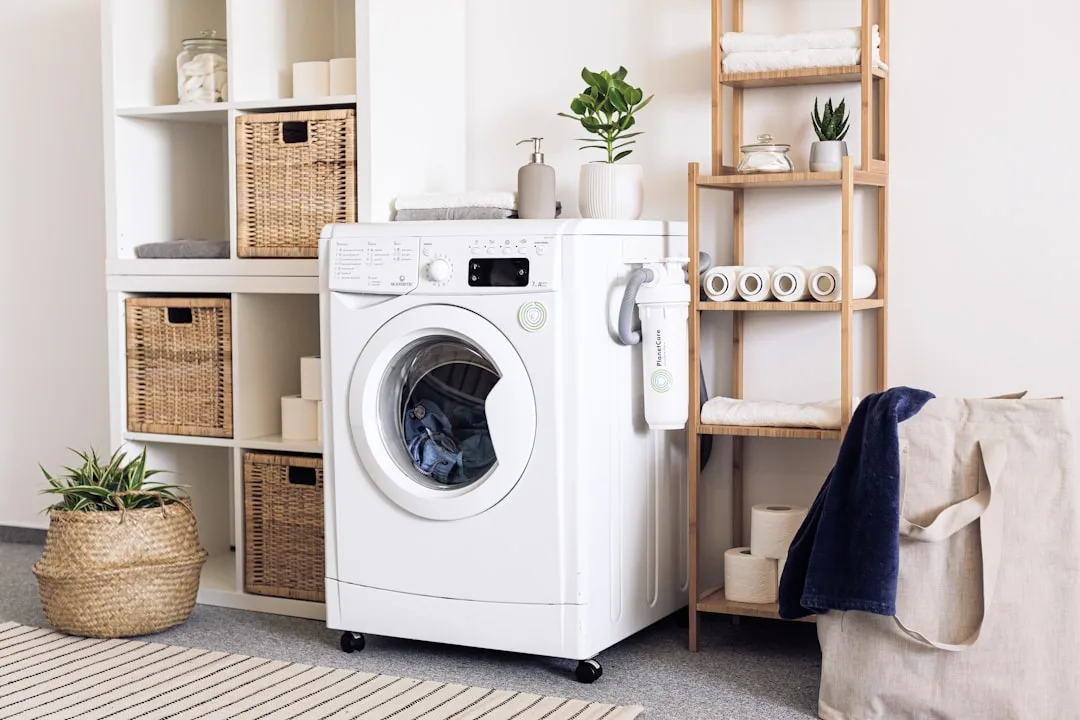
Floating shelves. Slim rolling carts. Over-the-door organizers. These solutions appear in virtually every small laundry room article because they photograph well and they’re easy to source. What they are not — and I need to be direct about this — is automatically useful in a room under 50 square feet.
The National Association of Home Builders reports that the median dedicated laundry room in new U.S. homes falls between 35 and 50 square feet. That’s smaller than most walk-in closets. And yet the distinction between a 35-square-foot closet-style laundry and a 54-square-foot dedicated room matters enormously for what storage will actually work. A slim rolling cart that functions perfectly in a galley-style room becomes a tripping hazard in a closet laundry with a bifold door. A floating shelf that’s perfectly accessible above a side-by-side configuration becomes unreachable — and potentially dangerous — above a stacked unit where you’d need a step stool to access it while standing on a hard floor inches from a running appliance.
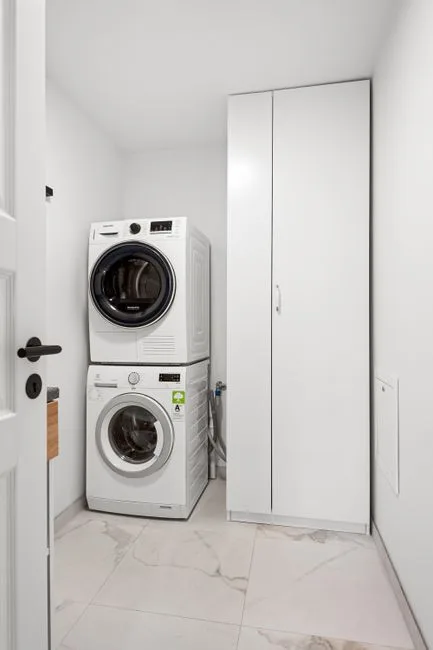
The stacking configuration changes the entire vertical storage equation. Side-by-side machines top out around 36 inches, leaving roughly 5 feet of usable wall above them. Stacked units can reach 74–76 inches — leaving you barely 2 feet of clearance before you hit a standard 8-foot ceiling. Same room, completely different geometry. The floating shelf advice that works for one is borderline reckless for the other.
But the deeper problem — the one nobody addresses — is what I started calling zone blindness. Most people treat a laundry room as a single-function space and try to optimize it as one zone. It isn’t. It has four distinct functional zones: washing, drying, folding, and supply storage. Each zone has different reach requirements, different frequency of access, and different ideal storage types. When you shove all four functions into one generic shelving solution, nothing works properly. I watched this happen in apartment after apartment before I understood what was actually going wrong.
Takeaway: Before buying a single storage product, identify which of your four zones is most dysfunctional. That’s where to start.
Measure Before You Buy: The Clearance Numbers Every Compact Laundry Room Needs
Most people measure their laundry room once, roughly, in the spirit of “let’s see if this cart fits.” That’s how you end up with a shelf that blocks the dryer exhaust or a cabinet that makes it impossible to fully open the washer door.
Here are the numbers that actually matter — and I’ve checked these dimensions enough times in enough real apartments that I can tell you exactly where people consistently get them wrong:
- Walking clearance: Most building codes require a minimum 18-inch clear walking path. In a narrow galley laundry, this isn’t a guideline — it’s the difference between a room that functions and one you dread entering.
- Front-load washer door swing: These doors open outward 20–24 inches. Any storage placed on the wall directly beside the hinge side needs to account for this, or you’ll be removing items from the shelf every single time you do laundry.
- Top-load lid clearance: 28–32 inches of vertical clearance above the machine. Install a shelf at 40 inches above a top-loader and you’ve created a room that works in theory and not at all in practice.
- Dryer exhaust clearance: Leave at minimum 15 inches between the top of your dryer’s exhaust vent and the underside of any shelf above it. The U.S. Consumer Product Safety Commission links improper dryer clearance to over 2,900 home fires annually — a number that reframes “aesthetic shelf placement” as a safety decision.
- Stacked unit depth: Most stacked washer-dryer combos run 27–32 inches deep. Any overhead cabinet or shelf needs to clear that depth or you’ll be leaning dangerously forward to reach it.
- Door clearance for the room itself: Bifold doors need zero clearance swing but restrict access width. Swing doors need 28–32 inches of arc clearance inside the room — space that most people accidentally fill with storage they then have to move every time they open the door fully.
The measurement most people skip entirely is what I call the dead zone audit: that awkward gap between the side of an appliance and the adjacent wall. This gap is almost always between 3 and 7 inches — too narrow for a cart, too wide to ignore. Measure it with a tape measure, not a glance. Write it down. That number will determine whether a slim-gap cart is actually an option or just wishful thinking.
Do the door swing audit before anything else. Stand in front of your washer with your arm extended the full distance the door opens, and note what wall space is genuinely unavailable. Most people lose 8–12 inches of what they thought was usable wall to door swing alone.
Takeaway: Write six numbers on a sticky note before shopping: walking clearance remaining, door swing reach, overhead clearance above dryer exhaust, your dead zone gap width, stacked unit depth, and room door arc clearance. Every product decision filters through those six numbers.
The Four Functional Zones of a Tight Laundry Room (And How to Assign Storage to Each)
Zone thinking is the single biggest shift I made in how I approached laundry room storage ideas small space planning — and it came from watching a client in a Wicker Park condo reach past her dryer sheets and wool balls every single time she needed her detergent, because she’d organized everything “by size” instead of by when she needed it.
Zone 1 — The Wash Station is the area immediately accessible when you’re loading the washing machine. Detergent, fabric softener, stain spray, mesh laundry bags — these all belong here, ideally within arm’s reach of the drum door. Not above the machine. Beside it, or in a small caddy mounted at the same height as the drum opening. The pattern I kept seeing was people storing wash supplies above the washer because that was the obvious space, then knocking things over every time they reached up while holding a full laundry basket. Arm’s reach, not overhead reach. Small distinction, massive difference.
Products that work well here:
- Magnetic side-mount caddies that attach to the washer panel (not the control panel side)
- Single-tier floating shelves positioned at drum-door height on the adjacent wall
- Slim 3-inch pull-out drawer units that slide into a dead zone gap beside the machine
- Over-the-washer tension rod systems with small baskets for frequently used items only
Zone 2 — The Dry Station is the most neglected. Dryer sheets, wool dryer balls, lint trap brush, and a small container for that lint you’re supposed to clean out every cycle — these items almost never have a designated home. They end up on top of the dryer, on the floor, on the shelf with everything else. A single small caddy or a magnetic container mounted on the dryer’s side panel (the metal side, not the control panel) handles this zone completely.
Products that work well here:
- Small magnetic bins mounted on the dryer’s metal side panel
- A single shallow basket on top of the dryer, used only for active dry supplies (not overflow from the wash station)
- A lint trap brush hung on a small adhesive hook directly beside the dryer control panel
- A labeled container for spare change and pocket items found before or during cycles — this alone eliminates 80% of the clutter that accumulates on dryer surfaces
Zone 3 — The Fold and Sort Station is where most compact laundry rooms completely fail. A 2023 survey by the American Cleaning Institute found that 61% of people report leaving clean laundry unfolded for more than 24 hours. The reason is almost never laziness — it’s that there is nowhere to actually fold. Most laundry room storage ideas small space guides skip this zone entirely, because it’s harder to sell a product solution for it. But creating even a minimal designated fold surface changes behavior dramatically.
In a room under 50 square feet, the fold station options are:
- A wall-mounted fold-down table (these extend to about 24 inches deep when open and fold flush when closed — the single most space-efficient solution I ever installed in a compact laundry room)
- A slim rolling cart that doubles as a folding surface when positioned correctly, with its top surface kept clear at all times
- The top of a front-load washer or dryer when it’s a side-by-side configuration, protected with a non-slip mat and kept deliberately clear of stored items
- A pull-out cutting board-style shelf installed in a cabinet above the machines, used only for folding
The sorting function — separating darks, lights, delicates — also needs a dedicated home. In small spaces, this almost always means a divided laundry hamper that lives in a nearby bedroom or closet, not in the laundry room itself. Trying to fit pre-sort hampers inside a 35-square-foot room is one of the most common mistakes I watched people make when implementing small laundry room storage ideas.
Zone 4 — Supply Storage is everything you don’t need during an active wash or dry cycle: backup detergent, extra dryer sheets, stain removers you use occasionally, cleaning supplies for the machines themselves. This zone should be the least accessible of the four — because you access it least often.
Products that work well here:
- High wall-mounted cabinets with doors (doors matter — open shelving in a damp laundry environment collects dust and humidity on supplies)
- Over-door organizers on the laundry room door itself, used only for true backup supplies
- A labeled bin on the highest usable shelf, restocked from bulk purchases stored elsewhere in the home
- Vacuum-sealed bags for backup textile items like spare mop heads or cleaning cloths
The Storage Solutions Designers Actually Use (And Why They Work in Small Spaces)
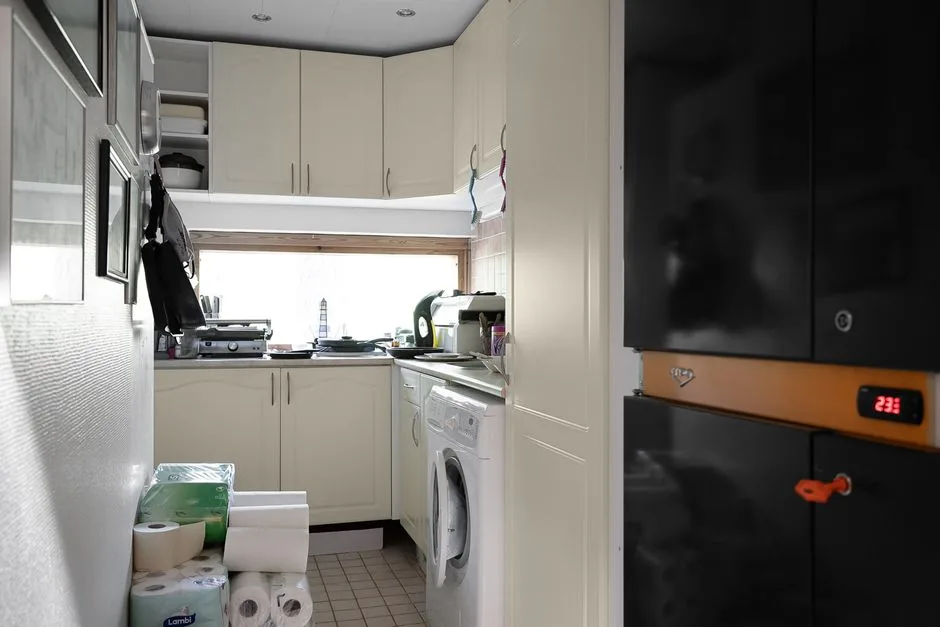
This is where most articles give you a product list. I’m going to give you a principles list instead, because the specific products change — the principles don’t.
Principle 1: Vertical First, Horizontal Second
In a small laundry room, floor space is your most valuable and most limited resource. Every storage solution that sits on the floor consumes floor space that you’re then navigating around for the life of that room. Wall-mounted solutions cost more to install and require more planning, but they return floor space to you permanently. In rooms under 40 square feet, I would almost always recommend spending more on wall-mounted storage and less on floor-standing furniture.
Specific applications of this principle:
- Replace a freestanding shelf unit with floating shelves at the same wall position
- Mount a drying rack on the wall rather than using a floor-standing rack that folds out
- Use a wall-mounted ironing board instead of a stored standing board
- Install a ceiling-mounted drying bar for air-dry items instead of a tension rod that requires floor-anchored poles
Principle 2: Door Real Estate Is Almost Always Unused
The back of the laundry room door and the inside surfaces of cabinet doors are consistently the most underused storage surfaces in small laundry rooms. They’re overlooked because they’re not visible when the door is open. They’re also ideal for small, lightweight items that don’t need structural shelf support.
What works on door surfaces:
- Shallow over-door organizers (depth matters — anything over 3 inches starts interfering with door closure or room clearance)
- Magnetic strips for scissors, safety pins, and small metal tools
- Small hooks for reusable shopping bags used for laundry transport
- A pocket organizer for instruction manuals and appliance documentation
Principle 3: The Decant Rule Saves More Space Than Any Organizer
Switching from original product packaging to uniform containers — a practice called decanting — saves more visual space and more functional space than any organizer product I’ve ever installed. A large detergent box occupies roughly twice the footprint of the same detergent in a tall, slim dispenser bottle. A bag of dryer sheets stuffed back into its original packaging takes up three times the space of the same sheets folded flat in a slim bin.
The items worth decanting in a small laundry room:
- Powder detergent into a sealed container with a measuring scoop attached to the lid
- Dryer sheets into a flat-stacking container
- Stain spray into a single labeled bottle (consolidating from multiple products where possible)
- Small hardware items like safety pins and clothespins into a single small jar
Principle 4: Label Everything You Can’t See
In small laundry rooms, items stored in cabinets or in containers with lids become invisible. Invisible items get purchased again, duplicated, and eventually create the clutter overload that defeats the storage system entirely. Labeling isn’t decorative — it’s functional. A label on a bin tells you when you’re low, what goes there, and stops you from opening six containers to find the dryer sheet you’re looking for at 7am.
Configuration-Specific Advice: Because Room Shape Changes Everything
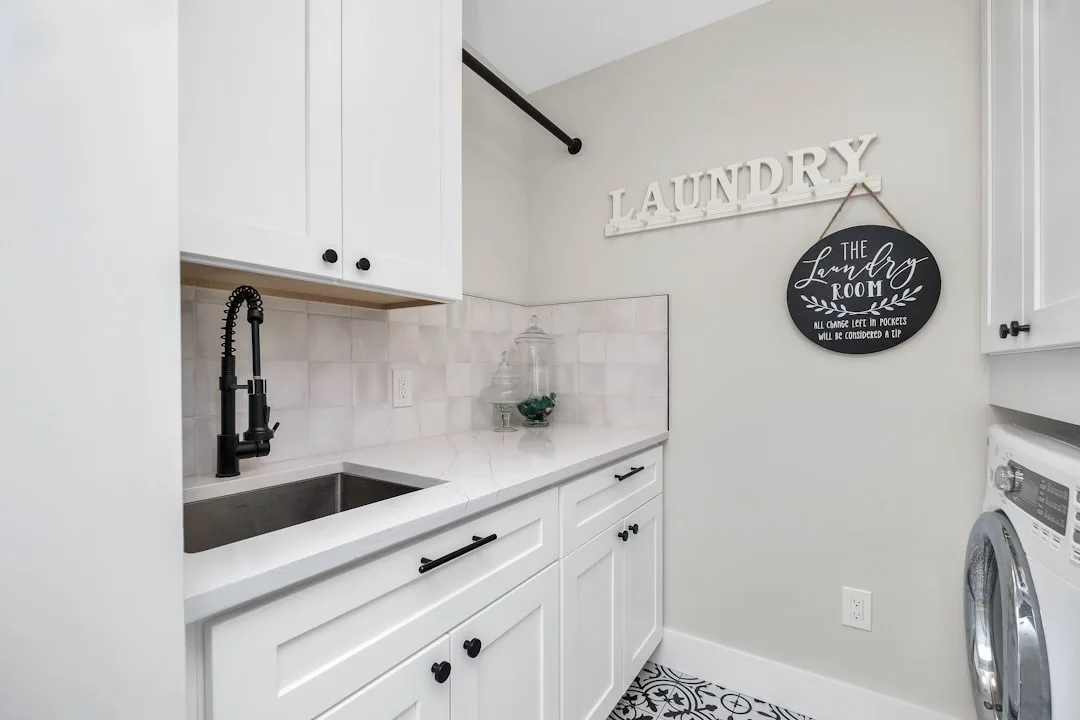
The laundry room storage ideas small space solutions that work in a galley layout fail completely in an alcove layout. Here’s how configuration should change your approach.
Galley laundry rooms (machines side by side in a narrow corridor) have wall space on two facing sides. The trap here is installing matching shelving on both walls and then being unable to stand between them comfortably. Use one wall for active storage (zones 1 and 2) and the opposite wall — if you must use it at all — only for supply storage or a fold-down table.
Closet laundry rooms (bifold or pocket door, machines stacked or side by side in a converted closet) have almost no usable wall space. The entire storage strategy here is:
- Use the wall directly above the machines for one shelf only, at a reachable height
- Use the inside of the closet doors for lightweight storage
- Accept that bulk supply storage lives outside this space
- Use the side walls of the closet opening for narrow hooks or magnetic strips
Alcove laundry rooms (three enclosed walls, open on one side) offer the best storage geometry of the three. The back wall above the machines is your primary zone 4 storage. The side walls are ideal for zones 1 and 2. The open side should remain open — closing it with a curtain or cabinet doors is tempting but reduces the sense of space significantly in a room that’s already tight.
Laundry closets behind bifold doors require a different mindset entirely: everything needs to be visible and accessible without entering the space. This means:
- No storage that requires opening, removing, or moving another item to reach
- Everything labeled and forward-facing
- Hampers that roll out rather than sit stationary
- No fold station inside the closet — folding happens outside it, always
The Mistakes I Saw Most Often (And How to Avoid Each One)
After eleven years of working in small laundry rooms, the same mistakes appeared over and over. Here they are, specifically:
Buying the cart before measuring the gap. Slim gap carts are sold in widths ranging from 4 to 9 inches. The gap beside your machines might be 5 inches on one side and 3 on the other. Measure before you order, and measure in two places — floor level and countertop level, because walls aren’t always plumb.
Installing shelves at one uniform height. A single shelf line at one height across an entire wall wastes the variation in what you’re storing. Detergent bottles are tall; dryer sheets are flat. Install shelves at different heights based on what they’re actually holding, not what looks symmetrical.
Using open shelving and then being surprised by the mess. Open shelving requires active maintenance. In a laundry room — where humidity is high, items are grabbed quickly, and the room is often the last to be tidied — open shelves become visual chaos within weeks. Cabinet doors aren’t just aesthetic. They hide the inevitable disorder of a working utility space.
Treating the top of appliances as permanent storage. The top of your washer and dryer is a work surface, not a shelf. The moment it becomes permanent storage, you’ve lost your fold station and your visual breathing room simultaneously.
Ignoring the floor entirely. In small laundry rooms, the floor is often completely occupied by machines — but the area in front of the machines and the walking path through the room deserve thought. A non-slip mat in front of the machines reduces fatigue during folding. A recessed hamper track (if you’re renovating) lets hampers slide out without consuming floor clearance. Even a simple decision about which direction the hamper faces can change whether the room feels functional or cramped.
What a Real Laundry Room Storage Makeover Actually Looks Like
To make this concrete: a client in a 38-square-foot galley laundry room came to me having already purchased two floating shelves, a slim rolling cart, an over-door organizer, and a freestanding three-tier shelf unit. None of it was working. She described the room as “impossible.”
Here’s what we changed:
- Returned the freestanding shelf unit entirely — it was consuming 14 inches of the 22 inches of walking clearance remaining after the machines were installed
- Repositioned the two floating shelves: one at drum-door height for wash station supplies, one at 66 inches for bulk backup storage
- Moved the rolling cart from beside the dryer (where it was blocking the door swing) to the opposite wall, used as a fold surface with a wooden top added
- Installed a magnetic side caddy on the dryer for dry station supplies
- Added door-mounted shallow organizers for truly lightweight items only
Total cost of changes: under $80, because most of it involved repositioning what she already owned rather than buying new products.
The room didn’t get bigger. The geometry didn’t change. What changed was the assignment of storage to zones, the removal of one floor-standing piece, and the reorganization of shelf heights. That’s the version of laundry room storage ideas small space advice that actually produces results — not a product list, but a framework for thinking about what goes where and why.
Frequently Asked Questions
Q: What’s the single most useful storage addition for a laundry room under 40 square feet?
A wall-mounted fold-down table, if you don’t have a fold surface. If you already have one, the most useful addition is a zone-specific caddy at drum-door height for wash supplies. The fold surface solves behavior problems (laundry left unfolded); the wash caddy solves access problems (knocking things over while loading). Most small laundry rooms are missing both.
Q: Are slim gap carts actually useful or just a trend?
They’re genuinely useful in exactly one situation: when your gap measures between 5 and 9 inches and you need active-access storage in that position. Outside of that scenario — if the gap is under 4 inches, or if the cart would end up storing items you rarely use — they add visual clutter without functional return. Measure the gap first. Then decide.
Q: Should I use open shelving or closed cabinets in a small laundry room?
Closed cabinets for supply storage, open shelving only for items you use every single laundry cycle. The humidity in a working laundry room, combined with the speed at which you’re typically grabbing items, means open shelves disorder quickly. Cabinet doors solve both problems. The compromise is one open shelf at active-use height and cabinets for everything else.
Q: How do I handle laundry room storage when the machines are stacked?
Stacked configurations change the entire vertical equation. Your usable shelf space is typically limited to one shelf above the unit at a reachable height — approximately 18–24 inches above the top of the stacked dryer, which on most units puts that shelf at 84–96 inches from the floor. That’s above comfortable reach for most people. The more practical answer for stacked configurations is to put most supply storage outside the laundry space — in an adjacent cabinet, a nearby closet, or a small dedicated utility shelf in a hallway — and keep only active-cycle supplies inside the laundry area itself.
Q: My laundry room is a closet with bifold doors. What laundry room storage ideas for small spaces actually work here?
Three rules for bifold laundry closets: everything must be visible without entering, everything must be reachable from the threshold, and nothing should require moving another item to access. In practice this means one shelf directly above the machines at a height you can reach from outside, a divided hamper that rolls out, supplies stored in a caddy on the side wall at eye level, and bulk storage relocated entirely outside the closet. Resist the urge to fill every inch — in a bifold closet, negative space is functional space.