Mixing sofa styles in your living room is one of the most effective ways to make a space look expensive — and it’s also one of the most misunderstood. The matching sofa set was invented by furniture showrooms to sell you two pieces at once — it was never a design rule, and the rooms that look most expensive almost never follow it.
Quick Answer
The matching sofa set was invented by furniture showrooms to sell you two pieces at once — it was never a design rule, and the rooms that look most expensive almost never follow it.
I spent eleven years speccing seating for living rooms across Chicago and New York, and the single most common thing I saw homeowners get wrong wasn’t color or scale or lighting. It was the assumption that two sofas had to match to look intentional. That assumption costs people money, makes rooms feel flat, and comes directly from furniture retail — not from any principle of design.
What actually makes a living room feel expensive is controlled tension: two pieces that are clearly different but clearly related. That relationship is what this article is about.
Why Matching Sofas Are Quietly Killing Your Living Room
In This Article
- Why Matching Sofas Are Quietly Killing Your Living Room
- The 3 Rules That Make Any Sofa Pairing Work
- 1. The Sectional and the Accent Sofa
- 2. Chesterfield Meets Clean-Line Contemporary
- 3. Two Sofas, Opposite Each Other — Making the Facing Arrangement Work
- 4. Mixing Materials: Leather and Fabric in the Same Room
- 5. Scale Contrast: The Oversized Sofa and the Slim Two-Seater
- 6. Pattern and Solid: Bringing Print Into a Two-Sofa Room
- 7. Mid-Century Modern Meets Organic Contemporary
- 8. The Neutral + One Bold Piece Formula
- 9. Two Different Periods, One Shared Finish
- How to Avoid the Most Common Mistakes When Mixing Sofa Styles
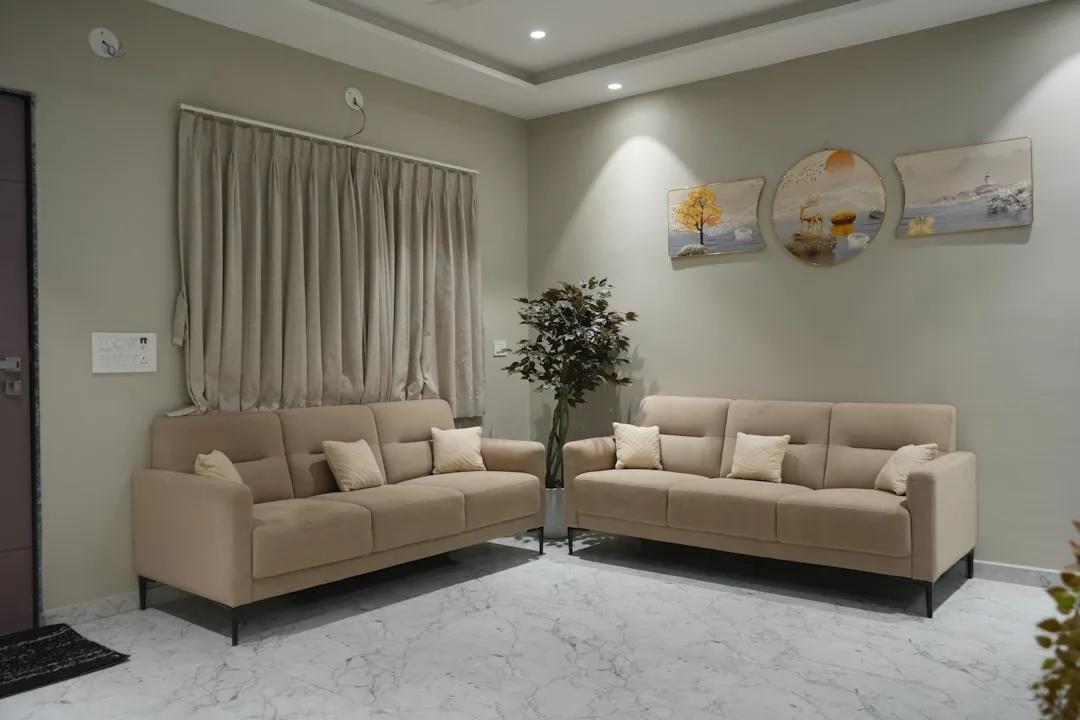
Somewhere around the mid-century boom, American furniture showrooms figured out that selling a sofa and a loveseat as a set moved more inventory than selling each piece on its own. The “matching suite” was a retail solution dressed up as a design standard, and it stuck — not because designers endorsed it, but because it made shopping easier and returns less likely.
The problem is what matching actually does to a room visually. When two sofas are identical, the eye recognizes repetition immediately and stops moving. There’s nothing to discover. The room reads as settled rather than considered, and the furniture becomes background rather than the point. Flat. Finished. Forgettable.
Contrast that with a room where the seating has been deliberately mismatched — different silhouettes, different materials, unified through something quieter like leg finish or color family. The eye moves between the pieces, comparing them, finding the relationship. That movement is what people describe as a room that “feels designed.” It’s not mysterious. It’s just visual rhythm, and matching furniture eliminates it entirely.
The pattern I kept seeing in high-end residential projects was this: the more prestigious the firm, the less likely you were to find two identical sofas in the same room. Not because expensive designers chase novelty, but because they understand that repetition in furniture is the visual equivalent of a monotone voice — technically fine, thoroughly unengaging.
One more thing worth understanding about the matching impulse: it signals anxiety about being wrong. Intentional mismatch signals confidence. And confidence reads as expensive before the eye even processes what it’s looking at.
The principles behind mixing sofa styles in a living room aren’t complicated once you understand what you’re actually doing — you’re creating controlled contrast, not chaos. Every pairing in this article follows the same underlying logic: find one strong difference, find one quiet similarity, let those two things do the work.
Actionable takeaway: Before you buy a second sofa, decide what it will contrast with — silhouette, material, or scale — and treat that contrast as the design decision, not a problem to solve.
The 3 Rules That Make Any Sofa Pairing Work
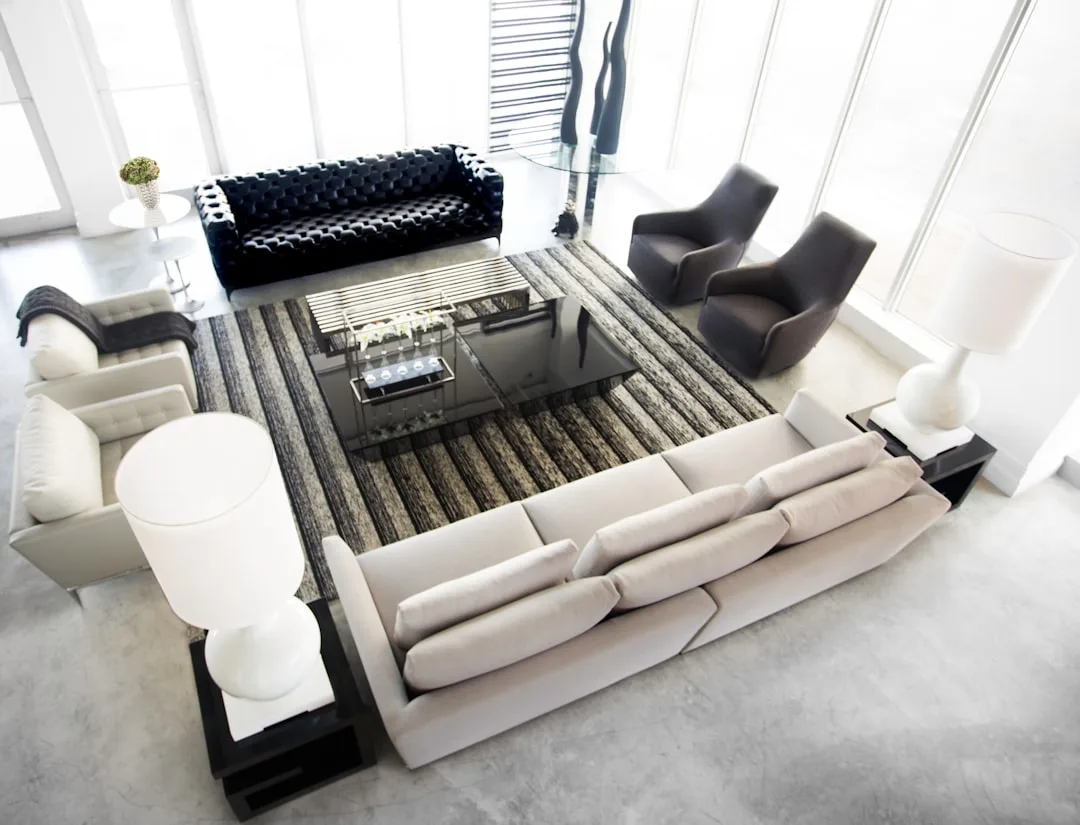
Before getting into specific pairings, it helps to understand the framework that sits underneath all of them. These aren’t arbitrary guidelines — they’re the structural logic that separates a deliberate living room from an accidental one.
Rule 1: One strong contrast, one quiet connection.
Every successful pairing has exactly one thing that’s clearly different and at least one thing that’s quietly the same. Different silhouette, same leg finish. Different material, same color family. Different scale, same arm height. The contrast gives the eye something to discover. The connection tells the eye the room was planned. When you break this rule — two contrasts with no connection — the room reads as disjointed. When you follow it, the room reads as considered.
Rule 2: Scale before style.
The single most common mistake when mixing sofa styles in a living room is choosing the second piece based on how it looks in a showroom or a product photo, rather than how it will read in relation to the first piece. Before you think about silhouette or material, establish the size relationship. In a facing arrangement, both sofas should be within 20% of each other in length. In an L-shaped arrangement, the secondary piece should read as roughly 50–65% of the anchor’s visual mass. Get scale wrong and nothing else fixes it.
Rule 3: The rug does more work than you think.
A single rug running underneath both pieces of seating is the fastest way to make a mismatched pairing look intentional rather than assembled. The rug creates a visual frame that says these two things belong to the same moment. Without it, even a well-matched pair can drift apart visually. With it, even a high-contrast pairing snaps into a room.
Keep these three rules in your head as you read through the pairings below. You’ll see them operating in every single one.
1. The Sectional and the Accent Sofa
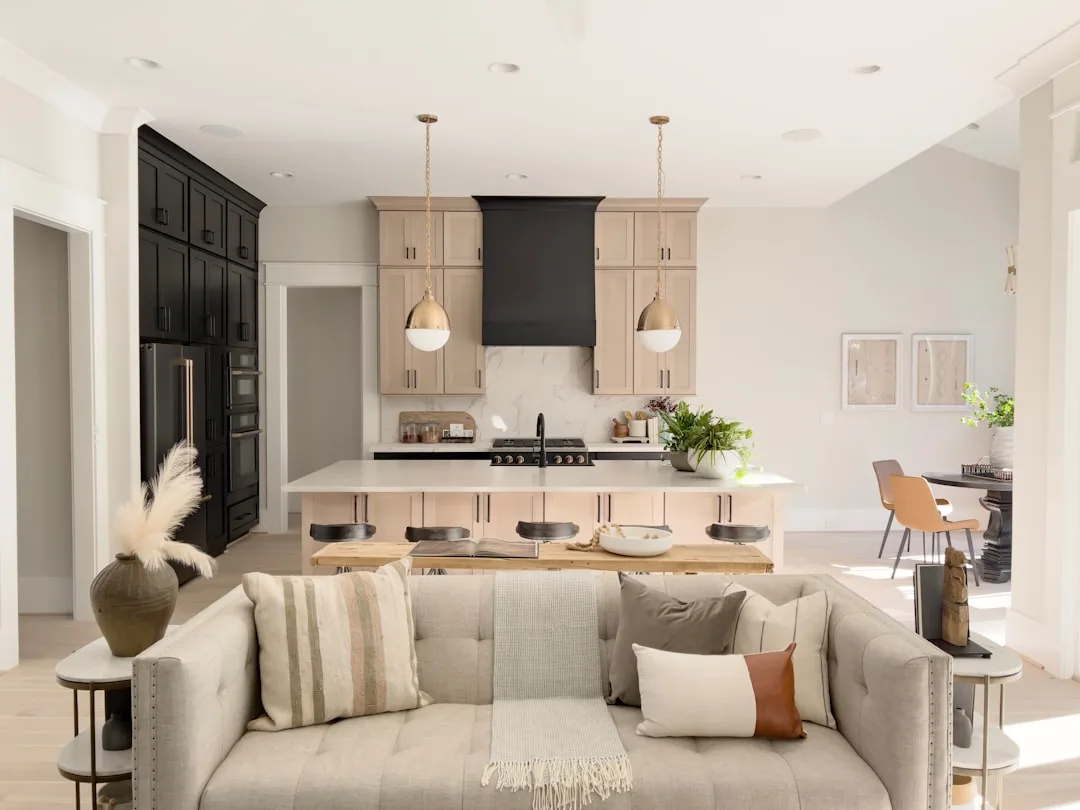
Most people who own a sectional never think to add a second sofa. The sectional already seats six, so why bother? Because a sectional alone — regardless of how beautiful it is — tends to swallow a room. It creates one enormous seating mass with no counterpoint, and the eye has nothing to bounce off of.
The fix is an accent sofa, placed on the perpendicular axis rather than opposite the sectional. Think of the sectional as the room’s anchor and the accent sofa as its counterweight — not competing, just balancing.
Scale is everything here. The accent sofa should read as roughly 50–65% of the sectional’s visual mass. Go smaller than that and it disappears, looking like an afterthought or an overflow piece dragged in from a bedroom. Go larger and you’ve created two competing anchors fighting for dominance, which is exactly what makes rooms feel unsettled.
The practical rule I used in client rooms:
- Leg finish: match the sectional’s leg material exactly, even if you swap the upholstery entirely
- Arm height: keep both pieces within 2–3 inches of each other — wildly different arm heights create a jarring horizon line when you’re seated
- Depth: the accent sofa can be shallower than the sectional, which actually helps — it reads as intentionally different in scale rather than just smaller
- Upholstery texture: if the sectional is matte (linen, cotton, boucle), consider a sofa with slight sheen (velvet, leather) to add visual interest without changing color
- Cushion count: don’t try to match it — an odd number of cushions on the accent sofa against an even number on the sectional creates another layer of deliberate asymmetry
One shared material element between the two pieces — matched legs, similar arm height, or even just the same throw pillow fabric appearing on both — creates subconscious unity without the pieces looking coordinated in the showroom sense. The eye reads “related” without reading “matchy.”
I once helped a client in Wicker Park pair a massive gray linen sectional with a tufted emerald velvet sofa on the perpendicular wall. Different in almost every way. But both had natural oak legs, and we ran the same jute rug underneath both. The room looked like it had been built by someone who knew exactly what they were doing. She had picked both pieces herself, two years apart, and was convinced they were going to look terrible together. They didn’t.
Actionable takeaway: Measure 50–65% of your sectional’s total width and use that number as your accent sofa’s maximum length when shopping.
2. Chesterfield Meets Clean-Line Contemporary
This is one of the highest-contrast pairings you can make, and it’s also one of the most searched — for good reason. Done right, it’s the room that makes guests ask who your designer is. Done wrong, it looks like a waiting room at a hotel that can’t decide if it’s boutique or budget.
The Chesterfield is a maximalist object. Deep button tufting, rolled arms, substantial visual weight — it carries centuries of formal tradition in its silhouette. A second maximalist piece next to it compounds the noise until the room feels suffocated. The move is a low-profile, track-arm contemporary sofa that does the opposite: clean lines, flat cushions, no decorative detail competing with the Chesterfield’s surface.
What makes this pairing cohesive rather than chaotic comes down to one decision: color family. Both pieces should live in the same tonal register — both warm neutrals, both cool grays, both in the blue-green family — so that the silhouette contrast is clearly intentional and the color isn’t adding a second layer of contrast on top of it. Two contrasts fighting at once is how rooms go wrong. One contrast, well-executed, is how rooms go right.
This pairing also benefits enormously from architectural context. A Chesterfield in a room with crown molding, a brick fireplace, or original wainscoting reads as an homage to the building’s bones. The contemporary sofa grounds the room in the present tense. Together, they make the space feel like it has a history and an opinion — which is the exact quality people reach for when they say a room feels “expensive” or “curated.”
A few specifics that make this pairing land:
- Use the same metal finish on leg hardware, coffee table legs, and light fixtures — it becomes the thread that ties the two eras together
- Place the Chesterfield on the wall with the strongest architectural feature (fireplace, bay window, built-ins) — let it be the formal anchor
- Put the contemporary sofa opposite or perpendicular, angled slightly toward the Chesterfield to signal dialogue rather than competition
- Add a single vintage accent piece — a leather campaign chair, a brass floor lamp, an antique side table — to support the Chesterfield’s register without doubling it
Actionable takeaway: When shopping for the contemporary counterpart to a Chesterfield, filter for track arms, low profiles, and a seat height within one inch of your Chesterfield’s. Silhouette contrast should be the drama. Everything else should be quiet.
3. Two Sofas, Opposite Each Other — Making the Facing Arrangement Work
The facing sofa arrangement is the oldest living room configuration there is, and also the one most likely to look either spectacular or deeply uninspired depending on one decision: whether the two pieces are identical or deliberately different.
When both sofas match, the facing arrangement reads as symmetrical and formal — occasionally appropriate, mostly flat. When the two sofas differ in a controlled way, the facing arrangement becomes a conversation, literally and visually. The eye moves back and forth between the pieces the way people move back and forth in dialogue.
The rules for a successful facing arrangement when mixing sofa styles in a living room:
- Length within 20% of each other — a 90-inch sofa facing a 72-inch sofa creates imbalance; a 90-inch sofa facing an 84-inch sofa creates tension that reads as intentional
- Seat height within 2 inches — when both pieces are occupied, the sightlines should feel level, not like one side is elevated
- One piece upholstered, one with exposed frame — a fully upholstered sofa facing a sofa with visible wood or metal framing creates strong contrast while maintaining the same category of object
- Use the coffee table as the mediator — a rectangular table that extends nearly the full length of the shorter sofa visually connects both pieces into a single seating zone
The most successful facing arrangements I’ve seen treat the two sofas the way a good editor treats a manuscript: each piece is doing its job, neither is trying to do both jobs.
Actionable takeaway: If your two sofas differ in length, place the longer one on the wall with less natural light — it will appear to recede slightly, equalizing the visual balance.
4. Mixing Materials: Leather and Fabric in the Same Room
Leather and fabric sofas in the same living room used to signal budget constraint — the idea that you bought what you could afford at different times. That read has reversed completely. A leather sofa paired with a fabric sofa, done correctly, now signals an understanding of material contrast that most matching-set rooms don’t have.
The logic is the same as texture in any other design discipline: a room made entirely of one surface — all smooth, all rough, all matte — is less interesting than one where different surfaces play off each other. Leather is cool, smooth, formal. Fabric is warm, textured, relaxed. Together they create a material conversation that gives the room dimension.
What makes the leather-and-fabric pairing work:
- Keep the leather piece simpler in silhouette — a clean-line leather sofa with minimal detail is a better partner than a heavily tufted or rolled-arm leather piece, which competes with whatever texture the fabric brings
- Match the undertones, not the colors — a warm cognac leather reads well next to a warm cream boucle or a warm terracotta linen; a cool charcoal leather reads well next to a cool slate blue or dusty sage fabric
- Use leather as the accent, not the anchor — in most living rooms, the larger sofa should be fabric and the smaller or secondary piece should be leather; leather’s visual weight is higher per square inch, so it doesn’t need to be the bigger piece to register as equal
- Don’t match the leather to anything else in the room — no leather coffee table, no leather chairs in the same colorway; let the leather sofa be singular
- Age matters: a slightly broken-in leather sofa next to a crisp, new fabric piece creates a pleasing patina contrast — don’t worry about the leather looking worn; worry about it looking cheap
Actionable takeaway: When combining leather and fabric sofas, buy the fabric piece first and bring a large swatch to leather showrooms. Match undertone in natural light, not showroom lighting.
5. Scale Contrast: The Oversized Sofa and the Slim Two-Seater
This pairing is underused and almost always successful when the proportions are handled correctly. The principle is simple: one very large sofa establishes the room’s scale, and one deliberately small sofa — a slim two-seater or settee — provides a counterpoint that makes the large piece look even more intentional rather than just big.
What makes this pairing different from simply having a mismatched set is the intentionality of the size gap. You’re not trying to find two similarly sized sofas in different styles. You’re committing to a large-and-small relationship the way a room commits to a large piece of art on one wall and nothing on the wall opposite.
The mechanics:
- The large sofa should be 90 inches or longer — anything shorter reads as a normal sofa rather than an oversized anchor
- The two-seater should be 60 inches or shorter — this is where you can afford to go more formal, more decorative, or more unusual in silhouette, because the size keeps it from overwhelming the room
- Place them on non-opposing walls — this pairing works best in an L-shape or angled toward each other, not in a direct face-off where the size difference becomes awkward
- Use the small sofa for the more expressive piece — a carved wood frame, an unusual fabric, a higher back — the small scale contains the expressiveness and keeps it from tipping into maximalist excess
- Add a single large-scale element near the small sofa — a tall floor lamp, an oversized plant, a large side table — to bring it into visual equilibrium with the anchor sofa
This is also the pairing that gives you the most flexibility when mixing sofa styles in a living room across different eras. A large, clean-lined contemporary sofa next to a small Victorian-silhouette settee is a pairing that works precisely because the size difference signals that you chose each piece for its own merits, not to create a set.
Actionable takeaway: When sourcing the two-seater, shop antique markets and vintage dealers — smaller sofas in interesting silhouettes are far easier to find secondhand than at retail, and the patina adds to the intentional contrast.
6. Pattern and Solid: Bringing Print Into a Two-Sofa Room
Most people treat pattern in upholstery as a risk to be avoided, particularly when they’re already navigating the complexity of mixing sofa styles in a living room. That instinct is understandable and wrong. A patterned sofa paired with a solid sofa is often the clearest signal that a room was designed rather than assembled, because pattern requires commitment — and commitment reads as confidence.
The pairing rules are precise here:
- Pattern on the secondary piece, solid on the anchor — the larger, anchor sofa should be solid; the accent sofa carries the pattern; this keeps the room from tipping into visual overload
- Pull the solid color from the pattern’s background, not its dominant color — if your patterned sofa has a cream background with navy and terracotta motifs, the solid sofa should be cream, not navy; the dominant color becomes an accent through pillows and accessories instead
- Scale of pattern matters as much as the pattern itself — a large-scale botanical or geometric on a smaller sofa reads as bold and confident; a small-scale allover pattern on a large sofa reads as busy and restless; match pattern scale to sofa scale inversely
- Avoid pattern on pattern — one patterned sofa is a statement; two patterned sofas facing each other require expert-level color matching most rooms can’t support
- Repeat the pattern’s secondary color in at least two other places in the room — a lamp base, a rug border, a piece of art — this grounds the pattern and prevents it from reading as a mistake
Actionable takeaway: Before committing to a patterned sofa, photograph your solid anchor sofa and bring the image to the showroom. Hold swatches of the patterned options against your phone screen in natural light. You’re looking for the pattern whose background matches your solid’s undertone.
7. Mid-Century Modern Meets Organic Contemporary
This is the pairing that defines a specific moment in interior design right now, and it’s effective because both aesthetics share structural DNA while looking visually distinct. Mid-century modern is linear, intentional, slightly austere — tapered legs, low profiles, precise proportions. Organic contemporary is curved, tactile, soft — rounded edges, textured upholstery, cloud-like forms. They contrast in shape but share a commitment to simplicity and quality of material.
What makes this pairing particularly successful for living rooms:
- The mid-century piece handles the structured end of the arrangement — place it where the room needs definition, usually against the primary wall or anchoring the conversation area
- The organic contemporary piece handles the comfort end — place it where the room needs softness, usually at an angle or on the perpendicular wall
- Leg style becomes the linking element — many organic contemporary sofas now come on slim, tapered legs that echo mid-century proportions; prioritize this feature when sourcing the contemporary piece
- Keep upholstery in the same material category — both in fabric (linen, boucle, cotton blend) or both with one leather accent; crossing material categories here adds a third variable that can overwhelm the silhouette contrast you’re trying to showcase
- Let the coffee table be mid-century in spirit — a walnut or teak surface with tapered legs bridges both aesthetics without choosing a side
The reason this pairing keeps appearing in the most-shared living room images is that it photographs beautifully — the silhouette contrast is clear and reads immediately, the softness of the organic piece adds warmth that prevents the room from feeling cold or austere, and the shared simplicity keeps it from looking cluttered regardless of what else is in the room.
Actionable takeaway: If you already own a mid-century sofa and want to add a second piece, search specifically for “curved sofa boucle tapered legs” — this combination was designed by the market to be exactly the contemporary counterpart to mid-century pieces, and the options at most price points are strong.
8. The Neutral + One Bold Piece Formula
This isn’t a specific sofa style pairing so much as a framework that works across all of them, and it’s worth addressing directly because it’s the approach that most reliably gets the mixing sofa styles in living room equation right for people who are nervous about getting it wrong.
The formula: one sofa in a true neutral — warm white, natural linen, oatmeal boucle, soft gray — and one sofa in a single committed color or material that reads as bold by contrast.
What “bold” means here is relative to the neutral. Next to a natural linen sofa:
- A deep forest green velvet reads as bold
- A cognac leather reads as bold
- A dusty rose bouclé reads as bold
- A charcoal cotton canvas reads as bold
Next to a charcoal sofa, none of those would read as bold — you’d need to go brighter or more saturated. The neutral establishes the baseline; the second piece defines itself against it.
Why this formula works so reliably:
- The neutral sofa never fights with the room — it recedes appropriately and lets the architecture, art, and accessories register
- The bold piece becomes the room’s point of view — it’s the decision that shows up in every photograph of the space and gives the room its character
- Mistakes are recoverable — if the bold piece stops working with your room over time, reupholstering or replacing one sofa is far more manageable than reconsidering an entire matched set
- The relationship scales with budget — this formula works at every price point because the neutral piece can be the more affordable of the two, and the bold piece receives the investment
Actionable takeaway: Identify your room’s most successful existing element — the rug, the art, the architectural feature — and let the bold sofa’s color come from there. The room will look planned because it will be planned.
9. Two Different Periods, One Shared Finish
The most advanced pairing on this list, and the one that looks most like something a designer built on purpose: two sofas from clearly different design periods, unified by a single shared finish detail that signals the choice was intentional.
Period contrast in furniture is powerful because it implies that you curated from different sources — that the room is assembled from pieces chosen for their individual merit rather than purchased as a package. That reads as expensive because it is expensive, in terms of time and knowledge if not always money.
What makes period contrast work versus look chaotic:
- The shared finish must be specific, not general — “both have dark legs” is too vague; “both have ebonized oak legs in the same stain” is specific enough to read as a decision
- The periods should be separated by at least 40–50 years — a 1960s piece and a 1980s piece are too close in visual language to read as deliberate contrast; a 1920s piece and a 1970s piece are far enough apart that the contrast is unambiguous
- Both pieces should be clearly well-made — period contrast fails immediately if one piece reads as a reproduction or a budget version; the quality of each piece needs to stand on its own before the pairing can elevate both
- The room’s other elements should be neutral in period — art, rugs, and accessories from a specific era will start to weight the room toward one period and undermine the contrast you’ve built into the seating
- Shop the earlier piece first — older pieces are harder to find in specific conditions and sizes; once you have it, finding a contemporary or modern counterpart that matches a specific finish detail is a manageable sourcing problem
Period contrast is where mixing sofa styles in a living room moves from a design approach to a point of view. It’s not for everyone. But when it’s done with a clear shared detail and two pieces of genuine quality, it’s the pairing that makes a room look like it could appear in a magazine — because it often does.
Actionable takeaway: Before buying any vintage or antique sofa as a primary piece, measure the seat height, seat depth, and arm height, and keep those numbers. Every subsequent piece you consider should be evaluated against them first.
How to Avoid the Most Common Mistakes When Mixing Sofa Styles
Getting the pairing right is one half of the equation. Avoiding the moves that undermine it is the other half. These are the mistakes that show up most often:
Buying both sofas at the same store. Not because it’s always wrong, but because it trains you to evaluate the pieces in relation to each other in a showroom context rather than in relation to your actual room. Showrooms are designed to sell pairs. Your room is not a showroom.
Treating color as the primary contrast. Color is the hardest contrast to control because it changes with light, with the room’s other elements, and over time. Silhouette and material contrasts are more stable and more legible. Use color as a unifier, not as the main event.
Skipping the rug. There is almost no pairing in this article that doesn’t benefit from a single rug running under both sofas. The rug is what tells the eye these two pieces belong to the same conversation. Without it, even a well-executed pairing can drift.
Making both sofas equally interesting. In any pairing, one piece should lead and one should support. The room needs a hierarchy. When both sofas are competing for attention — both patterned, both sculptural, both in statement colors — the room exhausts the eye rather than engaging it.
Ignoring the back of the sofa. If either sofa will be visible from the back — floating in the middle of the room rather than pushed against a wall — the back of the piece matters as much as the front. Many sofas that look beautiful from the front are unfinished or awkward from behind. Check before you commit.
Frequently Asked Questions
Can I mix sofa styles in a small living room, or does this only work in large spaces?
It works in small rooms — sometimes better than in large ones. The key adjustment is scale. In a small room, the contrast between two pieces needs to be in silhouette or material rather than in size, because you don’t have the square footage to absorb scale contrast without the room feeling crowded. A small room with a low-profile contemporary sofa and a slim vintage loveseat in a complementary color can read as deliberate and thoughtful. The same room with a large sectional and an accent sofa would be a mistake. Use the three-rule framework — one strong contrast, one quiet connection, a unifying rug — and the space constraint becomes a clarifying constraint rather than a limitation.
How do I know if two sofas that I already own can be made to work together?
Start with the leg finish and the arm height. If both pieces have the same leg material or can be refinished to match, and if their arm heights are within two to three inches of each other, you have a workable foundation. From there, the question is what one element you can add — a rug, matching throw pillows, a shared accent color in the accessories — that tells the eye the pieces are related. If the leg finishes are incompatible and the arm heights are dramatically different, the honest answer is that one piece needs to go.
Is it acceptable to mix sofa styles from completely different eras, like a Victorian piece with a modern sofa?
Yes, and Pairing 9 in this article covers exactly that. The requirement is a specific shared detail — not a general similarity, but something precise and identifiable, like a matched leg stain or an identical arm height. Without that shared detail, the era contrast reads as an accident. With it, it reads as a curatorial decision. The other requirement is quality in both pieces. Period contrast fails if one piece looks like a reproduction.
What’s the easiest pairing to start with if I’ve never mixed sofa styles before?
The neutral-plus-one-bold formula from Pairing 8. Buy or keep a solid neutral sofa — linen, boucle, or a clean fabric in a warm white or soft gray — and add one piece in a single committed color or material that contrasts with it. The neutral piece absorbs the risk; the bold piece does the work. If the bold piece stops working over time, you replace or reupholster one sofa rather than reconsidering everything. It’s the most forgiving entry point into mixing sofa styles in a living room, and it’s also one of the most effective.
Do the sofas need to be the same brand or from the same collection to work together?
No — and in fact, buying both from the same collection often defeats the purpose. Most furniture collections are designed to coordinate, which means they share enough visual DNA to read as a set rather than as two deliberately chosen pieces. The pairings that look most intentional almost always come from different sources: one from a retailer, one vintage, one custom. Different origins are a feature of the approach, not a risk to manage.
Can I mix sofa styles in a small living room, or does this only work in large spaces?
It works in small rooms — sometimes better than in large ones. The key adjustment is scale. In a small room, the contrast between two pieces needs to be in silhouette or material rather than in size, because you don’t have the square footage to absorb scale contrast without the room feeling crowded. A small room with a low-profile contemporary sofa and a slim vintage loveseat in a complementary color can read as deliberate and thoughtful. The same room with a large sectional and an accent sofa would be a mistake. Use the three-rule framework — one strong contrast, one quiet connection, a unifying rug — and the space constraint becomes a clarifying constraint rather than a limitation.
How do I know if two sofas that I already own can be made to work together?
Start with the leg finish and the arm height. If both pieces have the same leg material or can be refinished to match, and if their arm heights are within two to three inches of each other, you have a workable foundation. From there, the question is what one element you can add — a rug, matching throw pillows, a shared accent color in the accessories — that tells the eye the pieces are related. If the leg finishes are incompatible and the arm heights are dramatically different, the honest answer is that one piece needs to go.
Is it acceptable to mix sofa styles from completely different eras, like a Victorian piece with a modern sofa?
Yes, and Pairing 9 in this article covers exactly that. The requirement is a specific shared detail — not a general similarity, but something precise and identifiable, like a matched leg stain or an identical arm height. Without that shared detail, the era contrast reads as an accident. With it, it reads as a curatorial decision. The other requirement is quality in both pieces. Period contrast fails if one piece looks like a reproduction.
What’s the easiest pairing to start with if I’ve never mixed sofa styles before?
The neutral-plus-one-bold formula from Pairing 8. Buy or keep a solid neutral sofa — linen, boucle, or a clean fabric in a warm white or soft gray — and add one piece in a single committed color or material that contrasts with it. The neutral piece absorbs the risk; the bold piece does the work. If the bold piece stops working over time, you replace or reupholster one sofa rather than reconsidering everything. It’s the most forgiving entry point into mixing sofa styles in a living room, and it’s also one of the most effective.
Do the sofas need to be the same brand or from the same collection to work together?
No — and in fact, buying both from the same collection often defeats the purpose. Most furniture collections are designed to coordinate, which means they share enough visual DNA to read as a set rather than as two deliberately chosen pieces. The pairings that look most intentional almost always come from different sources: one from a retailer, one vintage, one custom. Different origins are a feature of the approach, not a risk to manage.