Most renters who attempt a rental apartment home office setup make the same mistake before they buy a single piece of furniture — they skip re-reading their lease, and by the time they’ve drilled four holes and installed a floating desk, they’ve already voided a clause that could cost them their entire security deposit. I’ve watched it happen. A client in Wicker Park lost $600 of her $1,200 deposit over two wall anchors and a cable channel she’d stuck to the baseboard with 3M adhesive. The landlord’s photography was thorough. Hers wasn’t.
Quick Answer
Most renters setting up a work-from-home space make the same mistake before they buy a single piece of furniture — they skip re-reading their lease, and by the time they’ve drilled four holes and installed a floating desk, they’ve already voided a clause that could cost them their entire security deposit.
This article won’t tell you to “add some greenery” and call it a day. What follows is what eleven years of working inside people’s actual apartments taught me — about space, about leases, about the gap between a workspace that looks good in a photo and one that actually holds up across a full workday.
Can You Actually Have a Dedicated Work Space in a Rental? (Yes — With Caveats)
In This Article
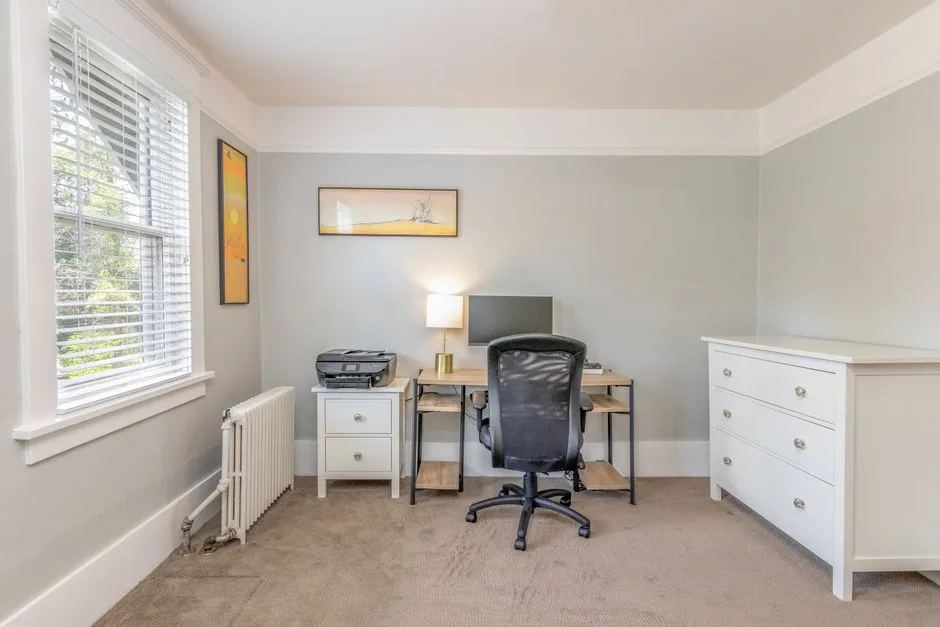
Dedicated workspace is achievable in almost any rental. The caveat isn’t space — it’s legal. Most standard leases contain a modification clause that prohibits structural changes: drilling, anchoring, cutting, patching. What they almost never restrict is furniture placement, zone creation, or how you orient objects within a room. That distinction is everything.
The critical difference is permanent vs. furniture-based. A floating desk bolted into studs is a permanent installation. A freestanding desk positioned against the same wall — same footprint, same function — is furniture. One voids your lease. One doesn’t. The law cares about the wall, not the desk.
Before you buy anything — before you even measure — pull out your lease and read the modification clause twice. Look for language around:
- “Alterations” — usually the broadest category; sometimes covers anything that changes the condition of the unit
- “Improvements” — often used to describe changes that add value, like built-ins or lighting fixtures
- “Fixtures” — legally specific; a fixture is something attached to the property that would cause damage if removed
- “Decorating” — some leases carve this out as permitted; others lump it in with alterations
Pay attention to whether the clause covers only structural changes or any modifications whatsoever. Some landlords use broad language that technically covers adhesive hooks. Most don’t. But you need to know which kind you’re dealing with.
If you want to do anything remotely ambiguous — tension rod installations, peel-and-stick wallpaper, adhesive cable management — get written permission. Not a text. Not a verbal yes in the hallway. An email will do; what matters is the paper trail. Something as simple as “I wanted to confirm in writing that it’s okay to use removable adhesive hooks rated under 5 lbs in the second bedroom” is enough. Most landlords say yes when you ask that specifically, because the ask is reasonable and you’ve demonstrated you’re the kind of tenant who asks first.
Before your first setup day, photograph everything:
- Every wall in your intended work area, from corner to corner
- Existing scuffs, nail holes, or paint chips — even ones you didn’t cause
- Baseboards, window frames, and floor surfaces near where furniture will sit
- The condition of outlets and cable entry points you plan to use
A 2023 Pew Research study found that 35% of remote workers have no dedicated workspace at home — and the correlation with lower productivity and higher burnout is consistent enough that it shows up across multiple workplace studies. For renters specifically, the obstacle isn’t usually the apartment. It’s the assumption that a dedicated workspace requires construction.
Takeaway: Read your lease before spending a dollar. If your landlord allows furniture-based zoning — and most do — you have more options than you think.
The 30% Rule Explained — And Why Most Remote Workers Apply It Wrong
Here’s something almost no article clarifies: the 30% rule has nothing to do with interior design. The U.S. Department of Housing and Urban Development defines housing cost burden as spending more than 30% of gross income on housing costs. That’s the 30% rule. It’s a financial benchmark developed to assess affordability at the household level — it has no bearing on how you divide a floor plan.
Where the confusion enters is from interior designers — including, I’ll admit, designers I worked alongside — who sometimes cite a loose “30% guideline” for functional zone allocation in open-plan spaces. The idea is that roughly 30% of a living area’s square footage should serve a single primary function at any given time to prevent the space from feeling chaotic. That’s a heuristic. A useful one, occasionally. But it’s not a rule, it’s not empirical, and applying it with false precision to a 480-square-foot apartment produces nothing useful.
What actually works is mapping your work circuit — the physical path your body travels during a workday. Not a percentage. A circuit.
Consider what you actually do between 9 a.m. and 5 p.m.:
- Where do you sit for deep focus work?
- Where do you take calls — standing, seated, pacing?
- Where do you eat lunch, and does that space double as a secondary work surface?
- What’s the path between your desk and the kitchen, and does it pull you out of focus or not?
- Where does natural light fall at 10 a.m. versus 2 p.m., and does it help or create glare on your screen?
- Which areas of the apartment feel “work mode” and which ones immediately trigger a mental shift toward relaxing?
Once you’ve traced that circuit honestly, you know where your work zone needs to live. It’s almost never the “best” corner with the most light. It’s usually the corner that keeps you out of the kitchen and away from the couch. The most productive rental workspaces I ever helped set up were positioned with friction in mind — deliberately placed so the path of least resistance led back to the desk, not away from it.
One practical way to map your circuit before committing to furniture placement: spend a single full workday in your apartment with a sticky note in your pocket. Every time you physically move from one area to another, mark it. At the end of the day, you’ll have a map of your actual movement pattern — not the idealized version. That data is worth more than any floor plan formula.
Takeaway: Stop trying to apply percentage rules to your floor plan. Map your actual work circuit and let that determine placement.
How to Set Up a Work Zone in a Small Rental Without Drilling a Single Hole
I’ll tell you what doesn’t work first, because I’ve seen it fail: buying a “home office bundle” from a big box store, assembling it in whatever corner has an outlet, and hoping for the best. What you get is a corner that looks like an office and feels like a storage unit — because nothing has been designed to signal to your brain that the space has a distinct purpose.
Zone creation in a rental is psychological before it’s physical. The direction your desk faces matters more than its size. A desk facing a wall creates a contained, forward-focused sightline that mimics the focused environment most people associate with productive work. A desk facing into the room — toward the couch, the TV, the kitchen — does the opposite. Same desk. Completely different behavioral outcome.
Research from the Journal of Environmental Psychology supports what I observed in practice: physical boundary cues, even symbolic ones, measurably reduce cognitive spillover between work and leisure behaviors in shared spaces. You don’t need a door. You need a signal.
Here’s what actually creates that signal without touching a wall:
- Tension rod partitions: Floor-to-ceiling tension rods — the kind rated for room dividers, not shower curtains — combined with fabric panels create a visual boundary that’s completely removable. IKEA’s KVARTAL track system adapts to this application. It’s not elegant, but it works.
- Freestanding shelving as a room divider: A bookcase positioned perpendicular to a wall defines space on both sides while adding storage. The KALLAX series from IKEA works well here. So does anything with a back panel that doesn’t require wall anchoring — the weight and footprint alone keep it stable.
- Area rugs as zone markers: A rug that sits only under your desk and chair creates a literal floor-level boundary that your brain registers as a distinct zone. It costs $40–$80 from most discount home stores and leaves zero trace when you move out.
- Lighting as a behavioral cue: A dedicated desk lamp with a warmer color temperature (2700K–3000K) that you turn on only during work hours trains your nervous system to associate that light quality with focused work. It sounds minor. Over weeks, it isn’t.
- Sound barriers without construction: A large upholstered headboard, a heavy curtain hung from a freestanding curtain rod, or even a strategically placed sofa can absorb ambient noise from the rest of the apartment and create acoustic separation between your work zone and the rest of the space.
- Cable management without adhesive: Floor-based cable raceways that sit under rugs, or weighted cable organizers that sit on desk surfaces, handle most cable situations without touching a single wall or baseboard.
For the desk itself, here’s what to look for in a no-drill rental apartment home office setup:
- Minimum depth of 24 inches — anything shallower and you’ll spend the day hunching toward your screen
- A surface height that puts your elbows at 90 degrees when seated (standard is 28–30 inches, but measure your own body)
- At least one drawer or a companion rolling pedestal, because desk clutter is the fastest way to make a rental workspace feel temporary and distracting
- If you stand during calls or focus sessions, a separate sit-stand converter on the desk surface beats a full adjustable-height desk in a small rental — it takes up less footprint when down
Takeaway: The right tools for a no-drill rental apartment home office setup exist at every price point. The constraint isn’t the apartment — it’s prioritizing the psychological signals over the aesthetic ones.
The Gear That Actually Matters (And What’s a Waste of Money in a Rental)
A rental apartment home office setup has a different budget logic than a permanent home office. You’re buying for portability and adaptability as much as for function. Here’s how to think about each category:
Worth spending on:
- A good chair — this travels with you to every future apartment. Spend here. A used Herman Miller Aeron or Steelcase Leap from a used office furniture liquidator runs $200–$400 and will outlast a decade of cheap alternatives.
- Monitor arms with clamp bases — clamp to the desk, no drilling, fully adjustable, and they dramatically reduce neck strain by getting your screen to eye level. Around $35–$80 for a reliable single-arm mount.
- A USB-C hub or docking station — one cable connects your laptop to everything. Reduces desk clutter, which matters more in a small rental than it does in a dedicated room.
- Acoustic panels on stands — freestanding acoustic panels exist and they work. If you’re on video calls all day in a reverberant apartment, this is a legitimate investment. They pack flat when you move.
Not worth spending on in a rental:
- Permanent cable channels adhered to baseboards — you’ll spend move-out day with a heat gun
- Built-in shelving or floating desks — the aesthetic gain does not outweigh the deposit risk
- A dedicated printer, unless your work requires it — the footprint cost in a small rental is almost never worth it
- “Office-themed” decor bundles — they eat budget that should go to the chair
FAQ: Rental Apartment Home Office Setup
Q: Can my landlord charge me for furniture marks on the floor?
Possibly, depending on your lease and local tenant protection laws. Most jurisdictions distinguish between “normal wear and tear” — which landlords cannot charge for — and actual damage. A small indentation from a desk leg on carpet typically falls into normal wear and tear. A deep gouge in hardwood does not. Use felt pads under every furniture leg before you place anything, and photograph the floor before and after. That documentation is your protection.
Q: I work from a studio apartment. Is a dedicated work zone actually realistic?
Yes, but it requires more intentional zone design than a one-bedroom or larger space. The key in a studio is creating psychological separation where physical separation doesn’t exist. Face your desk toward a wall rather than into the room. Use a rug to define the work zone’s footprint. Use lighting shifts — brighter, cooler light during work hours; warmer, dimmer light during off hours — to signal transitions. Avoid positioning your desk within sightline of your bed, if at all possible. The brain needs different visual cues to shift between modes, and in a studio, you have to engineer those cues deliberately.
Q: What’s the minimum square footage needed for a functional home office in a rental?
There’s no true minimum, but a functional work zone can be created in as little as 25–30 square feet — roughly a 5×5 or 5×6 footprint. That’s enough for a compact desk (48 inches wide, 24 inches deep), a chair with adequate clearance, and a small storage unit. What matters more than total square footage is the quality of the zone: consistent lighting, controlled sightlines, and acoustic separation from the noisiest areas of the apartment.
Q: Can I claim home office deductions as a renter?
If you’re self-employed and use part of your rental apartment exclusively and regularly for business, you may qualify for the home office deduction under IRS guidelines. Renters qualify on the same terms as homeowners — it’s the use of the space that determines eligibility, not ownership. The “exclusive use” requirement is strict: a desk in your living room that you also use for personal activities generally doesn’t qualify. A designated area used only for work, even without physical walls, may qualify if you can document the exclusivity. Consult a tax professional before claiming it, because the IRS audits this deduction at higher rates than most others.
Q: How do I handle a landlord who won’t give written permission for anything?
Work entirely within what your lease explicitly permits without written permission — which, for most standard leases, includes all freestanding furniture, area rugs, freestanding room dividers, and non-adhesive cable management. If your lease prohibits even adhesive hooks and you want to use them, the written permission ask is a hedge against dispute at move-out. A landlord who refuses to confirm anything in writing is a landlord you should document around carefully: photograph everything before and after, and keep records of all communication, even verbal conversations (note the date, time, and what was said). Your security deposit protection in a dispute comes from documentation, not from the landlord’s goodwill.
The honest summary of a successful rental apartment home office setup is this: the legal constraint is real but narrower than most renters assume, the psychological design work matters more than the furniture, and the money you’d spend on permanent modifications is almost always better spent on a chair that travels with you. The apartment is temporary. The habits you build in it aren’t.