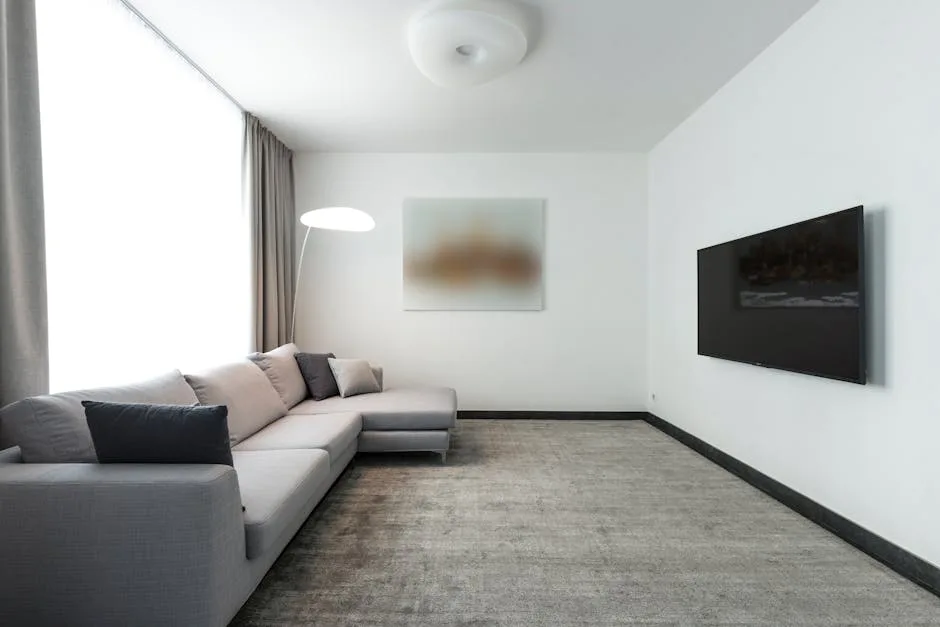
Sectional sofa placement in a small living room is one of the most searched and least honestly answered topics in residential design — because most of the advice online was written for rooms that are 40% bigger than the one you actually live in. A sectional sofa has a larger floor footprint than almost any other piece of residential furniture, and the gap between standard placement guidance and the reality of a compact floor plan is where most small-room sectional disasters happen. Not at the furniture store. Not during delivery. At 9 PM on a Tuesday when you realize the sofa you spent three months choosing has turned your living room into a furniture warehouse with a TV somewhere in the distance.
Quick Answer
A sectional sofa has a larger floor footprint than almost any other piece of residential furniture — yet the most common placement advice was written for rooms that are 40% bigger than the one you actually live in.
I spent eleven years doing this professionally — first in Chicago apartments that routinely topped out at 220 square feet of living space, then in New York where “cozy” is a real estate euphemism for “bring a measuring tape or suffer.” What I learned is that sectional placement in a tight floor plan is almost entirely a circulation problem, not an aesthetic one. Solve the circulation and the room looks good automatically. Chase the look first and you end up with a beautiful room nobody can walk through.
Why Most Sectional Placement Advice Fails Compact Rooms
In This Article
- Why Most Sectional Placement Advice Fails Compact Rooms
- 1. Anchor to the Focal Wall, Not the Longest Wall
- 2. Use the 2-3 Rule to Scale the Right Sectional Before You Buy
- 3. Treat the Chaise as a Fixed Obstacle, Not a Feature
- 4. The Corner Placement Is Not a Last Resort
- 5. Protect the 36-Inch Primary Path, Compress Everything Else
- 6. Reverse the Sectional’s Orientation When the Room Shape Demands It
- 7. Eliminate the Coffee Table or Replace It With Something Smaller
- 8. Use Rugs to Define the Zone, Not to Fill the Floor

Most layout guides exist in a parallel universe where every living room is at least 350 square feet and has exactly one doorway. The advice that flows from that assumption — “float your sofa,” “leave 18 inches to the coffee table,” “create a conversation grouping” — reads well in a magazine spread. In practice, it dissolves the moment you try to apply it to an actual apartment.
According to the U.S. Census Bureau, the median new single-family home living room measures roughly 330 square feet. That’s the median. Apartment and older-home living rooms routinely fall between 150 and 250 square feet — a range where standard sectional guides don’t apply, and where following them can actively make your room worse. “Leave 18 inches to the coffee table” is sound advice if your room depth is 16 feet. If your total room depth is 11 feet, that same 18-inch clearance leaves you with 4 inches between the coffee table and the wall opposite. Which means no coffee table. Which the guide never mentions.
The other failure is that most placement articles treat the goal as achieving a certain look — the staged, editorial, everything-floated composition — rather than preserving the two things that make a small room feel good to actually live in: functional circulation paths and clear sightlines from the primary seat. Interior designers I worked alongside in Chicago consistently cited furniture placement, not furniture size, as the primary cause of a room feeling cramped. A sectional on the wrong wall can reduce usable floor space by up to 30% compared to the same piece repositioned correctly. That’s not a stylistic difference. That’s the difference between a room that works and one that exhausts you.
Before you move a single cushion, ask this instead: where do people walk in this room? Mark those paths mentally. Every placement decision in this article is built around protecting them.
1. Anchor to the Focal Wall, Not the Longest Wall
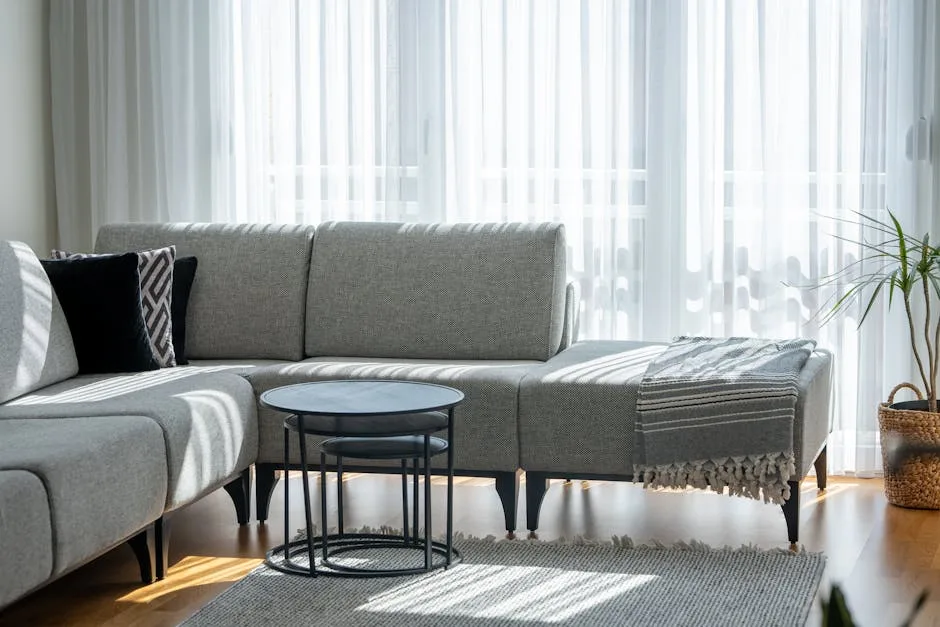
Here’s the instinct that ruins more small living rooms than any other single decision: seeing the longest wall and immediately pushing the sofa against it. It feels logical. The longest wall should hold the largest piece of furniture. Except in a narrow room, the longest wall is almost always also the wall that runs parallel to your only meaningful walkway — which means the sectional’s chaise arm juts directly into the path between the entry and every other room in the apartment.
Anchor to the focal wall instead. The focal wall is wherever the fireplace is, or the TV, or the best window — the architectural element the room is already organized around visually. That wall creates a natural conversation axis, meaning the sectional faces something specific and meaningful rather than just facing across open floor space. In a 12-foot-wide room, placing the sectional back against the focal wall frees the longest wall entirely for circulation, a sideboard, or simply breathing room.
There’s a refinement here that took me an embarrassingly long time to adopt in practice. Don’t place the sectional back flush against the focal wall. Pull it out 6 to 8 inches. It seems counterintuitive in a tight room — every inch counts, so why waste those 6 inches behind the sofa? Because that gap prevents the room from looking like furniture was staged against a surface, and it allows a thin floor lamp or a trailing plant to live behind the sofa back without being crushed. The room reads as intentional rather than crammed. That distinction matters more than the 6 inches costs.
A few questions worth answering before you choose your anchor wall:
- Where is the entry door relative to each wall? The chaise arm must never point directly at an entry door — it creates an immediate obstruction.
- Where are the electrical outlets? A sectional placed 8 feet from the nearest outlet turns into a wire management problem you’ll hate for years.
- Which wall gets the most natural light? Placing the sectional back toward the light source (rather than facing away from windows) keeps the primary seating area bright without requiring overhead lighting at all hours.
- Is there a radiator or baseboard vent on any candidate wall? Blocking heating or cooling vents with a large upholstered piece is a comfort problem in winter and a potential maintenance problem year-round.
- How does the wall relate to adjacent rooms? In open-plan layouts, the sectional’s back effectively becomes a room divider — useful if that’s intentional, disruptive if it cuts off visual connection to a kitchen or dining area you want to keep integrated.
Actionable takeaway: Stand in your entry doorway and identify the one architectural feature you look at first. That is your focal wall. Place the sectional back toward it before you consider any other variable.
2. Use the 2-3 Rule to Scale the Right Sectional Before You Buy
The 2-3 rule is one of those concepts that gets repeated constantly in design content and almost never explained in a way that’s useful for an actual purchase decision. Here it is applied specifically: your sofa should occupy roughly two-thirds of the wall it faces, not the wall it backs against. For a standard sofa this is reasonably simple math. For a sectional it requires measuring both legs of the L-shape independently against both relevant walls.
In a 12×14 foot room, you’re working with anchor walls of 12 and 14 feet. Two-thirds of 12 feet is 8 feet. Two-thirds of 14 feet is roughly 9.3 feet. A sectional with a main body of 8 feet and a return arm of 5 feet fits the 2-3 threshold safely on both walls — neither leg overwhelms its corresponding wall, and the room retains visual balance. Push those numbers to 10 feet and 7 feet respectively and you’ve crossed into territory where the sectional reads as oversized regardless of how you style it.
The buyers who skip this calculation before purchasing are the reason furniture returns exist at scale. Retailers who sell sectionals report that returns are disproportionately concentrated in purchases made for rooms under 200 square feet — and the majority of those returns happen not because the sectional physically won’t fit through the door, but because it physically fits the room and still makes the room unusable. Those are different problems with different solutions, and the 2-3 rule catches the second one before you’ve signed a delivery receipt.
A few additional scaling benchmarks worth keeping on hand when you’re comparing sectional configurations:
- Seat depth matters as much as overall length. A sectional with 38-inch seat depth in a room with 10-foot depth leaves you almost no usable floor space in front of it. Standard seat depth for compact rooms should stay at or under 34 inches.
- Chaise length varies dramatically by manufacturer. The same sectional listed as “108 inches” can have a 52-inch chaise or a 68-inch chaise depending on the configuration — two different furniture problems in the same room.
- Corner units add hidden bulk. An L-shaped sectional with a full corner block rather than a tight-radius turn can add 8 to 12 inches to both legs simultaneously. In a 12-foot room, that’s the difference between the piece fitting and not fitting.
- Modular sectionals allow mid-ownership reconfiguration. If your room dimensions are borderline, a modular sectional lets you remove one module if the math stops working — a fixed frame sectional gives you no such flexibility.
Actionable takeaway: Before any store visit, calculate two-thirds of each relevant wall in your room. Write those numbers on your phone. No sectional leg should exceed those measurements.
3. Treat the Chaise as a Fixed Obstacle, Not a Feature
This one requires a shift in how you think about the sectional’s shape before you think about where to put it. Most buyers choose a sectional because the chaise is appealing — it’s the reason to own a sectional rather than a standard sofa. But in sectional sofa placement for a small living room, the chaise is the single most space-consuming element in the configuration, and treating it as a flexible feature rather than a fixed circulation obstacle is how rooms stop working.
The chaise extends into the room perpendicular to the main sofa body. In a 13-foot room with a 66-inch chaise, you have roughly 7 feet of clearance left. That’s workable. In an 11-foot room with the same 66-inch chaise, you have 5 feet — which sounds acceptable until you subtract 18 inches for a coffee table clearance zone, leaving you with 3.5 feet of actual walking path. A standard interior doorway is 32 inches wide, so you’re essentially walking through a doorway-width corridor every time you cross the room.
The fix is to orient the chaise toward the shortest wall, not the longest one. This is the opposite of the instinct most people follow. The logic is that the short wall absorbs the chaise length without stealing from a primary circulation corridor. A room that is 12 feet wide and 16 feet long has meaningfully more space to absorb a 66-inch chaise on the 12-foot wall than on the 16-foot wall — because the 16-foot dimension is almost always the one you walk along.
Actionable takeaway: Mentally place the chaise end against each wall in your room and calculate the remaining clearance. The orientation that leaves the most continuous open floor space wins, regardless of which direction you initially assumed the sectional should face.
4. The Corner Placement Is Not a Last Resort
Corner placement — where the sectional’s inner corner sits at the room’s corner — gets treated as a fallback option, the thing you do when nothing else works. In compact rooms, it’s frequently the first option you should try, and the one most likely to solve the circulation problem entirely.
When the sectional corner aligns with the room corner, both legs of the L run along walls rather than projecting into the center of the room. This is categorically different from how a sofa or loveseat sits against a wall, because the sectional’s L-shape actually uses the corner architecture rather than ignoring it. The result is that the maximum amount of floor space — the entire diagonal center of the room — remains open. In a 12×12 foot room, a corner-placed sectional can leave a clear floor area of roughly 60 to 65 square feet in front of it. The same sectional placed on a single wall with the chaise projecting inward leaves closer to 40 to 45 square feet.
The objection most people raise is that corner placement looks like the room was arranged by necessity rather than intention. That objection dissolves when you add a well-placed coffee table and acknowledge that the open center of the room is the visual breathing space that makes everything else look considered. The room doesn’t look cornered — it looks organized.
What corner placement requires:
- The inner corner of the sectional must clear any baseboard heat sources. Most sectional inner corners sit 1 to 3 inches off the wall, which is usually sufficient, but verify before committing.
- You need a clear TV or focal point on the diagonal. Corner placement naturally creates a diagonal sightline from the seating position, which means your focal wall is the corner’s opposite diagonal — often a less obvious wall than you’d initially choose.
- The entry path must not cut across the sectional’s open face. If the room entry is directly across from the sectional’s open side, corner placement creates a dead-end entry experience. Works fine if entry is from the side.
Actionable takeaway: Before ruling out corner placement, tape out the sectional footprint in the corner on your floor and walk the remaining space. Most people are surprised how functional the room feels.
5. Protect the 36-Inch Primary Path, Compress Everything Else
Professional space planning operates with a hierarchy of circulation clearances. The one that matters most for sectional sofa placement in a small living room is this: your primary path — the one between the entry and the rest of the home — must maintain at least 36 inches of clear width at all points. That is the minimum comfortable clearance for two people to pass, for someone carrying laundry, for a child running through. Below 36 inches, a room feels like it’s making you apologize for being in it.
Every other clearance in the room can compress below standard guidelines if the primary path holds. Coffee table clearance can drop to 14 inches if you have a narrow coffee table and a 36-inch path is preserved. Secondary seating — a chair in the corner — can sit closer to the sectional than the recommended 8 feet of conversation distance if the primary path is clear. The hierarchy is: primary path first, secondary clearances negotiable.
Where this changes sectional placement decisions specifically:
- In a narrow rectangular room (under 11 feet wide), the sectional almost always needs to run along the short wall to keep the long-wall path clear at 36 inches.
- In a square room (12×12 or similar), corner placement typically preserves the primary path better than any single-wall configuration.
- In an open-plan layout where the living area connects to a dining area or kitchen, the sectional back should never bisect the path between zones — it should define the edge of one zone while leaving the transition open.
Actionable takeaway: Walk your primary path right now, from your front door to your kitchen or hallway. Measure the narrowest point. If it’s under 36 inches, that’s the placement problem to solve first, before any aesthetic consideration.
6. Reverse the Sectional’s Orientation When the Room Shape Demands It

Most sectionals are sold in a standard configuration — main body on the left or right, chaise extending in a fixed direction. Most buyers choose the orientation that matches how they mentally picture the room. This is a planning error that costs a meaningful amount of usable floor space in compact layouts.
Reversing the sectional’s orientation — chaise on the left instead of right, or vice versa — is not a design preference decision in a small room. It’s a spatial math decision. The question isn’t which orientation you prefer aesthetically. The question is which orientation places the chaise along the wall that has the least traffic and the most available depth.
A practical example: a 14×11 foot room with entry on the long wall, TV on the short wall, and a window on the right side of the short wall. Standard orientation with chaise on the right sends the chaise toward the window wall — which may interfere with radiator placement or window access. Reversed orientation with chaise on the left sends the chaise toward the unbroken left wall — cleaner clearance, no conflict with architectural elements.
Before ordering, confirm with the retailer:
- Whether the sectional is reversible (most modular sectionals are; many fixed-frame sectionals are not)
- What the lead time difference is between standard and reversed configuration — some manufacturers treat reversed as a custom order with additional lead time
- Whether the return policy differs for reversed configurations
Actionable takeaway: Sketch both orientations to scale on graph paper before deciding. The orientation that preserves the most continuous clear floor path is the correct choice regardless of which direction feels more natural.
7. Eliminate the Coffee Table or Replace It With Something Smaller
This is the placement fix that causes the most resistance, and the one that most reliably transforms a cramped sectional arrangement into a functional one. The standard coffee table — 48 inches long, 24 inches wide, placed 18 inches from the sofa face — is a piece of furniture designed for rooms larger than the one you’re working with. In a small living room where sectional placement has already consumed a significant portion of the floor area, the coffee table is often the piece that converts “tight but workable” into “actually dysfunctional.”
The hierarchy of replacements, from most space-preserving to least:
- Nesting tables: Two small tables that slide under each other when not in use. Surface area on demand, zero floor footprint when stored. The best solution for rooms under 180 square feet.
- Ottoman with tray: An upholstered ottoman roughly 24×24 inches with a removable tray provides a surface without hard edges and doubles as additional seating. Easier to reposition than a rigid table.
- C-table or side table on casters: A single surface that slides over the sofa arm or chaise. No floor clearance required at all — it occupies the same footprint as the sofa itself.
- Smaller fixed coffee table: If a traditional table is non-negotiable, size it at one-third the sofa length rather than two-thirds. A sofa with an 8-foot main body paired with a 32-inch coffee table instead of a 54-inch one returns nearly 2 feet of clearance depth to the room.
What you’re solving by eliminating or downsizing the coffee table isn’t just floor space. You’re solving the visual density problem — the stacked horizontal planes of sofa seat, coffee table surface, and floor that make a small room feel like it’s filling up from the ground. One fewer horizontal plane creates perceptible vertical breathing room even when the actual ceiling height hasn’t changed.
Actionable takeaway: Remove your current coffee table for 48 hours and live with the open floor space. Most people find the room immediately more functional and don’t miss the surface as much as they expected.
8. Use Rugs to Define the Zone, Not to Fill the Floor

The rug decision in a small living room with a sectional is where a lot of otherwise good placement work gets undone. The default impulse is to buy a rug large enough to fit under the sectional — which, for a large sectional, means a rug in the 9×12 or 10×14 range. In a room that is itself 12×14, you’ve essentially carpeted the entire floor and removed all sense of zone definition from the space.
The correct rug strategy for sectional sofa placement in a small living room is to use the rug to define the conversation zone in front of the sectional, not to anchor the sectional itself. This means:
- The rug should sit primarily in front of the sectional, extending beyond the coffee table area but not necessarily under the sectional body.
- Rug size should be proportional to the open floor area, not the sectional footprint. In a 12×14 room with a corner-placed sectional, the open floor area might be 7×9 feet — which means a 5×8 rug creates definition without overwhelming the space.
- The rug’s front edge should be at least 6 inches back from the primary circulation path, so the path reads as distinct from the seating zone even when they’re close together.
The secondary function of the rug in a tight room is to reinforce the visual boundary of the seating area so the sectional reads as a contained zone rather than furniture that has spread across the floor. A sectional without a rug in a small room tends to visually merge with the rest of the floor area and make the room feel consumed by furniture. A rug, even a modest one, creates a frame that contains the sectional visually and returns the surrounding floor space to the room.
Actionable takeaway: Measure the open floor area in front of your sectional. Choose a rug that covers roughly 60 to 70% of that area — large enough to define the zone, small enough to leave visible floor around its perimeter.
Frequently Asked Questions
Can a sectional sofa actually work in a living room under 200 square feet?
Yes, but configuration and placement matter more than they do in any other room size. The sectionals that work in rooms under 200 square feet are almost always compact two-piece or apartment-scale configurations — main body under 84 inches, return arm under 60 inches, seat depth at or under 34 inches. Corner placement combined with nesting tables instead of a coffee table is the layout that most reliably makes a small-room sectional functional rather than oppressive. The bigger risk isn’t that the sectional won’t fit. It’s that it fits and still leaves the room unusable. Scale to the 2-3 rule before you buy.
What is the minimum room size for a sectional sofa?
There’s no universal minimum, but a practical working threshold is 10×12 feet — 120 square feet of floor area. Below that, even a compact sectional will consume so much of the floor plan that circulation becomes genuinely difficult. At 10×12, a sectional with an 80-inch main body and a 56-inch return arm placed in the corner can work, but leaves very little room for anything else. The more useful question is whether your specific room shape — its doorway locations, window placement, and connection to adjacent spaces — can accommodate a sectional’s L-footprint without blocking a primary path.
Should a sectional touch the wall in a small living room?
Not flush, but close. The 6-to-8-inch gap behind the sectional back is useful for visual reasons — it prevents the room from looking staged against a surface — and practical ones, allowing slim floor lamps or cord management behind the piece. In a very tight room where every inch is critical, you can reduce that gap to 3 or 4 inches without losing the visual benefit entirely. What you want to avoid is placing the sectional flush against drywall with zero clearance, which tends to make the seating area feel like a display rather than a place to sit, and creates a maintenance headache every time something rolls behind the sofa.
Is it better to buy a smaller sectional or a standard sofa for a small living room?
For most compact rooms, a correctly scaled sectional outperforms a standard sofa-plus-accent-chair configuration because it consolidates seating into a single footprint rather than distributing it across two pieces with clearance requirements between them. Two separate pieces need spacing from each other, spacing from the coffee table, and spacing from circulation paths — three clearance zones instead of one. A compact sectional placed well requires only one clearance zone in front. The caveat is that you have to be willing to skip the accent chair entirely and resist adding supplementary seating that reintroduces the multi-piece problem.
How do I know if my sectional is in the wrong position without starting over?
The clearest indicators that sectional sofa placement in your small living room needs adjustment are behavioral rather than visual. If people consistently stand rather than walking fully into the room, the entry path is blocked. If you find yourself turning sideways to get between the sectional and another piece of furniture, your primary clearance is under 24 inches and needs to be at minimum 36. If the TV feels too close or too far from the primary seat, the sofa-to-screen distance is off — optimal distance is roughly 1.5 to 2.5 times the diagonal screen measurement. If the room consistently feels smaller than its square footage should suggest, the sectional is likely on the wrong wall. Start by taping out an alternative placement on the floor before moving anything.