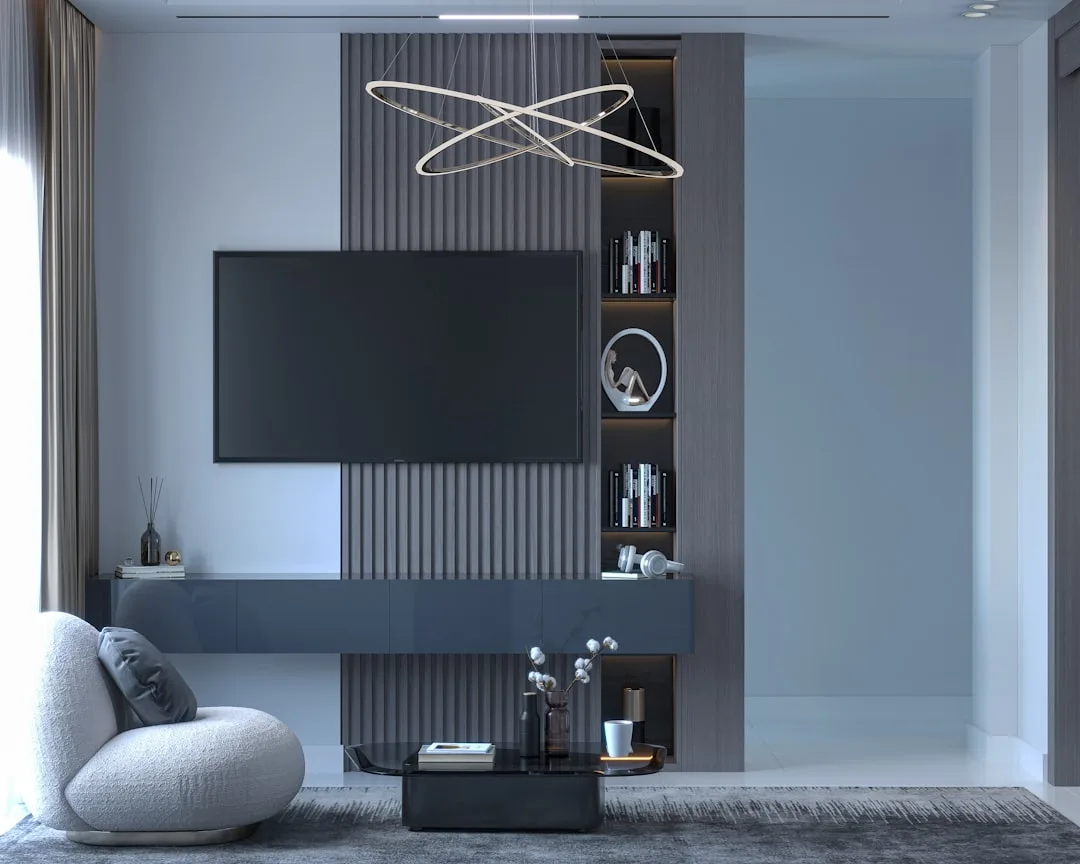
If you’ve been searching for tv wall living room ideas that actually solve a real problem — not just make a room look good in photos — you’re in the right place. The TV is the first thing every guest looks at when they walk into your living room — and in most homes, the wall around it is doing absolutely nothing to help. It’s just a black rectangle floating on beige paint, with a cord dangling toward a console that’s six inches too narrow, lit by a ceiling fixture that casts glare across the screen every evening. I’ve walked into hundreds of apartments and houses that looked exactly like this. The homeowners weren’t lazy or tasteless — they just never had a framework for thinking about the TV wall as an actual design problem worth solving.
Quick Answer
The TV is the first thing every guest looks at when they walk into your living room — and in most homes, the wall around it is doing absolutely nothing to help.
That’s what this is. A framework. Not a mood board.
Where You Put the TV on the Wall Changes Everything Else
In This Article
- Where You Put the TV on the Wall Changes Everything Else
- How to Lay Out a Living Room Around the TV Without Making It the Whole Personality
- What to Put on the Wall Behind the TV (That Actually Looks Intentional)
- Lighting the TV Wall Without Wrecking Your Eyes or Your Mood
- How to Hide Cords Without Calling an Electrician
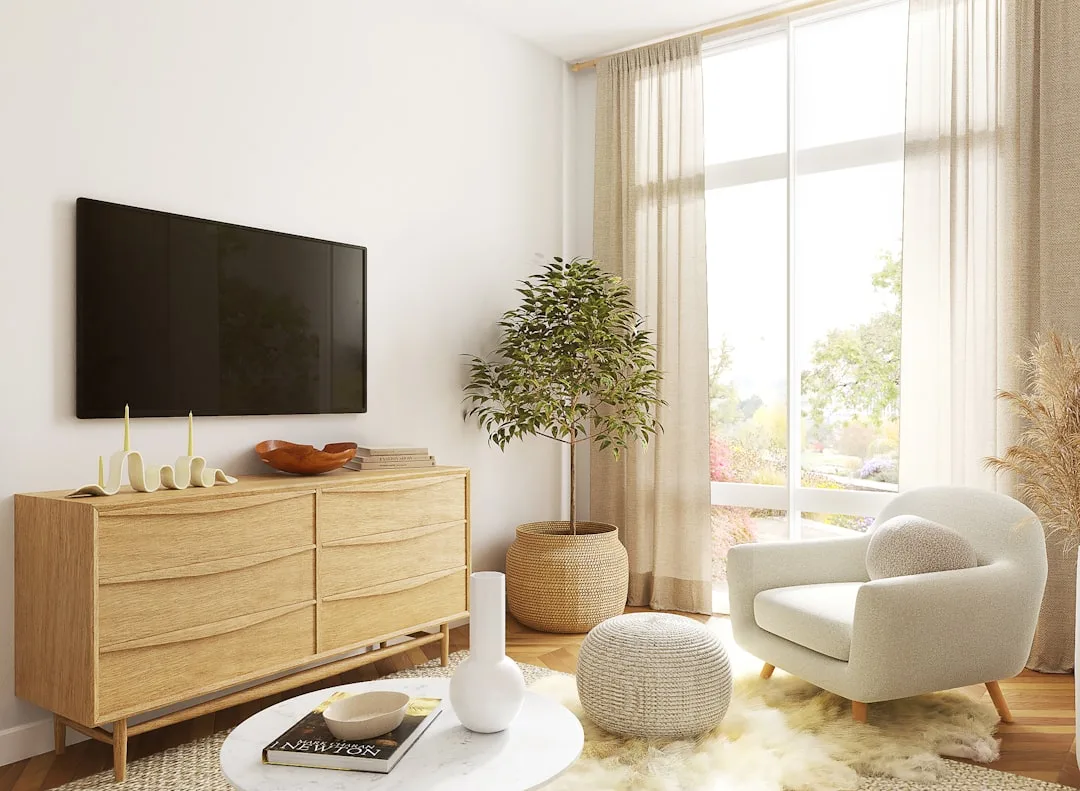
Most people choose the TV wall by default — it’s wherever the cable outlet was roughed in during construction, or wherever the previous tenant put theirs. That’s not a decision. It’s an inheritance. And it’s worth fighting against, because TV placement is the single constraint that determines almost every other furniture and lighting choice in the room.
Start with glare, not aesthetics. Mounting a TV on a wall directly opposite large windows — especially south- or west-facing ones — guarantees a reflective disaster every afternoon. I had a client in Lincoln Park who spent four months convinced her new TV had a defective screen. It didn’t. She’d mounted it on the only wall that caught direct sun from 2 to 6 PM. We moved it ninety degrees and the problem disappeared.
The Society of Motion Picture and Television Engineers recommends a viewing distance of 1.5 to 2.5 times the diagonal screen size. For a 65-inch TV, that translates to roughly 8 to 13.5 feet from the seating — which immediately tells you whether a given wall even gives your furniture room to breathe.
Here’s the decision framework I used with clients:
- Glare first: Walk the room at 2 PM and 5 PM. Eliminate any wall that catches direct sun during those windows.
- Height next: The center of the screen should land between 42 and 48 inches from the floor for most sofa heights — eye level when seated, not when standing.
- Traffic flow third: The wall you see first when you enter is often a bad choice. If foot traffic passes between the seating and the screen, the layout fights itself constantly.
- Corner placement last resort: It works in small or awkward rooms, but requires angled furniture and a full-motion mount — without both, someone in the room is always craning their neck.
In open-plan spaces, the TV wall does double duty as a zone anchor — it needs to face the primary seating, not the kitchen island or the dining table. When it doesn’t, neither space feels like it belongs anywhere.
Wall type matters more than most people realize. Before you mount anything, identify what’s behind the drywall on your preferred wall:
- Stud walls: Standard mounting, but locate studs precisely — a TV mounted into drywall alone will eventually pull free.
- Concrete or masonry: Requires masonry anchors and a hammer drill; adds 30 minutes to the job but holds more securely than any stud.
- Plaster over lathe: The most unpredictable substrate. Use a toggle bolt system or a French cleat spread across multiple lathe strips — single-point anchors fail here regularly.
- Hollow-core partitions in apartments: Check your lease before drilling anything structural. Many buildings require written approval for wall-mounted TVs above a certain weight.
Your takeaway: Before you buy a mount or a single piece of décor, spend one full day in your living room noting where light hits each wall and at what time. Then choose.
How to Lay Out a Living Room Around the TV Without Making It the Whole Personality
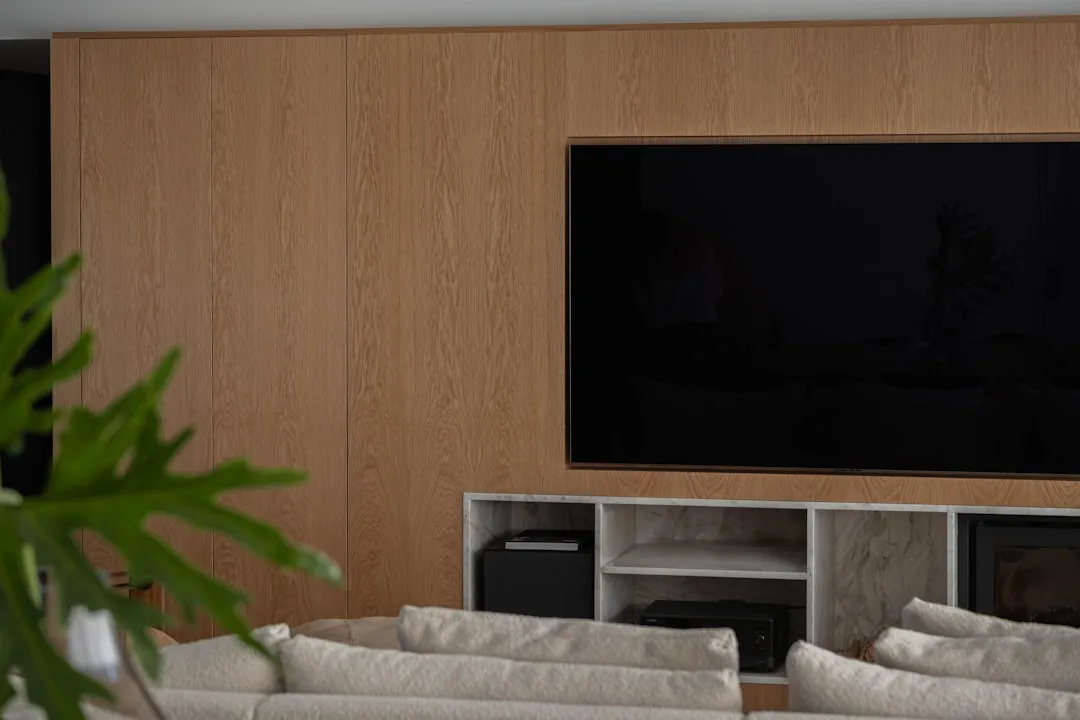
Here’s the tension I watched play out in nearly every living room consultation I did: the homeowner wanted the TV to be functional but not dominant, and then arranged every piece of furniture in a straight line pointing directly at it like a very casual firing squad. The instinct makes sense — you want to see the screen. But it produces a room that feels like a waiting room at a home electronics store.
The fix is two focal points, not one. A living room with only a TV to look at feels impoverished even when it’s beautifully furnished. Identify a secondary focal point — a fireplace, a large window with a view, a composed art wall — and arrange furniture to acknowledge both without fully committing to either. Two accent chairs set at a slight angle away from the TV axis do this naturally. They say: we watch things, and we also talk to each other.
Pull your sofa away from the wall. Twelve to eighteen inches of breathing room between the back of the sofa and the wall is enough to make the seating feel intentional rather than pushed to the edges of a room that’s too big for the furniture in it. It also improves sightlines to the screen by positioning viewers slightly closer to it.
In rectangular rooms specifically, the TV belongs on the short wall. I know that feels counterintuitive — the long wall seems like the obvious place for the big feature. But putting the TV on the short wall maximizes seating depth, which means more viewing distance, better sight angles, and a room that actually functions rather than just photographs well.
A rug under the front legs of the sofa — minimum — anchors the seating group and creates a visual boundary in open-plan spaces. Without it, the TV zone bleeds into the dining area or entry and the whole floor plan reads as one undifferentiated space.
Common layout mistakes and what to do instead:
- Mistake: Pushing all furniture against the walls. Fix: Float the sofa at least 12 inches from the wall — the room will feel larger, not smaller.
- Mistake: Buying a coffee table that’s too small. Fix: The table should be roughly two-thirds the length of the sofa, centered in front of it.
- Mistake: A single overhead light source. Fix: Layer three light sources minimum — ambient, task, and accent — so the room reads as dimensional rather than flat.
- Mistake: Identical parallel seating rows. Fix: Break the row with one chair at a 30-degree angle; it reads as intentional rather than accidental.
- Mistake: No side tables. Fix: Every seat needs a surface within arm’s reach — no exceptions if you want the room to actually feel usable.
- Mistake: Rug that’s too small. Fix: In most living rooms, go up one size from what you think you need. The rug should sit under at least the front legs of every piece of seating.
A few broader layout principles worth keeping:
- Float furniture; walls are for art, not sofas
- Secondary seating at angles, not parallel rows
- The rug defines the zone — size up, almost always
- Side tables within reach from every seat reduce the “I have to get up” friction that makes rooms feel uncomfortable to actually use
Your takeaway: Draw your room to scale on paper — or use a free tool like RoomSketcher — and test the two-focal-point layout before you move anything physically.
What to Put on the Wall Behind the TV (That Actually Looks Intentional)
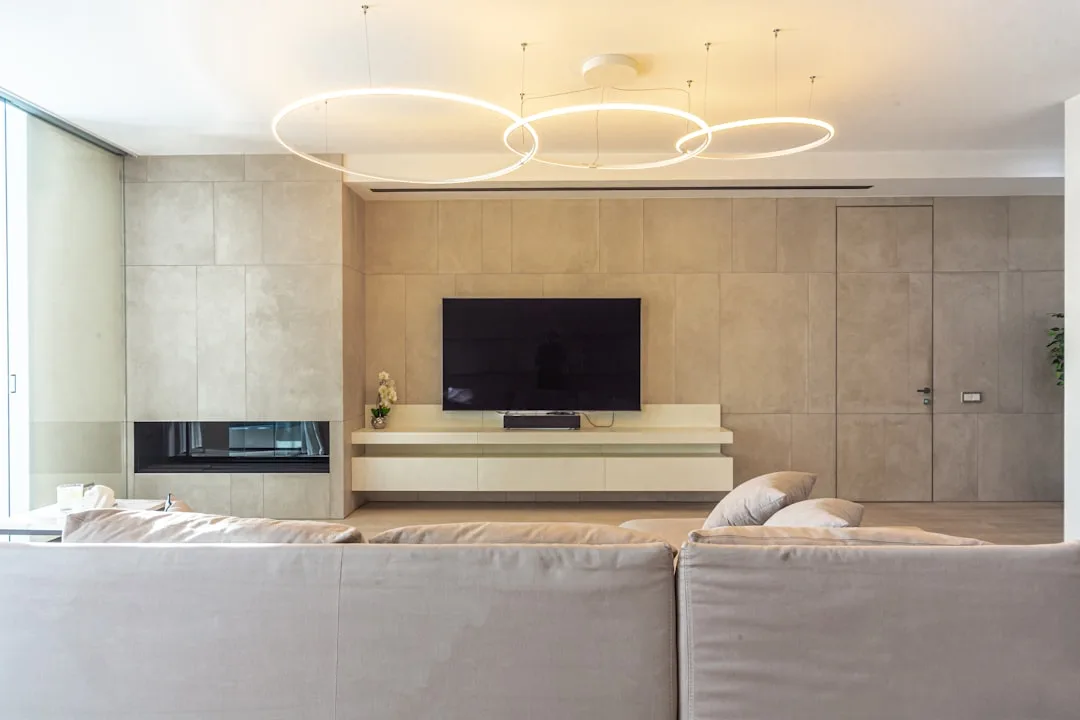
Nothing in budget decorating advice frustrates me more than “add some texture to the TV wall.” Texture. As if that narrows it down. Here’s what actually works, ranked by cost and effort, with the tradeoffs stated plainly.
Accent wall paint is the cheapest effective option and the most underused. A darker or deeply saturated tone behind the TV does something visually useful — it reduces the “floating black rectangle” effect by giving the screen something to recede against. The TV stops looking like an interruption and starts looking like an architectural feature. Cost: one can of paint and a Saturday afternoon. Among all the tv wall living room ideas that cost almost nothing, this one delivers the most immediate visual payoff.
Good color directions for a TV accent wall:
- Deep charcoal or near-black: The most effective at hiding the screen border — works in both cool and warm rooms depending on undertone.
- Forest green or olive: Adds organic warmth without the heaviness of a dark neutral; pairs well with natural wood consoles.
- Warm terracotta or rust: High contrast, high personality — works best when echoed somewhere else in the room so it doesn’t read as isolated.
- Navy: A classic that’s hard to get wrong — gives the wall depth and formality without being aggressive.
- Warm white against an off-white room: Subtle but effective — creates just enough contrast to frame the screen without committing to drama.
Wood slat panels are the most searched TV wall treatment right now, and the trend has real staying power because it works. Google Trends data shows searches for “wood slat TV wall” increased over 300% between 2021 and 2024 — more growth than shiplap and wallpaper combined. The reason it’s popular isn’t just aesthetics. Slat panels add warmth and tactile depth to a wall without overwhelming small rooms, and they’re genuinely forgiving to install because minor imperfections disappear into the shadow lines between slats.
What to know before you buy slat panels:
- Real wood vs. MDF-faced: Real wood will shift with humidity, which matters in climates with seasonal extremes. MDF-core panels with a wood veneer face are more dimensionally stable and usually cheaper.
- Slat spacing: Tighter spacing (under 1 inch) reads as more refined and formal. Wider spacing (1.5 to 2 inches) reads as more casual and rustic.
- Backing panel color: Most slat panels come with a black or dark backing between slats. This is intentional — it’s what creates the shadow line depth. Don’t paint it white thinking it’ll look cleaner; it won’t.
- Wire management: Plan your cable routing before installation. Running wires behind slat panels after the fact is far harder than routing them during install through a simple conduit channel.
- Full wall vs. partial: Floor-to-ceiling slats read as architectural. Slats applied only behind the TV (a 6-foot-wide panel, say) read as a backdrop. Both work — they just make different statements.
Built-in shelving flanking the TV is the highest-effort, highest-return option. When you frame the TV with cabinetry on both sides, the screen becomes part of a composed wall rather than a thing that happened to get hung there. The proportions matter enormously here:
- Shelving depth should match or slightly exceed the TV depth — typically 10 to 14 inches — so the TV doesn’t protrude awkwardly past the cabinet face.
- Leave at least 8 inches of shelf height for standard hardcover books, and at least 14 inches for objects and art pieces that need room to read from across the room.
- Lower cabinets with doors are more practical than open shelving below the TV — they hide the equipment clutter (routers, streaming devices, game consoles) that inevitably accumulates.
- Paint built-ins the same color as the wall for a seamless, architectural look. Paint them a contrasting color if you want them to function as a statement piece in their own right.
Wallpaper behind the TV deserves more credit than it gets in most tv wall living room ideas discussions. A single-wall application keeps costs reasonable — you’re papering 60 to 100 square feet, not a whole room — and a bold pattern or texture here does something paint can’t: it adds visual complexity that makes the TV disappear into it rather than stand in front of a flat backdrop. Grasscloth, large-scale botanical prints, and geometric tile-pattern papers all work well. Avoid small-scale busy patterns — they create optical conflict with the TV content when the screen is dark.
Floating media consoles vs. floor-standing units: This is a choice most people make based on aesthetics alone, but there are functional factors worth considering:
- Floating consoles make cleaning the floor easier and create an airier look in small rooms.
- Floor-standing units offer more storage and don’t require wall anchoring beyond the TV mount itself.
- The console should be at least as wide as the TV — ideally wider — so the screen doesn’t visually overhang the furniture below it.
- Console height should land the TV center between 42 and 48 inches regardless of mount type — account for this when selecting a unit.
Lighting the TV Wall Without Wrecking Your Eyes or Your Mood
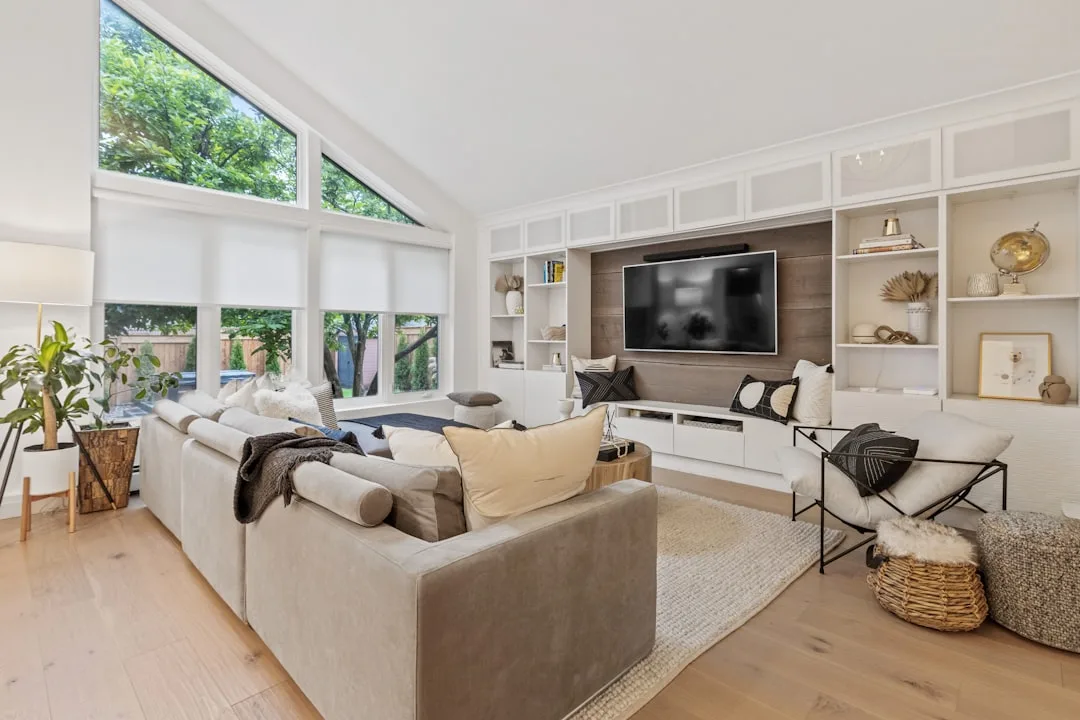
Lighting is the part of tv wall living room ideas that almost no one addresses until they’ve already finished everything else and noticed the room still feels wrong after dark. Here’s why it matters: a bright overhead light above a TV screen creates a contrast ratio your eyes have to constantly adjust to — dim screen, bright ceiling, dim screen. It’s fatiguing in a way that’s easy to mistake for the TV itself being unpleasant to watch.
The solution is bias lighting plus layered ambient sources.
Bias lighting — LED strips mounted to the back of the TV, facing the wall — reduces eye strain by raising the ambient luminance around the screen. It’s not a decorative trick. It’s a perceptual one. Studies from Philips and independent vision researchers have found that bias lighting can reduce eye fatigue during extended viewing by measurable margins. The color temperature matters: 6500K is the international standard for professional color-critical work; 4000-5000K is a good everyday compromise that reads as neutral without being harsh.
Layered lighting for a TV wall should include:
- Bias lighting: Behind the TV, 5000-6500K for accuracy, lower if you prefer warmth.
- Sconces or picture lights flanking the TV: Add architectural interest and fill light without pointing directly at the screen.
- Table or floor lamps in the seating zone: These provide the ambient warmth that makes a room feel inhabited rather than staged.
- Under-cabinet or shelf lighting in built-ins: Strips under shelves highlight objects and create depth — one of the highest-return lighting details in a composed TV wall.
- Dimmer switches on everything: Non-negotiable. A room that can only be at full brightness or full darkness has half its potential.
What to avoid:
- Recessed cans directly above the TV — they hit the screen at an angle that creates hotspots.
- Pendant lights centered in the room that compete with the TV wall for visual attention.
- Warm white bulbs mixed with cool white bulbs in the same space — the color inconsistency reads as unfinished even if each individual fixture is attractive.
How to Hide Cords Without Calling an Electrician
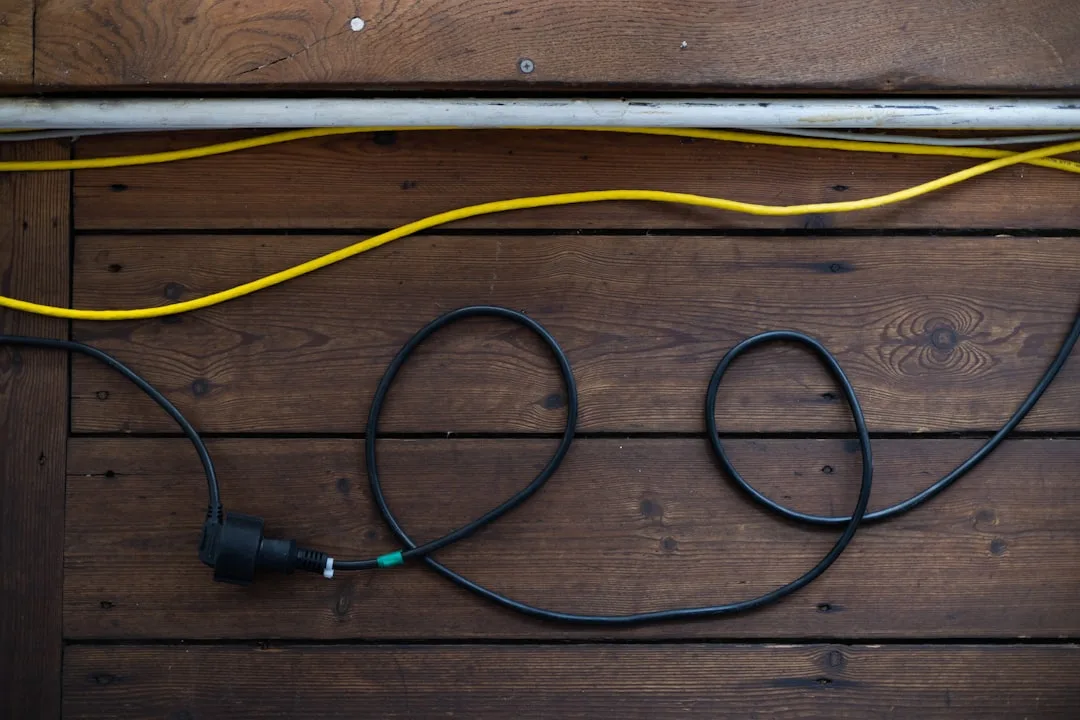
Visible cords are the fastest way to make even a well-designed tv wall living room look unfinished. The good news is that most solutions here cost under $50 and take an afternoon.
Options ranked by effort and permanence:
- In-wall cable management kit: Two wall plates connected by a tube that runs inside the wall cavity. Requires cutting two small holes — one behind the TV, one near the outlet — and fishing cables through. No new wiring, no electrician needed in most cases. Cost: $20-40. Looks completely clean.
- Raceway channels: Surface-mounted plastic channels that run cables along the wall. Less invisible than in-wall kits but paintable and renter-friendly. Best for cases where you can’t cut into the wall.
- Cord covers that match baseboards: When the cable needs to travel down to a floor-level outlet or console, a baseboard-matching cover makes it essentially disappear.
- Power bridge kits: Similar to cable management kits but include a recessed outlet inside the wall — useful when you need a powered outlet behind the TV itself rather than routing cables to a lower outlet.
- Wireless HDMI transmitters: When cords truly can’t be routed — masonry walls, concrete slabs — wireless HDMI transmission eliminates the cable between source devices and the TV entirely. Quality has improved dramatically; latency is now low enough for gaming in most systems.
The one thing none of these solve: the power cord from the TV to the outlet. That always needs a physical path. Plan that path before you mount the TV, not after.
Frequently Asked Questions
How high should a TV be mounted on the wall?
The center of the screen should sit between 42 and 48 inches from the floor for standard sofa seating. This puts the screen at eye level when you’re seated — not standing, which is the most common mounting mistake. In rooms with floor cushions or low-profile furniture, drop that number by 4 to 6 inches. In rooms with tall barstools or counter-height seating, raise it accordingly. The SMPTE guideline is a useful check: if the top of the screen is more than 15 degrees above your sightline when seated, the TV is too high.
What size TV actually works for my room?
Use the 1.5x to 2.5x rule: multiply your screen’s diagonal measurement by 1.5 for the minimum viewing distance and by 2.5 for the maximum. A 65-inch TV works best at 8 to 13.5 feet. A 75-inch TV pushes that to 9.5 to 15.5 feet. If your room is smaller than the minimum distance, the screen is too large — you’ll see pixels and scan lines before your eyes settle, which is fatiguing over long viewing sessions.
Can I put a TV above a fireplace?
Technically yes, practically it’s rarely ideal. The two problems are heat and neck strain. Heat from the firebox rises directly toward the TV — modern fireplaces with electric inserts or closed-front gas units are less of a concern than open wood-burning fires, which generate enough radiant heat to degrade electronics over time. Neck strain is the bigger issue: above a standard mantel puts the TV center at 55 to 65 inches — well above the comfortable 42-48 inch range. If you do it, use a tilting mount that angles the screen down toward the seating, and keep the TV at 55 inches max height from floor to center.
What’s the best TV wall treatment for a rental apartment?
Peel-and-stick options have improved significantly. Removable wallpaper (especially grasscloth-texture and geometric prints) works well as a TV wall backdrop and leaves no damage. Freestanding shelving units flanking the TV create a built-in look without drilling. For the TV mount itself, most landlords allow standard wall mounting with written notice — check your lease, patch the holes cleanly when you leave, and document the wall condition before and after. Command strips are not rated for TV weight; don’t use them for mounting.
How do I make a small living room TV wall look intentional rather than crowded?
Three moves that work consistently in small rooms: keep the console low and narrow (under 18 inches deep), use a lighter wall treatment rather than a dark one — dark recedes but in a truly small room it can feel oppressive — and eliminate everything from the wall that isn’t doing compositional work. One strong object on either side of the TV reads as deliberate. Five objects reads as clutter. In small-space tv wall living room ideas, restraint does more than addition.
How high should a TV be mounted on the wall?
The center of the screen should sit between 42 and 48 inches from the floor for standard sofa seating. This puts the screen at eye level when you’re seated — not standing, which is the most common mounting mistake. In rooms with floor cushions or low-profile furniture, drop that number by 4 to 6 inches. In rooms with tall barstools or counter-height seating, raise it accordingly. The SMPTE guideline is a useful check: if the top of the screen is more than 15 degrees above your sightline when seated, the TV is too high.
What size TV actually works for my room?
Use the 1.5x to 2.5x rule: multiply your screen’s diagonal measurement by 1.5 for the minimum viewing distance and by 2.5 for the maximum. A 65-inch TV works best at 8 to 13.5 feet. A 75-inch TV pushes that to 9.5 to 15.5 feet. If your room is smaller than the minimum distance, the screen is too large — you’ll see pixels and scan lines before your eyes settle, which is fatiguing over long viewing sessions.
Can I put a TV above a fireplace?
Technically yes, practically it’s rarely ideal. The two problems are heat and neck strain. Heat from the firebox rises directly toward the TV — modern fireplaces with electric inserts or closed-front gas units are less of a concern than open wood-burning fires, which generate enough radiant heat to degrade electronics over time. Neck strain is the bigger issue: above a standard mantel puts the TV center at 55 to 65 inches — well above the comfortable 42-48 inch range. If you do it, use a tilting mount that angles the screen down toward the seating, and keep the TV at 55 inches max height from floor to center.
What’s the best TV wall treatment for a rental apartment?
Peel-and-stick options have improved significantly. Removable wallpaper (especially grasscloth-texture and geometric prints) works well as a TV wall backdrop and leaves no damage. Freestanding shelving units flanking the TV create a built-in look without drilling. For the TV mount itself, most landlords allow standard wall mounting with written notice — check your lease, patch the holes cleanly when you leave, and document the wall condition before and after. Command strips are not rated for TV weight; don’t use them for mounting.
How do I make a small living room TV wall look intentional rather than crowded?
Three moves that work consistently in small rooms: keep the console low and narrow (under 18 inches deep), use a lighter wall treatment rather than a dark one — dark recedes but in a truly small room it can feel oppressive — and eliminate everything from the wall that isn’t doing compositional work. One strong object on either side of the TV reads as deliberate. Five objects reads as clutter. In small-space tv wall living room ideas, restraint does more than addition.